Blog posts are a labour of love for me, and yet there is a cost to running this site and organizing my walks.If you’d like to help with that, I’d really appreciate something for my tip jar.The Buy Me a Coffee service allows patrons like you to fund writers like me. If that sounds like a worthy idea to you, then go ahead – keep buying me coffees.Thank You Very Much to everyone who has contributed already!
*****
Over the past couple of years of walking I’ve gone through a fair amount of gear, so I thought I would share some feedback for stuff that’s tried and trusted. Hope it helps.
Where, when, how do I use it?: I bought this in 2017 to use on day walks around town. Since then I’ve also used it as a light office laptop bag – the hydration sleeve fits a Macbook.
It’s probably been on at least 1000km of walks with me, and carried its share of weekly shopping too. BTW you can get 4 bottles of wine into it no problem, 5 in a pinch if they are the long slim Alsatian style bottles. I use it quite a bit, especially in summer when you need lots of water.
It’s about a 12L bag, pretty small yet big enough to hold water, sunglasses, a light rain jacket, and some snacks for a day hike. It’s got lots of pockets, including 2 side mesh pockets for water bottles, plus a small and large compartment, and 3 pockets inside the large compartment of which one is for a hydration bag. There’s a hydration port and a little Velcro support on one of the straps to keep the hydration tube near your mouth. Even if full to bursting, it easily fits as a carry-on bag for airlines.
I like that it features mesh straps as well as raised mesh cushions on the back, so that air can circulate and it doesn’t cling to you. It’s pretty light weight, only around 550g empty, and it can carry a few kilos with no issue. There’s a waist strap and a sternum strap, and a decent amount of adjustability in the shoulder straps.
I have a relatively long torso, and on me I have to extend the shoulder straps to almost full length in order to get the waist strap sitting on my hips, so if I am not carrying much I just let clip the waist strap behind my back and hitch it up a bit higher for more comfort. At the same time, it’s adjustable enough that my wife can wear it too even though she’s shorter than I am, by just cinching the shoulder straps. That was a big feature for me – I didn’t want this particular pack to be mine only, since there are times when we are both out for hikes and I can take my bigger daypack and give her this lighter one.
Finally, it comes with a decent rain cover that’s easy to put on/off, and tucks away easily. If the bag does get rained on without the cover, it still keeps things pretty dry unless it’s been soaked for hours. The outer cover has some good florescent flashing on it, so it shows up well against headlights at night, which is good because I got a grey/silver one. The rain cover itself is a dayglo yellow so that works well too.
Would I buy it again?: It’s been pretty hard-wearing and looks near-new after 3 years of use. I assume I will get years more out of it so by the time I wear it out, Deuter will probably have come out with some new model. That said, I like the Deuter products and would definitely look at their line in future.
Disclaimer: This is not a “review”. I don’t go around sampling things, instead this is a summary of my own experience with a product I have used a lot. All opinions contained in this post are my own. I offer no warranties or assurances for your experiences with the same product. I bought the gear with my own money and have not received any form of compensation from the manufacturer. Take my feedback as given – caveat emptor.
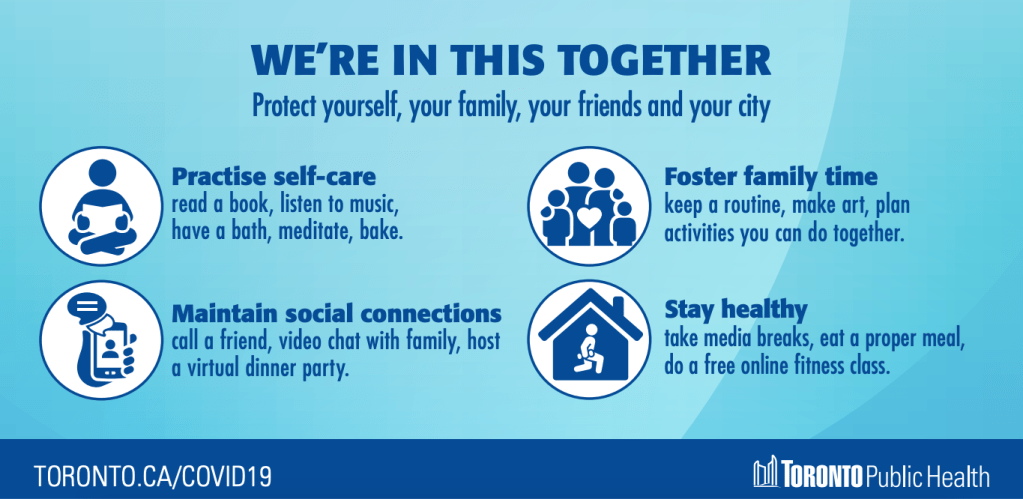
Happy Thanksgiving Canada! Enjoy your long weekend, call your friends and family, and celebrate COVID-safely. Here are some tips from the BC public health service.
graphic from BC Center for Disease Control
More little scenes observed on my walks …
Walking in our neighbourhood, I passed a house where the owners had decorated a small tree with smiley-face balloons on a tree and then added a row of little multi-coloured windmills. It was their response to COVID-19, to brighten things up. I smiled as I passed by, just as a guy rode past on a bike and I heard him mutter “too much plastic” as he went by. Party pooper, I thought. And then, damn, he is right. But still.
Three young men are sitting in a park, talking as I pass. One says, with the total conviction that comes of experience, “If you walk into a room like you own it, I don’t care what you’re wearing, if you have swag, then if there are 10 women in the room, 3 of them will want to [have intimate relations with] you”, (or words to that effect). And I think, how do you know that? Are you the guy who walks into the room, or are you the guy who watches the guy who walks into the room? And then, why do guys tell each other what women want? Why don’t they just ask the women?
Walking through Rosedale, I come round a corner and practically bump into someone. I look and realize it’s Geddy Lee, of Rush fame. He’s working his phone and looks trim and fit for a guy who must have 10 years on me, and still a bit like the skinny bass player I saw on stage in Detroit about 40 years ago – unlike myself. And afterwards I think, I should have said something cool.
Walking round and round the garden, I run into the next door neighbour. “I’m in COVID quarantine”, I say. “Oh”, he says, and raises his hands and backs away. “I was in Ontario”, I say, apologetically. And he backs away further. I’m the plague guy now.
Ever since COVID-19 hit, I had a feeling that there would come a day when I would be locked in for a 14-day quarantine. That day has come. Our son is attending university in Halifax NS, and the Canadian Maritime provinces have imposed an Atlantic Bubble. This means that anyone coming into the bubble from outside (like from Toronto) has to quarantine for 14 days upon arrival. Since we wanted to spend Thanksgiving with our son, we came out at the end of September and are now in lock-down.
Because we knew we’d have to go through this, we rented a place in downtown Halifax that’s about 10 blocks from his university and close to lots of restaurants and grocery stores that deliver. We found a cozy home that has a small yard, and is also on two floors.
That means my daily walking routine consists of a series of micro-walks. It’s about 60 steps for me to circle the garden, so if I do about 15 laps then I cover just over a km in about 10 minutes. My goal is to get 30 minutes of walking in per day, and 15 flights of stairs, so every hour I get up and do some laps around the house and up the stairs, and once a day I go outside and circle the garden for 15-20 minutes. Over the course of the day I can get in around 6000-7000 steps.
As I write this, it’s only day 4 of my 14 and when this is published I’ll still have a week to go. I’m also taking advantage of the enforced sit-in to catch up on some reading and to do a little armchair learning. I’m just hoping we don’t have a solid day of rain, because it would be really tedious circling the garden in mud, but so far so good.
The reward, of course, is that when this quarantine ends we can have a family meal and celebrate. Till then, I’ll be going round and round, and round and round, and round and round …..
There are days when you have a plan, and days when that plan gets changed. Sometimes that change leads to what I think of as lucky walks. This week had one of those.
I had booked our car for a service, and was expecting that it would be an hour or two, enough time to go for a short wander nearby and grab some breakfast. When I dropped it off, however, I was told that it would actually be 6-7 hours. What to do?
Since it was a lovely early autumn day, I decided to walk home and come back for the car later, giving myself about a 10 km walk. I took a wandering, back-streets path through Leslieville and Riverdale, Cabbagetown and Rosedale. It was wonderful, seeing the leaves coming into colour, hearing kids laughing in playgrounds, smelling the autumnal tang of turning leaves.
Cabbagetown
And in walking, I couldn’t help thinking that I was a really lucky person. Lucky to have the time to wander like that. Lucky to have the opportunity. Lucky to live in a great walking place like Toronto. Lucky to have my health to enjoy it.
Someone famous once said (Edison perhaps?) that luck is what happens when preparation meets opportunity. I think there’s a lot of truth in that, and I do think that to some degree we make our own luck that way, by being prepared. So while I wasn’t thinking about a long walk when I dropped off the car, on that day, in that place and time, I got lucky and took advantage of it.
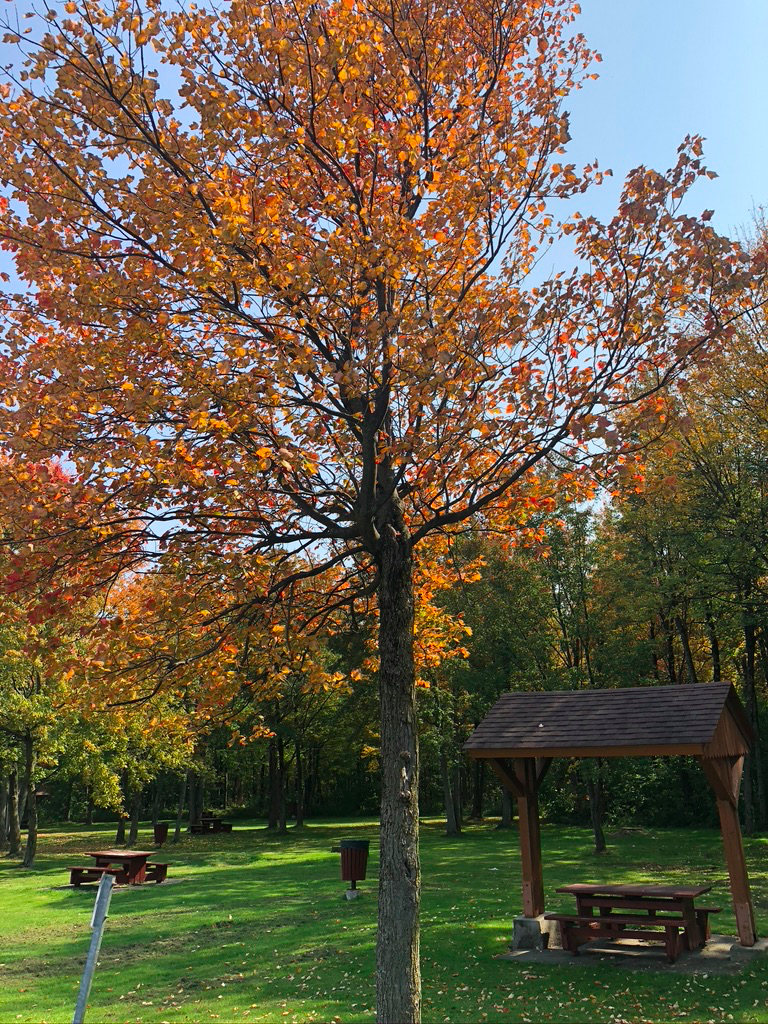
Autumn colours
Those lucky walks are probably the most fun of any of the walks that I do. They happen when I’m not looking for them, when a window of time and chance presents an opening, like the hint of a path in a forest, and I just have to take it.
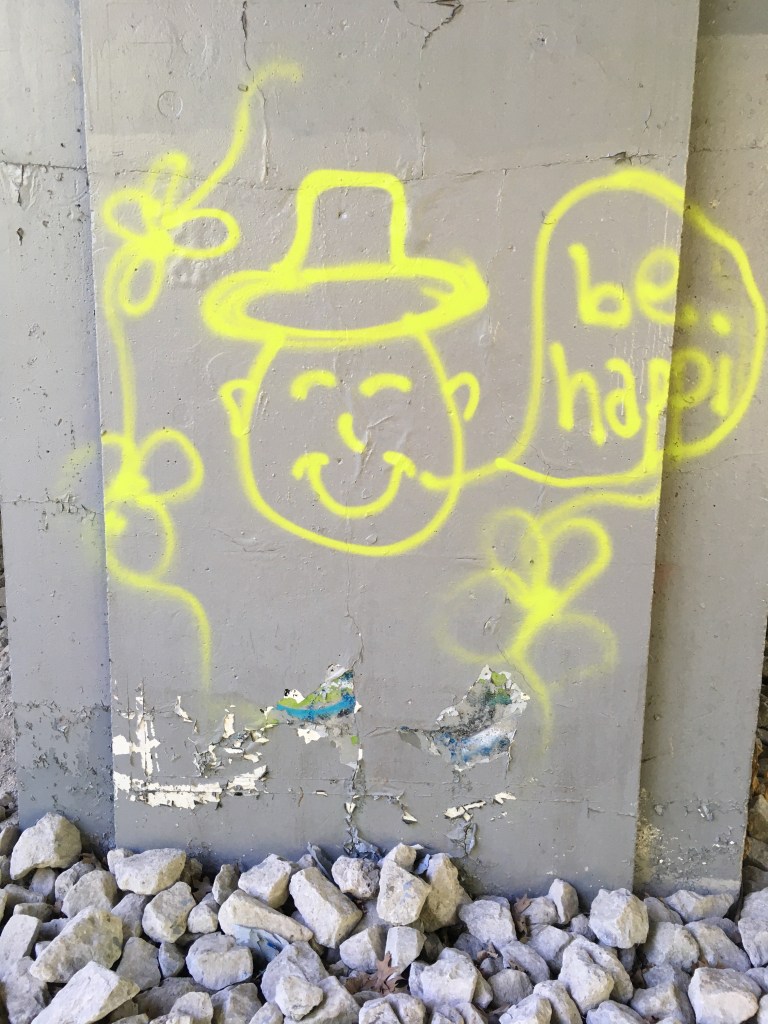
Graffiti at Glen Road pedestrian bridge in Rosedale
I like that. Life gives you lemons, we know, but life also gives you luck. Take a walk and embrace it.
Blog posts are a labour of love for me, and yet there is a cost to running this site and organizing my walks.If you’d like to help with that, I’d really appreciate something for my tip jar.The Buy Me a Coffee service allows patrons like you to fund writers like me. If that sounds like a worthy idea to you, then go ahead – keep buying me coffees.Thank You Very Much to everyone who has contributed already!
*****
Over the past couple of years of walking I’ve gone through a fair amount of gear, so I thought I would share some feedback for stuff that’s tried and trusted. Hope it helps.
What is it?: Swiss Army Knife. The closest equivalent that I can see is the Tourist Model which has the same blades as mine and also includes a toothpick and tweezers.
How much?: Bought years ago – probably around $20 back then. The current price for the Tourist model is is $40 CAD
Where, when, how do I use it?: My recollection is that I bought this before we were married – so 33+ years anyway. I think I picked it up for my first trip abroad in 1987, and I know I had it for our honeymoon which we spent backpacking around the Greek islands.
Since then it’s been many places – Italy, France, Ireland, Scotland, England, Switzerland, Saudi Arabia, Kuwait, Madagascar, Germany, the Netherlands, Australia, New Zealand, the USA, and Canada, and possibly a few others. It travels with me everywhere. In the old days it could come in my carry-on bag, and these days it travels with the checked luggage.
It’s been used many times on picnics, which is probably my favourite use. Somewhere we have a picture of a picnic lunch in France, where the knife is sitting next to some pate, a baguette, and some tomatoes from the market – that’s how I visualize this knife. I’ve also used it countless times to open a bottle of wine, to trim a stray thread off my clothes before a business meeting, to cut open a package, and I think even once or twice to open a can.
It used to live in my briefcase, then it lived in my business suitcase, and now it’s in my everyday daypack. It’s been a small, often hidden, but handy part of my travels and it’s probably as much a good luck charm as it is a tool.
For me, any traveller needs something like this. It’s lightweight, versatile, simple, compact, and effective. It embodies a style and form aesthetic that I love – it does exactly what you would think it would do with simple efficiency and elegant ergonomics. I can’t imagine taking a trip without it, and even if I never travelled I would want one.
Would I buy it again?: Lord, I hope I never lose it. If I did, I’d buy something similar.
Disclaimer: This is not a “review”. I don’t go around sampling things, instead this is a summary of my own experience with a product I have used a lot. All opinions contained in this post are my own. I offer no warranties or assurances for your experiences with the same product. I bought the gear with my own money and have not received any form of compensation from the manufacturer. Take my feedback as given – caveat emptor.
Blog posts are a labour of love for me, and yet there is a cost to running this site and organizing my walks.If you’d like to help with that, I’d really appreciate something for my tip jar.The Buy Me a Coffee service allows patrons like you to fund writers like me. If that sounds like a worthy idea to you, then go ahead – keep buying me coffees.Thank You Very Much to everyone who has contributed already!
*****
And now on to the regular post …..
I live in mid-town Toronto, so I frequently go for walks about the neighbourhood to get my daily exercise. I was out one day recently and it occurred to me that while I take it for granted sometimes, there is a lot of appeal in the nearby streets, parks, and ravines that would make a great walk for both residents of the city as well as visitors to Toronto. I’ve laid out this route to take in the best features of the Lytton Park and Lawrence Park neighbourhoods including several of the local sights and providing a glimpse of the charms of mid-town. I mean really, downtown hipsters, every once in awhile it won’t kill you to venture north of Bloor.
Length: About 8 km, so around 1.5 hrs.
Surface: Mostly paved, with some gravel paths in the ravines
Public Transit: Start and end at Eglinton Station on the Line 1 subway
Route:
entrance to Eglinton Park
Starting at Eglinton Station, use the exit at the south end of the platform so that you come out on west side of Yonge Street and south of Eglinton. As you exit the station, turn right (south) and walk about 100m to Berwick Avenue, and turn right (west). Follow Berwick about 200m to Duplex Ave and turn right (north). After about 100m, turn left (west), crossing Duplex and following Anderson Street. Continue 3 blocks to Lascelles Boulevard, then turn right (north). Take Lascelles north to Eglinton, where you can cross at the traffic lights and enter Eglinton Park.
Follow the path to the right of the Community Centre and past the arena and parking lot to enter the park itself. The path continues along the east side of the park and exits at Roselawn Avenue. Cross Roselawn at the crosswalk, and continue north up Rosewell Avenue. This continues for about 6 blocks north to Lytton Avenue. At Lytton, turn left (west) and follow it as it descends and curves north. At the corner of Lytton and Alexandria, you will pass the delightful Lytton Sunken Gardens.
Continuing up Alexandria, the road ascends and curves right (east). Follow Alexandria to Rosewell Avenue, then turn left (north). Follow Rosewell north for about 4 blocks past the John Ross Robertson and Glenview public schools. Just north of Glenview school, there is a foot path along the top edge of the bowl-shaped ravine in which the school’s playing fields are laid out. Follow this and then turn right (east) on the foot path along the north edge of the school yards, with Lawrence Park Collegiate Institute on your left.
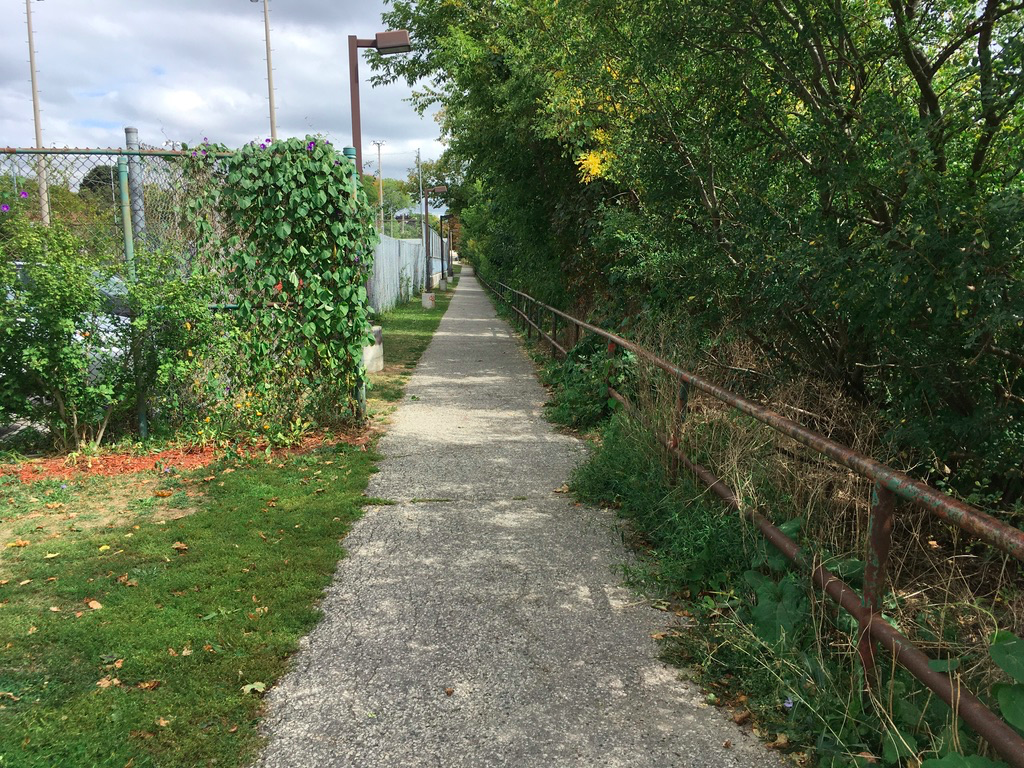
The foot path between Lawrence Park Collegiate and Glenview School
At the end of this foot path where it joins Cheritan Avenue, there is a roadway on your right descending down into the Glenview playing field. Follow this down and at the bottom, turn left and walk back east past the baseball diamond to find the entrance gate to the Chatsworth Ravine. Enter the gate and follow the path beside Burkes Brook, crossing the bridge and then continuing till you reach Duplex Avenue. There is a steep flat path on the right or a set of stairs on the left – either takes you up out of the ravine and onto Duplex.
Cross Duplex and on the east side of the street you will see the steps descending into the Duplex Parkette (which are not on Google Maps, so it thinks you can’t get down into the park – that’s not true, though in winter if it’s icy, you can take Chatsworth Drive down to Yonge instead). Follow the stairs down and then continue east along the path towards Yonge Street. Near Yonge, the path forks, so go left to get to the crossing lights at Yonge and Chatsworth. Cross Yonge here and then turn right (north) and walk up the street less than 100m to the entrance to Alexander Muir Memorial Gardens.
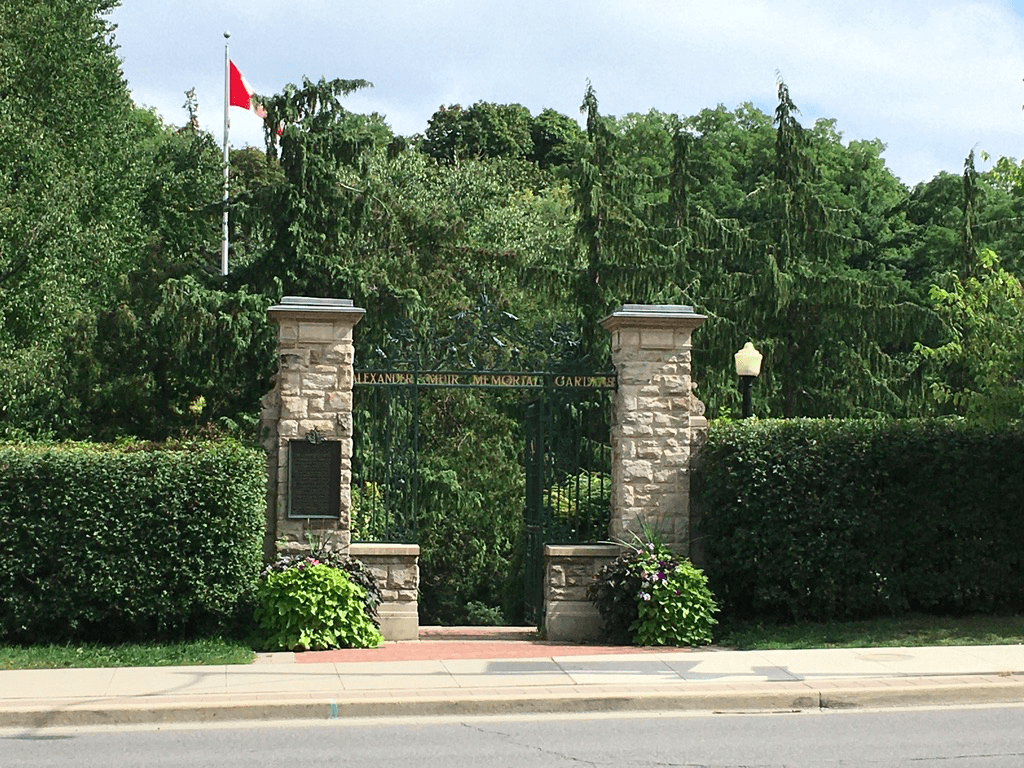
Entrance to Alexander Muir Park
Enter the park and meander through the gardens until you come to tennis courts. Turn right leave the gardens to get onto the roadway that runs east parallel to the tennis courts. Follow that and you enter Blythwood Ravine along the foot path beside Burkes Brook which is channelled underground between Duplex and Yonge. Follow the foot path beside the stream east, crossing under Mount Pleasant Road.
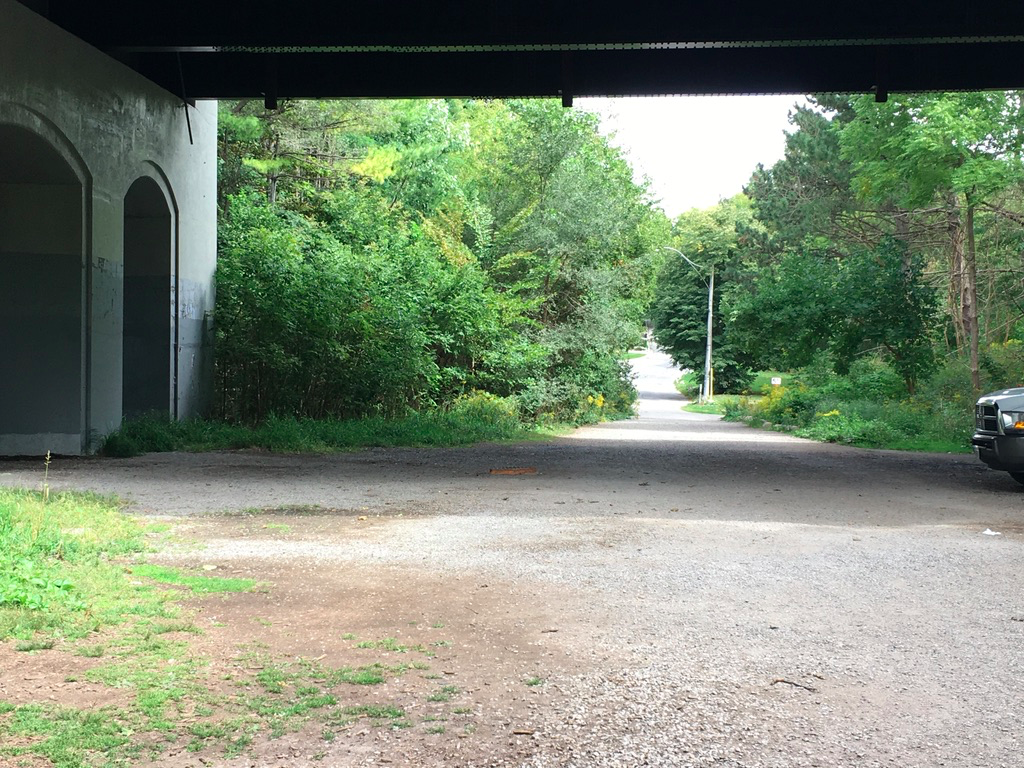
Path under Mount Pleasant Road with Strathgowan Avenue straight ahead
On the east side of Mount Pleasant, the path ends, with a new path on your right and a roadway directly ahead (Strathgowan Avenue). Continue straight along Strathgowan for about 50m and then turn left (north) to climb the public foot path up onto Dundurn Road. Follow Dundurn north for about 4 blocks to Dinnick Crescent and then bear right to follow Dinnick another block north to Cheltenham Avenue. Turn right (east) and follow Cheltenham for about 3/4 of a km to Mildenhall Road. Cross Mildenhall to enter Cheltenham Park, and follow the path east through the park to emerge on the other side at Bayview Wood. Keep going straight and the road bends right (south) turning into St. Albans Crescent. Keep following this round as it continues bending right and starts heading back west.
After completely turning back west, as you continue straight ahead Rochester Avenue begins, so follow this east past Mildenhall Road to St. Ives Avenue. Turn left (south) on St. Ives and follow it south to St. Leonards Avenue. Turn left and then immediately right after less than 100m to St. Leonards Crescent, turning right here and following it south as it bends east a bit. At the junction with Dawlish Avenue, St. Leonards Crescent turns into Fidella Avenue which continues south and bending west. Follow that south until you reach Strathgowan Crescent. Turn right (west) and follow the crescent for about 100 m as it curves south and climbs the hill. At Strathgowan Avenue, turn right (west) with the Blythwood School yard on your left. Follow Strathgowan down the hill till you come to the path back into Blythwood Ravine, on your left just before get to the Mount Pleasant Road underpass.
Turn left onto the path into Blythwood Ravine and follow it north and east. After several hundred meters, the path ascends and connects to Blythwood Road. As you come out of the ravine, cross Blythwood using the crosswalk and turn right (west). Climb up the hill and cross Mount Pleasant Road at the traffic lights. Continue on Blythwood for about 500m to Blythwood Crescent. Turn left and follow that to Sheldrake Blvd. Turn right (west) and follow Sheldrake to Yonge Street. Turn left (south) on Yonge and walk back to Eglinton Avenue to the finish.
Sights:
Of the many delights of this route, my favourite is probably just wandering along wide, tree-lined, quiet streets as I walk through the Lytton Park and Lawrence Park neighbourhoods. Often, especially on weekends, there’s no one about and it’s peaceful and calm. The only people you do meet are locals out walking dogs or doing a bit of yard work. Some of my most relaxing walks have been through these streets on a misty, rainy early spring day, and you can kick up little piles of leaves in the autumn or enjoy the shade in the summer too.
Burkes Brook in Chatsworth Ravine
These streets were laid out in the early part of the 20th century and many of the homes date back to the 1920s and 1930s. Nowadays (sadly to my tastes), a number of these older homes have been demolished and replaced with large modern structures, but there are enough of the older ones left that you can see see hints both of the original agricultural past in early Toronto (look for the original farmhouses on Blythwood in between Mount Pleasant and Yonge) as well as the early city planning in the lay out of the roads. Those early planners were keen to provide lots of winding streets, in an era when the car was starting to dominate planning – hence the width of the streets and in many cases the lack of sidewalks.
There is history here too. Alexander Muir Gardens is named after the man who wrote what for many years was the unofficial Canadian national anthem (at least to English Canadians) – The Maple Leaf Forever. The gardens were laid out in the 1930s to honour him, and the wind may oblige you to provide a nice shot of the flag that bears that symbol.
The parks and ravines are also lovely. Burkes Brook is one of the many small tributaries of the Don River and the City of Toronto has both exposed it in some parts and buried it in others. Following its course is a bit of an adventure as you go from wooded ravines to parks to urban street crossings – check out the Lost Rivers Project to learn more about these hidden creeks and streams.
Many people don’t realize it, but Elginton Park is also set in a filled-in creek ravine. Mud Creek is flowing under it and under Eglinton Avenue itself, and then crosses under Yonge south of Eglinton near Manor Road, to follow the line of Tullis Drive on the east side of Yonge and eventually flow under Mount Pleasant Cemetery into the ravine under St. Clair Avenue and onwards to the Don. These hidden creeks are all over Toronto and help to explain why some of the streets curve and bend the way they do.
This walk is also linked by the spine provided by Yonge Street. Between Eglinton and Lawrence Ave, Yonge is a solid line of shops and retail, providing those who leave nearby with their everyday needs and ensuring that this is actually a fantastic, walkable area both east and west of Yonge.
There are also at least 10 schools in the area, along with the parks, so this is a family-friendly place as well. That explains the bajillion dogs and their owners, as it seems to be a neighbourhood requirement to have 2.5 kids, 3.5 bikes, and 4.5 dogs per household. And also, it should be said, 1.5 luxury cars per driveway, reflecting the upper middle-class demographic. This area used to be very, shall we say monochrome, and is now becoming more diverse culturally, echoing Toronto as whole though also echoing its social/cultural stratifications as well. Property prices here have not gone done, to say the least.
The Eglinton Park fieldhouse
Finally, I like this area simply because I’ve lived here on and off for close to 40 years, since I arrived in Toronto to attend university at Glendon College, which is just east of Lawrence Park. I’ve watched the neighbourhood change and grow and evolve over the years. I’ve coached my son’s baseball teams playing in Eglinton Park, and I’ve pushed him on his toboggan down the hill at Glenview School, where he also did his swimming lessons. It’s been a wonderful place to live, and when we’ve returned to the hood after living elsewhere, we’ve always settled right back in like the proverbial dirty sock. It’s home.
Food & Refreshment:
Yonge and Eglinton is amply supplied with many food shops, restaurants, coffee shops, and bars to stock up for a picnic, fuel up ahead of the walk, or rest up afterwards. There is a great breakfast place called Boom on Eg at Lascelles, just as you enter Eglinton Park, and there is one of my favourite greasy spoon diners on Yonge near Castlefield (Good Bite is just that, and no disrespect intended calling it a greasy spoon). All of that choice means it’s easy to combine a nice walk with some shopping, with the subway right there so that you can leave the car at home.
As well, Eglinton Park has both water fountains and public washrooms, and there are also both of these in the Community Center itself so that you can stop off year round. There are water fountains in Alexander Muir Gardens, Duplex Parkette, and Cheltenham Park, though all of these are turned off between October and May. Otherwise, take advantage of the coffee shops along Yonge or in the Yonge-Eglinton shopping centre.
Diversions:
The route describes exits Burkes Brook ravine at Blythswood Road. If you want to stretch yourself further, instead of heading to Yonge along Blythswood Road, cross it and descend on the south side of the road, so you can keep going on the path as you enter Sherwood Park. After about 500m, past the picnic area, you can either turn right to climb up out of the park at Sherwood Avenue and so return to Yonge, or else turn left (east) and follow the path along Burkes Brook through the east end of the ravine to Bayview Avenue. If you do that, then a great way to get back to Yonge is to go south on Bayview to Mount Hope Cemetery and cut through that peaceful spot to exit onto Erskine Avenue which will take you east back to Yonge. If Mount Hope Cemetery is closed, then continue south on Bayview to Broadway Avenue, where you can turn right (west) and follow it all the way to Yonge.
As you go up Rosewell Avenue and come to Glenview School, you will notice that there is a treed ravine on the west side of the street. These are part of the grounds of Havergal College, a private school and thus private property. This ravine, however, is part of Burkes Brook, so to keep following it north, walk around Havergal by going north up Rosewell to Lawrence Ave, turning left to get cross to the west side of Avenue Road, then turning right (north) across Lawrence to go north up Avenue Road to Woburn Avenue. Here, on the northwest corner, there is the entrance to Brookdale Park. The path here keeps going north, and if you follow that onto Grey Road, you can keep going up to about Brooke Avenue and so follow more or less follow the course of upper Burkes Brook.
Blog posts are a labour of love for me, and yet there is a cost to running this site and organizing my walks.If you’d like to help with that, I’d really appreciate something for my tip jar.The Buy Me a Coffee service allows patrons like you to fund writers like me. If that sounds like a worthy idea to you, then go ahead – keep buying me coffees.Thank You Very Much to everyone who has contributed already!
*****
And now on to the regular post …..
Several years ago, I was training to do the Toronto Waterfront Marathon. I had never done a walk (and I walked it more than I ran it) of more than about 20 km, and since a marathon is 42 km, I planned out a walk that would be about 30 km in length and incorporate some ups and downs to get my legs built up.
Length: About 32 km, including about 200m of vertical ups and downs
Surface: Mostly paved, with gravel path on some of the ravine trails, plus the wooden boardwalk in the Beaches.
Public Transit: Start and end at Eglinton Station on the Line 1 subway
Route:
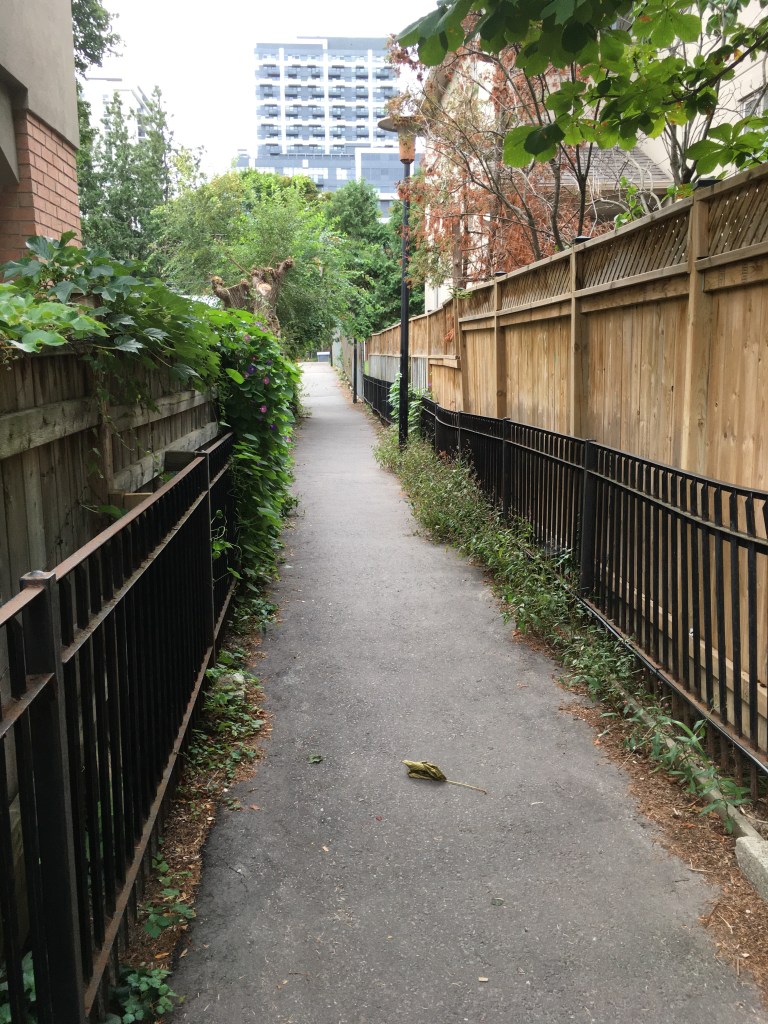
Starting from Eglinton Station, head south on east side of Yonge St and turn east (left) at Manor Road. Cross the street and turn right (south) down Tullis Drive. Follow Tulis south to Belsize Avenue, crossing the street to the south side. You’ll see a fence laneway in front of you – take that as it’s a public right of way and follow it to Millwood.
Laneway between Belsize and Millwood
Turn left (east) on Millwood and proceed down the hill. At Acacia, turn south (right) and follow that to Davisville Avenue. Cross Davisville and turn west (right) for a few meters to Pailton Crescent. Turn left (south) and follow Pailton to Merton Street. As you cross Merton at the crosswalk, there is a path directly in front of you beside a condominium building and that takes you to the Beltline Trail.
At the Beltline, turn left (east) and follow it for about 100m to the entrance into Mount Pleasant Cemetery. Inside the Cemetery follow the purple painted lines on the road, following it east under Mount Pleasant Road and around towards the memorial gardens. The marked path takes you east and south and exits the cemetery at Moore Avenue, opposite the entrance to the Moore Ravine Trail – careful, there are always many impatient drivers as you try to cross.
Descend on the trail into the ravine and follow it for about 1km. When you reach the entrance to the Don Valley Brickworks, you can detour left over the bridge and follow the trails in the Brickworks, or else continue on the Beltline south until you enter the Brickworks opposite the main buildings near the car park. Exit the Brickworks complex here, crossing Bayview Ave at the lights to join the Lower Don Trail (turn right, south). Follow the Don Trail south parallel to Bayview for about 1.5 km to the traffic lights at Rosedale Valley Drive. Cross here and directly in front of you will be the stairs up the hill beside St. James Cemetery. Climb up to reach Wellesley Park.
Walk through the park and onto Wellesley Street, and keep going about 100m to Sumach Street. Turn left (south) and follow Sumach to the entrance to Riverdale Park. Turn left into the Park and follow the path diagonally across past Riverdale Farm, in a south-east direction, to reach the stairs leading down into the Don Valley. Follow the path down to reach the bridge over Bayview Avenue – climb up, cross the road, and then take the stairs down onto the Lower Don Trail. Follow the Trail south about 1.5 km to Corktown Common.
If you go past the Common, the Trail bends a bit west and then east under the Don Valley Parkway overpass, to come to a trail junction. Turn left (east) here to cross the Don River and then join the Martin Goodman Trail parallel to Lakeshore Blvd. If you detoured into the Common, follow the paths in the park back out through the junction tunnel that passes under the train tracks to rejoin the Lower Don Trail.
Once on the Martin Goodman Trail, follow it east for 2-3 km to reach the entrance to Woodbine Beach park. It’s better to walk on the north side of Lakeshore, as the cycle path and foot path are separated here so you’re not constantly being dinged by cyclist’s bells.
Martin Goodman Trail between Carlaw and Leslie
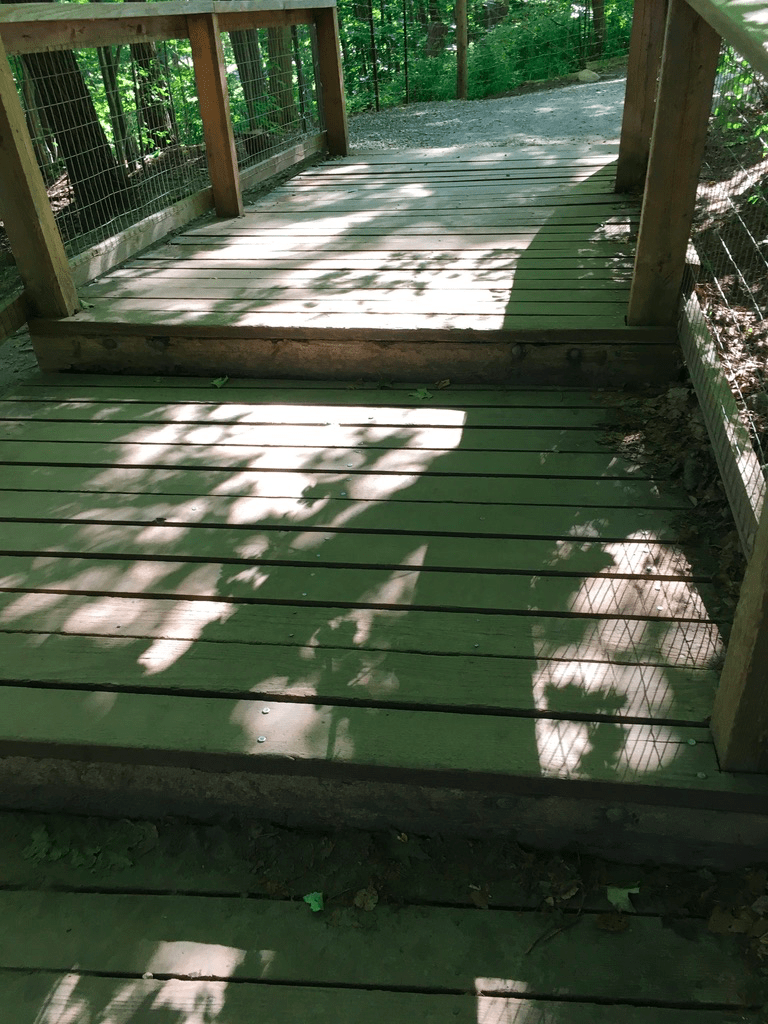
When you reach Woodbine Beach park, cross Lakeshore at the traffic lights and turn into the park, follow the Martin Goodman trail pathway connect to the west end of the Beaches Boardwalk. Keep going east following the boardwalk for 2 km to reach Balmy Beach Park.
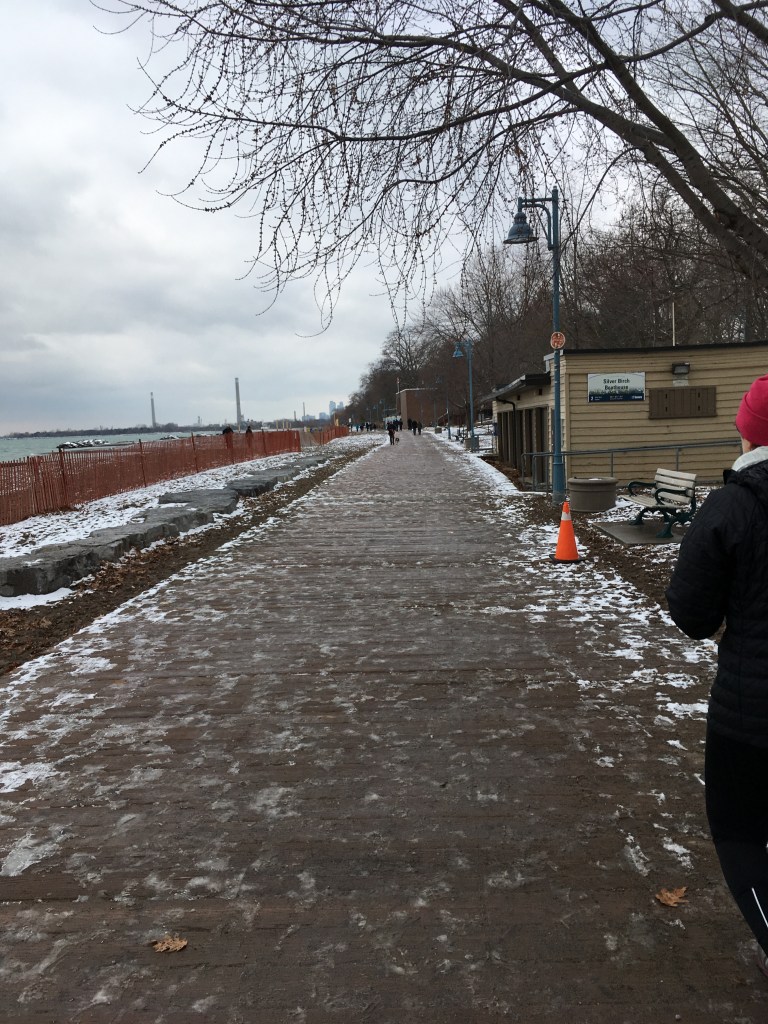
the Boardwalk at Beaches park.
At Balmy Beach, at the end of the Boardwalk, turn north (left) onto Silver Birch Drive and follow it north to Queen Street. At Queen, turn left (west) and follow it for about 500 m to the entrance to Ivan Forest Gardens park, on the north side of the street. Turn into the park and follow the trail north through the park, which will turn into Glen Stewart Park, and exit at Glen Manor Road East. Cross that street and descend into the Glen Stewart Ravine, following the trail north and east.
Exit the Glen Stewart Ravine trail at Kingston Road and turn right (east). Walk along Kingston Road east – you can either go all the way to Victoria Park Ave and then turn left (north) or else turn north up one of the side streets such as Scarborough Road and follow that to Gerrard – if you do that, turn right (east) on Gerrard and walk east to Victoria Park, then turn left (north). Once on Victoria Park, follow it north under the train tracks and on past Danforth Avenue. Keep going north past the Victoria Park subway station, and about 500m north of the station the road descends into a gulley. On the west side of the road opposite the Dentonia Park Golf Course you will find a set of stairs descending into the Taylor-Massey Creek Park trail system.
Once on the trail here, follow it west for about 4 km to reach the lower Don parklands. At the Lower Don off-leash dog park, turn right (north) and follow the trail north and then west crossing under the Don Valley Parkway to reach the junction with the Don Valley Trail system. Turn right (north) crossing the Don River over the old Don Mills Road bridge,
the old Don Mills Road bridge
and follow the trail through the parking lot to reach a bridge over the train tracks. Turn left (west) at the top of the bridge and follow the trail to reach the entrance to E. T. Seton Park.
In Seton Park, cut across the car park and turn right (north) along the roadway. Follow the road north till you pick up the West Don Trail inside the park, and then take that trail north through E. T. Seton park all the way to the car park on the south side of Eglinton Ave near Leslie Street. Turn left (west) at that car park and follow the roadway west and then north to cross under Eglinton and enter Wilket Creek Park.
hints of autumn on a September day
Keep going north through Wilket Creek till you reach the junction of the roadway/trail that turns west (left) heading towards Sunnybrook Park. Follow that roadway/trail west into and through Sunnybrook Park, towards the Riding Stables. Just before you reach the Stables, there is a path on the west side of the road that leads to a bridge which crosses the West Don River. Take that path west and on the other side of the river, turn left (south) on the trail beside the off-leash dog park. Follow the trail heading south and then bending west. On the west side of the dog park, turn right (north) onto the Burkes Brook trail. Follow this north and bend to the west to keep going parallel to the water. The trail officially ends after about 500-600m, but you can exit the official trail and keep going west on the unofficial trail. This continues for another 500 m to reach a steep hill climbing up out of the ravine to reach Bayview Avenue.
Cross Bayview (either directly here or else a bit to the north at the traffic lights by Sunnybrook Hospital). On the opposite side of Bayview, reenter the Burkes Brook trail and descend into the ravine again. Follow this trail west for about 1km, climbing the stairs passing through the off-leash dog area, to descend into Sherwood Park. At Sherwood Park, turn north and then west at the bridge over Burkes Brook (next to the City of Toronto maintenance buildings) and climb the hill along the roadway to exit the ravine/park onto Sherwood Avenue.
Up the stairs in Burkes Brook
Follow Sherwood west for about 500m to Mount Pleasant Road. Cross at the traffic lights and continue west along Sherwood for about another km or so to reach Yonge Street. Turn left (south) on Yonge and follow it for about 1km to reach the finish back at Eglinton Station.
Sights:
I like this walk because of the variety of scenery – the forests and wildness of the ravines, the garden settings in the parks, the sand and the lake along the Boardwalk, and the urban stretches through the upper beaches. That variety keeps it interesting over the whole length of the walk, and it also means that in any season there will something different. The ravines and shaded streets also mean you have some shelter from summer sun, though note that in winter most of the trails are not cleared or salted so they can get icy.
The Beltline down Moore Ravine
Another cool thing about this walk is that it actually follows a number of the various creeks and brooks that have been buried over time. For example, at the start of the walk, Tullis Drive follows the course of Mud Creek. If you listen carefully at the manhole cover at the corner of Tullis and Glebe Road, you can usually hear the stream following under your feet. The same happens on Millwood in the little gully that you descend into – that gully is there because of the creek. Check out the Lost Rivers project to learn more about this fascinating part of Toronto’s history.
down the hill on Millwood into the Mud Creek gulley
I also like this route for the many angles it gives you on the Toronto skyline. From the Don Valley near the Brickworks, you see it from the north and east. From beaches, you see it directly along the lake and you get the tall chimneys of industry poking up as well. You always see the CN Tower poking through and that landmark is usefully to navigate by. These landmarks are reminders that while you’re walking through many beautiful natural settings, the industrial and commercial aspects of the city are always around you.
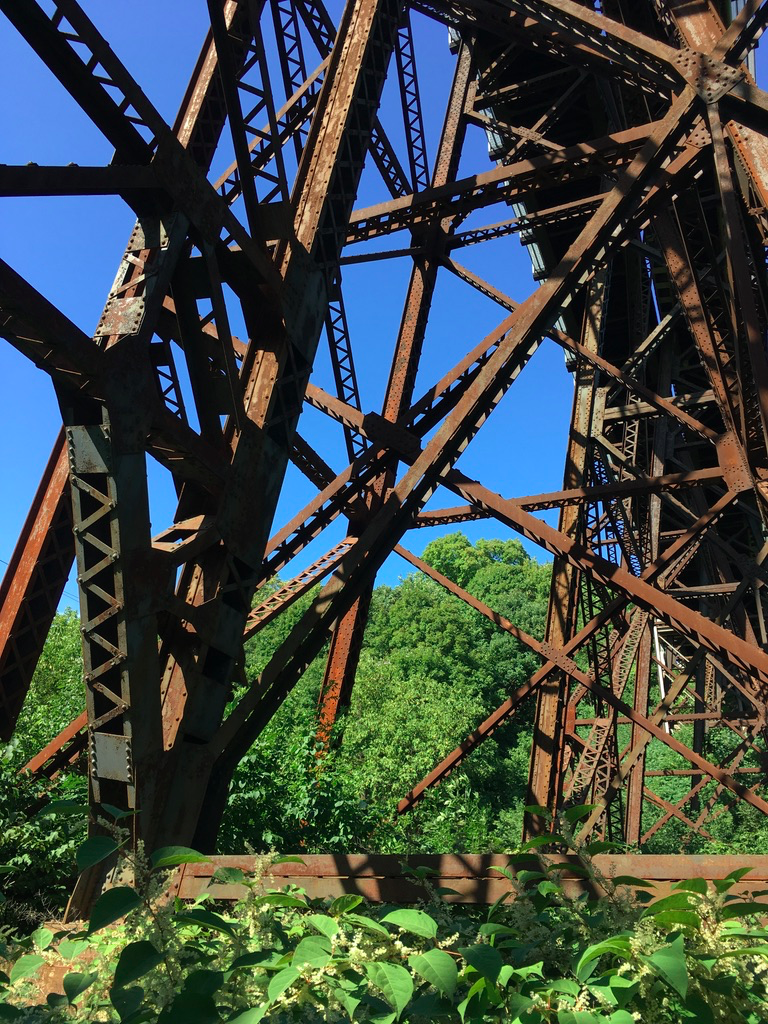
Industrial Toronto reclaimed – the old railway bridge at the north end of E.T. Seton Park
The many parks that this route takes in are also little time capsules. Corktown Common and the Brickworks, for example, are relatively new additions to the City’s park system, having been created in the 2010’s as part of the revitalization of what had been industrial areas. A generation earlier, in the 1970’s, parks such as E.T. Seton were added, and to offer the growing middle classes not just trails but also recreational amenities like a disk golf course and an archery range. A generation before that, in the 1940s after WW2, Sunnybrook Park was laid out after a private estate was taken over during the war to create a health facility for returning veterans. And finally, another generation back in the 1920s, the parks in the Beaches are 100 years old and reflect the formal gardens, picnic areas, and baseball diamonds that were popular then.
Taylor Creek
Finally, this route, especially around the Beaches, is great for people watching, I’ve seen everything from multi-generational families out for a stroll to movie shoots to outdoor aerobics classes. It can get crowded in high summer, especially on a weekend, but for people watching that just adds to the fun.
Food & Refreshment:
There are several spots where clusters of restaurants and coffee shops will set you up for the journey. That starts with Yonge & Eglinton, which is packed with places to grab some food as you set out or as you finish.
In the Brickworks there are washrooms, water fountains, and a great cafe, plus on weekends there are often farmers markets or festivals on (note that COVID-19 may crimp these a lot so check ahead).
At Corktown, there are washrooms and water fountains, and there are several coffee shops nearby. Near the Common, the shops/restaurants at the Distillery District, or the St. Lawrence Market, offer lots of choice.
In the Beaches, there are washrooms and water fountains in several of the parks. There are also cafes near the Boardwalk, and of course along Queen Street itself there are many places to chose from. If you are paying attention to the route, you’ll see that Queen between Silver Birch Drive and Ivan Forest Gardens is about half-way, so it makes a natural spot to stop for a break.
North of the Beaches, your last chance for coffee or food is near Victoria Park and Danforth. After that, if you are following the route as described, there are no coffee shops until you get back to Yonge Street. There are some washrooms and water fountains in Taylor-Massey Creek, E. T. Seton, Wilket Creek, and Sunnybrook Parks.
Note that all of the public washrooms and water fountains in any of the city parks are seasonal, so they close around October and don’t reopen till May. Note also that COVID-19 is causing restrictions on some of these facilities. In winter, you may need to use coffee shops along the route.
Diversions:
I’ve described the route in a counter-clockwise direction. You can of course reverse that and go clockwise round. The hills are the same I think – you are still climbing in and out of various ravines, but it might be a bit easier going clockwise as the climbs are less steep.
It’s easy to break this up if you want and tackle it over different days. Jump on/off points include the Brickworks, Corktown Common, Queen Street, or Victoria Park Station.
The Distillery District and Corktown St. Lawrence are worth exploring in their own rights, as is the Beaches neighbourhood. If you break up the route, you could spend a few hours in either area and that would be a great way to explore the eastern part of the city.
As noted, seasons matter quite a bit on this route. Summer near the lake is awesome, the trees in the ravines are stunning in autumn, the wildflowers in spring are gorgeous, and the quiet of a fresh snowfall is peaceful. You could walk this route multiple times and see different things every time.
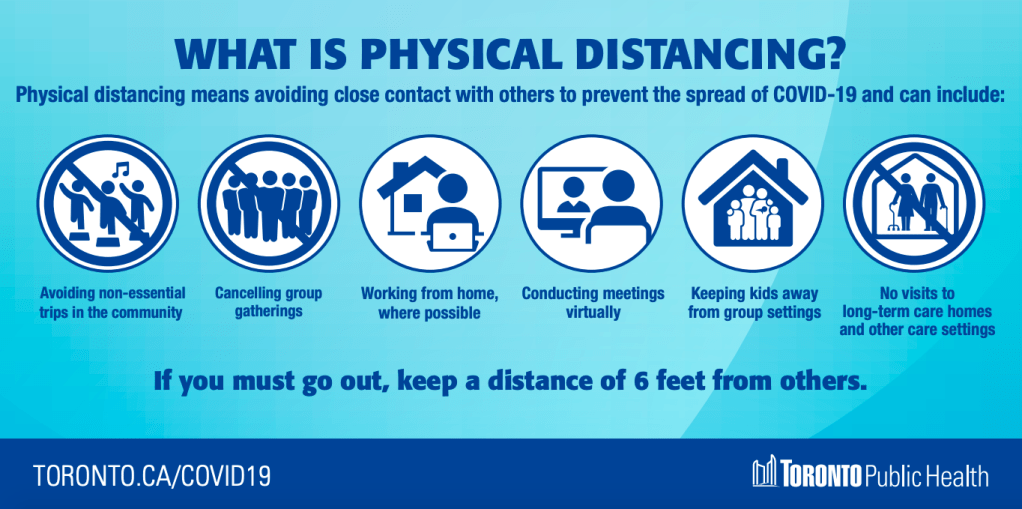
For the past several months now, I’ve been starting off most of my posts with this:
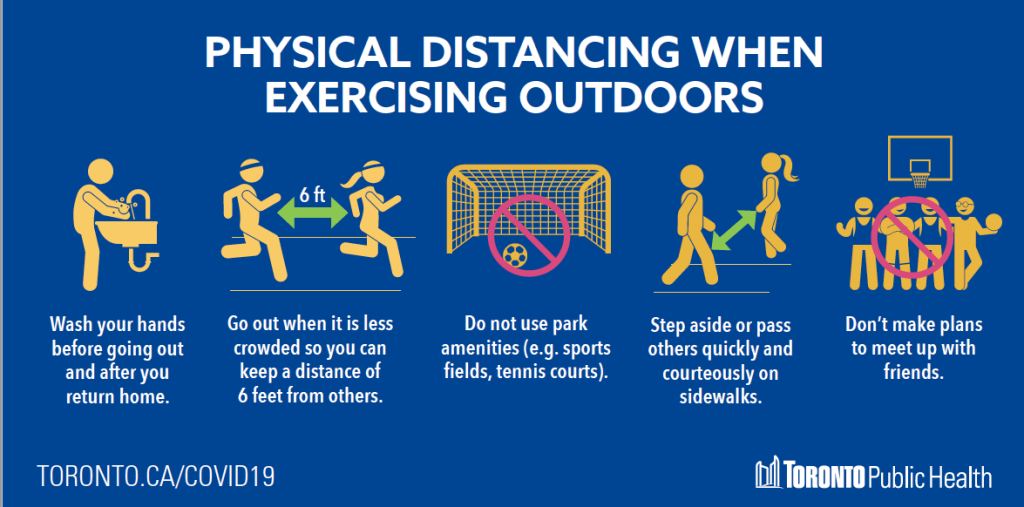
Hey Toronto, remember to practice Physical Distancing during the COVID-19 pandemic! Also be aware that some of the amenities, parks, or services listed below may have limited availability. Please check the links included below for up to date information on what’s open and what’s not.
And after 6 months of the COVID-19 pandemic, I’m wondering if I need to keep saying that. Don’t we all know this by now?
You hear people talk about “the new normal”, and the idea that what we have become used to with COVID-19 is what we’re going to have to keep doing for the foreseeable future. We all hope there will be a vaccine soon, but in the meantime we just need to keep doing the right things to manage the epidemic.
wearing a mask where physical distancing isn’t practical, like shops and indoor public spaces
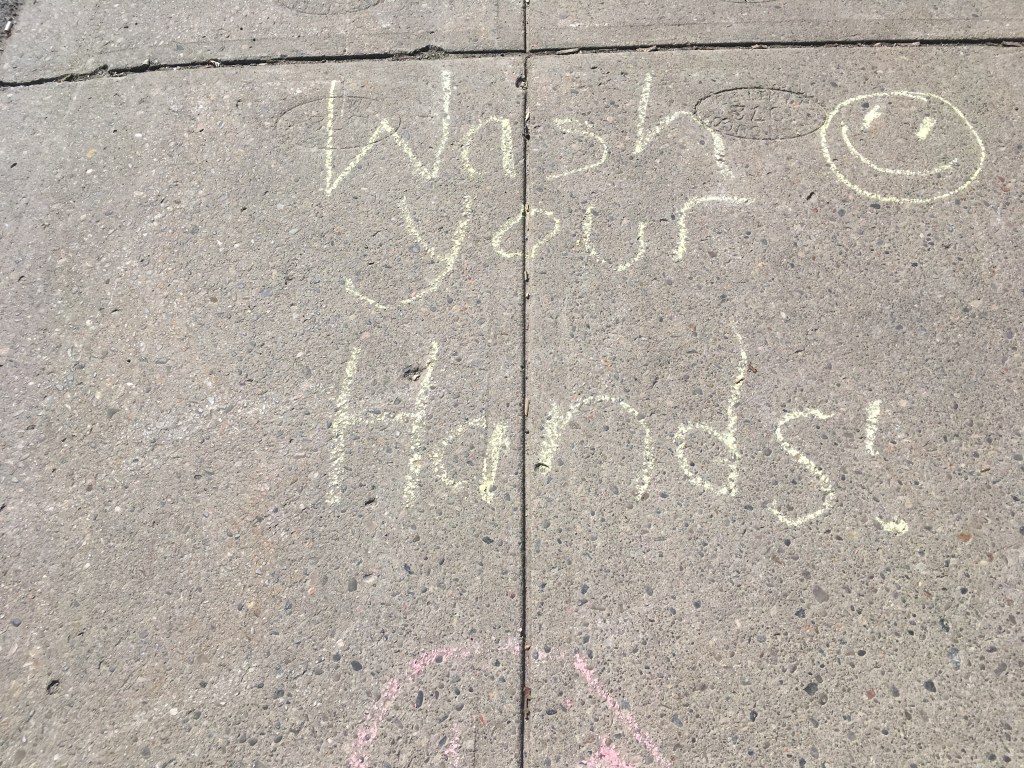
washing hands and avoiding contact points
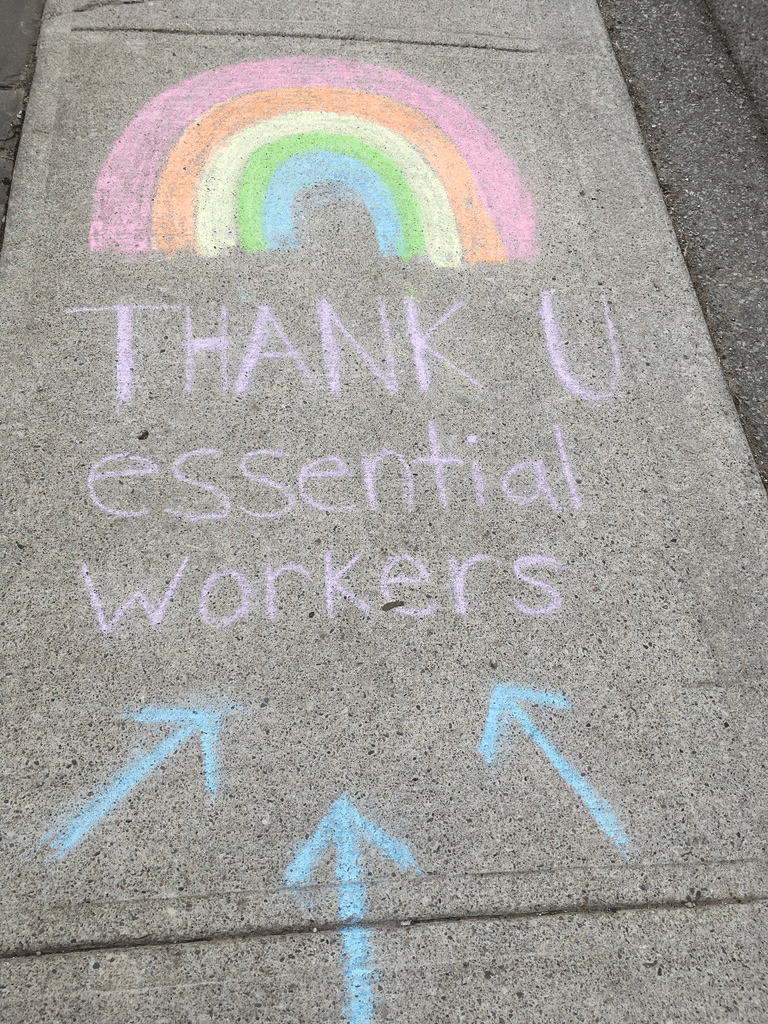
cheering each other up with sidewalk chalk art
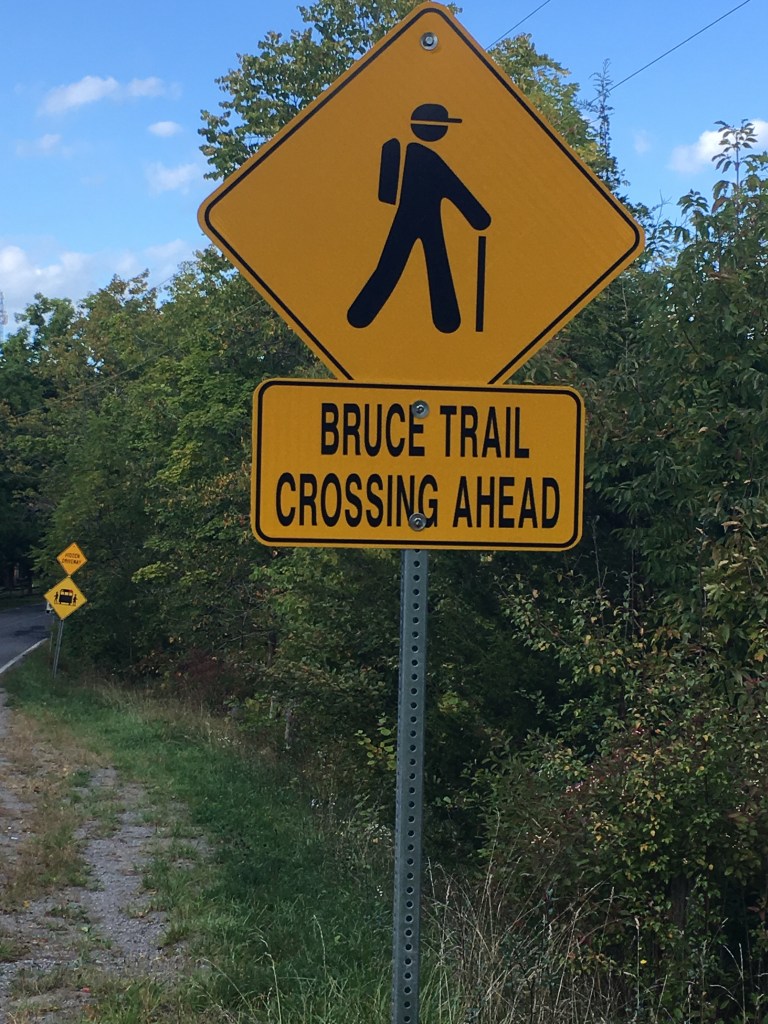
While that’s become mundane, at least for me, what’s also become part of my new normal is the way I’m walking these last few months. For example, I’ve stopped thinking or planning for long multi-day out of town walks. The Bruce Trail is out right now, partly because sections are closed, partly because the Bruce Trail Org is actively discouraging through-hikes, and partly because I’m reluctant to book B&Bs or hotels right now.
And then, within the city, my routine has changed. In the Before Times, I would take public transit to some end point and walk home. Now I don’t want to use those the bus or subway, and since the City has closed many public washrooms in parks and has shut off public water fountains, I need to plan my routes carefully around pit stops while carrying extra water with me.
All of that means much of my walking has been local, 1-2 hour forays around nearby neighbourhoods. Thankfully, we live in mid-town and there are many quiet, shaded backstreets to chose from, so most days I ask Siri to just randomly pick a direction – North, East, South, or West – and head off that way.
With tricks like this, and some others I’ve learned, my new normal COVID-19 walking routine is helping me to keep sane.
COVID-19 Walking Hints and Tips
Walk on the left when you can. This means you’re facing the traffic if you have to step into the street briefly to give space on the sidewalk to someone else
Backstreets have less foot traffic. On busy streets like Yonge, I sometimes feel like I need to wear a mask because of the density of other pedestrians. On side streets, there’s hardly anyone about any day of the week, and it’s quieter so I can hear the birds.
Plan your route. Like I said, washrooms and water can be tricky. I can carry water, and I guess I can pee in the bushes if I need to, but that only works in forested parks and ravines. The neighbours don’t take kindly to pits stops in their hedges.
Planning ahead also means both hydrating before I leave as well as emptying the bladder.
Avoid bike trails, especially on weekends. Toronto has many multi-use trails, like the Don Valley Trail, and they are mostly too narrow to allow 2m of physical distancing from cyclists. Weekends are the most congested with would-be Tour de France pelotonistes, so I look for walker-friendly options.
Take a picnic. With many coffee shops and restaurants still limited in seating, and requiring mask-usage if you do go in, it’s easier to just take some snacks and have a bite on a park bench somewhere.
Skip parks with off-leash dog runs or playgrounds. Parks like this usually mean more pedestrians and less physical-distancing, which should mean more mask-wearing, and I don’t like to wear a mask outdoors, so I just don’t go near those parks.
Look for big, natural settings. Toronto is blessed with a wonderful system of ravines, trails, and parks that are big enough to offer lots of trails and fewer people for lower density, especially during mid-week.
Look for quiet neighbourhoods with lots of windy streets. Toronto has many areas that feature beautiful homes, lots of shade, and little traffic. Often these are quiet any day of the week so you can go for walks when the weekend-warriors are clogging the parks. Personal favourites include:
Lawrence Park
Lytton Park
Cedarvale / Wychwood
Hoggs Hollow
Rosedale and Rosedale Heights
Forest Hill and Upper Forest Hill
Moore Park
Chaplin Estates
Davisville
Leaside
Rathnelly
The Beaches
Leslieville
Check out the cemeteries. I’ve written many times about walking through Mount Pleasant Cemetery, and Mount Hope and Prospect Cemeteries are favourites too. They’re quiet, shaded, and usually free of cyclists, and this time of year I can fill my water bottle at one of the taps around the grounds. That said, please do remember that first and foremost these are places of memory and quiet contemplation.
The worse the weather, the fewer people about. If it’s raining or really hot/cold, you can avoid crowds by using the weather to keep crowds down. Remember – there’s no bad weather, just poor clothing choices.
And probably most importantly, remember that we’re all in this together. We’re all missing something, we’re all a bit inconvenienced, and we’re all impatient to be able to get back to whatever it was we thought was normal before.
Blog posts are a labour of love for me, and yet there is a cost to running this site and organizing my walks.If you’d like to help with that, I’d really appreciate something for my tip jar.The Buy Me a Coffee service allows patrons like you to fund writers like me. If that sounds like a worthy idea to you, then go ahead – keep buying me coffees.Thank You Very Much to everyone who has contributed already!
*****
Over the past couple of years of walking I’ve gone through a fair amount of gear, so I thought I would share some feedback for stuff that’s tried and trusted. Hope it helps.
How much?: $150 CAD + tax, plus $35 + tax for the rain cover
Where, when, how do I use it?: I bought this recently, in spring 2020. Partly this was because I wanted a bigger pack for day hikes than the Deuter RaceX 12L pack that I also use. Partly it was simply because the Osprey was on sale, so I ended up getting it for about $60 off the combined price of the pack and the rain cover.
I’ve used it multiple times in just the first few weeks, for hikes as well as shopping runs, where BTW the extra bottle wine capacity (6-8 bottles versus 4-5 for the Deuter) is a useful feature. I’m planning to use it as my go-to day-hike pack. I like it for several reasons:
It’s the right Goldilocks size, not too big nor too small.
It comes in sizes, so I was able to get the long one that fits my long torso.
It has a semi-rigid frame-like structure, meaning it’s stiff enough to feel like it’s got a frame but it doesn’t actually have one which keeps weight down
The waist belt has side pockets, useful for little things like COVID-19 essentials (face masks and hand sanitizer), Clif bars, Swiss Army knife, etc.
The outside mesh pockets are big enough to hold a 1L Nalgene bottle
There are lots of pockets inside and out to organize your stuff, and it’s got a hydration sleeve with a port for the tube as well.
It will hold a laptop no problem in the hydration sleeve.
It’s relatively water resistant even without the rain cover, and really good with the cover on.
Compared to the smaller Deuter bag, the Osprey bag is heavier of course, but not by as much as you’d think. The Talon holds 22L in volume versus 12L, but it weights only 810g versus 550g, a decent tradeoff of weight for load, and you can carry up to around 8 or 9kg with it.
The biggest thing for me is the adjustability of the strap system. While I like my Deuter RaceX bag too, the Osprey just fits me better because it’s longer. I took it out for a 4 hour hike the other day, carrying 2L of water plus snacks with an ice pack, rain jacket, sun glasses, a seat cushion, and COVID-19 masks and hand sanitizer, so pushing 4kg with the weight of the bag itself, and once I had it adjusted it rode well up and down hills and stairs feeling light and comfortable the whole time. And that was on a 30C day when I was perspiring a lot – the mesh back system really helped.
Would I buy it again?: Yes, I like this bag. Since it’s new and I’ll likely get years out of it, by the time I’m ready for a new one Osprey will have some other model out. That said, I’d definitely look at their products again.
Disclaimer: This is not a “review”. I don’t go around sampling things, instead this is a summary of my own experience with a product I have used a lot. All opinions contained in this post are my own. I offer no warranties or assurances for your experiences with the same product. I bought the gear with my own money and have not received any form of compensation from the manufacturer. Take my feedback as given – caveat emptor.
Part of a series on my favourite places to go for a walk in Toronto
Blog posts are a labour of love for me, and yet there is a cost to running this site and organizing my walks.If you’d like to help with that, I’d really appreciate something for my tip jar.The Buy Me a Coffee service allows patrons like you to fund writers like me. If that sounds like a worthy idea to you, then go ahead – keep buying me coffees.Thank You Very Much to everyone who has contributed already!
*****
And now on to the regular post …..
Any time of the year is a good time for the beach
If you live in Toronto, just saying “the Beaches” probably brings up several images – the shops, restaurants and bars, ice cream, the parks, the sand, the boardwalk, and probably more besides. Whether you are a lifelong resident or a weekend visitor, strolling the boardwalk and staring at the waves is magical.
Location: There’s the “beach” part of the Beaches and then there’s the neighbourhood. The sandy lakefront starts at Woodbine Beach and continues along the lake to Balmy Beach Park. The neighbourhood stretches along Queen eastward from around Woodbine Avenue to the end of Queen Street near Victoria Park Avenue, and then south to the lake and north to Kingston Road.
Public Transit: Take the Queen 501 Streetcar east from Queen Station on Line 1 and get off at Coxwell Avenue for Woodbine Park, or a bit further east past Woodbine Ave for the shops.
Why I like it:
For me the Beaches bring up several other images. One is of Canada Day in 1999 – we had just arrived back in Toronto that day, having returned from London, so we thought we’d go for a walk to get reacquainted with the City. The Beaches seemed like the perfect spot to do that. There was a big celebration and party going on in Kew Gardens, and we nearly cried thinking about what we had left behind in London and what was welcoming us back to Toronto.
And then when we were expecting our son and my wife was well along in her pregnancy, in fact a day or 2 past her due date, we decided to go for a walk along the boardwalk. We’d heard that exercise was a good way to get things going, along with eating spicy food, so on our stroll we also grabbed a slice of hot pepperoni pizza.
With no signs of impending labour, we wandered the neighbourhood and came across a home for sale with an open house in progress. We popped in, and must have fit the estate agent’s profile, because she was all over us. We were living in a downtown condo at the time and knew that eventually we’d want a home with a garden and some space for a toddler, and this was a nice family house that backed onto the local school – you could send your child off through the backyard gate into the school grounds – and for a few moments we had serious thoughts of “what if we lived in the Beaches”.
And then we realized that the timing wasn’t great – she was only days from delivery and we didn’t fancy moving with a 1 or 2 month old – so we kept on strolling. Soon enough, within a few days our son was born, and we had more important things to do.
And as he got older, every few months we’d drive out to the Beaches, this time with a stroller, and walk along the boardwalk. Later our strolls took in the parks and playgrounds and ice creams and chasing him along the sand and tossing pebbles into the waves. Once he even won a prize by guessing the # of jelly beans in a jar at a local antique called The Seagull – it was a framed picture of well-known Beaches shops and restaurants. We kept that for years afterwards.
And then there’s the Toronto Waterfront Marathon. I did that in 2017, and the last quarter of the route took in Queen Street right through the heart of the neighbourhood. The eastern end of the route was at Maclean Avenue, where you turned and headed back down Queen, and from that turn there were about 8-9 km to the finish. I was exhausted when I came up Woodbine Ave onto Queen and as I plowed along I kept thinking “where is Maclean, when do I get there”. I was one of the stragglers at the end of the race but there were still lots of locals cheering on us slowpokes as we dragged ourselves through. I still think of that whenever I pass Maclean.
So all of those memories colour how I see the Beaches. I’m sure I’m not the only Torontonian who has a range of memories of the neighbourhood, and I’m sure that as long as we live here we’ll continue to visit to soak up the spirit of the place.
Sights:
The lakefront and the sand are why this area is popular, and the sightseeing starts there.
Woodbine Beach
There’s much more to the area than the actual beaches, of course. The parks are great for picnics and playgrounds. There’s also the pool at Woodbine Park, the outdoor skating rink at Kew Gardens, and many great spots to run around as a kid, an adult, or a dog (there are several off-leash dog run areas along the beach). Plus there are dozens of benches and Adirondack chairs along the boardwalk, perfect for people-watching or just staring at the lake.
The people-watching and window-shopping are also fun along Queen. The area is constantly changing, and old favourites like Seagull Antiques or Lick’s Burgers have sadly closed up, but new places open constantly and there are still some familiar spots like the Sunset Grill and the Beacher Cafe. COVID-19 has put a dent into the retail character of the area, but it will bounce back over time and in the meantime there’s plenty to see and do.
That’s true any time of the year, by the way. The changing seasons are reflected in the parks and the lake. On a hot summer day, the water is blue and enticing, while on a cold January day it can be grey-green and forbidding, but it’s always fascinating. The autumn colours are wonderful, and the spring flowers too. And the many places to pop into along Queen mean that you can always warm up or cool down no matter what the weather.
New Year’s Day at Balmy Beach
Food & Refreshment:
There are dozens of ice cream, coffee, burger, pizza, and other takeaway places in the area, including a Pizza Pizza outlet in Kew Gardens at the Boardwalk. There are also usually food trucks around on weekends. And of course, there are many local bars and restaurants to choose from, offering casual to formal options.
Another great idea is to visit some of the many food shops along Queen and grab the ingredients for a picnic – fresh fruit, bakeries, cheeses, snacks, coffee, tea, soft drinks, and more are all available, and there are many picnic tables scattered around the parks along with shady spots and sunny sand where you can enjoy your feast.
There are public washrooms in the parks, along with public water fountains. These are seasonal, open from about May 1 to about Oct 1 depending on the weather. Outside those months, the many coffee shops on Queen are good places for a pit stop.
Diversions:
The Leslieville neighbourhood lies just to the west of the Beaches, along Queen between about Broadview to about Leslie. It’s only about a 2 km walk or so between the neighbourhoods, and there are lots of shops and sights in between, so breakfasting in Leslieville and lunching in the Beaches makes for a great day out.
If the weather is kind, walking from Queen Station on Line 1 along Queen out to the Beaches will take you about an hour and a half, and then you can take the Streetcar back. You can also do that in reverse, and walk back to Queen Station.
The Martin Goodman Trail follows the lakefront all the way across Toronto. Walking or cycling that trail to and from the Beaches is a great way to get some exercise.
The Glen Stewart Ravine runs north from Queen at about Glen Manor Drive, and takes you along a wonderful trail up to Kingston Road. The autumn colours here are spectacular.
The RC Harris Water Treatment Plant at the east end of Queen















 Walkablog