PEI’s Island Walk Part 1 – Charlottetown to Summerside

Blog posts are a labour of love for me, and yet there is a cost to running this site and organizing my walks.If you’d like to help with that, I’d really appreciate something for my tip jar.The Buy Me a Coffee service allows patrons like you to fund writers like me.  If that sounds like a worthy idea to you, then go ahead – keep buying me coffees.Thank You Very Much to everyone who has contributed already!

*****

In June 2022, I completed the 700 km Island Walk, around Prince Edward Island. You can read about that walk over several posts, starting with this one.  

This was before Hurricane Fiona caused so much damage on the Island, impacting many of the places I visited.  Some of what I describe below may have changed by the time you do the Island Walk, but please, don’t let that stop you.  PEI needs your tourist support as it recovers.

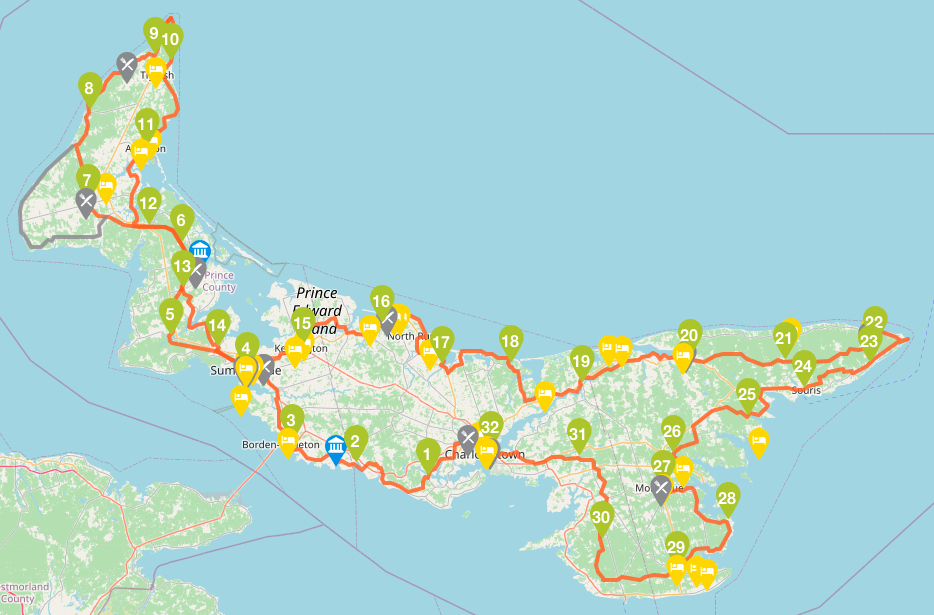
This post is about days 1-3 of my journey, between Charlottetown and Summerside.  The links below have the details from the Island Walk website for the Sections that I covered during this part of my journey.

Screen capture from the Island Walk website – copyright OpenStreetMap

Note, by the way, that the section #s on the official website are somewhat confusingly labelled. They are based on each finish point, and since the overall walk start point is also the overall finish point, the 1st section is labelled as “32-1” with its accompanying web page titled as Section 32 (because it starts at the end of the last section, which is section 32) and goes to the end of section 1; thus the 2nd section is labelled as “1-2” and its webpage is titled Section 1, and so on. 

That said, the links below reflect the sections as I walked them.

I highly recommend that you use the Island Walk website and its directions for the details of the official route, since that route can change from time to time such as for detours around major road works.  I also encourage you to use the official route and its sections as a starting point.  Find your own pace, detour as and when your fancy takes you, walk the sections in whatever order seems sensible, and remember – everybody walks their own camino.

If you are planning on doing the walk in chunks spread over several months or years, this portion is a good intro to the route and the island.
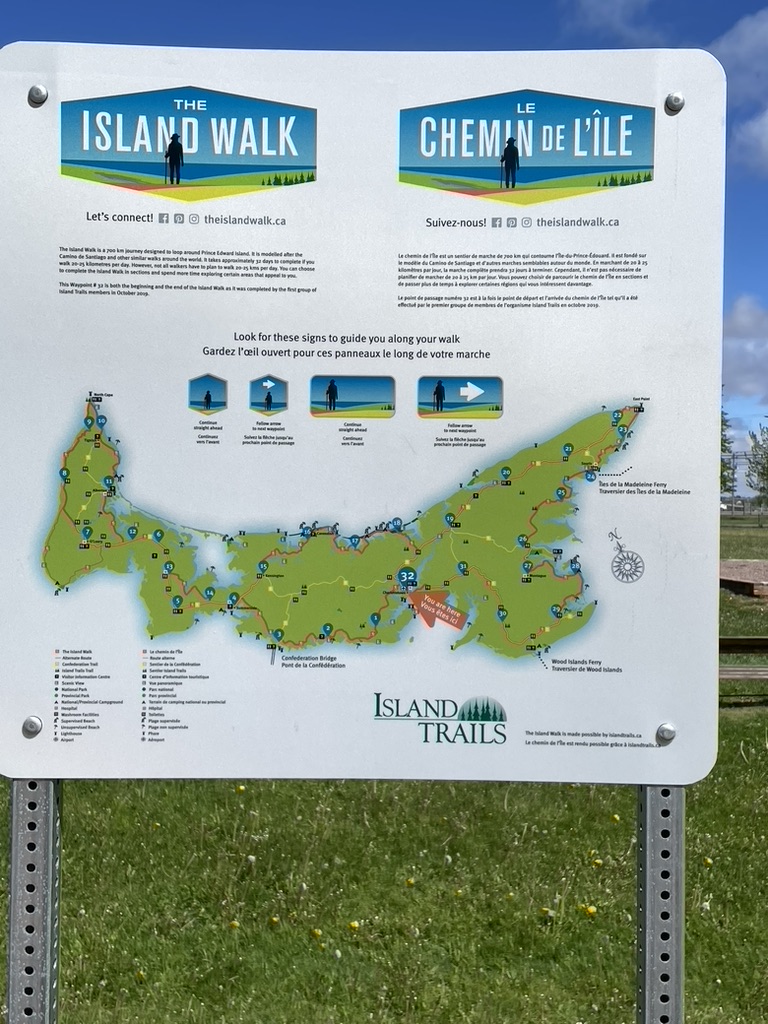

Beginnings

That first morning dawned a bit chilly with low grey skies and a breeze.  I was fidgety and nervously eager to get started, and had to force myself to take a minute and check my pack again, even though I’d gone over it twice the night before.  One cup of coffee, a bite of toast, a banana.  Time to go.

My original plan had been to travel from bed to bed each day, as you would on the Camino de Santiago, so that every day I’d carry all my clothes, toiletries, electronics, and some snacks and food with me.  That approach changed as I delved into the planning and realized that it was impractical to walk from accommodation to accommodation – in some stretches I’d have to do 40km or more, and deviate by several km from the route to find a place.  As a result, I settled onto the idea that I’d base myself in several places for a few days at a time, and find transportation to take me to/from the trail each day.  (See this post for details of my plans and gear choices).

So come that first morning, even though my wife Ann was still in PEI with the car and was travelling to our next accommodations in Summerside, I still chose to take all my clothes and gear with me that first day, just as a kind of penance for my original sin of mis-planning.  That meant that my pack was pretty heavy for a day hike – about 11 kg.  And since it was a cool morning, I was wearing a couple of warm layers.  

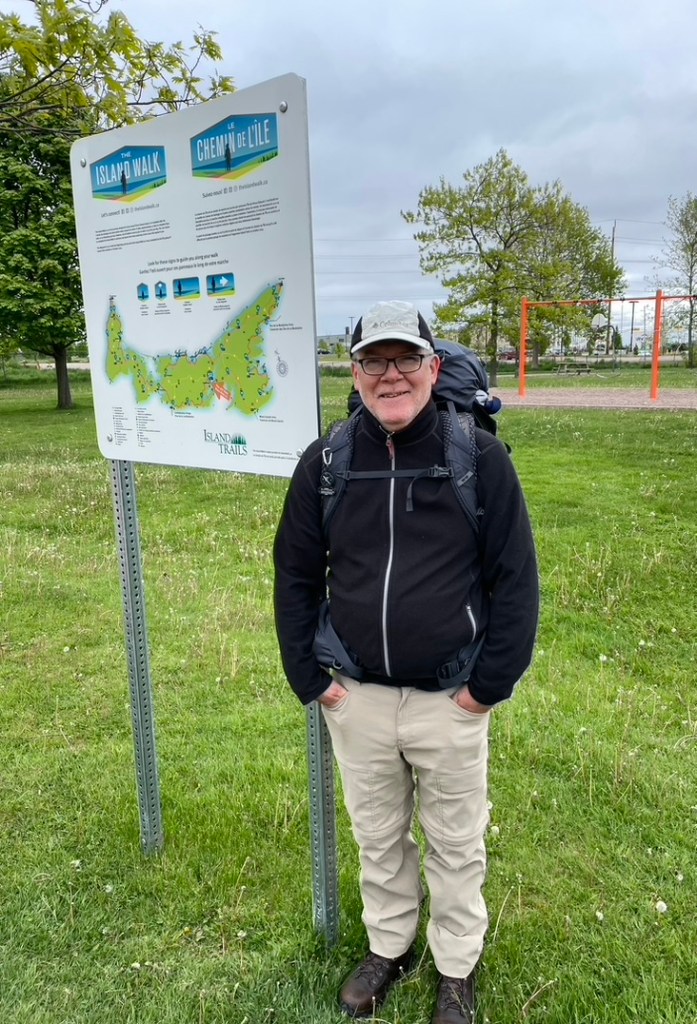
I felt over-dressed and over-burdened as we walked together, a few blocks from the place we’d stayed at in Charlottetown over to Joe Ghiz park where the route starts.  This wasn’t an Everest expedition but that’s how I felt.  We didn’t say much.  We reached the park, and then with little ceremony, Ann quickly took a couple of pictures, we hugged, and I was off.

In hindsight, that first hour, first morning, first day weren’t typical – I hadn’t yet found my routine.  I fiddled with the shoulder and waist belt straps on the pack, trying to get it sitting just right on my back and shoulders and hips.  I put on clothing layers and took them off.  I started out with walking poles and then put them away.  I was hungry but undecided about whether to stop and eat or just get going to let a rhythm build.

So I focused on walking.  The 1st Section of the Walk starts at km 0 of the Confederation Trail in Joe Ghiz park, so the first couple of kilometres are along the Trail as you head north out of the city before turning west.  This Section is “mostly a road walk with some great views of North River in Charlottetown and the Elliot River in Dunedin”, according to the Island Walk website.

And so I found it.  Charlottetown does have some lovely quiet streets in its downtown, but a quick walk through them reminded me of an old joke I’d heard in England, about something being small but perfectly formed.  Practlcally all of the downtown area (and there’s barely an uptown let alone a midtown) is within earshot of the bells of St Dunstan’s Basilica Cathedral.  Joe Ghiz park is just a few blocks from the city’s centre, but it’s already on the outskirts of the downtown core in an area that at one point was obviously full of warehouses and manufacturing – hence a rail line, which is now the route of the Confederation Trail.  All of that means that your initial sights on the Walk are urban/industrial, but you don’t mind because you’re Walking the Island Walk and eager to get going.

And in truth, the Trail is a good way to start the Walk since you’re away from traffic and there are benches and picnic tables where you can stop if needed, as I did with my adjusting and fiddling.  And then, after only a few km, you realize that you’re already on the outskirts of Charlottetown, near the University of PEI, and there are farms on one side of the trail and big box retailers on the other. 

Quite soon, you leave the Confederation Trail and the road-walking starts, because in order to get out of the city you have to cross some rivers, which are bridged by busy streets and highways. In fact, I followed the same route outbound along Capital Drive that we’d driven into the city, past the same fast food restaurants and strip malls, none of which was any more interesting at foot speed in walking than it was at road speed in driving.  At a busy roundabout, Capital Drive turns into PEI Highway 1, the Trans-Canada Hwy, and you follow that for a couple of km.  You do pass the big Cow Creamery shop just out of town, if that’s your thing, but it had started to drizzle so that first day it wasn’t mine.

It was only once I’d clicked off perhaps 10km of the route, having left Charlottetown behind and reached the outskirts of the nearby town of Cornwall, that I left the Trans-Canada highway behind and started onto the secondary roads, to finally get into the countryside.

But having reached rural PEI after a couple of hours of walking, my bladder was nudging me and my stomach was agreeing.  Looking around, I thought it would be completely appropriate to make my first rest stop at a Tim Hortons – Canadian roads from coast to coast to coast are practically paved with Timbits.  
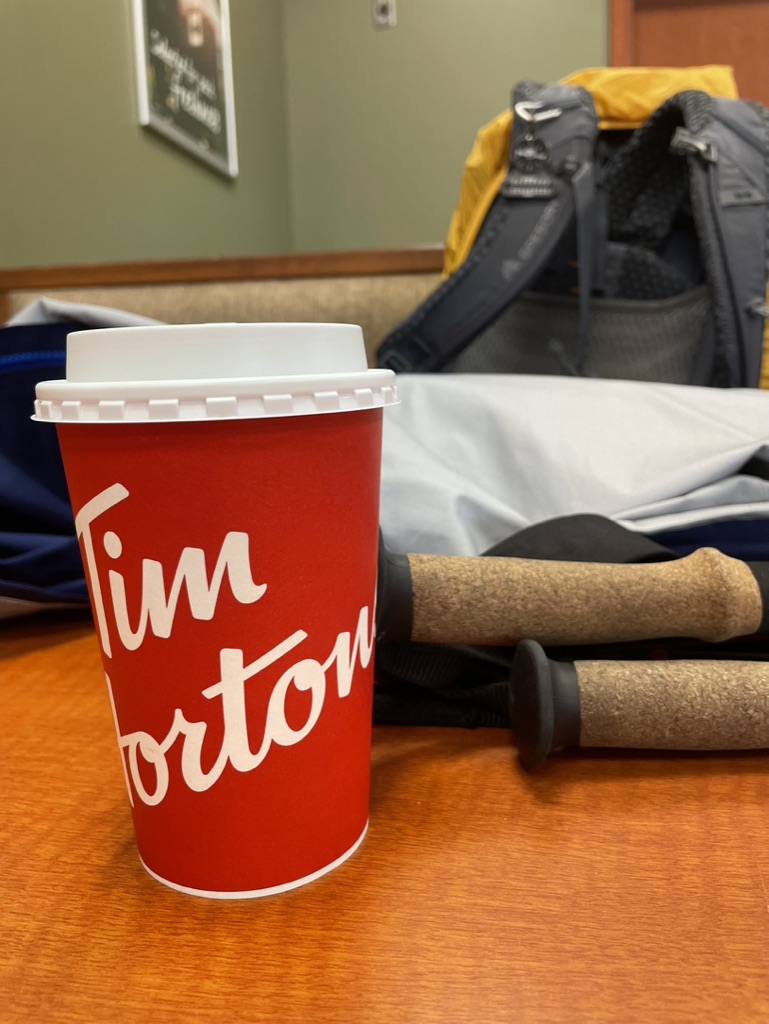
But, ironically, that turned out to be the only Tim’s stop I made on the entire walk, which in retrospect still surprises me.  

I had assumed before the walk that PEI was covered with Tim’s locations just like the rest of Canada.  I hadn’t accounted for two things, however.  One is the relatively low population of PEI, which can only support so many coffee and donut shops, so those that exist are on the main highways outside a handful of largish towns, places which are often bypassed by the Walk route.  The other is that Islanders divide their loyalties between Tims, the rival Robin’s Donuts chain, and the many ice cream stands on the island.  

What I also learned, as the walk progressed, is that the low population density, concentrated as it is in places like Charlottetown, Summerside, Souris, and Montague, means that things like diners, coffee shops, cafes, and corner stores are often non-existant along the Walk route.

But that lesson was in the future – here I just wanted my medium dark roast double/double with milk, a breakfast wrap, and a bio break.  And after I’d sat for a short rest, and asked the staff to fill my water bottle (another first time for something on that first day), and wondered why no one was looking at the weird guy with a backpack and walking poles because I secretly hoped that I could tell crowds of awed listeners about my Big Adventure, I hoisted my gear and got going again.

Continuing that first day, heading south and west along secondary roads into gently rolling farming country that’s only 10 km from downtown Charlottetown as the crow flies but which feels like it’s much further, I was taken by the quiet.  I’d lived for 40 years in big cities, and I still associated walks with city soundscapes and background noises.  Here, there was little road traffic, nor many people about.  I barely heard a dog bark.  Just the measured click of walking poles, the clip of boots on pavement, and the susurration of breeze-stirred leaves.  I did notice the crows, though – noisy buggers.  All, in hindsight, a foretaste of things to come, had I known it.

I reached the end of Section 32-1 at a crossroads near the hamlet of Dunedin.  I was disappointed when I got there, expecting some sort of prominent landmark and in fact seeing nothing but more farms and fields, with just the Island Walk marker next to a stop sign to tell me I’d reached the end of this first Section.  It was mid-afternoon, and looking around, I confirmed that, yep, quiet, green, crows – all good. 

In planning the trip, I had broken it up into walk stages of approximately 30 km each because I had a goal of finishing in about 23 days instead of the suggested 32.  So, because Section 32-1 is only about 21 km long, I continued walking.  Section 1-2 of the Island Walk includes “lots of walking on red dirt roads with a canopy of trees overhead. Two of the nicest quiet dirt roads on PEI – Rebokary Lane and Ferguson Rd”, says the guide.  
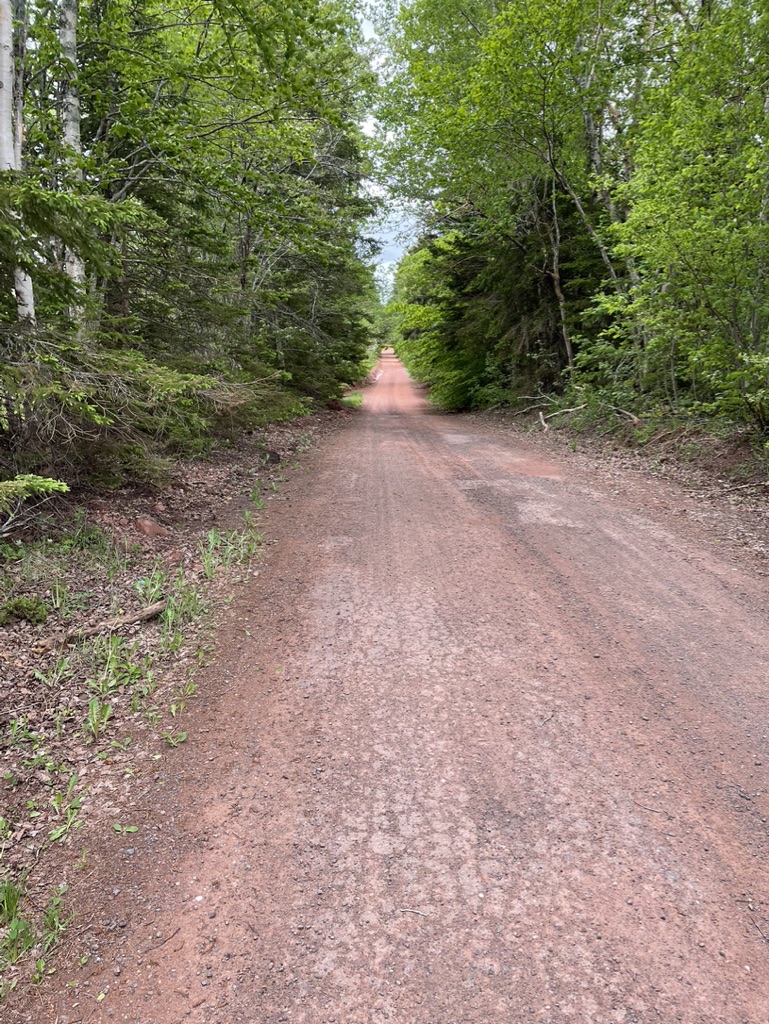
And that’s what I found at first – this Section brings you into the “real” rural PEI, as the route initially follows paved secondary highways and then the first of the many dirt roads I would follow over the Walk, up low hills and past sunken lanes and hedgerows and roadside bushes and freshly tilled fields.  Again, though, a bit of a disappointment – “nicest red dirt roads”?  Yeah, they’re red and they’re dirt and they’re roads, but that’s it? Just red, dirt, roads?  I was underwhelmed at the time, but I later came to rather like these modest, unassuming yet iconic PEI byways.

Still, it was here that I noticed something that was to become a pet peeve as the Walk progressed.  I was getting tired, at this point about 6 hours into my first day, and I really needed a pee.  No gas stations, community centres, or other signs of civilization were to hand, and since I was on a dirt road, in the middle of seemingly nowhere, I reckoned I could be a country boy and duck behind a tree. 

That solved the immediate problem, but while I needed a rest, I didn’t want to sit on the wet dirt – oh for a park bench or a convenient set of church steps – so I just shrugged off my pack for a few minutes while I stood under a tree and sipped some water.  After that less-than-refreshing break, I glanced at my watch, mindful of the pick-up time I’d arranged with Ann, slung my pack again – which someone had filled with rocks, clearly – onto shoulders that I knew would show bruises later that evening, and cursed the stiffness in my hips and knees.  “So you wanted to walk around PEI, huh?  Move it, slow poke.”  The first self pep talk.

Plodding on, southwesterly, I reached the end of the dirt road and merged onto the paved Route 19 highway that runs along the Argyle Shore.  I could feel the hot spots on my feet turning into blisters as I walked, but I was damned if I was going to text Ann for an early pick-up.  That first day was ending with what was the first of many end-of-day, put-your-head-down-and-just-get-on-with-it trudges, west along Route 19 for several more km.

My target was the Argyle Shore Provincial Park as a pick-up point.  Looking ahead, I could see the road climbing a gentle hill and I’d think, ok, last one, and then I’d crest it and stride down and and then look up to see another one, and each seemed to get longer and longer and steeper and steeper.  The sun had come out and there were some nice views out over the blue-green waters of the Northumberland Strait, looking charming and calm, and I could see the Nova Scotia coastline just across the water.  Home, I thought.  Just over there.  
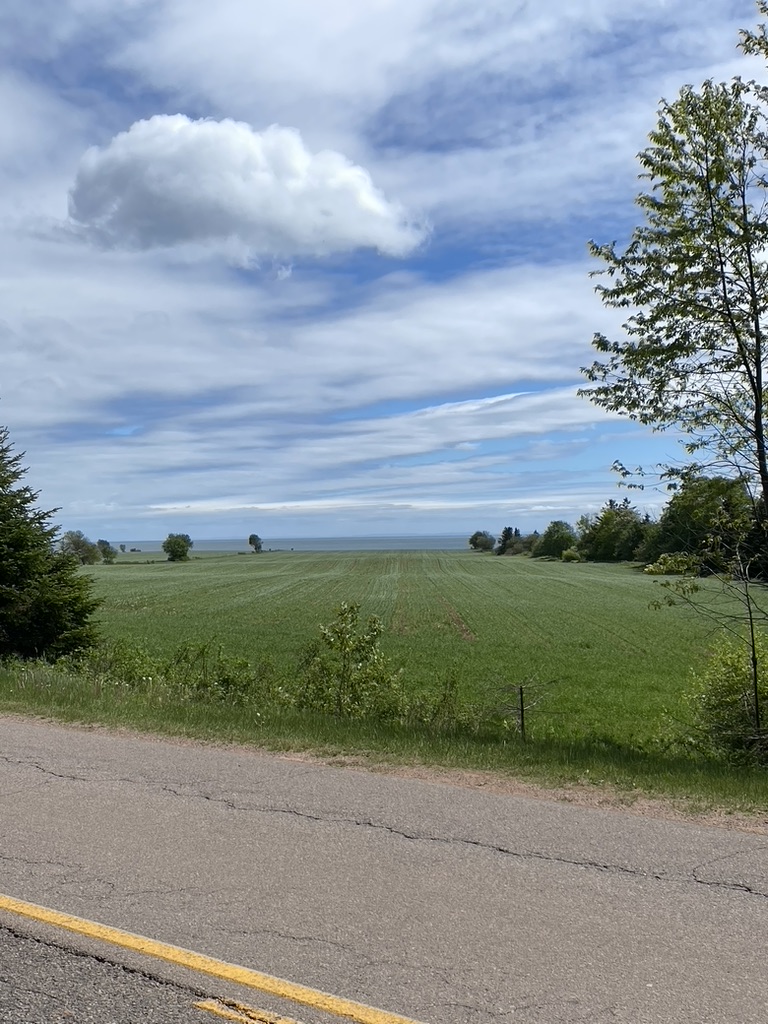
And then I looked up with about 500 m to go and saw my wife walking towards me, down a gentle slope, to escort me for the last few minutes of my first day.  “How are you feeling?”  “Tired”.  I slumped into the car when we got to it.  

It took about 15-20 minutes to drive into Summerside where we were staying, and by the time we got to our AirBnB, I could hardly get out of the car, the muscles in my legs having stiffened and the blisters on my feet ballooned.  After hobbling into the house, it took a desperately needed mug of strong sweet tea, a long hot shower, and a restorative glass of wine before I could look at my feet.  Ugly puffy blisters greeted me from the bottoms of several toes on both feet along with the side of my left foot.  I took out my first aid kit, extracted some alcohol swabs, blister bandages, and antiseptic cream, and reached for my Swiss Army knife.  Ann looked on with disgusted interest.  “Eeewww”.

An appropriate word for Day 1.  It had proven to be more challenging than I had expected.  The low rolling countryside, up and down crossing ravines and small river valleys, had been unexpected – PEI is flat, right?  I was surprised to see the stair count on my exercise tracker – so much for my assumptions of an easy walk.

The Argyle Shore

Rolling out of bed the next morning was easy, as I’d slept like a log.  Standing up was the hard part.  The popped blisters covered in bandages and moleskin didn’t bother me so much as the stiffness in my legs and back.  I hobbled about for 15 minutes making coffee and a light breakfast, then gathering snacks, assembling sandwiches, filling water bottles, grabbing a spare shirt and pair of socks, and tucking everything into my pack.  I was ready to go by 8:00.

Ann drove me back to Argyle Shore Provincial Park, and I got out of the car feeling reluctence at the prospect of doing it all over again, competing with eagerness at the same time.  But the sun was out, and while the westerly breeze had a bite to it, it seemed a fine morning to put on sun glasses, snug on my broad-brimmed hat, and shoulder my pack.  

My goal that day was to finish the 2nd half of Section 2, which ends at Victoria-by-the-Sea, as well as then completing Section 3 of the route, which ends at Borden-Carlton.  Altogether, that meant about a 32 km day.  

I continued following Route 19 for several km to De Sable, and it took all of that to work out the kinks in my legs and feet.  Or more precisely, to walk myself into a rhythm where I didn’t notice my feet.  By the time I crossed the Trans-Canada Hwy to continue northwest on secondary and dirt roads, I was feeling relaxed and back into my mental walking zone, letting random thoughts play along with snippets of songs, tuning back into my surroundings occasionally to listen to the wind in the trees or inhale the rich earth loaming smells of the fields. 
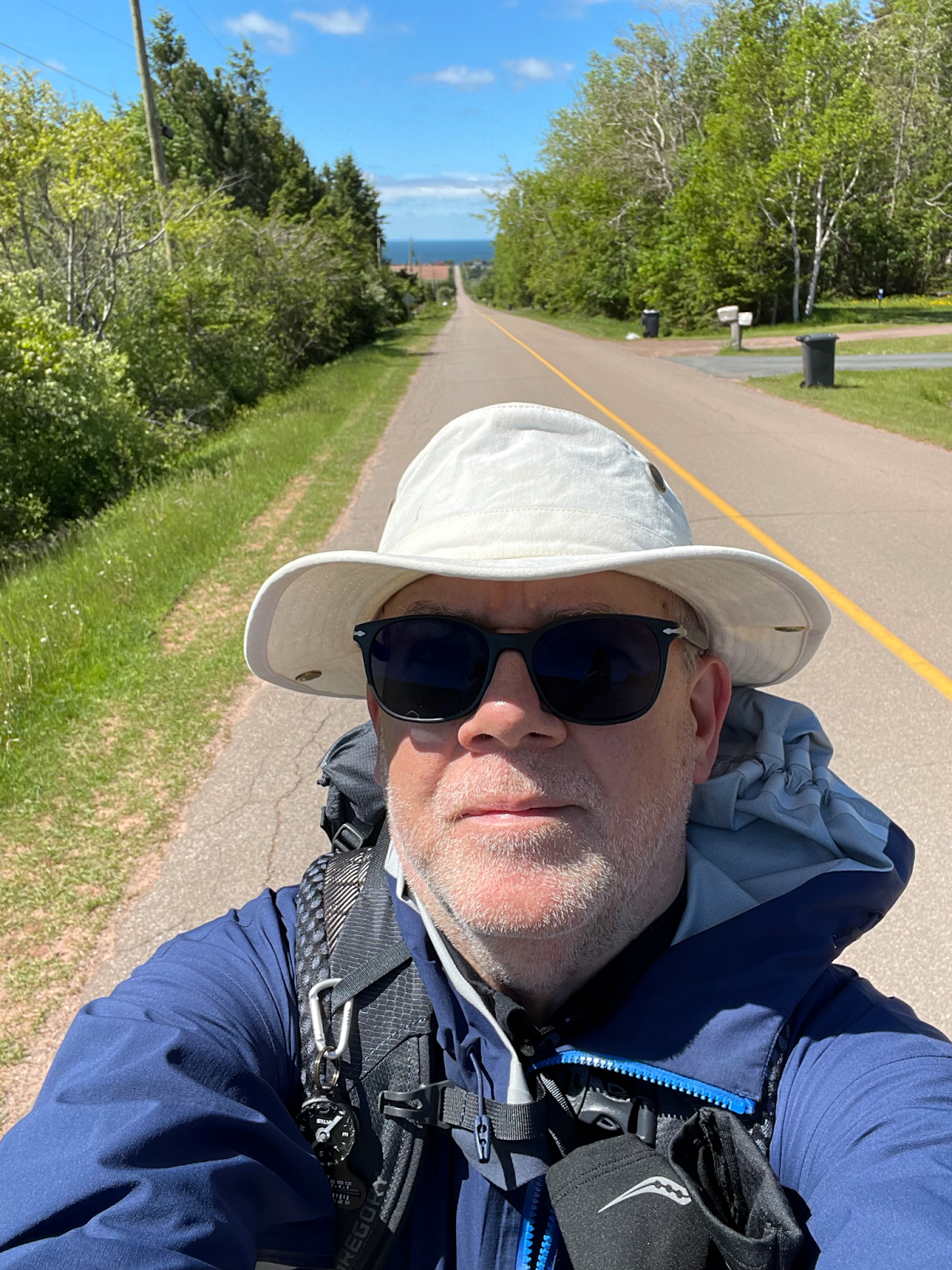
The route here along the Argyle Shore is relatively quiet, and compared to the northern shore up around Cavendish and the Prince Edward Island National Park, it’s relatively under-touristed.  The day trippers go north from Charlottetown, so it’s the long term tourists who park their RVs here or rent seasonal cottages in places like the Argyle Shore.  I passed several such sites, some with enviable views – since the road is set back from the shore by a km or two, the land between the road and the shore is privately owned and these campsites and cottage clusters get the seaside at first hand.  And since it was very early in the season for tourists – the Provincial Park hadn’t even opened yet – there were few other people around.  No walkers, no cyclists in view, and barely a vehicle.

There are spots here on the route where you climb a bit, and can look back south across the Northumberland Strait, and the air that morning was sharply clear (I’d even call it a bit crisp with the chilly breeze).  For the most part, the scenery was of farms and fields, holiday homes down private lanes, small patches of forest, and modest houses.  Only a few barking dogs.  And crows – PEI seems to have 10 times more crows than people.  They caw, the sound I recognized, and they cry with screeching-baby like sounds that I hadn’t heard before, and the thought occurred that this was the reason why the collective noun is of a murder of crows.

Sections 2 and 3 are all road-walking, west along Route 19 and then north up Route 116 into some hills, west and then south along red dirt roads, and back onto Route 116 south, crossing the Trans-Canada again and heading for the shore, and then turning west along a causeway into Victoria-by-the-Sea – the terminus of Section 2. By this point, the breeze had freshened into a proper stiff headwind, a light gale even, so that I had to lean into it and hold onto my hat.  Later in the walk, I would come to appreciate any breeze as a mosquito defence, but that morning it felt like a fight with the stubborn westerly wind.

I took a break in Victoria, walking out along the wharf, 
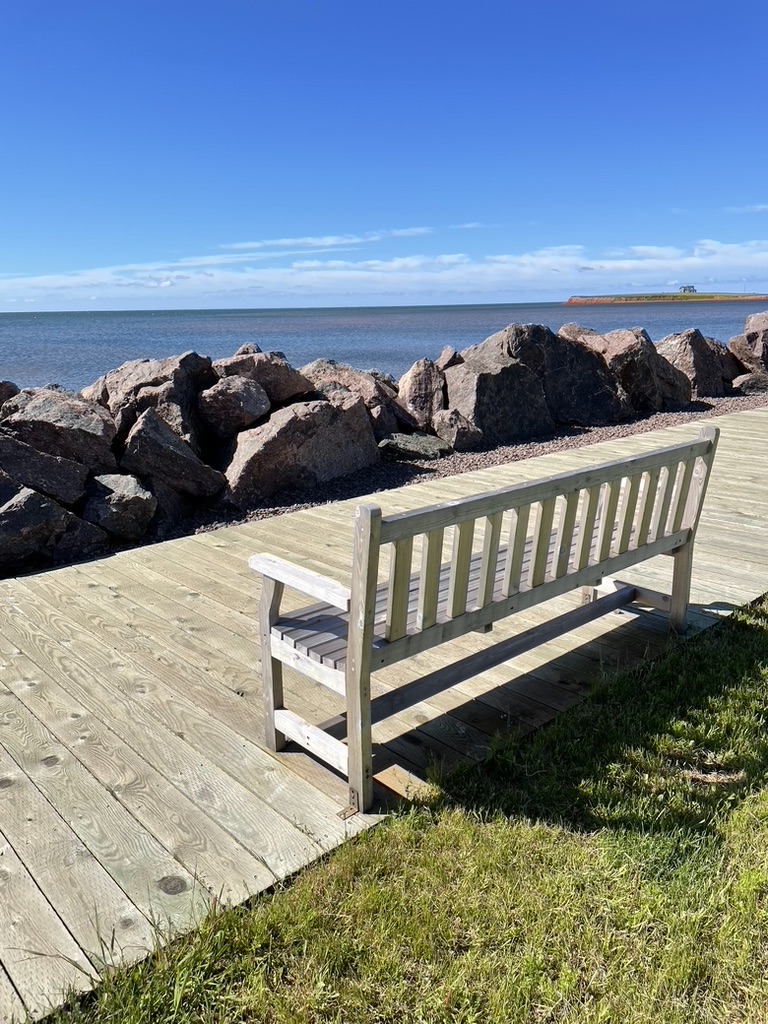
to stop for a late breakfast at a place out called Casa Mia. It was a nice stop, with a delicious omelette and friendly service.  The restaurant’s views over the water were lovely.  My planned 30 minute stop turned into 55 minutes, and it was a challenge to get up from the table and head back out just after mid-day, but I wanted to finish the 20 km of Section 3 that day by reaching Borden-Carlton by about 4:00 pm.

The Island Walk website says that Section 3 “starts with dirt road walking and then some road walking with a great view of the Confederation bridge”.  Except that it’s more of a graveled road rather than a red dirt road, which granted isn’t paved but it is less pleasant to walk on gravel than packed red dirt – the stones can shift a bit under your feet so it takes more concentration.  After a few km on this gravel road, I joined the bigger Route 10 highway, following it west for the rest of the day along the shore, through Augustine Cove to Cape Traverse.  There were some glimpses of the Confederation Bridge, and as it slowly grew larger I knew I was making progress towards my goal for the day.
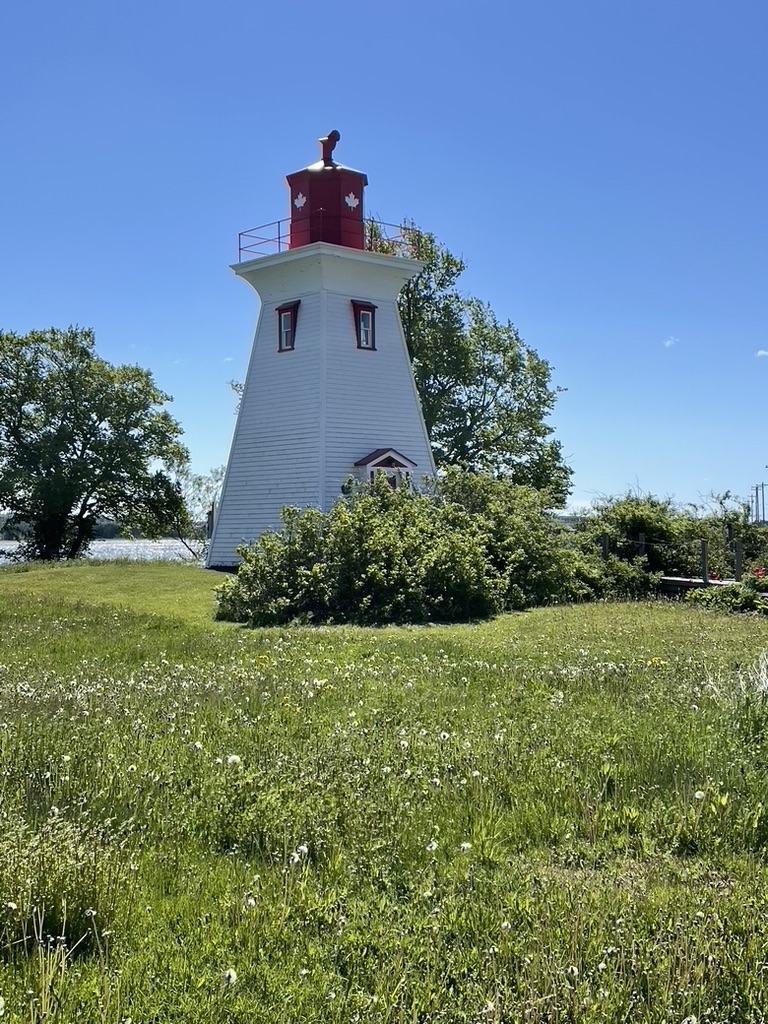
I was back into my walking rhythm after the break at lunchtime, and I was getting my pace figured out.  If I sang Old MacDonald Had a Farm to myself at a moderate galloping beat, then that gave me a steady 5 to 5.5 km per hour pace.  Over time, I tried other tunes.  Little snippets of The Lion Sleeps Tonight or Sudbury Saturday Night.  That helped, but when a song gets stuck in your head as you walk, it’s maddening, so I found myself looking around for some arresting sight to break my train of thought and change the music.

By mid-afternoon that day, I was learning that road-walking has its own challenges.  Uneven shoulders scattered with chunks of pavement.  Too many glimpses of roadside trash.  And, worst of all, no place to sit and rest, no place for a pee.  My habit on long walks, usually, is to take breaks every 90 to 120 minutes, and that was proving to be difficult here, unless I simply stopped by the side of the road and stood there with my pack off while having a drink.  I did find a field with a small grove of bushes that screened me from the road, and had a bio break there.  But places to sit were hard to find.  And my feet were barking again, the blister bandages having rubbed off and balled up in my socks.  

With steady walking, the distance to Borden-Carlton gradually shrank.  15 km to go.  10 km, then 5.  The sun swung past its zenith and headed west to shine back into my face.  At two pm, I checked the map to see where I was.  At three, I looked again – closer but getting there by 4 was looking tough.  And then, as I walked I told myself that it’s a marathon, not a sprint.  Let your body tell you when to stop, so I did, a bit short of my end-of-day target of Borden-Carlton to complete Section 3, and instead texted Ann to pick me up about 3 km early, at Cape Traverse.

Summerside was closer, but still far enough away for my legs to stiffen up in the car again, and the hobble into the house must have had the neighbours wondering about the cranky old guy who was vacationing there.  After my new daily ritual of a strong, sweet mug of tea and a hot shower, I confirmed what I had suspected, that my old blisters had new ones, and got out the first aid kit again.  After dinner, I read for a bit, and dozed while I did so.  The exercise and fresh air had tired me right out, so it was an early night.

Onwards to Summerside

That 3rd morning was the last time that my wife would be with me for a while on this trip, until the latter half of my journey.  It was bittersweet to give her a hug that morning when she dropped me off in Cape Traverse, before she headed home to Lunenburg.  I was still ramping up, learning and slowly getting fitter, and I was becoming more inwardly focused as I locked onto my goal.  At the same time, a friend to talk to each evening is a good way to unwind, and now I’d be on my own for a bit.
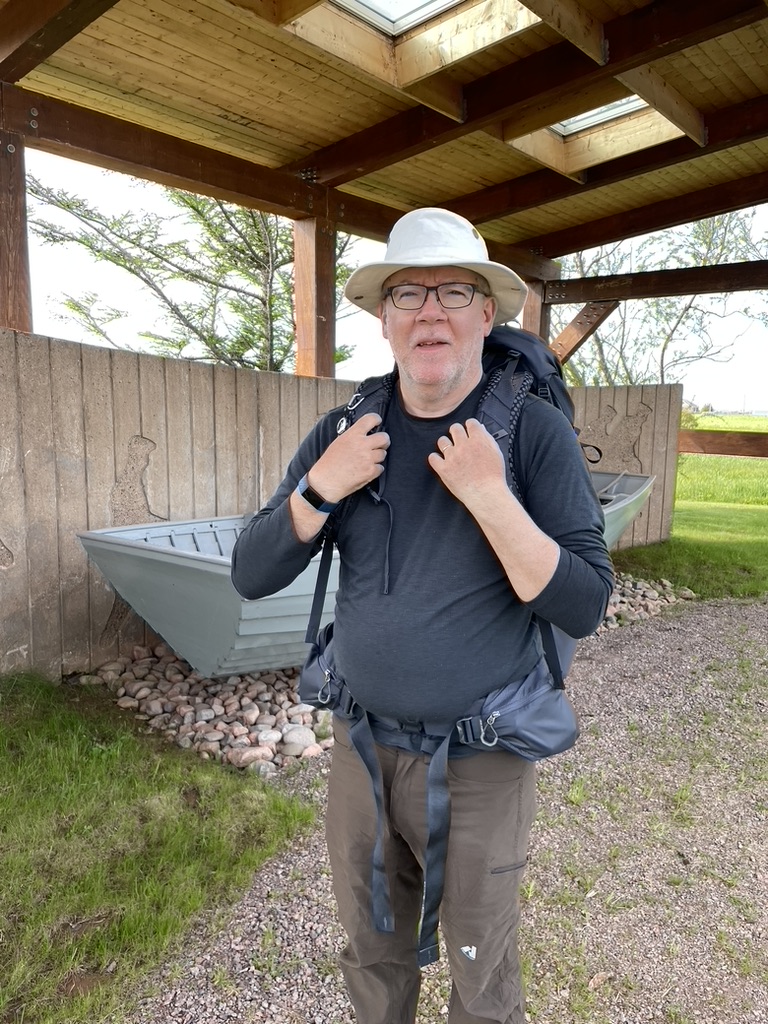
But it was good sunny, breezy, warm-but-not-hot walking weather, and I felt rested and ready, as I set out along Route 10, watching as the car disappeared into the distance,  The rural character of PEI is strong in this area, along the Northumberland Strait – farms, some views of the sea, farms, more views of the sea, occasional glimpses of the Confederation Bridge, and so on to, through, and past Borden-Carlton to finish Section 3 within my first hour of the day, and then across the Trans-Canada Hwy in Borden-Carlton where I onto start Section 4 along Route 10 towards Summerside.  

The Island Walk website stated that in this Section I would “walk by farms and fields and through small communities, including Central Bedeque. Busy road entrance to Summerside (8 km), then a peaceful walk on the Confederation Trail right through the city.”

And for the most part, that’s accurate.  This part of the route follows Route 10 for about 10 km, and about 5 km out of Borden-Carten I stopped at a church that had a picnic table out front, for a short rest and a water break.  Getting up to leave, I had a chat with the woman who looked after the church, who came out to see who this strange person was. She asked where I was walking, and I explained about the Island Walk.  She was quite interested, and wished me well, the first of many friendly people I met on my walk.  It was only later that I realized that in more than 2 days of walking to that point, I’d yet to meet another walker or a friendly local.

After that welcome break, I continued west towards Central Bedeque, where I stopped at a great little place called Baba’s Kitchen for lunch.  
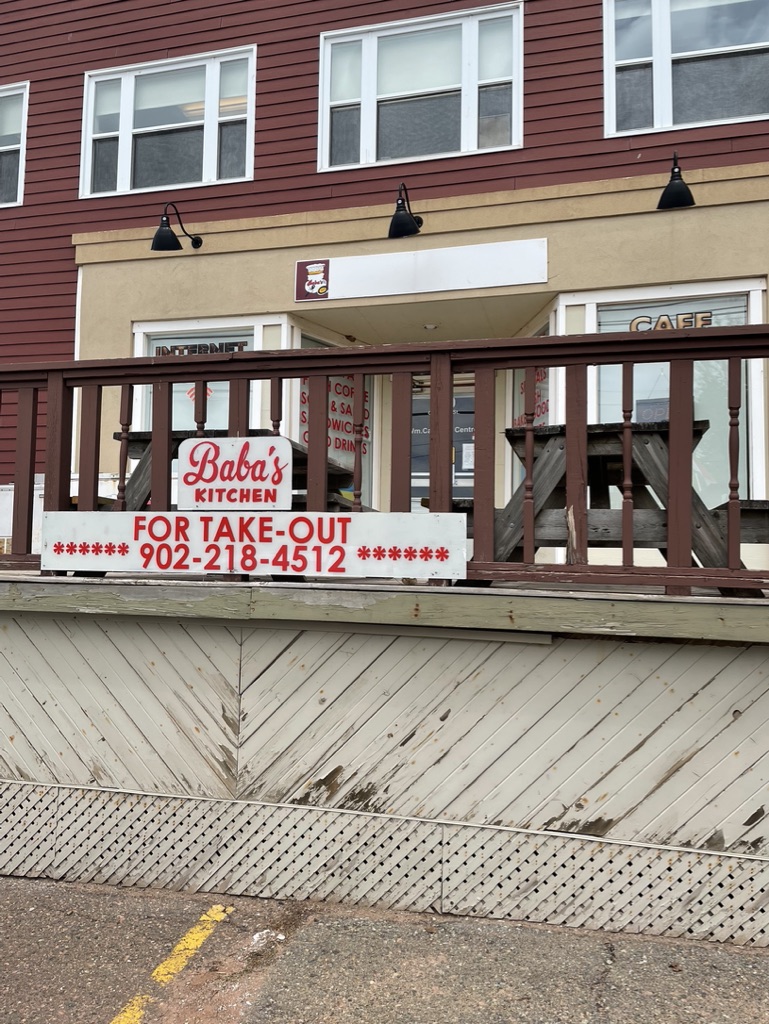
I walked in to find a queue of people lined up to place their orders, and several of the ladies in line saw my pack and asked where I was walking.  It turned out that they were a group of quilters from all around the maritimes, in PEI for a quilting weekend.  As we chatted, they asked where I was from – Lunenburg, I said.  Oh, you have to meet so-and-so in our group, she’s from Lunenburg.  And so I met Lynne, with whom I had a great chat.  It turned out that she lived only about a kilometer from me, a nice little small-world moment.

After a very tasty sandwich and a coffee, I continued on my way.  Outside Central Bedeque, the route joins and follows the Trans-Canada Highway (the “busy road entrance to Summerside (8 km)” part), and as I walked along I heard a series of cheerful car horn toots, as each of the quilters I’d met passed me – thank you ladies, that put a huge grin on my face.  

But soon after that, I realized that I didn’t much fancy walking all the way to Summerside along the busy and noisy Trans-Canada Highway with its trucks and cars.  Instead I detoured, and followed empty sun-bathed secondary roads north to Wilmot Valley, where I joined the Confederation Trail at Travelers Rest about 5 km outside of Summerside.  
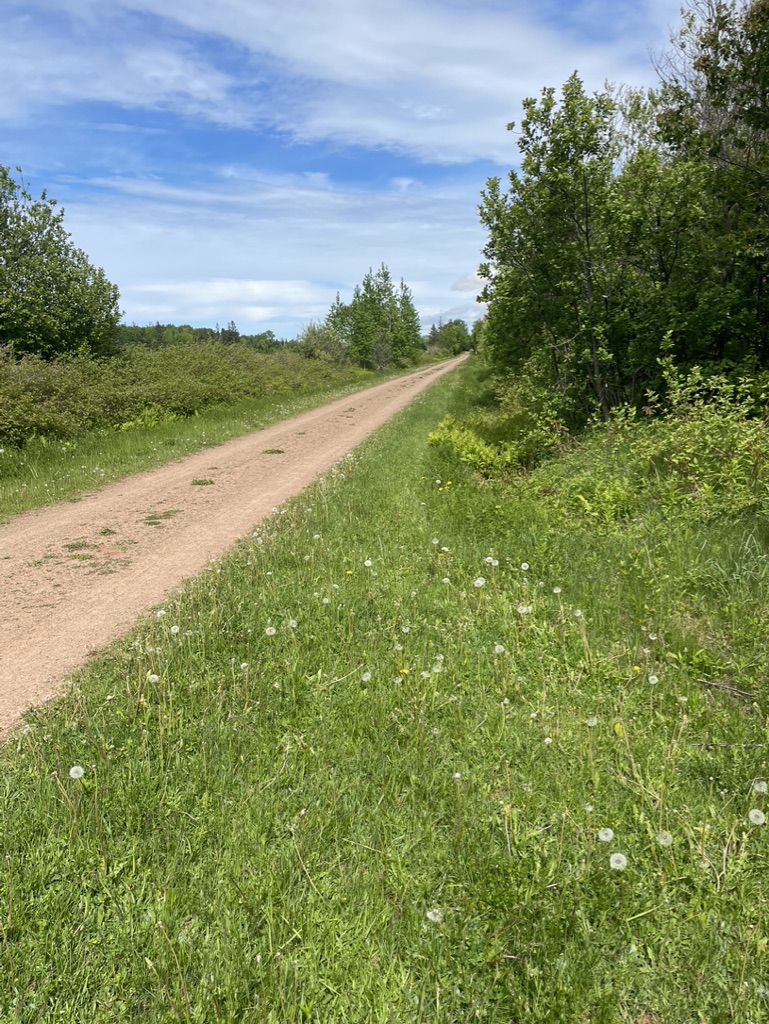
That detour was pleasant enough, and it did get me to the end of Section 4 in downtown Summerside via the Confederation Trail, 
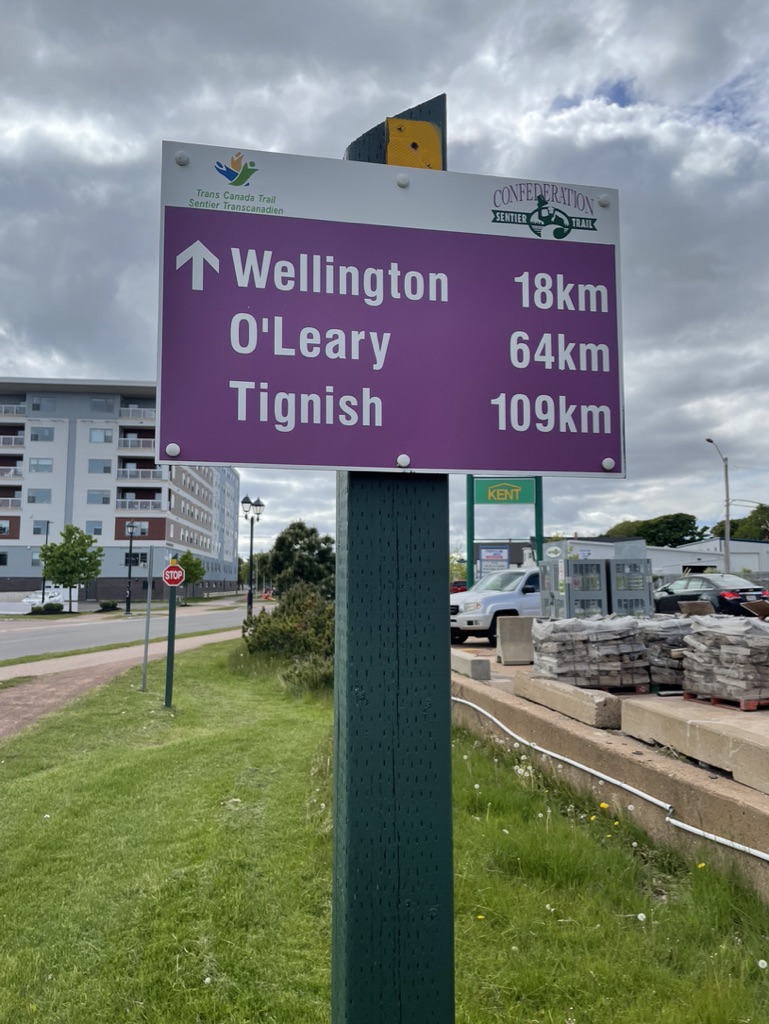
just as the official route would have, but it was at the cost of walking an extra 8-9 km that day.  My planned short day had ended up being longer than I’d thought and I was ready for a rest by the time I reached my accommodations in Summerside.  Lesson learned – stay on the route.

I did notice, though, that as you get closer to Summerside, you start to shed some of the ruralness I’d walked through earlier.  Summerside is the biggest community on the island outside of Charlottetown, and you pass ice cream joints, antique shops, and other seaside resort town things as you get closer to the town.  Then, somewhat suddenly as you join the Confederation Trail for the last bit into town, your walk goes back to being quiet and shady and green – quite a contrast after the busy stretch of the Trans-Canada, and a welcome change at that.

It also struck me that Summerside is a community that can’t make up its mind as to whether it’s a seaside resort town or a service and light industry town.  There’s a big Canada Revenue Agency office here, and a former air force base, along with a great boardwalk by the sea and yet more ice cream places.  It’s clearly a service town, but it has these seaside touches too.  All in all, however, I couldn’t quite like it – it felt sprawly and tawdry in places, missing those lovely wooden houses you see in other parts of the province.

And so I finished the first part of my walk.  Three days to get into the rhythm of it with help and support from my wife.  The next couple of stretches would be solo.  I was looking forward to them.

Day 1 Summary – Charlottetown to Argyle Shore

  • Pretty good day for walking – a bit overcast with a few showers in the morning, then sun all afternoon.  Cool for June, about 6C in the morning, and quite breezy.
  • Completed all of Section 1 (21 km from Charlottetown to Dunedin) and roughly half of Section 2 (which in total is 24 km from Dunedin to Victoria-by-the-Sea).  
  • Daily GPS distance = about 30 km, elapsed time almost 7 hours
  • Fitbit daily stats = 31.4 km, 42,100 steps, 395 exercise minutes, 154 flights of stairs

Day 2 Summary – Argyle Shore to Cape Traverse

  • Good weather, lots of sun, though coolish temps and strong breezes that kept me in a windbreaker all day
  • Completed the rest of section 2 from Argyle Shore Provincial Park to Victoria-by-the-Sea and then walked almost all of Section 3 (which is 20 km in total from Victoria-by-the-Sea to Borden-Carlton)
  • GPS measured distance = about 28 km, elapsed time just under 7 hours
  • Fitbit daily stats = 30 km walked, 40,200 steps, 367 exercise minutes, 97 flights of stairs

Day 3 Summary – Cape Traverse to Summerside 

  • Another great walking day, sunny, breezy, and warmer so I could finally get down to shirtsleeves
  • Completed the remaining few km of Section 3 from where I had left off at Cape Traverse to Borden-Carlton, and then more or less did Section 4 (21 km from Borden-Carlton to Summerside), though I deviated from the official route entering Summerside
  • GPS measured distance = about 30 km walked, elapsed time just over 8 hours
  • Fitbit daily stats = 31.8 km, 42,600 steps, 400 exercise minutes, 47 flights of stairs

Suggestions

Cornwall, Victoria-by-the-Sea, and Borden-Carlton between them have several options for accommodation and dining, and the larger communities of Charlottetown and Summerside that book-end this portion of the Walk have many such options.  That said, it’s still tricky to walk from accommodation to accommodation in this area – the end of Section 1 is out in the middle of the countryside though there is one B&B I saw about 500m from that point.  After that, though, Sections 2, 3, and 4 all end in towns where you can find lodging.  I’d strongly recommend booking ahead, especially in high season.

If, like me, you base yourself in a place like Summerside for a few days while you do this part of the walk, and if you don’t have a spouse or partner with you who can drive you to/from the route each day, then you’ll need to plan transportation options.  Summerside has a couple of taxi companies that cover most of the west end of the island – they will run you all the way out to North Cape if you want.  That can be expensive, however – expect rates in the region of $2 per km.  

Other transportation options exist.  There are some tour operators who will provide rides.  There is also the T3 bus network, which can get you to/from some of the points on the Island Walk route.  Check their website for full schedule info.

As for sustenance, in these first sections it’s possible to find a lunch spot each day, at Cornwall, De Sable, Victoria, Borden-Carlton, and Central Bedeque.  Nevertheless, I would recommend taking some snacks, and you’ll need water.  I was able to fill water bottles at the places I stopped at for lunch.

Bio pit stops are another matter.  All that road walking means that if you need to pee, you’re either sneaking into the bushes by the side of the road, or holding on till you reach a gas station (and there aren’t a lot of those along these roads).

I did notice a number of churches along more major roads like Route 19 and Route 10, as well as a few community centres and museums, and I learned as I progressed over the rest of the Walk to look out for these types of places, because they often provided a restful sit-down on a bench or some steps.  Outside of that, however, there are few other rest options on the road sections, unless you are comfortable just flopping on the ground.

Next – Summerside to Tignish


Other Posts About this Journey


If you feel like supporting my blog, you can buy me a coffee.
PEI’s Island Walk – Plans, Gear, and Lessons

Blog posts are a labour of love for me, and yet there is a cost to running this site and organizing my walks.If you’d like to help with that, I’d really appreciate something for my tip jar.The Buy Me a Coffee service allows patrons like you to fund writers like me.  If that sounds like a worthy idea to you, then go ahead – keep buying me coffees.Thank You Very Much to everyone who has contributed already!

*****

In June 2022, I completed the 700 km Island Walk, around Prince Edward Island. You can read about that walk over several posts, starting with this one.  

This was before Hurricane Fiona caused so much damage on the Island, impacting many of the places which I had visited.  Some of what I describe below may have changed by the time you do the Island Walk, but please, don’t let that stop you.  PEI needs your tourist support as it recovers.

This post is about how I planned the walk, deciding on things like the pace to follow and gear to use; where I stayed and how I found accommodations; how I worked out logistics like getting to and from the route each day; and what lessons I learned along the way.

Forgive the wordiness and lack of pics – this is full geek mode for me.


Research

Once I’d decided to do it, I fell into my project planner mode, and started to figure out how I was going to walk it. How many days to take? Follow the route closely or ad lib in parts? What to take, and what to carry? Where to stay?

One of the good things about the Island Walk is that the PEI government has adopted it under its tourism umbrella, so the route signage is pretty good. The official website has a good map, and you can download to print out the route directions stage by stage if you want. 

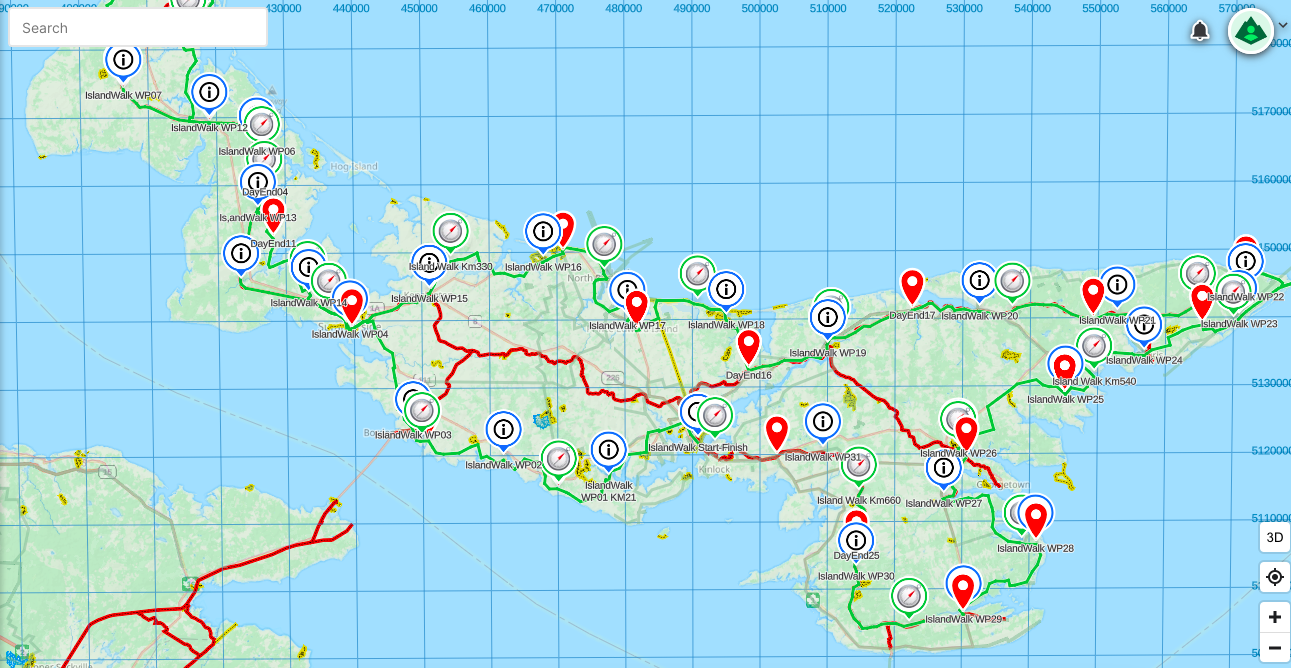
As well, the route has been added to map sets like Open Hiking and the Back Roads Map Books Canada Trails, which smart phone apps such as AllTrails or GaiaGPS can use. I used GaiaGPS on my walk, with a premium subscription so that I could trace my route and add waypoints. I did that in advance of the walk, to have markers show up for each of the 32 suggested stage end points as well as for each 30 km of the Walk.

There are other sources too.  For example, the Island Walk website will point you to the official guide book which you can order online. I didn’t bother with it, to be honest, but it’s there. A few hours of Googlewhacking found several blog posts, Facebook pages, and YouTube videos about the walk, including one by the original founder of it, Brian Guptil, and I am sure that since I looked in the spring of 2022, there have been more posted.

There’s also an official Facebook page that’s linked to the Island Walk website, and that has a private message blog for which you’ll need to request access. That official blog is handy, because it lets you pose questions to other walkers and get advice on things like places to stay or eat, or transportation options.

Plans

While doing my research, I quickly determined that I wanted to do the walk in less than the suggested 32 days, partly to save money on accommodation and partly because I just didn’t want to be away from home that long. The stages as marked on the suggested route are mostly between 20-25 km, and I knew from experience that I could handle as many as 35 km in a day, so that led me to aim, initially, for about 30 km per day so that I could finish in about 23-24 days. 

Based on that idea, and the notion that I’d walk from accommodation to accommodation each night (see the section below), I created a walking plan where each daily stage targeted about 30 km of the route, plus whatever distance I’d need to walk to/from accommodation each day.  I used Google Maps to trace the route and scoured for places to stay – hotels, B&Bs, holiday cottages, and camp sites.  I reckoned that I could take camping gear with me and use that for some of the nights.  

The result was a plan that did get me round the Island in about 23 days, but which didn’t look very appealing.  There were a number of pretty long days, approaching 40 km when I took the walk to/from accommodation into account.  Also, in some cases there was only one B&B or holiday resort that would work given the stage lengths, but I was planning to do this starting in late May, and some of these didn’t open for the season till mid-June. 

So Plan #1 went out the window.

For Plan #2, I went back to the drawing board.  After more research, I saw that people on the Island Walk Blog were talking about using some of the towns as a base for several days, and arranging transport to/from there.  That sounded like a better idea, so taking into account that the town I chose as a base had to be on the route and have some grocery stores and shops, I decided to use Summerside, Tignish, Kensington, and Murray Harbour as my bases.  I rejgged my planned stages and was able to reduce the daily walking average to about 30 km, since with pickups and dropoffs I could stick closely to the route.  That would get me to the finish in 23 days.

After talking it over with my wife, we also decided that she would join me for the 2nd half of the walk, so that she could explore the Island herself while schlepping me to and from the route each day.  She had initially planned to be with me for the first couple of days anyway, so that gave me transport coverage for about 18 days out of the 23.  Given that I could start or end a few stages in my base town, I assumed I would only need transport help for a few days.

Plan #2 survived the start of the walk, but hit a wall on Day 6.

I was slogging and foot sore, and everything felt like a grind, as I struggled up the west coast of the Island towards Tignish.  I managed 20 odd km that day of a planned 32, and took a rest stop at Mimnigash, and then I basically couldn’t get up.  After 30 minutes of self-pep-talk, followed by 30 more of now-what mental meanderings, I called my ride in Tignish and asked to be picked up early.  

When I got settled into my hotel that afternoon, I called my wife and we talked through where I was at.  I listened to her chuckling, as she said she had been wondering when I’d realize that 23 days was too short, and we agreed to lengthen the trip.

Looking at the official stages, I realized that I’d ended my Day 6 at the end of Stage 8, at Mimnigash.  That put me 2 days ahead of the official 32 schedule already.  To finish in 27 or 28 days, I just needed to pick up another 2-3 days over the rest of the walk, which I reckoned I could do by adding a couple of km per day to each of the remaining official stages.  That approach allowed me to reduce my planned daily walk length from an average of about 30 km down to about 25-27 km per day, while increasing the duration to about 27 days in total.  This became Plan #3. 

In order to make this plan work, I needed to adjust my accommodation bookings.  I had a place lined up in Kensington, and they were able to move my dates by a day, so that worked out.  After that, however, I wasn’t sure where to go.  B&Bs and AirBnBs were filling up fast, and were getting more expensive with the high season starting.  Plus there was a festival of some kind in Charlottetown for the weekend I planned to finish, June 26-27, and hotels there were sold out.

Thus Plan #3 quickly evolved into Plan # 4, as I ended up booking a place in Murray Harbour, and then a final one in Vernon Bridge.  This changed my stage plans, and I added one more day, so that I’d finish in 28 days.  My daily average distance dropped a smidge more, and more importantly, things now looked doable.

And so parts of Plan #2 combined with Plan #4 became my actual as-walked plan.  I ended up averaging 25.5 km per day, with a longest day of 34 km, and a shortest of 15 km.  I started on Wednesday, June 1, and finished on Monday, June 28.

With all of that learned, my advice on Planning is simple – you should make one based on as much research as you have time for, and then you should expect and allow it to evolve as circumstances change.  If I had tried to stick rigidly to my original plan, I wouldn’t have enjoyed the walk as much because I would have been more tired and possibly would have injured myself in pushing too much.   

Routes

While I may have adjusted my plans a few times, in the end I did follow the official route quite closely in terms of the roads and trails followed, only deviating a bit around Summerside. I also had a few days where I walked the described route for a stage, and then added several km to it in order to get to/from that day’s accommodation.  This added a few km to the overall total distance walked – it came to about 718 km compared to the official route length of 690 km, making my overall daily average of actual walking come to about 26.6 km.

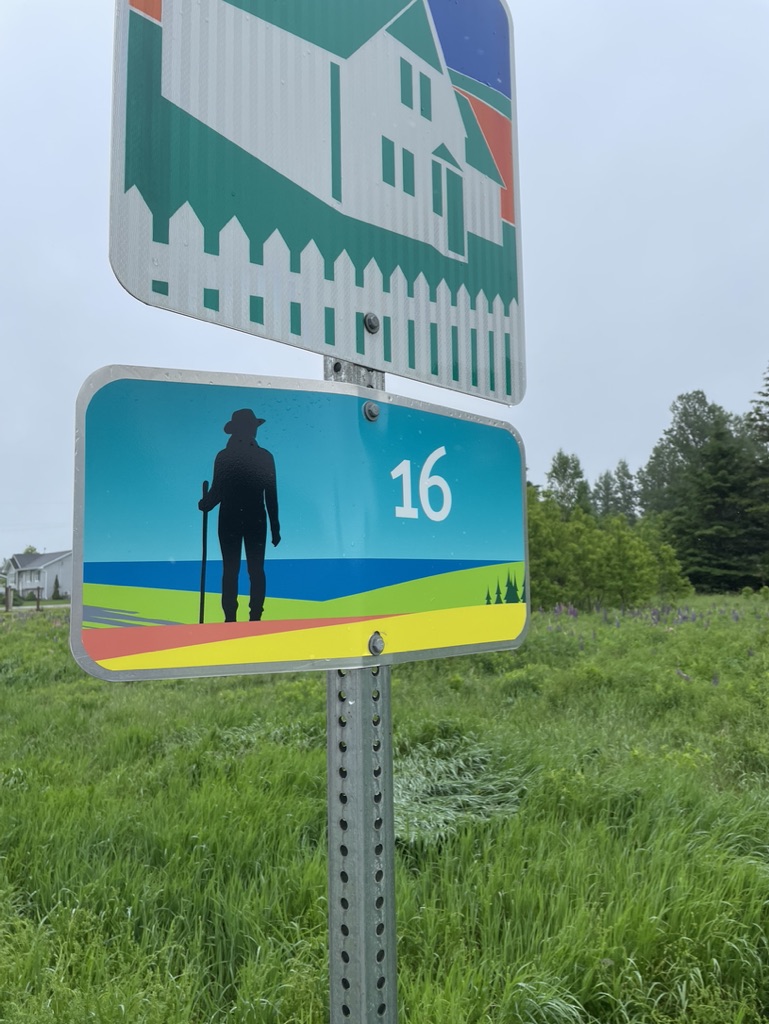
Also, you will find that for the most part, the whole of the route is sign-posted quite well, with directional signs telling you when to turn onto this road or that.  

The signs are placed with the assumption that you are walking correctly, and safely, facing oncoming traffic, i.e you are on the left side of the road with cars on your right.  They are generally on the right side of the road – that is, on the opposite side of the one you should be walking on.

The signs are only on one side of the road, so this sign-posting practice also assumes that you are going clockwise round the island, following the sections from 1 to 32 in order (i.e start in Charlottetown, head to west Summerside, then north Tignish, etc).  If you do the route the other way round, or a la carte in chunks, you may have to look over your shoulder for the signs.

There were a few places where I could have added a short detour to my day, to take in a place of interest.  The official stage descriptions point out these sorts of things.  For me, generally speaking, I didn’t do that.  The only exception was the walk through Prince Edward Island National Park up around Cavendish and into North Rustico.  There the official route follows the park walking/cycling trail, which is inland a bit beside the road.  Instead, I cut down onto the beach and walked along it parallel to the road.  It didn’t really change the distance but it was far more satisfying.

Over the course of my walk, I got into the habit each night of reviewing each day’s route as-walked, marking where I finished using my map app, and then scouting the next day’s route using Google Maps in satellite view to get a sense of the directions, sights, and possible rest stop options along the way.  This became quite handy, particularly on road sections, as I quickly learned that finding a comfy spot to sit and rest was a challenge. 

Later in the walk, when my wife joined me in PEI and drove me to/from the walk every day, using the map app and Google Maps also let me geomark the next day’s start and end points, and put those into my wife’s phone, so that she could just follow the directions in the car.   

Accommodation

As you can see based on how my planning evolved, finding accommodation drove it as much as the route itself.  While the Island Walk is referred to in some places as a “Camino” like walk, the reality is that it would be quite difficult to do it in the manner of the Camino de Santiago.  You simply can’t walk from accommodation to accommodation expecting to find an inn or hostel or B&B more or less on the route every 5-10 km.  The tourist accommodation on the island is concentrated in a few places (Charlottetown, Summerside, the Cavendish area, the Stanhope area, etc.), which leaves long sections at the west and east ends of the Island where there aren’t any B&Bs or hotels conveniently near the route. 

It’s also important to realize when planning your accommodation that PEI has a short but intense tourist season.  Many places only open after about mid-May or Victoria Day weekend (3rd Monday in May), and shut not long after Labour Day (first Monday in September) or at latest Thanksgiving (2nd Monday in October).  But July and August are peak tourist – the island’s population doubles or even triples in these months.  That leaves narrow 4-week shoulder seasons in June and in September, which can work as I found in June.  

So all of that said, if you make your plans well in advance, e.g. in January for a walk in June or July, then you probably could book things out so that you could walk more or less from place to place, as long as you accept that you’re going to have more than a few days where you’ll need a lift as well as some extra distances to/from the route.

An alternative to that is to try to camp your way round the Island.  There are some provincial parks that offer campsites as well as several private campgrounds, relatively near the route.  In a few cases these align with the suggested stages, but for the most part they don’t, so you’ll have to improvise your stage lengths as needed.  Even then, there aren’t formal campgrounds near the route in all cases. 

For example, walking the Confederation Trail between St. Peter and North Lake covers more than 50 km, with essentially no nearby campsites.  You could try knocking on doors and asking if you can camp in a field, and Islanders being pretty hospitable, you might be able to make that work.  I wouldn’t try to stealth camp, though.  There is essentially no crown land along the route, so if you try to stealth camp you’ll be trespassing on private land and that’s not just illegal, it’s downright rude.  

By the way, another thing I learned in my research is that while there are many cottages for rent on the island, many of them are in holiday resorts where they only rent by the week.  It was frustrating because some of these were right on the route, but since I only needed one night I couldn’t use them.

All of this is a long-winded way of explaining why I ended up replanning a couple of times and settling on a base-accommodation approach.  In the end, I spent 5 nights in Summerside, 4 nights in Tignish, 6 nights in Kensington, 11 nights in Murrary Harbour, and finally 3 nights in Vernon Bridge.  These places were a mixture of AirBnBs and inns.  Since I had left it late, I had trouble finding AirBnBs around Montague and around Souris, which would have been a lot more convenient for the east end of the island than Murray Harbour, but on the other hand the place in Murray Harbour was great.  If you book a few months ahead of time, and if you avoid peak season in July/August, you should be fine finding something.

Practicalities and Logistics

I met just a few fellow walkers on the trip, but in chatting with those few people a consensus emerged on a few things to keep in mind when planning this walk.  In no particular order, I’d list them as follows.

  1. Road walks = no place to sit down, no place to pee
  2. Accommodation needs to be planned well ahead
  3. Since accommodation is likely to be spread out and not near the route, transportation to/from the route is key
  4. Timing is everything – you’ll have a short season to do the walk if you want things to be open but avoid the tourist crush

I think if I was going to do the walk again, I’d seriously consider packing a small portable stool or chair, which would be a blessing especially on the road walk sections.  There are many stretches where you’re multiple hours between towns.  Scouting each day’s route the night before using Google Maps in satellite mode helped me to spot community centres, public parks, churches, schools, post offices, and even cemeteries, where they might be a bench, as well as toilet facility candidates like gas stations, cafes, bakeries, and ice cream stands. 

This let me make notes for myself about distances between these landmarks, so that, for example I could start on a morning knowing that after about 8 km I’d come to a church where I could sit on the steps for a break.  Even then, I had a couple of frustrating days where I’d find the church I’d seen on the map but realize that it’s wooden steps had been removed because the church had been closed.  On a rainy day when you don’t want to sit on the ground, that’s a real pain.

For most people, the other key is that while you need to stay hydrated, doing so usually leads to the need for a bio break every so often.  If you are discreet and careful, you can sometimes find a conveniently located little stand of trees or bushes just off the road.  Nevertheless, it always seemed that I had been walking for hours without seeing a car and then the moment I stepped off the road, 3 of them would trundle past.  Or I’d walk along a promising stretch of road with houses on one side and fields on the other, only to realize that every stand of trees or bushes was exactly opposite someone’s house.  

I did meet one fellow walker who’s strategy was simply to walk fast, drink little, and hold it all in.  She would hydrate and pit stop before leaving, and then plow through each stage non-stop, only looking for a toilet when she had reached her destination at the end of a stage.  That might have worked for her, but it wouldn’t work for everyone, and it certainly didn’t work for me.  All I can say is that if you do need to “go”, al fresco, you need to be respectful of others and of private property and follow the backcountry rule – leave no trace.  

Since getting to/from the trail and your accommodation may well require transportation, you’ll have to figure this out ahead of time.  There are some options.  If you’re near Summerside or Charlottetown, there are several taxi firms that you can book and they’ll drive you for 50 km or even 100 km if you need it so that you can be dropped at the start of a stage and picked up at the end.  But that convenience  will be pricey – expect to pay up to $2 per km.

An alternative is the T3 bus network, and it’s a good option in some cases.  It’s very inexpensive at $2 per ride (as of June 2022).  It runs from several of the towns you’ll pass through, on routes that lead back to Charllottetown but pass through several places, e.g. the route between Summerside and Charlottetown passes through Kensington.  To use the service, you need to make a booking on their website, which can be same-day but is better done the night before. 

Through careful planning, you can arrange these rides to get from your accommodation to your drop-off and pick-up points.  The drawback is that the buses are on fixed schedules and run only 2-3 times a day, so there might be 4-5 hours between runs, thus you’ll have to time your walk to catch the bus.  And, at least as of June 2022, the buses only run Monday-Friday so on weekends you’ll have to find alternate methods.

One of those alternate methods is to do the Walk without walking – ride a bike instead.  I met several people who were doing the route this way.  By riding, they could not only go a bit faster and do the route more quickly, they could also find accommodation as much as 10 km off the route, and they could adjust their daily stage lengths to go from town to town.  The route is easy to cycle as the Confederation Trail is firmly gravelled, and the rest is on roads.  

If cycling is not your thing, and buses don’t work, nor taxis, then one other option is to find a sherpa – a person to drive you to/from the route each day.  This in turn takes several forms.

One is to use one of the private tour companies in PEI that have started to offer Island Walk packages combining accommodation arrangements as well as transportation, so that your luggage is schlepped for you and they take you from B&B to B&B.  You can find outfits that do this by doing some research on the blog that goes with the Island Walk website.

A similar idea is to stay at one of several resorts, inns, and B&Bs which offer transportation to/from the route.  You can usually book this at the time you book the accommodation.  As the Island Walk becomes more popular, I suspect that this type of thing will grow.  You can find these kinds of places by doing some research on the blog that goes with the Island Walk website.

One method I used was to ask for advice at one of the inns I stayed at, and they pointed me to a private tour operator named Stanley MacDonald.  He runs custom small-group tours for cruise ship passengers coming into Charlottetown, and in between he’s happy to pick up Island Walkers like me and take them to/from anywhere on the island.  There are several operators like this, and again, using the Island Walk blog can help you connect with them.

Finally, there’s the Little-Help-From-Your-Friends approach.  In my case, my wife stayed with me for about half of the time I was doing the walk.  She would drive me each day to/from my route, and in between she explored the island, visiting museums and shops and beaches and cafes and just generally chilling.  Similarly, you could also walk with a buddy or two, and use two cars where you both drive to the endpoint to leave a car, then drive back to the start and park the other car, so that at the end of the day you can drive back and pick up the 1st car again.  

There is one other way to do it, and that’s simply to plan your accommodation and your daily stages so that, as with the traditional Camino, you walk from place to place each day.  A combination of camping (including asking people to stay in their field) along with B&Bs or hotels might well work, if you’re able to do the detailed planning required.  I didn’t meet anyone on the Walk who was trying this, but I suppose it’s doable.

Food, Snacks, and Hydration

I’ve done all-day walks many times, and I’ve learned what works for me regarding nutrition.  First of all, I focus on hydration – I’d rather carry the extra weight of an additional water bottle than run out on a hot day.  For this trip, most days I started with about 1.5L of water and I tried to fill my bottles whenever I could at a store or coffee shop.  On a few hot days, I also carried an extra 500ml water bottle, just in case.  In addition, I always tried to include fruit with my snacks and lunches, since oranges, grapes, cherry tomatoes, etc. will provide a lot of hydration and electrolytes.

Regarding food, I try to eat lightly during the day while I am walking, saving the larger meal for the end of the day.  That means starting with a simple breakfast – yoghurt and toast, a bagel and cream cheese, or oatmeal with honey, that sort of thing – and then carrying snacks and food to provide short bursts of calories every couple of hours during the walk. 

I try to avoid junk foods like candy bars or high-sodium chips or jerky, and instead eat healthy foods like fresh fruits and veggie snacks, sandwiches with lean proteins like smoked turkey, whole grain breads, and so on.  I’ll carry a few protein bars, as well as a nut-free (I’m allergic) trail mix of raw pumpkin and sunflower seeds, raisins, and dried fruit.  I avoid things that need to stay cold – no tuna salad with mayo – so I can skip heavy ice packs.

On this walk, I also tried to limit caffeine during the day.  I just had one cup of coffee in the morning, and then waited till I was done for the day before I had any more.  Caffeine is a diuretic (it makes you pee), so limiting it made sense to me.

There were a couple of occasions where I was able to buy lunch along the route, but I think that only happened about 4-5 times for me.  So the rest of the time I packed a lunch.  You could adjust your route a bit I guess and hit a few more places, but you’ll need to pack a lunch at least half the time.  I have seen that a number of the B&Bs and inns that offer Island Walk transportation and stay packages will sometimes offer to make you a packed lunch as well, so that’s up to you.

One other tip is to choose accommodation that’s near grocery stores – that’s in part why I chose to stay in Summerside, Tignish, and Kensington.  It was much healthier to buy fresh food and prepare it myself for snacks and meals, rather than eating out all the time, and it was cheaper to boot.  30+ years of travelling on business taught me that there’s much to be said for home cooking.  

Gear

As for what to wear and carry and take, I think there are only a few essentials.

  1. Comfortable shoes
  2. Comfortable walking clothes suitable for the day’s weather
  3. Rain gear
  4. A knapsack or day pack
  5. Water
  6. Snacks and often lunch
  7. Bug protection

After that, it’s up to you.  I carried a little inflatable seat pad, for example, and it came in handy several times when I couldn’t find anywhere to sit down.  I also carried some spare clothes in a dry bag, tailored each day to the weather and conditions.  It was great to be able to change out of a sweaty shirt before getting into the car for a 45-min ride back to my digs, or to have a warm fleecy handy, or a complete change of clothes when I knew I’d be walking in the rain.  And the dry bag for these clothes was key as well.  Despite the fact that I had a rain cover for my pack, there were a couple of all-day walks in the rain that would have soaked anything I was carrying.

On the other hand, I did not carry sunblock or bug spray.  I don’t like putting chemicals on my skin (and suffered bug torment accordingly), but other walkers I met did have that on hand.  It’s a personal choice, and of course the time of year will factor in as well.  Peak mosquitoes are in May and June.

What else?  Well, many people use walking poles, and I started with a set as well.  I had used them previously on a 1-week 200 km walk from Niagra-on-the-Lake to Toronto that included part of the Bruce Trail, and they were essential gear there.  However, after the 2nd day of the Island Walk, I gave them to my wife to take home, since the road and trail conditions were fine, and I wasn’t carrying a big pack.  You decide.

A word on the foot wear – really, you could wear just about anything, as long as it’s comfortable.  I wore mid-weight hiking boots, which I was careful to break in before the Walk, and they worked pretty well.  I had some blisters early, and near the end of the walk I had a little bit of muscle/joint/ligament pain in the soles and ankles, but mostly that was just about walking for 6-7 hours a day.  Overall I was quite pleased with the boots. 

Other walkers whom I met wore running shoes, hiking/trail shoes, and in one case hiking boots, and I’m sure their respective choices worked for them too.  Just keep in mind that if you’re doing the whole walk in one go like I was, you are going to exercise your feet more than you’re likely to have done before.  Shoes that work for a 1 or 2 hour hike may not hold up for multiple 6-hour days of walking.  Keep that in mind, and don’t wear either brand-new footwear or old comfortable-but-not-enough-mileage-left footwear.

As for clothing, it’s really about the weather.  I walked in June, and at the start on June 1st the day’s high temp was about 10 C, with some rain showers and a cold wind in my face.  I started the walk carrying a light touque and runner’s gloves, just in case.  By the end of the walk, the daily temps were up in the mid-20’s and peaked around 30 C, with hours of blue sky above.  I knew going in that I’d get a range of conditions, so I focused on lightweight layers that I could add or subtract as needed. 

Also, since I had a few days where I’d be carrying all of my clothes and gear from one night’s accommodation to another, I kept my clothing selection small and focused on lightweight items – just 3 pairs of trousers, 3 wick-away fast-dry T-shirts, 3 pairs of underwear, 4 pairs of merino wool socks, 1 wick-away fast dry long-sleeve T-shirt, and 1 lightweight fleecy, and of course each day I’d wear part of that.  All of my clothes fit into a 10L dry bag and I could get that plus everything else into a 38L overnight pack with no issue.  

In addition to those clothes, I packed and often wore two bits of rain gear, a jacket and a pair of pants.  The rain jacket also gave me another outer layer if it was cold, and it served well as mosquito defense too.  As with most rain gear, you’re going to sweat under it if you’re working hard, GoreTex or not, so the jacket I used had underarm zips so that I could ventilate a bit as I walked while keeping out moisture.  But even so, it’s hard to balance staying dry vs staying cool.  Accept that rain gear helps but you’re going to get wet anyway.

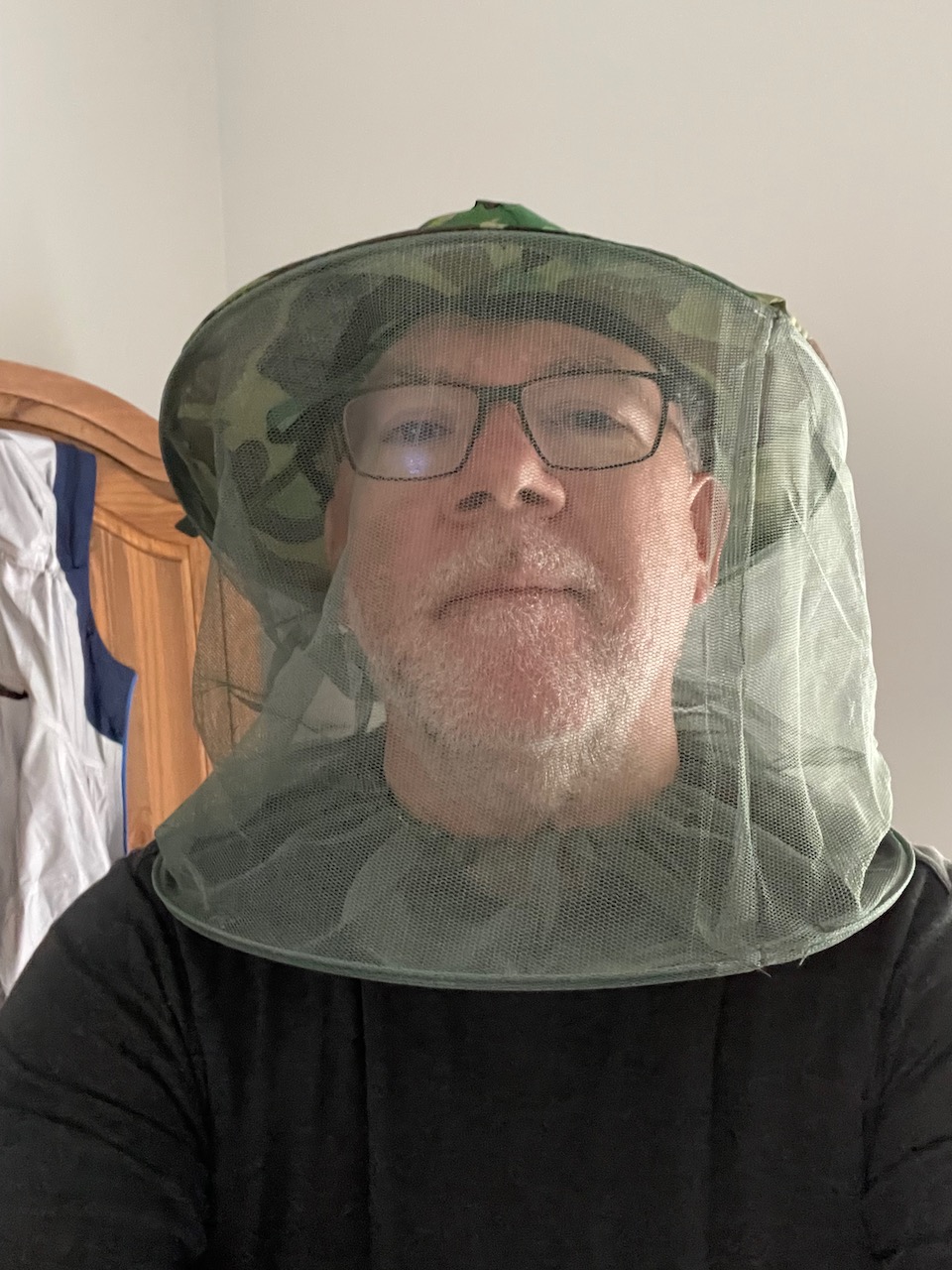
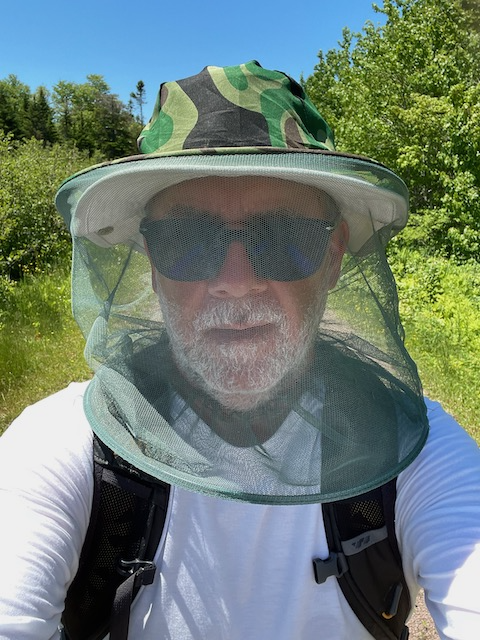
The final piece of essential gear for me was my hat.  I actually had 3 of them – a full brim Tilley hat for sun protection, a baseball style hat that I could wear under my rain jacket hood to keep the rain off my glasses, and my bug hat.  

The latter was picked up at a dollar store in Alberton in the 1st half of  my journey, after battling mosquitoes along the Confederation Trail, and it turned out to be darn handy.  Your head, your choice, just keep sun, rain, and bugs in mind.

I ended up using two different packs on the trip.  I have a 55L multi-day pack that I really like and I used it for the first half of the trip.  During this part, my wife wasn’t with me, so I had a few days where I had all my clothes and gear with me as I left one accommodation and moved on to the next, so I had to carry stuff that I didn’t need during the day on the trail – all my spare clothes, my indoor sandals, toiletries, snacks, electronics chargers and cables, an iPad.  Altogether, with some extra snacks, lunch, and full water on board, my pack came in at roughly 11kg.  I could have left a few things out of course, but the pack made carrying that weight all day quite comfortable.

During the 2nd half of my journey, my wife joined me so we had a car available, eliminating the need to carry everything.  That let me switch to a lighter 38L overnight pack.  This was, to be honest, still a bit bigger than I really needed, and I also own a 22L day pack which would have worked, but using the 38L pack meant that I could just chuck stuff in and not worry too much about packing carefully, and that way I always had spare clothes, rain gear, first aid kit, sitting pad, snacks, lunch, and water all to hand.

You could of course get by with a much smaller day pack, especially if you have someone able to sherpa you around each day.  I met a walker during my journey who carried a little 15L day pack, with just a rain jacket, some water, and a light snack.  You decide what works for you.

Let’s see, what else?  I did carry a first aid kit every day, though fortunately I never needed it during the day while walking.  I went through a bunch of blister bandages, though, and the associated alcohol swabs and antibiotic cream that you need to pop a blister while reducing the risk of infection.  My first aid kit also had tick tweezers, and thankfully I never had to use them.

Outside of all that, there was other gear that I used at night, rather than carry on the trail.  Toiletries of course – toothbrush, shampoo, deodorant, etc.  Also an iPad for entertainment, and that meant chargers and cords.  Plus I had indoor sandals to wear, and what a blessing that is when you finally take your boots off each night.  I had thought about adding a fancier shirt in case I went out for dinner but in the end didn’t carry that.  I did carry a little sewing and repair kit, but never needed it.  Your choice.

Gear List

  • Gregory Balto 55L multi-day pack – used for the 1st half of the trip
  • Gregory Paragon 38L overnight pack – used for the 2nd half of the trip
  • Oboz Yellowstone hiking boots
  • Mountain Equipment Coop (MEC) Hydrofoil rain jacket
  • MEC Hydrofoil rain pants
  • MEC seat cushion
  • MEC 10L dry bag
  • Outdoor Research 5L dry bag
  • Tilley T3 sun hat
  • Outdoor Research baseball-style hat
  • 1 pair Black Diamond carbon fibre walking poles
  • Phone charger cubes and cables
  • iPad
  • Toiletries kit
  • First aid kit – lots of blister bandages, needle & antiseptic, moleskin, tweezers
  • Repair kit (sewing needles, thread, buttons, safety pins, duct tape, and light parachute cord)
  • Medium sized MEC quick dry trail towel
  • 1 L Nalgene water bottle
  • 600ml squeeze water bottle
  • Clothing
    • 3 pairs pants (all quick-dry synthetic material, 2 of them convertible into shorts)
    • 3 wick-away stay dry T-shirts 
    • 4 pairs merino wool socks
    • 3 pairs underwear
    • 1 long-sleeve wick-away stay dry T-shirt
    • 1 lightweight zip fleecy
    • 1 pair slides as indoor shoes
    • 1 merino wool lightweight touque
    • 1 pair runners lightweight gloves 

Training and Fitness

It’s a bit of a cliche, but really, how do you know if you’re ready to do a 700km walk without actually doing it?  Do you train for a marathon by running a marathon?  


In my case, I knew beforehand that a) I wanted to cover around 30km a day, and b) that I would be carrying clothes, rain gear, food, water, etc. each day that would add up to something like 6-8 kg.  So I did a few training walks of 10-20 km around town and nearby areas, and then after a few such walks where I’d carried nothing, I started to add a full pack with between 10-15 kg of kettle bell weights in it.  By the time I started the walk, I’d done a couple of 25 km hikes carrying more weight than I was planning for on the actual trip, so I reckoned I was good to go.

What that didn’t prepare me for, however, was the repetitive stress of walking every day.  It’s one thing to work out, it’s another to do it over and over again.  Your body is, literally, made for walking, so you will adjust and get used to it, but you’ll find that it takes some time.  The first few days of walking, I had a fair amount of muscle and joint stiffness on top of tender feet due to blisters.  By about day 7 or 8, however, I’d walked myself into decent shape and was generally fine each evening.  But then, by day 25 or so, I was starting to feel new aches and pains, and I put those down to just long term wear and tear.

One thing I’d do differently in future would be to plan for a couple of rest days.  I think taking a rest day every 10-15 days would be prudent, and as I get older will probably be essential.  As it was, I walked every day and just used a couple of 3-hour/15 km days as a way to rest a bit, so that’s another way to do it – mix up your daily distances to give yourself some short days once in a while.  

Everyone is different, of course, and while you definitely don’t need to be a high-performance athlete to do the Walk, you are likely to find that you do need to push yourself on this if you plan to do it in one continuous journey as I did.  Some of that will be mental and some physical.  As long as you let your body dictate your pace, and are honest with yourself, you’ll be fine.  I did this at age 59, and wearing a spare 5 kg around my belly, and not only survived but enjoyed it. 

Lessons

One of the reasons I decided to do the Island Walk was because my bucket list of walks includes a number of long-distance, multi-week journeys – things like the Camino de Santiago, for instance.  I wanted to use the walk to learn what works for me.  In that sense, it was a great test, and more than anything I learned what might be the most valuable thing I could have learned – simply that I can do it.  There were times when I felt like bailing out, and I didn’t.  Just knowing that I am able to push through that mental wall is important.

But more than that, If there is one key takeaway for me, it’s that this kind of journey is like a knife that pares away your preconceptions and strips you down to essentials.  You walk, you eat, you sleep, you walk some more.  Repeat.  It’s an energizing feeling, that sense that you don’t need to worry about anything else.  Just walk.  


Other Posts About this Journey


If you feel like supporting my blog, you can buy me a coffee.
Big Walks – PEI’s Island Walk

Blog posts are a labour of love for me, and yet there is a cost to running this site and organizing my walks.If you’d like to help with that, I’d really appreciate something for my tip jar.The Buy Me a Coffee service allows patrons like you to fund writers like me.  If that sounds like a worthy idea to you, then go ahead – keep buying me coffees.Thank You Very Much to everyone who has contributed already!

*****

Over the past few years, I’ve been thinking about doing a Big Walk. My bucket list has a number of them – the Camino de Santiago in France and Spain, the Bruce Trail in Ontario, and many more – and I keep reading about ideas for others as well. I had plans to take on at least one of these in each of 2020 and 2021, but the COVID-19 epidemic meant that those dreams stayed just that – dreams.

So come spring 2022, after 2 years of listening to me wish and sigh, my wife finally put the boot in and said it was time to either do one of these walks or else stop talking about it.

OK, agreed, but which walk to do? Knowing that 2022 would probably still have some COVID-19 travel disruptions, I decided to try something that was relatively close to home. Plus, knowing that this was going to be my first multi-week walk, it made sense to choose something that while challenging was also achievable in terms of length and terrain. That line of thought led me to the Island Walk.

Morning, Day 1

This is a relatively new addition to the world of long walks. It was first tried out in 2019 by a couple of experienced walkers from Prince Edward Island who had done the Camino de Santiago in Spain and who wanted to find a similar length walk that would showcase their home province. They came up with a route that combines walking on red-dirt back roads

with sections of the province’s Confederation Trail

to take you more or less around the coast of Prince Edward Island. It’s about 700 km in total, and is divided into a suggested 32 daily stages which range between 12 -26 km in length. In the end, I chose to do it a bit faster than that pace, finishing in 27 days.

Why?

The first question asked by most of the people I spoke to both on the walk as well as friends and family before and after is, why? Why do it?

The lazy answer to that is to say “because it’s there”, and that was part of it. Could I complete a long walk like that? And beyond that, I had a few other things in mind:

  • Exploring PEI – this was the only Maritime province I’d yet to visit, and seeing it on foot seemed like a great way to explore Canada’s smallest province
  • Physical challenge – despite trying to average 75 minutes of activity per day for the past 5 years, I’ve still managed to add a few pounds, and a good long walk was one way to shed a few of those
  • Trying out ideas – if I am going to do other long-distance multi-week walks, I’d like to figure out what works for me in terms of pace, gear, nutrition, etc. Doing so close to home was a bonus.
  • Thinking time – a walk is always a chance for me to clear my mind, but the mental challenge of maintaining focus while remaining observant while walking 5-6 hours a day is a new one
  • Put up or shut up – there comes a point where you either decide to do something or you put it aside.

Impressions

So having done, what did I think? Did I like it? Was it worth it? Did it meet my expectations or preconceptions?

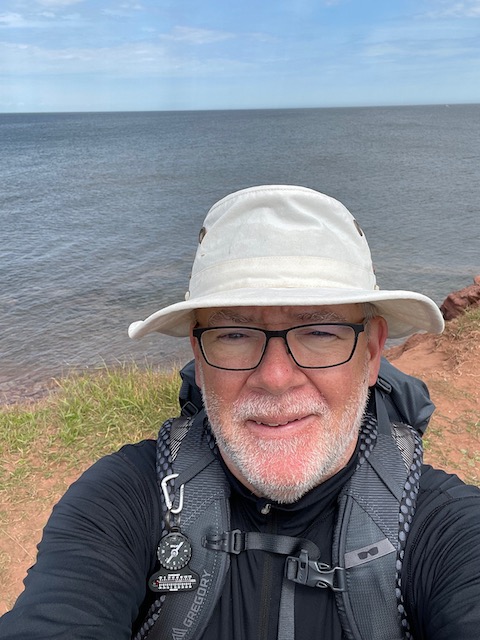
At North Cape, Day 8

A couple of weeks have gone by since I finished it, and I’m still digesting it. There were things I liked – the structure of a long walk, the routine of getting up, getting ready, getting out, and getting it done, day after day. There was the rhythm of it, getting locked into a sort of Zen calmness and clarity, when the steady pace emptied my mind and I simply walked.

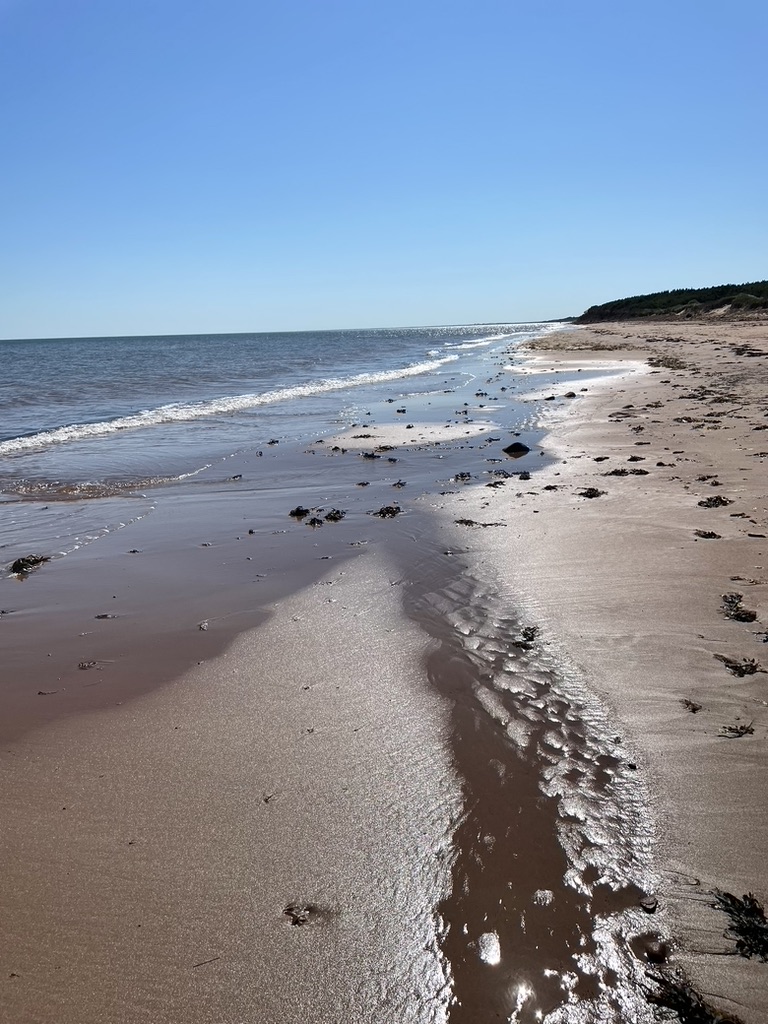
I liked some of the scenery. PEI is a low-key kind of place – no rugged mountains or crashing seas, but calm seas, long beaches,

green fields, wild flowers, fishing ports, and friendly people.

I liked the challenge, the push you need to start each day even when your feet hurt and the drive you need to see it through. I liked the solitude (I met exactly 6 other walkers and 4 cyclists on the route over 27 days) and I liked chatting to people that I met along the way.

I didn’t like the bugs – the mosquitoes were voracious.

I didn’t like the monotony of some stretches of the Confederation Trail, running flat and straight and on and on. I didn’t like having to to hitch rides most days to and from the route because there were few accommodation options adjacent to the route. And I didn’t like road walking, long stretches with no place to sit and rest, and hard asphalt that made my heels and ankles ache.

But those are quibbles. No journey contains only the highlights, there are always low lights and often no lights, and to expect otherwise is to be rudely awakened; but I wasn’t so much awakened to those things as resigned to them as being part of the journey that simply taught different lessons.

I guess the biggest takeaway for me is that a journey like this isn’t supposed to have one purpose, one impression, one lesson. Some time ago, a line I read in a blog post about the Camino de Santiago stuck in my head – “everyone walks their own Camino”. That message resonated again and again each day of my journey. No two people are going to do a walk like this, even if they are walking together, and do it for the same reasons while forming the same memories.

If I could distill anything out of this, I think it would be a few little mantras. Cherish the journey, respect the journey, and learn from it. Accept it on its own terms. Don’t overthink it. Your journey is its own lesson. Everybody walks their own Camino.

For the the last day, I’d deliberately walked extra distance on the preceding few days to ensure I’d have a short day at the end, partly in case of rain and partly because I didn’t want to finish the walk with a long sloggy day. And as I came into Charlottetown I was struggling to digest the journey, what it had meant, what I felt, how I thought of it. Ann wanted to meet me at Joe Ghiz Park where the route starts and ends, and a couple of friends, Michael and Carol, had come up from Lunenburg to surprise me and celebrate crossing the finish line. I was about a kilometre from the park, and way ahead of schedule, so I doddled a bit on the Hillsborough Bridge to look at the city skyline,

and then I texted Ann to say that I wanted to get there by myself so that I could try to process it. And so that’s what I did – walked the last bit trying to be normal, got to the park, took a selfie,

done

took off my pack, and when Ann walked in and gave me a hug, I started to cry. That was how I processed it – with tears, of relief and thanks. I thought I was walking by myself, and at that moment I realized that I was really walking with her.

Memories

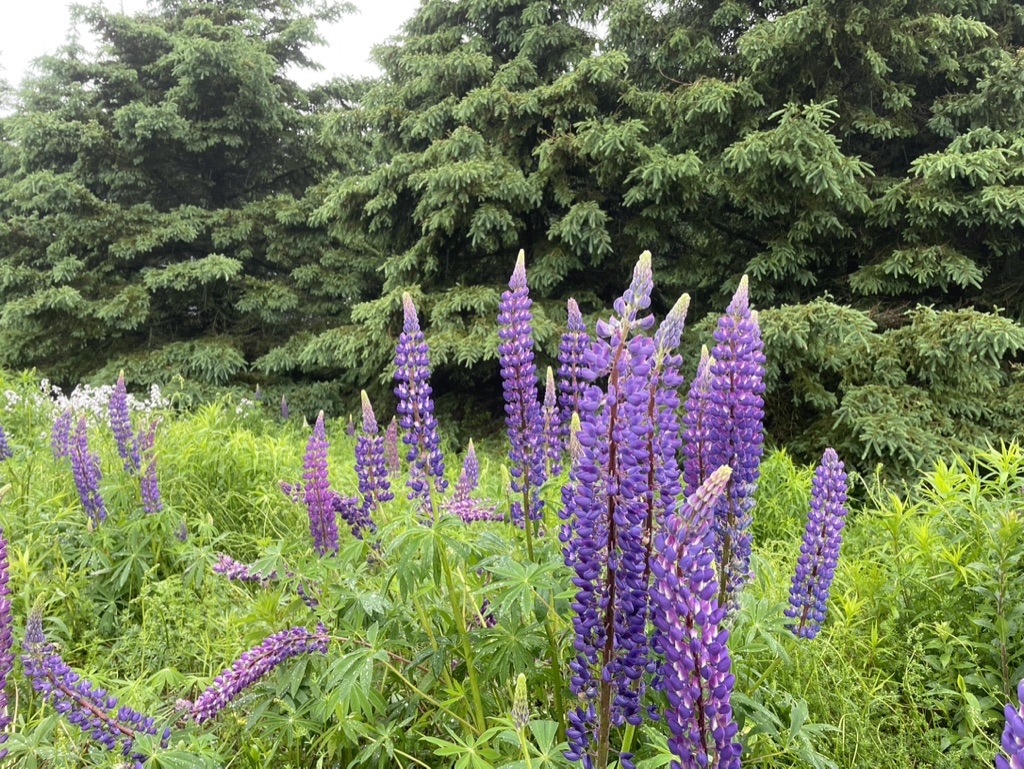
Green on red – PEI’s colour palette in June is layers of green upon red earth, with little yellow and purple and pink and white flowered highlights.

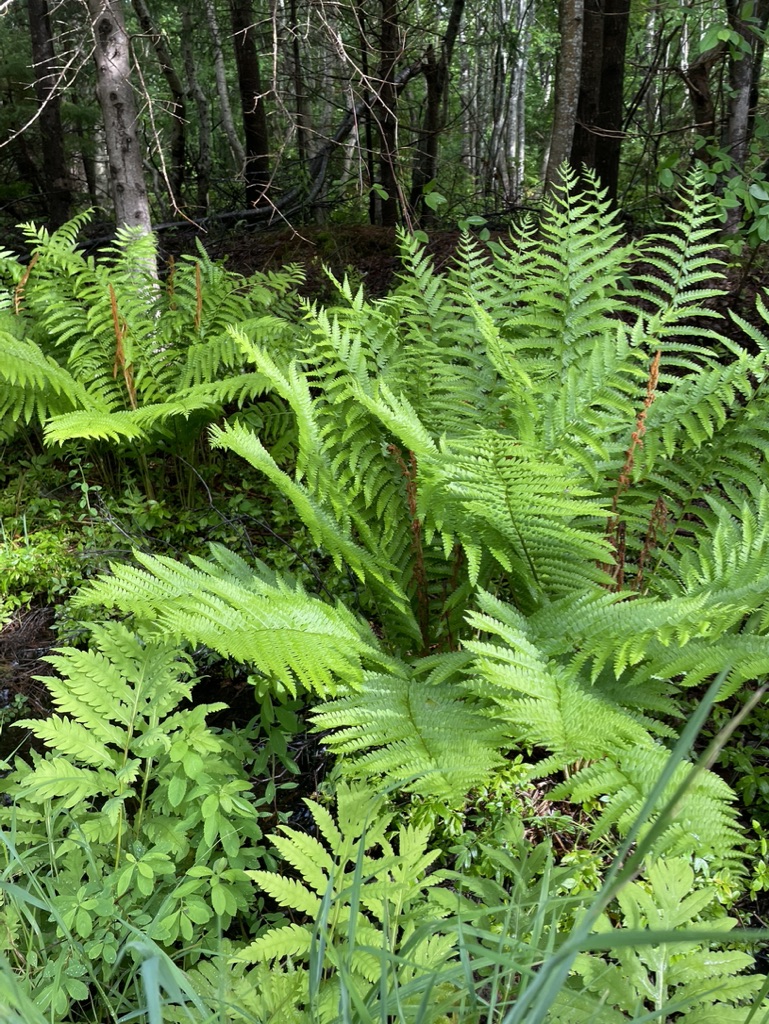
Blue maritime skies. Grey rain-filled lowering clouds, and soft misty mornings. Green tunnels of trees and shrubs and bushes and ferns.

Odd sights.

Blue-green seas. Black crows. Red mud. And more green on red, red on green, again and again.

The rural character of the province sinks deep into your brain, until you expect no other colours. Green on red. Sunshine and trails. Memories.


Over the coming weeks, I’ll be writing more about this walk. Stay tuned.

If you feel like supporting my blog, you can buy me a coffee.


Other Posts About this Journey


If you feel like supporting my blog, you can buy me a coffee.
Bucket List Walks

Blog posts are a labour of love for me, and yet there is a cost to running this site and organizing my walks.If you’d like to help with that, I’d really appreciate something for my tip jar.The Buy Me a Coffee service allows patrons like you to fund writers like me.  If that sounds like a worthy idea to you, then go ahead – keep buying me coffees.Thank You Very Much to everyone who has contributed already!

*****

An ever-changing list of walks I’ve done or would like to do. If it’s in bold italics it means I Did It!

Walks close to home in the Maritimes

Walks in Ontario

  • The Bruce Trail, Ontario
    • Niagara Section
    • Iroquois Section
    • Toronto Section
    • Caledon Section
    • Dufferin Highland Section
    • Beaver Valley Section
    • Blue Mountain Section
    • Sydenham Section
    • Peninsula Section
  • Yonge Street (from Lake Ontario to Lake Simcoe)
  • Tracing the path of Lord Simcoe from Fort George in Niagara-on-the-Lake to Fort York in Toronto
  • The Great Trail T-O-M walk – Toronto to Ottawa to Montreal following the Great Trail routes
  • Montreal to Toronto following the Waterfront Trail

Walks in the Toronto area

  • Crisscross Toronto (west to east and south to north, across the city within its boundaries)
  • Waterfront to Wine
    • East, from Toronto to Prince Edward County along the Waterfront Trail
    • West, from Toronto to Niagara along the Waterfront Trail
    • South, from Toronto to Pelee Island along the Waterfront Trail
  • The Great Trail in Southern Ontario (within 2 hours of Toronto)
    • Toronto Waterfront Trail
    • Toronto Pan-Am Trail
    • Toronto Pan-Am Connector
    • Niagara River Recreational Trail
    • Pickering Waterfront Trail
    • Durham County Recreational Trails
    • Laura Secord Legacy Trail
    • City of Hamiton Trails
    • Fort Erie to Hamilton connector trails
    • Hamilton to Brantford Rail Trail
    • Brantford to Kitchener connector trails
    • Kitchener to Elora connector trails
    • Elora to Barrie connector trails
  • Oakridges Moraine Trail around greater Toronto

Walks out in the world someplace

Personal Journeys

  • The journey of the Bradt Brothers, tracing my ancestors from New Amsterdam (now New York) up the Hudson to Albany and then west across upstate NY, across to Fort Erie, and along the Talbot Trail to Leamington in Essex County, SW Ontario, where I was born.

Boundaries

It’s human nature, I think, to look for the edges and test the boundaries of something. Or maybe that’s just my nature.

Water’s edge

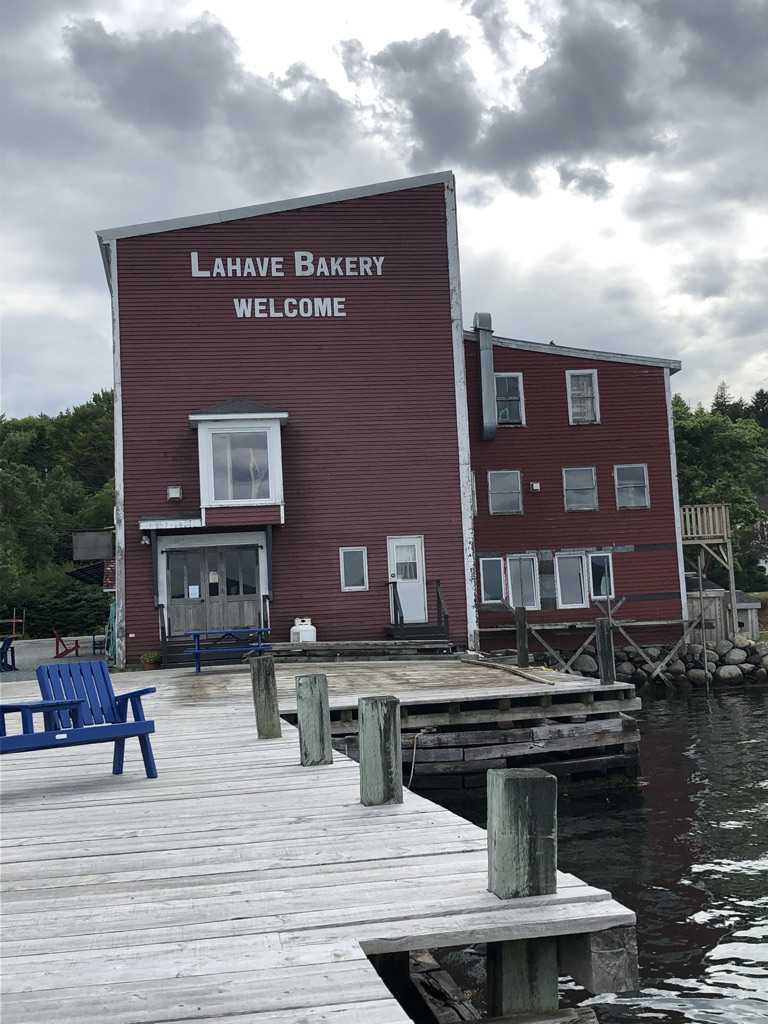
I was thinking this the other day, walking the pier near the Lehave Bakery, testing the edges by walking out along the wharf. Walk to the edge, and follow it round.

That notion of following the edge has been in my head, because now that we’re here in Lunenburg I’ve been thinking about some of the walks I’d like to do within the province, adding them to my bucket list, and those walks are themed by the edges I’d follow.

Nova Scotia is predominately a coastal province. By that I mean that most of the population lives near the sea shore. The larger cities and towns are mostly on the coasts – Halifax, Yarmouth, Sydney, and not least Lunenburg. The population has always faced the sea and looked to it for their livelihood. It means there are lots of roads and now trails that follow those coasts, so that makes walking a coastline activity.

Thinking about that got me thinking about boundaries and edges and limits. There are limits of geography, like the coast lines, and I’ll follow those. There are limits of endurance and strength, and while I don’t think I need those in exceptional quantities, walking several hundred km around the coasts will certainly call for some gusting towards those limits, at least for me.

And then there are limits we set for ourselves, limits of ambition I’ll call them. What do we want to achieve? How far do we push ourselves? Where will we take ourselves? Those limits are different for everyone of course, and I think they are also different at different points in our lives. The limits I set myself in my teens and 20’s are not those of my 40’s, 50’s, and 60’s. Do I want to walk these walks now because I want to push back on the shrinking of those physical limits? Maybe. Or maybe it’s just that now that I am retired and have a more or less grown child and fewer responsibilities, I feel like I can stretch my limits in ways that would have seemed imprudent or impractical when I was younger and paying mortgages and climbing corporate ladders.

The Olympics are on as I write this, and that is the spectacle of human limits writ large. What are competitive athletics if not tests of the limits of human strength and endurance and ambition? My walks are not my Olympics by any means, but deep down they come from the same source. Find the edge, and explore it.

TO Streets – Spadina

Part of a series, walking the main streets of Toronto

One of the streets I wanted to walk in criss-crossing Toronto is Spadina Avenue. It’s interesting for several reasons. For one thing, it was laid out as one of the grand boulevards downtown, where it’s about 60-70 m wide. For another, it’s been a draw for immigrants from around the world for more than 100 years, again especially downtown, where successive waves of newcomers to Toronto have left their mark. And finally, selfishly, it ends close to my home in mid-town, so in walking the length of it from the Lake I am basically walking home.

It starts right down at the Harbour, at Queens Quay, and on a January day it was pretty chilly down there. Come back in June and there will be people everywhere enjoying the sun, but on this day it just looked a bit bleak.

Looking north, the view is even less inspiring, since you are staring at the Gardiner Expressway, which Spadina has to cross under.

Going under the Gardiner, there’s a sense of a lost opportunity – all that land hidden away and under-utilized in a city that needs more housing, more parks, more green-space, more bike infrastructure, more community space. There are plans to do something with this – further west near Fort York there’s a cool new park area – and it will be interesting to see how this evolves given all the priorities the city faces.

From the gloom under the Gardiner, you emerge onto the bridge over the train tracks – quite a lot of them in fact, with many commuter lines leading in and out of Union Station. These railway lands were originally along Toronto’s waterfront, and development over the past 100 years has moved the water’s edge south. We’ve compounded that by allowing a wall of condo towers on the south side of the tracks, so that we’ve cut off our old downtown from the lake. There are ambitious and expense plans to build over the train tracks and create a park connecting the condos to the core – all part of the evolution of the city I suppose.

Finally, north of these barriers past Front Street, you feel like you’re in an actual busy, humming, urban neighbourhood. The area from Front Street north to 1 Spadina Circle near College is packed with shops, bars, restaurants, markets, people, streetcars, bikes, scooters, buskers, hipsters, students, and hawkers. There’s a lot of energy here, whatever the weather.

There are also some interesting little nods to history. Up until about 30 years ago, the area between King and Queen was Toronto’s Garment District, and it’s still known by that name and is commemorated by a giant thimble sculpture at the corner of Richmond and Spadina.

Between Queen and Dundas, you walk through what is still sometimes referred to as Chinatown, though these days it’s a more eclectic mix of shops and restaurants. Further past that, north of Dundas, you pass Kensington Market. This stretch, between Queen and College, is a great place to explore at leisure – it’s often said you can dine around the world in these few blocks. It was inner-city working class for a long time, and over the past 40-50 years has become first seedy, then bohemian, and now more hipster. The venerable old El Mocambo club is still there, and is soon to re-open. When the El Mo gets gentrified, you know the whole area is going that way.

As I was walking through here, I thought of a tune from the 80’s by a group called the Shuffle Demons – check out Spadina Bus and tell me you don’t think it’s catchy.

Continuing north, if you stand in the middle of Spadina at one of the streetcar stops, you get a great view south back towards the lake,

as well as north, towards the old hospital at 1 Spadina Circle that is now the University of Toronto Daniels School of Architecture.

North of Spadina Circle, coming up towards Bloor, you are on the west edge of the U of T campus, where some of the residences present a bold look.

Past Bloor, you keep climbing, subtly at first and then, when you get to the Baldwin Steps, quite steeply. The steps look pretty daunting – I was walking through here one summer day when I passed a bored personal trainer who was working out a poor slob (i.e. a middle aged overweight guy like me), making him do reps up and down the stairs. I thought of that as I slogged up on this day.

But, the view you get looking back south over the city from the top of the stairs is great, one of the best in the city. You can tell yourself when you are standing here that, 20,000 years ago you’d be on the beach overlooking Lake Iroquois which extended to this point – the Baldwin Steps are basically climbing to the ancient shoreline.

And of course, when you get to the top, you’re right next to one of Toronto’s most famous landmarks, Casa Loma. This ornate pile is now owned by the City, and is also home to a schwanky restaurant as well as lots of free events throughout the year. Whenever I go past, there’s always a swarm of tourists taking selfies.

Spadina keeps going north past Casa Loma, and you soon come to the bridge over the Nordheimer Ravine, part of the park/trail system that is today where the infamous Spadina Expressway would have been had it been built. I’m so glad that never happened.

On the other side of the ravine, you come to St. Clair Avenue. This is a residential area, and the gateway to Forest Hill, one of the more upscale neighbourhoods in Toronto. That said, the area around Spadina and Lonsdale is home to Forest Hill Village, a cozy little shopping area that’s just “the village” to those in the hood.

Spadina keeps climbing through here, and the village gives way to more houses and blocks of flats as you progress towards Eglinton. When you get to Eg, it looks like Spadina ends at a T-junction, and a pretty ugly junction at that, what with the Eglinton Crosstown construction underway and an auto repair shop on the corner. But, if you keep going east about 100 meters to Chaplin, you can turn north, cross Chaplin, and find the remaining few hundred meters of Spadina.

The Avenue here finishes its journey with houses on one side and Memorial Park on the west side.

My son played baseball here when he was in little league, and that image stuck in my mind despite the snow over the diamond.

Many times, walking Toronto’s streets is a journey through time for me, and Spadina captures that perfectly. The shops and markets, the Garment District, U of T, Casa Loma, and Memorial Park at the end are all reminders of different eras, personal and civic.

I like Spadina for what it is today as well as what it has meant to our city. It’s a timeline and a time tunnel, and a time-saver for getting down town. Walk it and see.
TO Streets – Eglinton

Part of a series, walking the main streets of Toronto

Back in the 80’s, Yonge and Eglinton was known derisively as Young and Eligible, and I was then young, somewhat eligible, and lived in the neighbourhood. I also worked a couple of km ways east along Eglinton, just off of Laird Drive, so I travelled back and forth along it every day. It all means that I have a somewhat nostalgic attachment to Eg, so it was natural that I’d include this one in my tour of TO streets. And in case you’re wondering, many Torontonians know it as “Eg” more than “Eglinton”.

There is also the fact (and I didn’t know this until I looked it up) that Eg is the only major street in today’s City of Toronto that takes you through all 6 of the former boroughs of Metro Toronto – Scarborough, East York, Toronto, North York, York, and Etobicoke. By walking it, I’d get a chance to explore Toronto’s history as well as its present, and that’s the whole point of this TO Streets exercise.
So all that said, I decided to do the walk in 2 halves, travelling out to the east and west ends of Eg and walking back towards mid-town. That way I’d be travelling against the commuter rush in the morning and walking towards home.

I decided to start on the eastern end, and that is at the intersection of Kingston Road and Eglinton, well out into Scarborough.

Since the Eglinton Go Train station is near that intersection, I travelled out to it to start off, but to avoid retracing my steps along Eg, I left the station heading a bit south and east, so that I walked through what is the old heart of Scarborough village and up along Kingston Road to get to the start of my walk. There isn’t, to be honest, very much to look at as you stare west along Eg from Kingston Road.

Still, it was a nice sunny day, so the walk was pleasant. Heading west, I kept thinking of the punch lines to a running joke – you know you are in Scarborough when …. there are more Chevies than Bentley’s; there are more Tim’s than Starbucks; there are more payday loan shops than bank branches; there are more “ethnic” restaurants than “Canadian” ones; and on and on.

You get the point. It’s a place of newcomers and of working class people building a life. Downtown Torontonians tend to look down on the suburbs, and Scarborough is that writ large. It’s easy to turn up your nose at the endless strip malls, but you have to admit that these suburbs are where the majority of Toronto’s population actually lives.

One thing that is absolutely apparent is that it’s a car’s world. The street is wide because cars are how people get around. At the eastern and western ends of Eglinton, the only public transit is by bus. For long stretches, until I was within 2 km of Yonge from the east and about 3 km of Yonge from the west, I was the only pedestrian. This isn’t a place where people walk around, or bike for that matter. It’s mostly open and unshaded, the wind whips and bites (or the sun bakes in summer), and if it had been raining it would have been very unpleasant. As it was, the dust and grit off the road as the traffic flowed steadily, not to mention the mess from the Eglinton Crosstown construction, clogged my sinuses and left me with a brutal headache when I got home. What idiot walks 40km across Eglinton?

After a steady hour plus of walking, I came to the east end of the giant construction project that is the current state of the Eglinton Crosstown. It will provide almost 20km of light rail transit, from Mount Dennis in the west to Kennedy Road in the east, and after living through the first 3 years of the project, I’ll be very glad to see it finish (fingers crossed) in 2021.

It’s necessary of course, it will be great when it’s done, and there’s no way to build something on this scale without mess and disruption. Still, everyone who lives near Eg is getting tired of it.

It also made my walk from the east problematic between Victoria Park and Brentcliffe. In this section, pedestrians are even more of an afterthought than elsewhere – sidewalks on one side or other of the road were closed, and for one 500 meter stretch just west of Don Mills Road, there wasn’t any sidewalk or foot path at all.

I trudged through thick mud along the lane used by the construction equipment in order to keep going, attracting stares from the workers and preparing to jump out of the way if a lorry came by.

Still, there is culture along Eglinton. At Wynford Drive, on the north side of the road, there is the Aga Khan Park surrounding the Aga Khan Museum with its asymmetrical and distinctive glass pyramid roof.

OK, the construction meant that I couldn’t easily detour to get there, and even if there hadn’t been construction there is no easy walking path to it off of Eglinton (all hail the car!), but it is a wonderful place and well worth a visit if you’re in the area.

One other cultural feature of both east and west Eglinton, and one that reinforces the downtown hipster stereotypes about the suburbs – the only 2 bowling alleys I can think of in Toronto were the two I passed along Eg in Scarborough and in Etobicoke. Surrounded by parking lots and fast food joints, they are exactly what hipsters find so amusing about these areas.

I finished my walk from the east coming through the Yonge & Eg mid town intersection. With the sun pouring down on a January day, it was quite pleasant in a noisy, messy way. It’s like when your child destroys the house when they are playing – you know it’s healthy for them to play, you love it when they laugh, so you put up with the mess and join in rolling on the floor.

A couple of days after walking Eglinton East, it was time to do Eglinton West. At this end of the city, my starting point was Centennial Park at the City boundary at Etobicoke Creek. While this is the official western edge of Toronto, Eglinton keeps going west from here deep into Mississauga.

My wife was kind and drove me out to the park, saving me an hour on the bus, but it was a grey day for a long walk. There had been a little dusting of snow overnight, and walking through the park was quite pretty, with just a few squirrels skittering through dried leaves.

I came out of the park onto Eglinton at Etobicoke Creek. Looking south, over the creek and the park, you’d never guess you were next to Canada’s busiest airport and busiest roads.

But looking back east, toward Yonge, was a bit daunting – the road rises out of the creek valley, and just keeps going and going.

As I set off, I was startled to see that I was at about 5500 Eglinton West. Since Eg East ends at 3500 and that had taken me 3+ hours to walk, I realized that I had a long way to go from this end. And for the first 2 hours, that’s what it seemed like. There is a bike path along Eg at this end, but there was very little foot or bike traffic – just me and the cars.

Years ago, in the early 90’s, we had lived near Runnymede and Annette in the Bloor West neighbourhood. I had a consulting gig then which took me to Montreal a lot, and the quickest drive to the airport was up Scarlett Road and then west along Eglinton. I thought of that as I was walking, because Centennial Park is actually a bit west of the airport, and I always think of the airport as being west outside the city, yet here I was still in Toronto. It reinforced the fact that Toronto covers a lot of area – 800+ square km.

I was also struck by how much this area had changed. 30 years ago, Eg West took you through open fields and meadows. Now, it’s lined with townhouses and condo towers. The old Plant City nursery near Jane is now closed, soon to become more condo’s I assume.

And meanwhile Eg goes on and on. There isn’t a lot of scenery out here – it was just houses, condos, apartments, and the occasional strip mall.

There was a little scenic break when I crossed the Humber River near Scarlett Road, and that reminded me that this is where I had stopped when I walked up the river in the autumn. I need to come back to this spot and keep going north, sometime this spring.

East of the river, as you climb towards the Mount Dennis neighbourhood, you come to the construction site at the west end of the Eg Crosstown.

There are some hills to climb here – and by the way, walking the length of Eg across the city means you traverse the valleys of the Don, the Humber, and Black Creek, so you are climbing a lot. According to my fitness tracker, I did the equivalent of 160+ flights of stairs over the 2 days.

The climb up the hill to Mount Dennis is also the exit from the residential stretch of Eglinton West – from there to Yonge, the street becomes narrower and more densely packed, with with actual shops rather than strip malls and stretches of houses amongst the condos and apartments.

I kept trudging through here, because soon I passed the Allen Expressway exit, and was into the home stretch through the Upper Village. This is my ‘hood, and I know the area well. Eg is busy here, both with the everyday commerce of any big city as well as with the ongoing construction, so that the walk back to Yonge and Eg requires a back and forth shuttle from one side of the street to the other given closed footpaths.

I finished up at back at Avenue Road, with a little bit of snow just starting to fall. The day was starting to wind down, having taken 4+ hours to walk Eglinton West, and I was glad to get home and reflect on the walk.

One strong impression was that it’s a long way across Toronto, 40 km or so. It’s also a long way across the history of Toronto. Eglinton East in Scarborough calls the 1950s and ’60s to mind, the worship of the car, the development of strip malls and the Golden Mile, and low density housing spread out over wide areas. A big old 1962 Caddie with tail fins still wouldn’t look out of place here.

Eg West is a bit newer – the condos are only 10-20 years old, so it’s more of a ’90’s and ’00s kind of place that calls a Humvee to mind. It’s still about cars with its multiple lanes of traffic, and there’s a feeling of begrudgement in conceding some small sliver of space for pedestrians – “oh I guess we have to build a side walk but hey who’s going be dumb enough to walk out here!”

What’s more subtle and yet for me stronger, is the sense of Eglinton as a cross cultural slice of Toronto’s diversity. All those apartment blocks and condo towers are full of 1st and 2nd generation Canadians. They want their tastes of home and so there’s Jamaican, and Bengali, and Mandarin, and Persian, and Afghan, and Syrian, and lots of other “ethnic” restaurants (and by the way, what’s an “ethnic” restaurant anymore? Is that even an appropriate term? Maybe I’m dating myself with that term, perhaps a culturally-specific restaurant is what I mean.)

And then there are thrift shops and money transfer outlets, used car lots, bus shelters, Tim Hortons, and community centres. There’s energy and multi-generational families and playgrounds along with gas stations. There’s new development, renewal, and regeneration. There’s investment and the sense that these were in the 1960’s and 70’s and now are again “up and coming” neighbourhoods. You can’t help but feel that they represent what Toronto is, as much or even more so than the glass towers downtown.

The neighbourhoods strung along Eg – Mount Dennis, Fairbank, Oakwood, the Upper Village, Leaside, Don Mills, the Golden Mile, and Scarborough Village – are for me some of the jewels in Toronto’s necklace. They represent what I’m most proud of in my country – the opportunity we provide to start a new and better life.

Yes, Eglinton also illustrates some of the things that I am not proud of – the traffic and pollution and over-consumption, the racism, the poverty – but I keep seeing the gleam under the grit, the hope in the toil, and the future emerging from our past.

I like Eg. It’s Toronto. And that makes it fun, even if my sinuses are clogged with the dust of this walk.

TO Streets – Yonge

Part of a series, walking the main streets of Toronto

If I am going to write a series of posts about walking the main streets of Toronto, of course I have to start with Yonge Street. My centre point for these walks is the intersection of Yonge & Eglinton, and there’s a certain anchoring that Yonge provides to Torontonians – you’re either an East-of-Yonge or a West-of-Yonge person. And then again, there’s a personal attachment to the street, having lived in a condo with a Yonge Street address, worked at an office on Yonge, and walked parts of it many, many times over the past 40 years.

Back in 1970, a film called Goin’ Down the Road was released, and it’s become an iconic statement of, in part, how the rest of the country sees Toronto. Back in the early 1980’s, SCTV did a spoof of the film (“We’re going to Yonge Street!”), and it’s still funny today – wow do John Candy & Joe Flaherty look young! – and I couldn’t help but recall it as I started out on my walk.

The street starts at Queens Quay at Toronto Harbour, and on a cold January day there was ice to remind me that there’d be a wind-chill as I walked north. It was grey overhead, and hardly more inviting as I stared north towards the underpass below the Gardiner Expressway.

Walking north along Yonge from the lake isn’t really a pleasant walk, given the traffic, the gloomy underpasses, the noise, and on this day the mud and slush. It’s uphill of course, as the city rises away from the lake. In fact over the length of my walk, I climbed from about 76m above Mean Sea Level at Yonge and Queens Quay to almost 200m MSL at Yonge and Steeles.

That led me to think that for Torontonians, “downtown” literally means “down” town. If you ask the average person, they’ll probably say that Downtown is between Front and Bloor. MidTown is roughly around St. Clair up to Eglinton. Uptown is more variable – to me anything north of Sheppard is above the tree line, but if you live up at Cummer then Sheppard is probably like your downtown. And all of this is measured, for the most part, based on where you are along Yonge. You can be on King Street, for example, but if you’re more than about 500 m east or west of Yonge, then you’re not “Downtown” – you’re in the Entertainment District maybe or Corktown, but that distance from Yonge is the key.

One of the things you notice as you walk north is that, downtown, the subway stations are only about 5-6 minutes walk apart (King to Queen, Queen to Dundas), but as you go north they get farther and farther apart, so that by the time you are at Lawrence, you’re a good 30 minutes walk to get to York Mills. That compression of distance is, I suppose, appropriate – it’s more densely packed and there’s that big-city-downtown feel you get.

I couldn’t help but notice how much is changing along Yonge. We have a thing in Toronto for faux preservation, where new buildings retain a portion of an old one as a facade, to give the illusion of preservation. At Yonge and Alexander there’s a good example, where the venerable clock tower of an 1870’s fire station will be incorporated into a new condo.

I noticed, as I continued along, that one of the things that contributed to that gloomy feel, besides the grey skies and slushy streets, was the fact that most people seemed to be walking with their eyes cast downwards. For every person looking straight ahead and catching your eye with a twinkle, there would be several either looking at their feet or looking at their phones. In any big city, people scurry about lost in their thoughts, but when the sun is out and there’s a warmth in the air, people seem to look up more. They’re more engaged in their surroundings then. On this day, the gloomy skies equalled gloomy expressions. Oh, for spring to arrive.

Another thing I noticed is the street numbers. I started at #1 Yonge Street, and walking north, the climbing numbers mounted with my steps. In fact, if you pay attention moving about the city, over time you’ll get to know roughly how far north along Yonge an address is based on the numbers. Anything below 1000 is south of Bloor. St. Clair is at about 1600 Yonge, Eglinton is at about 2400, Sheppard is around 4000, and all the way up at Steeles you’re at about 6400. The numbers keep climbing north of Toronto, and go up into the 12,000’s by the time you get up to Richmond Hill. As you’re walking up Yonge, if a cold north wind is in your face then it feels like the numbers equal the icy heights you’re ascending.

Walking north, while you are mostly climbing the whole way, there are some dips as well. Between St. Clair and Eglinton, then Eglinton and Lawrence, and finally between Yonge Boulevard and Sheppard, you cross the ravines of Mud Creek, Burke’s Brook, and the West Don River. The latter is especially steep,

descending almost a 100m into Hoggs Hollow as you cross the Don,

and then climbing fairly steeply towards Sheppard.

I’ve walked lower Yonge before, between the lake and Eglinton, and living in mid town means I’ve ranged up as far as York Mills. I’ve never done the upper part of Yonge however, north of York Mills, so it was new to me to walk through here. I was surprised to find, at about Cummer, that there is a small cemetery on the east side of Yonge, that dates back to the mid 1800’s.

When I looked it up after my walk, I learned that this was established by the Cummer family, who settled in this area in the 1820’s. It was a reminder of how this area was the market garden that fed Toronto, right up into the 1940’s, back when it was known as Willowdale.

Today, however, it’s about as far from a pastoral setting as can be – it’s just a wide canyon of condo towers, designed for cars and packed with fast food restaurants.

That said, it’s interesting to see Toronto’s melting pot expressed in those fast food restaurants. I passed Italian, French, Greek, Japanese, Korean, Chinese, Vietnamese, Turkish, Lebanese, Syrian, Persian, Indian, American, and of course the uber-Canadian Tim Horton’s along the way. As you go north, the residents change from multiple-generations-in-Canada near Rosedale to just-arrived-and-sinking-roots above Sheppard.

When you do get to Steeles, there’s a bit of an anticlimactic feeling, because it doesn’t look any different on the north side of Steeles, in Markham, as it does on the south side, still in Toronto.

It’s a car’s world up here. There are some people walking around, but mainly this is laid out for cars. How it will evolve over the next 20-30 years will be interesting. I’d love to see the sidewalks widened, bike lanes expanded, street furniture and trees installed, and an actual pedestrian feel introduced. Whether we get there soon or not is up in the air. This area is, like it or not, more representative of Toronto than, say, Dundas Square. Turning the downtown into a walker-centric space is one thing, but I’m not holding my breath that areas like Yonge & Steeles will look like that any time soon.

Still, breathing in scents of auto exhaust mingled with BBQ duck, flavoured vape, and frying onions; reading shop signs written in Korean, Mandarin, Persian, and Hindi; overhearing snatches of conversation in a dozen languages; feeling the energy – it’s what makes Toronto dynamic. We are a melting pot, and people still want to go down the road to Yonge Street. We look different today than in the 1970’s, let alone the 1870’s, and in 50 years time the 2070’s will probably still see the energy of Toronto expressed along Yonge.

TOStreets – Walking the City

Lately, I’ve been thinking about how to keep my walking boots busy over the winter while at the same time avoiding the same-old, same-old paths I’ve walked many times already. It came to me, as I was out for a walk (of course), that the thing to do was walk the streets of Toronto.

That sounds perhaps a bit of a cliche, walking the mean streets of the Big Smoke, but that’s not what I had in mind. As I thought about, my mind revolved around the idea of some of the major streets in Toronto, and doing it in a way that could fit into some sort of pattern. Instead of random walking here and there, I wanted to find a way to organize my walks, and I realized that Toronto’s east/west grid system lends itself perfectly to my plan.

As it happens, I live pretty close the middle of Toronto. The intersection of Eglinton Avenue and Yonge Street, is only about a km from home, so I can use that as a starting point to anchor my walks while I explore the major streets of Toronto.

So, that’s my cunning plan to make my winter walking more interesting. I can walk Yonge Street, from the Lake to Steeles, and Eglinton from mid-town to its east and west end points. And I can use Yonge & Eg as a transit jump-off, and head to other streets like Dundas, or Finch, or Bathurst, or Lakeshore. By following these, I’ll criss-cross Toronto and wander through the many neighbourhoods that make up the city, and along the way get exposure to the diversity of cultures in our mosaic.

I reckon winter and spring are good times to do this, since it would be baking hot in July. I’ll pick decent weather days and chunks of the city that will keep me occupied all day. I have about 3 months till April, and then we’ll see what the weather looks like for trail hikes outside Toronto.

I’m going to call this project my TOStreets plan, and as I complete each section I’ll update a map to show where I’ve been.

Hey Toronto, here I come.

Armchair Walks

On a cold, blustery, snowy, sleety, grey, and miserably wintery day, the thought of getting out for a walk is less than appealing. I know I should go out, but it looks nasty and it’s hard to muster the energy to put on the layers and winter gear.

So instead, I’m lingering inside over coffee and thinking about walks – armchair trekking if you will.

There’s the local walks around the city I could do over the winter – perhaps the Rouge River trails, or the upper Humber. And there are neighbourhood walks that are fun, like Bloor West and around High Park. Then again, I can revisit old favs, like the Don Valley, the Brickworks, and Wilket Creek/Sunnybrook Park. All that can keep me busy, but it doesn’t really need a lot of armchair planning.

So what about the long walks I want to do in the summer – perhaps another section or 2 of the Bruce Trail, or some parts of the Great Trail or the Waterfront Trail? There are lots of trails on my bucket list that I’d like to get to. I’m poring over maps looking at the trail and figuring out distances between accommodation. That will keep me occupied for a bit.

I like doing that, what might be termed map planning or “maplanning” – opening up All Trails or Google Maps and exploring different places where I’d like to take a long walk, like the Chemins de Grandes Randonnées in France, or the National Trails of England, or the Te Aroroa Trail in New Zealand.

Of course, you aren’t armchair walking if you’re not gear-dreaming too – what will I need if I take a particular trail? Is there enough accommodation available that I can skip a tent? How rugged is the trail so what foot gear is best? What about clothes – is it wet or dry, cool or hot? What percentage of time will I need to be in a tent versus a warm, dry bed? How big of a pack will I need? What’s the mean length of time between hot showers likely to be?

And logistics – how long will it take? How many days do I plan for? How do I get to and from the start and end points? How much does it cost to fly to that country in the first place? What sort of budget will I need? What time of year is best for that trail, in terms of weather, accommodation, and avoiding the tourist hordes?

Of course I’d like to actually be out on the trails actually walking carrying actual gear. Armchair walking is fun for an afternoon, but sooner or later you need to get to it. Soon … when the snow stops.