Between May 18 and July 5 of 2023, I walked from The Hawk on Cape Sable Island, the southern tip of Nova Scotia, to its northern tip at Cape North on Cape Breton Island, a 1000+ km trek. This is the story of part of that journey. See these posts to read about the whole journey:
A big thank you to everyone who hasbought me a coffee over the past year. The Buy Me a Coffee service allows patrons like you to fund writers like me, to cover things like the costs of running this blog, new shoes and gear, and journeys like this. If that sounds like a worthy idea to you, then go ahead – keepbuying me coffees.
Where am I now?
Home, in Lunenburg. I’ve had a few days now to let things sink in – that I finished my journey; that I made a plan and saw it through; that I have a life to fit back into, everyday things to do, friends to see, family to hug and hold.
Fun Facts
I walked a total of 1,027 km, which is about the same as:
walking from Toronto to Montreal and back again
walking from Paris to Berlin
walking a bit more than 24 marathons
It took me around 264 hours of walking to do it, so I averaged just under 3.9 kph, which sounds slow but in my defence that walking time includes rest breaks. I probably rested around 10-12 minutes for every hour I walked.
I climbed just under 4500 flights of stairs, according to FitBit, and a flight of stairs in Fitbit-land is equal to roughly 3 meters, making it more than 13 km of vertical ascent (and descent, since I started and ended more or less at sea level). That’s like:
climbing both Mount Everest and Mount Blanc
climbing the CN Tower in Toronto 31 times
descending the 1829 meter deep Grand Canyon more than 7 times
It took me about 1.4 million steps to do it. Think about that the next time you’re walking on an exercise machine.
I crossed 32 rivers – here’s the list, see how many you recognize: Barrington, Clyde, Roseway, Jordan, Sable, Tidney, Broad, Mersey, Medway, Petite, Lahave, Mushamush, Martins, Gold, Middle, East (the one west of Halifax), Musquodoboit, West, East (the other East River next to Sheet Harbour), Salmon, Moser, Ecum Secum, Liscomb, Gaspereaux, St. Mary’s, Larry’s, Salmon (the other one near Guysborough), Southwest Mabou, Mabou, Margaree, Fishing Cove, and the North Aspy. Not to mention dozens of brooks and streams.
I passed through several hundred cities, towns, and hamlets with names that include one of these words: Bay, Basin, Cove, Harbour, Lake, or Point.
I saw at least one moose, beaver, seal, deer, whale, bald eagle, osprey, otter, fox, snake, turtle, frog, toad, squirrel, and chipmunk.
I slept in my tent in provincial park campgrounds, National park campgrounds, private campgrounds, a couple of backyards, and on crown land. I also spent the night in several inns, hotel, and motels, as well as in a couple of apartments, four houses or cottages, a glamping tent, a yurt, a fancy manor inn, an RV, and on the floor of a house under renovation. Somehow I missed sleeping in a barn.
I lost about 5 lbs in weight in total and about an inch off my waistline, and gained a few pounds of leg muscle.
I saw the following objects by the side of the road:
A spoon, a fork, a knife, in separate locations hundreds of km apart
A kids backyard play set
Enough furniture to fit out a living room including a sofa, an armchair, several coffee tables, and an ottoman
A ladies black patent leather pump, left foot, 3 inch heel, fortunately empty
A men’s black rubber boot, also empty
Several tires
Many banana peels
Hundreds of work gloves
With hand on heart, I can truthfully sing:
I’ve been to Ecum Secum and I’ve been to Chezzetcook.
I’ve passed through East Port Medway and I’ve walked to Necum Teuch.
I’ve crossed the River Mushamush and been to Mushaboom.
I climbed up Cape North mountain and I’ve seen the lilacs bloom.
From Barrington to St Lawrence Bay I’ve hiked through many trials,
And from cape to cape along the way I’ve gotten a million smiles.
The Blooper Reel
When you take on any project, there will be mistakes made and lessons learned. I am the first to admit that I got lucky on several occasions – the God of Fools was watching over me.
First and foremost, had I started my journey just a few days later in May, I would have been stopped right away by the forest fires near Shelburne. And despite central Nova Scotia getting flooded out with rain for days on end in June, I really only had a few bad-weather days to walk in the rain. So luck played a big part in my ability to complete the journey with minimal fuss.
But the God of Fools also made sure that I was bitten on the arse by my own mistakes, just to make sure that I learned something:
Like when I tried to follow the maps I was using, stubbornly, when my own eyes told me that there wasn’t a road there to follow.
Like when I didn’t check my map and just assumed I was on the right road, which took me several km in the wrong direction near Voglers Cove.
Like when I made accommodation arrangements in advance, but forgot to change or cancel them when I changed my plans. I ended up cancelling things last minute, too late to get a full refund, or even a partial refund in some cases.
Like when I refused to use bug spray but sat out anyway amidst swarms of black flies. I was bitten so badly in Sheet Harbour that my ears and right arm were swollen and puffed out red, itchy blisters.
Like when I didn’t keep my water bottles full and ran low in high temps, near Judique, and nearly collapsed from heat exhaustion.
My Favourite Things
Lupins and daisies and ferns in green grasses,
Sunlight that dazzles the sea through my glasses.
Lichens on rocks and the ferns under forest,
Blue jays and robins and the crows in their chorus.
Tumbling water and waves on sands sings,
These Scotian delights are my favourite things.
Ahem. Apologies for the parody. But here are a few of my favourite things from the journey:
Favourite coffee – Uprooted Cafe in Musquodoboit Harbour
Favourite sandwich – the breakfast wrap from LaHave Bakery in LaHave
Favourite meal – tie between the lobster dinner hosted by Jude Avery in Larry’s River and the dinner of pasta with cured shad roe prepared by Eric Southey in East Port Medway.
Favourite moment – sitting by the Clyde River just listening to the water
Thoughts
If there was one question that came up again and again from people I met, from Barrington to Bay St. Lawrence, it was “why are you walking this journey?”
There isn’t a single answer to that. What I told people during my journey was part of the answer: that I did it because I wanted to see if I could; that I wanted to explore the province and see places that I’d never visited before; and that deep down, I had this nagging feeling that I’m getting older and if I don’t do these things now, I may not get the chance in future.
But when I was a child, a middle child who was always content to imagine his own adventures, I would make lists, devouring mail order catalogues searching for jack knives and hiking boots and tents and sleeping bags and ropes and axes and all the things that I’d need for the journeys I wanted to make; borrow every book in the town library that told tales of adventures and explorations; and lacking the ability to actually buy the things I thought I wanted or travel off to strange lands, I’d cobble together backpacks from scraps of wood and an old pair of jeans and fill them with cookies and sandwiches and my pretend camping gear, to set off through the nearby fields and bush lots to find my dreams.
And now I am, perhaps, a grown-up child, able to peruse online catalogues to purchase real packs and tents and gear, and buy it and take some food and few clothes, to set off on actual adventures, sleeping in the woods and meeting strange creatures and overcoming fierce adversity to accomplish my quest. Are we not all kids at heart, at least some of the time? Maybe deep down, this was my boy’s own adventure.
I don’t know, to be honest. I’m sure I walked this for many reasons, only some of which are transparent to me. But I do know that I’m glad that I did it.
*****
What was the best part of the journey? Hands down, I’d have to say it was meeting the many, many people who stopped to chat with me. I had dozens of interesting conversations, with people in every community I passed through, always with smiles and often handshakes as well as a few hugs.
The kindness shown, again and again, reaffirmed my belief that most people, in most places most of the time, are decent, warm, thoughtful, and caring, and to be able to share their thoughts as I passed through their community remains my enduring memory.
*****
There were often times when I’d be explaining my journey to someone and they would ask, “are you doing this on your own?” And I would say yes, I’m walking it solo.
Maybe I was in a physical sense, but I was never alone. Ann was always with me. She was constantly in my thoughts, and we would touch base several times a day.
But deeper than that, she was with me because she’s a part of me. We’ve been through a lot together. I could not have completed this kind of journey without her support. Thank you, my love.
What next?
More walks, of course. I have my bucket list of journeys, and I hope to cross off a few more. Ann has relatives in Ireland who are getting older, we haven’t been there in a few years, and we know we need to get there soon. Maybe a walk or 3 there could be next.
And of course, I’ve only scratched the surface of Nova Scotia and the Maritimes; parks I haven’t visited, places I haven’t seen. I’d love to walk the shores of the Bay of Fundy, along both the New Brunswick and Nova Scotia coasts; do the circular hike round Kejimkujik National Park or the coastal path along Cape Chignecto Provincial Park; the rail trail along the Annapolis Valley; or more of Cape Breton Island, along the eastern shore.
But in the short term, I think it’s about consolidation. Sorting out what I learned, what I liked, what I’m leery of repeating. Saving up. Planning and preparing.
And lastly, I think, there’s some writing to do. I told myself on this walk that I should try to turn this into something publishable. So let’s see.
Like what you read? Buy me a coffee. Your donation helps offset the costs of maintaining this blog.
Between May 18 and July 5 of 2023, I walked from The Hawk on Cape Sable Island, the southern tip of Nova Scotia, to its northern tip at Cape North on Cape Breton Island, a 1000+ km trek. This is the story of part of that journey. See these posts to read about the whole journey:
A big thank you to everyone who hasbought me a coffee over the past year. The Buy Me a Coffee service allows patrons like you to fund writers like me, to cover things like the costs of running this blog, new shoes and gear, and journeys like this. If that sounds like a worthy idea to you, then go ahead – keepbuying me coffees.
Where am I now?
In my hotel in Bay St. Lawrence, drinking Lunenburg Ironworks Bluenose Rum from a tea mug and eating a somewhat worse-for-wear bar of Peace By Chocolate that I’ve been carting around in my pack for two weeks since Antigonish, after completing my journey by reaching Cape North. Done.
*****
How I got here from Cheticamp, the précis version:
followed the Cabot Trail highway through Cape Breton Highlands National Park and on past it to the town of Cape North
turned north and followed the Bay St Lawrence road to that town, at the top of the island.
from there, slogged up the Money Point Road to reach the lighthouse
slogged back the same way to return to the hotel where I’m staying
*****
There was a bit more to it than that of course. When I left Cheticamp, I had a ride booked to take me to where I’d left off, at the parking lot for the Skyline Trail. It was July 1, Canada Day, and I was expecting the road to be busy, but for the first hour I mostly had the road to myself. Quiet enough, in fact, that I saw a moose about 30 meters into the bog and bush.
Shortly afterwards, a Mountie passed me and waved. And when I thought about the beaver I’d seen the day before, I reckoned that was as Canadian of a hat trick as you could want on Canada Day. Eh.
I had climbed to the interior plateau the previous day, so it was relatively easy walking up and down modest dips and rises before beginning the descent to Pleasant Bay. There were several viewing points along the way and I took advantage of those for rest stops in the muggy heat.
Dropping from 400 meters to near sea level takes only about 4-5 km, so the road twists through S-bends, sometimes at about 8% grades.
It was hard on my legs, tougher in fact than the climb the day before.
And I crossed out of the Park and entered Pleasant Bay.
With clouds building, I chugged on through, stopping only at the local restaurant to borrow their Wifi for a few minutes to send a text home, and at the general store to pick up dinner – ramen noodles! – pressing on to reach MacIntosh Brook campground before 3:00.
I was worried because there are only about 10 spots at that campground and I had visions of no room at the inn. But when I arrived to see about 6 or 7 cars in the parking lot, I was surprised, in looking around, to see no tents or campers. There’s a short hiking trail out of that campground and apparently everyone else was off on that.
I walked around and picked a good spot, set up my tent, and went into the well-equipped cooking shelter. Empty. I quickly unpacked my cooking gear and made myself a cup of tea. I spread out my gear. I took off my shoes. I plugged in my phone to charge, and got out the iPad to read a book. I made myself quite at home, really.
And then it started to rain. It was still sunny off to the west, so I thought it would be brief, but two hours later it was still raining. All the hikers had left and I had the place to myself. I was starting to think about sleeping in the cooking shelter when a young single mom arrived with two kids.
Her English was only moderately better than my horrible French, and we had one of those fractured conversations where the gist of the meaning gets across with gestures and the occasional word.
And then after a while three cyclists arrived, and set up. And before I knew it we were having a very Canadian conversation, swapping thoughts on the virtues of different camping gear and where to get it, sharing travel stories, and comparing horror stories about the bane of outdoor life in Canada – mosquitoes, black flies, deer flies, and horse flies – “and then a big one flew right up my nose!”
A very fitting end to Canada Day.
*****
In the morning I was up early, finishing breakfast and packing up to make an early start – it promised to be hot and muggy, and I had another climb day to do. It’s 15 km from MacIntosh Brook to the east edge of the Park where the Big Intervale campground is located. To get there you have about 350 meters of vertical up and vertical down to do.
The road rises gently at first, and when the hills start you’re quickly onto an 8%-9% grade – nearly a meter of height gain for every 10 meters forward.
I took it slowly, sweat dripping in the muggy heat. The road shoulder sometimes narrows to near nothing, so I was listening for oncoming traffic while walking the road. A cyclist passed me, pushing himself steadily, weaving across the road sometimes, but never stopping. “Allez, allez, allez!”, I shouted, and he grinned through gritted teeth.
It took me more than an hour to crest the mountain and reach the plateau. I took a break there sitting on the steps of an emergency shelter, and took off my soaked shirt to dry for a bit in the wind.
The downhill, like before, was harder on my legs than the up. I could feel my Achilles tendons protesting as I gradually moved from viewing point to viewing point, until I finally reached the lower flat section.
The Big Intervale campground was a major disappointment. I had known in advance that it was unserviced, but so was MacIntosh Brook. I was dismayed to see that in this case “unserviced” meant no running water, no flush toilets, no cooking shelter, no food storage lockers or decent trees to hang a food bag, and only 3 lousy tent sites with minimal trees to screen and provide some shelter. And it was forecast to rain that night.
I hemmed and hawed. Stay? Press on 12 km (and 145 meters more climb) to the town of Cape North, where there was a hostel? Or try to hitch a lift back to MacIntosh Brook?
I didn’t have the energy to get to Cape North, and staying put seemed a last resort, so I ended up by the side of the road with my thumb out. No takers for nearly an hour while I was being nipped by flies. Granted, I did look sweaty and my prominent backpack was probably off-putting as well. And then a young family of 5, and their dog, stopped and I piled into their van.
We chatted away for the 10 minute ride – did you see any moose? Yes, one. We saw 5! Where are you going? Guess how much my pack weighs? Was that your green tent at MacIntosh Brook yesterday? – we saw it when we came out of the trail there.
They were lovely, gracious, and didn’t overtly wrinkle their noses at my sweaty aroma, and I thanked them profusely when they dropped me off. A Trail Angel family.
That night, once again it seemed like I’d be the only camper and I was actually preparing to just sleep in the cook shelter, when a family came in just as it was getting dark. I didn’t want them coming in to find me sleeping on a bench, so I quickly set up my tent and crawled in, as swarms of mosquitoes buzzed against the mesh.
*****
It rained fairly hard overnight, and during a lull in the drops at 6:30 in the morning I quickly packed up and moved everything into the cook shelter. I spread the tent out to dry, made breakfast, and got myself organized for the day. After the previous day’s experience, I was reckoning on another hour or more to hitch a lift back to Big Intervale.
And then a park employee came by to check on things, and we got chatting about my journey, which he must have found interesting enough that he become Trail Angel #2, breaking the rules to give me a lift back to where I’d left off.
A 2-hour walk in off-and-on rain brought me to Cape North, where I had been looking forward to breakfast at the only restaurant in town. It was closed when I got there, however, opening in about 30 minutes, so I wandered down to the local general store to pick up some groceries. Turns out dinner and lunch and breakfast for the next two days were about to be tortilla wraps with cheese and sardines, fruit cups, and some yogurt drinks for the vitamins.
After catching up on email while I had lunch at the restaurant (after 2 days of no cell data or voice service in the park), I finished my day reaching a little place that offered very basic hiker cabins for the night.
But the outdoor shower I took in the rain was refreshing, steaming under hot water while cold drops fell from the sky. And while the hut was just a roof and walls and a simple bed, it was worth it when the heavens poured a deluge overnight, hammering on the tin overhead at 4 a.m.
*****
And then the next day, it was off to Bay St Lawrence, after stopping for an hour to have coffee with Gerard, the owner of the rustic cabins. A very personable and friendly native of the area, he gave me some great tips about the Cape North trail.
The road was surprisingly busy with traffic, but it didn’t take long to climb up into the hills and over a low pass to come down into St Margaret’s Village
and then on to Bay St Lawrence.
I headed straight for the local seafood takeaway, and arrived to find it closed. Since I was by the water anyway, I made sure to take a selfie standing at the very end of the road, the northernmost bit you can drive to on the Island, and took a pic looking back south.
I went up to the motel where I was staying and wimped out on camping on their grounds, instead opting to stay in an RV they keep for overflow guests. I didn’t think I’d sleep that night, but eventually did, after walking back down to buy fish and chips from the seafood shack which had in fact opened for the evening.
*****
And then this morning, it was up with the birds, eating quickly, and putting only day essentials into the pack. I took a selfie and sent it to Ann, who said I looked way too serious.
But the thought of climbing over the mountain that you can see over my shoulder, and then back again, was weighing me down. That, and the realization that I was a few hours away from the finish.
The climb up, and then down the other side, was every bit as tough as I had thought it would be.
The old road that the lighthouse keepers used to use is now essentially just a very rough rocky trail, rising in spots at about a 20%-25% grade – a meter of rise every 4 or 5 forward.
It took me more than 2 hours to cover the 5 or 6 km distance to the other side, with a few close shaves where fallen trees nearly blocked the trail completely.
Stumbling down the last few meters brought me to a rough path along open grassy meadows at the foot of the cliff, the last bit of northward trek to do.
I swore out loud when, just a few meters from reaching the point, coastal erosion almost stopped me – there was a narrow, looks-dodgy-but-what-choice-do-I-have, more-or-less way past,
and then I was through and standing at the base of the light.
I took the selfies that I had told myself I would, and tried to smile or at least look like I was happy to be there.
But I couldn’t sit down. I wandered around for a bit, exploring and finding some photo worthy sights,
and then set off to see if I could get water at a brook that was on my map. I found the stream
and filled the bag of my water filter kit, clambering up from the stream to walk back to where I’d left my pack, and then had to retrace my steps to pick up the filter hose that I’d dropped.
By the time I sat down to eat something, it had started to mizzle a light mist, the kind that gets you wet without seeming to rain hard.
I asked myself what I was thinking. I hoped for something profound, but maybe that will come in hindsight. All roads come to an end, and if you’re lucky it’s where you wanted to go.
And then, just like that, I packed up, and turned to go – walking south for the first time in 7 weeks.
Sleeps and Eats
This was a feed-myself stretch – oatmeal, dried fruit, cheese, tortilla wraps, ramen, and granola bars. There’s a grocery store in Cheticamp, but after that just a couple of modest general stores in Pleasant Bay and Cape North.
I did have a takeaway fisherman’s platter from the Seaside Shack in Bay St Lawrence. Meh. But I was hungry.
Oh, and I had a decent fish lunch at Morrisons in Cape North – that was ok, the staff were friendly, and they let me park my soppy, wet-clothed butt for almost 2 hours while I poached their wifi.
As for stays, there were two camping nights in the Park at the MacIntosh Brook campground. I liked it – the only thing missing was a hot shower, but with essentially no one there, I made do with a standup washcloth bath and that was refreshing enough.
Gerard’s place, which he calls Asbaigh-a-Tuath (the Gaelic for Aspy Bay), is deliberately quite simple. It’s basically the same price as a campsite in a private campground, without the RVs and with a roof instead of a tent. It suited me fine, and meeting Gerard was a bonus.
Finally, I am currently at Burton’s Sunset Oasis motel in Bay St Lawrence. It’s a small 5-room place that books up in summer, as it’s the only motel in town. It’s simple, very clean and tidy, has kitchenette facilities in each room, and a great view back to the west over the town.
Stories
I was sitting at a scenic lookout, about an hour’s walk outside of Pleasant Bay. There had been a little gaggle of cars and gawkers there when I arrived, but in the way of the Cabotistas they took their selfies and quickly motored on. Once they left it was peaceful, and I sat in the sun enjoying the quiet.
A car pulled in with Ontario plates and two couples got out, a bit older than me I thought. They saw my pack and came over. We got chatting about my walk, and then one of the ladies asked “so where are you from?”
“Lunenburg.”
“Oh, were you born there?”
“No, I was born in the most southerly place in Canada.”
“Leamington! You were born in Leamington? We’re from Leamington too!”
And then a cascade of “Do you know so and so?” followed.
After a bit of further chat, one of the guys just shook his head and chuckled- “ what are the odds?”, he said.
*****
At another scenic stop, I walked in to see a car parked and a mom and dad taking pics of their kids with the view in the background. I slumped off the backpack and sat on the guardrail to catch my breath.
The dad noticed and came over, and we started chatting. He asked where I was walking to, and I explained about the tip to tip thing. He was from Michigan, so I tried to convert kilometres to miles for him. “Wow, that’s impressive.” He turned to his teenage daughter and drew her in – “did you hear that, he’s walking the whole of Nova Scotia”. Then asked if he could pick up my pack. “Holy cow, you’re carrying that!?!”. “Yep”.
Why does everyone want to know how much my pack weighs?
*****
I had finished the journey, reached the Cape, and now I was on my way back. It had been tiring already, and I was halfway up the mountain on the return when I thought I heard voices. Huh?
I looked up to see two people coming down, soon joined by two more. The pair of couples were from Britain, and they asked what I had thought of the Cape. “It was pretty special, especially for me since it’s the end of a long journey – I’ve walked a 1000 kilometres the length of Nova Scotia to get here”.
“Well, then we’re glad that we didn’t get there too soon and disturb you.”
“Yes, thank you for that.”
“Where next?”
“Well, actually I’ve always wanted to walk Lands End to John o’Groats”.
“Oh you should.”
Yes, I thought, I should. But not now.
Where next?
Home. Well, Baddeck first, and then Mabou. But I can’t wait to get home.
Route
Here’s the original plan. I have more or less followed it as written, though had some changes due to the fires around Halifax. But I’m done. Time for step 33.
Pick up the Shelburne County Rail trail and follow it to Clyde River
Then walk along the tedious Highway 103 to Shelburne
Where you’ll get back onto the rail trail to walk to Lockeport
And then from Lockport, continue following the rail trail through and past the Tidney River Wilderness area to reach Highway 3 at Summerville.
Where you continue on the highway for a bit and then get back onto the rail trail to reach Liverpool
And then continue on the rail trail up to around Port Medway, before exiting onto Route 331, the Lighthouse Route coastal road, to walk all the way to LeHave.
From LeHave, take the ferry over the river and walk to Lunenburg on the local back roads, and then
From Lunenburg, take the Rum Runners Trail through Mahone Bay, past Chester, and on past Hubbards to Upper Tantallon, and then
Detour south onto the Joshua Slocum Trail to reach old dirt roads through Five Bridges Wilderness Area to reach Glen Margaret, where you
Pick up Route 333, the Peggy’s Cove Road, to walk down to the lighthouse, and then bear east towards Prospect to connect with
The Old Halifax road which takes you north back to Glen Margaret
Where you connect onto the old St. Margaret’s Bay Road to walk east to Halifax
And then walk through the city to the ferry terminal.
There you catch the ferry over to Woodside in Dartmouth
To reach the Shearwater Flyer rail trail, which takes you northeast to Lawrencetown
Where you follow back roads to Porters Lake and then onto Highway 7 to reach Chezzetcook,
Where you turn onto Route 211 and follow the coast road northeast to Isaacs Harbour, and then
Branch onto Route 316 and follow that to Larry’s River.
At Larry’s River, you follow (natch), Larry’s River Road north to reach Highway 16 outside Guysborough,
And Highway 16 takes you to Boylston where you get onto Route 344, which
Bears northeast and then north and then west, around the coast to Aulds Cove, where the TransCanada Highway Canso Causeway clambers across to Cape Breton Island.
Turn the corner and follow the Cabot Trail east, up across the island past Big Intervale and Sunrise to reach the hamlet of Cape North (not the actual Cape North, just yet).
Turn onto the Bay Saint Lawrence Road and follow that to Bay Saint Lawrence.
Between May 18 and July 5 of 2023, I walked from The Hawk on Cape Sable Island, the southern tip of Nova Scotia, to its northern tip at Cape North on Cape Breton Island, a 1000+ km trek. This is the story of part of that journey. See these posts to read about the whole journey:
A big thank you to everyone who hasbought me a coffee over the past year. The Buy Me a Coffee service allows patrons like you to fund writers like me, to cover things like the costs of running this blog, new shoes and gear, and journeys like this. If that sounds like a worthy idea to you, then go ahead – keepbuying me coffees.
Where am I now?
Cheticamp. I arrived yesterday (June 29) and am spending two nights here.
To get here, I left Inverness and followed Highway 19 for a bit before turning off onto a Shore road, the Broad Cove Marsh Road, a decision that was rewarded with some amazing views down the coast and over the water.
This took me to Dunvegan, where I joined Route 219 for a tedious, humid, misty/rainy, sweltering slog to Whale Cove, (though I did get a nice sunset there),
and then on to Margaree Harbour. I picked up the Cabot Trail here,
after a short detour (let’s not call it a navigation mistake) through the town past the harbour and a lovely white wooden church
and back to the highway. The road crosses the Margaree River and the wind that day was blowing from the right direction to cause the steel bridge structure to hum like a wind chime, holding a note which brought to mind the long E-major piano chord at the end of the Beatles’ A Day In The Life.
After that, it was road-walking along the Cabot Trail all the way past St Joseph du Moine, Grand Étang,
and finally into Cheticamp. It was a gusty, windy day, and with my pack acting like a sail I was blown off balance several times. And the wind played more music, as it set the overhead wires singing and the long grasses swaying.
Almost immediately, I was rewarded by the sight of a young beaver swimming in a small pond next to the road,
a sight that makes me feel extra Canadian on the eve of Canada Day.
Soon after that little shot of Canuckness, I turned off the road and followed a couple of the hiking trails – the Chemin du Buttereau
and the Vieux Chemin de Cap-Rouge, both of which trace the old roads used by the Acadian settlers who lived in the area prior to the creation of the park in 1936.
They were similar in terms of scenery, I.e. you didn’t see much other than the forest that’s regrown over the land
since the Acadians’ land was expropriated for the park, but that’s a reminder of the reason today’s Nova Scotia Acadian population still holds deep feelings about the many ways they were shoved about since 1748 as pawns of first the colonial and later the provincial powers.
Together these two trails took me to about Cap-Rouge, and from there I slowly climbed the Cabot Trail highway
past the veterans monument that always brings a tear to my eye – there is one of these placed in a national park in every province. I took my hat off and stood quietly for a moment.
And after that moment was ended by a family of three driving up and taking pics of each of other with the coastline in the background, I trudged onwards, relentlessly up and up and up.
Rounding a corner, I could see small windswept little trees hugging the top of the next mountain, and then realized the trees were moving – I was looking at other hikers exposed above me as they did the Skyline Trail.
I ended the day when I reached the parking lot for that trail, and cursed a bit that I wasn’t able to hike it – I would have liked to have done but since it’s a loop that takes 3-4 hours to do, it doesn’t get me closer to my finish. Another time.
Here are the stats so far:
Total kilometres walked – 956
Total # of days spent walking – 40
Total # of steps walked – 1,297,000+
Total # of hours spent walking – about 243
Total # of stairs climbed according to FitBit – 4148
Sleeps and Eats
Hmm, less to tell here. The AirBnB in Cheticamp is quite nice and centrally located in town near the grocery store. As a result I am enjoying two nights of my own cooking, along with some nice Nova Scotia wine.
That’s with the knowledge that the remainder of this trip will be backpacking food – ramen, couscous, oatmeal, dried fruit, pumpkin seeds, and turkey jerky. Yum!
The stay at Whale Cove is best left alone on the theory that if you can’t say something nice then don’t say anything at all.
And beyond that, I’ve only stopped at one place for lunch, the Belle View restaurant in Belle Cote just outside Margaree Harbour. They make a perfectly respectable breakfast, which kept me going for a few hours.
Stories
As I was taking a water break at a little photo op spot on the Cabot Trail outside Belle Cote, a cyclist came in for a quick water break as well. I walked over to her. “Where did you start this morning?”. “Dingwall”, she said. Holy crap, I thought, that’s at least 90 km from here, and she’s not even sweating, as I looked down at my soaked T-shirt.
“Good ride? At least it’s downhill for you from that direction”.
“Yes, but this headwind (she was going south) is annoying. It was so strong it pulled my helmet back and strained my neck.”
“Well, on the bright side”, I said in a voice that would have had my son rolling his eyes at my Dad tone, “at least it keeps the bugs down.”
“Thanks for that positive spin”, she said, and sped off nonchalantly towards Baddeck, another 50+ km in front of her, and she still wasn’t sweating! Lord, to be young.
And then 5 minutes later a guy on a cycle passed me, whom I assumed to be her partner. He was grunting uphill into the wind as we met, and I shouted out “you eat headwinds for breakfast!” If he was her partner, I pictured them comparing notes at the end of day and joking about the old guy they’d seen backpacking.
*****
When I got to the Park, I went into the visitor center to see if there was anything they could tell me about walking through. I explained what I was doing to the young guy behind the desk. He got up and had a quick chat with his colleague. “This guy is walking through the park. What pass does he need?”, I overheard. “Why?”, she asked. More huddled conversation. He came back, and after some fiddling decided that I needed a three-day visitor’s pass, but since the next day was Canada Day which was free, and the next day was Sunday which think he said was also free, charged me $8.50 for a one-day pass. I guess they don’t get a lot of foot traffic.
*****
Because I was staying in Cheticamp again after walking partway through the Park, I had arranged for a ride service to pick me up at the end of the day’s walk and bring me back to town. The driver pulled up and I put my stuff in and climbed into the front seat. We got chatting.
“So where did you start from?”
“This morning from Cheticamp, and overall from Cape Sable Island. I’m walking the length of Nova Scotia.”
“How old are you?”
“I turned 60 this year”.
Glances, gives me a once-over. “Crap”, he thinks to himself so loudly I can hear it, “he’s in better shape than I am and I’m younger than he is”.
We natter for a bit about training and exercise and then I said that really this trip was about the journey, exploring the province. I explained that I’d resolved to find at least one moment every day when things are peaceful and calm, to remind myself that there’s always a good moment if you stop to notice it when it happens.
He looked at me and nodded, then shared a very personal story of loss, and I could only say how sorry I was. He shook his head – “Thank you for telling me that, about finding that moment every day. That helps.”
We got to my place and I tried to give him a tip along with the fee. “Keep it. Just don’t charge me for the therapy you just provided”.
We shook hands as I got out, and I was reminded again that the people I meet on this journey are the best reason for doing it.
Where next?
Looking at my plan, I have less than a 100 km to go, though there is more than 4000m of climb and descent in that. Ann texted to remind me that I am now 5 sleeps from my goal. It’s hitting me now, I’m close.
From tomorrow it’s two more days to finish walking through the Park, then on to Cape North the town and turn left towards Aspy Bay for a night, then keep going up to Bay St Lawrence to sleep if I can on the last night, and then it’s up over the mountain to the Cape North lighthouse for a selfie before a return climb over the mountain to Bay St Lawrence. Et Finis.
Route
Here’s the original plan. I have more or less followed it as written until part way through Step 9, where I had to move off the trail, skip steps 10-13, and just followed the road from East Chester and through Halifax (step 14).
This latest bit has seen me complete Steps 25-27, though I have to skip Step as I can’t go to Fishing Cove so from here it’s onto Step 29. After that, it’s still more or less the plan as described.
Pick up the Shelburne County Rail trail and follow it to Clyde River
Then walk along the tedious Highway 103 to Shelburne
Where you’ll get back onto the rail trail to walk to Lockeport
And then from Lockport, continue following the rail trail through and past the Tidney River Wilderness area to reach Highway 3 at Summerville.
Where you continue on the highway for a bit and then get back onto the rail trail to reach Liverpool
And then continue on the rail trail up to around Port Medway, before exiting onto Route 331, the Lighthouse Route coastal road, to walk all the way to LeHave.
From LeHave, take the ferry over the river and walk to Lunenburg on the local back roads, and then
From Lunenburg, take the Rum Runners Trail through Mahone Bay, past Chester, and on past Hubbards to Upper Tantallon, and then
Detour south onto the Joshua Slocum Trail to reach old dirt roads through Five Bridges Wilderness Area to reach Glen Margaret, where you
Pick up Route 333, the Peggy’s Cove Road, to walk down to the lighthouse, and then bear east towards Prospect to connect with
The Old Halifax road which takes you north back to Glen Margaret
Where you connect onto the old St. Margaret’s Bay Road to walk east to Halifax
And then walk through the city to the ferry terminal.
There you catch the ferry over to Woodside in Dartmouth
To reach the Shearwater Flyer rail trail, which takes you northeast to Lawrencetown
Where you follow back roads to Porters Lake and then onto Highway 7 to reach Chezzetcook,
Where you turn onto Route 211 and follow the coast road northeast to Isaacs Harbour, and then
Branch onto Route 316 and follow that to Larry’s River.
At Larry’s River, you follow (natch), Larry’s River Road north to reach Highway 16 outside Guysborough,
And Highway 16 takes you to Boylston where you get onto Route 344, which
Bears northeast and then north and then west, around the coast to Aulds Cove, where the TransCanada Highway Canso Causeway clambers across to Cape Breton Island.
Turn the corner and follow the Cabot Trail east, up across the island past Big Intervale and Sunrise to reach the hamlet of Cape North (not the actual Cape North, just yet).
Turn onto the Bay Saint Lawrence Road and follow that to Bay Saint Lawrence.
Between May 18 and July 5 of 2023, I walked from The Hawk on Cape Sable Island, the southern tip of Nova Scotia, to its northern tip at Cape North on Cape Breton Island, a 1000+ km trek. This is the story of part of that journey. See these posts to read about the whole journey:
A big thank you to everyone who hasbought me a coffee over the past year. The Buy Me a Coffee service allows patrons like you to fund writers like me, to cover things like the costs of running this blog, new shoes and gear, and journeys like this. If that sounds like a worthy idea to you, then go ahead – keepbuying me coffees.
Where am I now?
Actually, Cheticamp.
However, two days ago I finished walking the Celtic Coastal Trail when I reached Inverness, and I wrote a post for that – but I tried to finish it in my tent and fell asleep. So here it is two days later.
And to be perfectly honest, I am sitting in the laundry room of the Inverness Beach Village Campground waiting for my stuff to dry and taking advantage of a spot where there are no black flies, but there is power to charge my phone and a wifi connection.
Oh oh, mild panic – in sorting through my laundry as I was putting it into the washer, I realized I was missing a T-shirt. Thinking back, I recalled that it was the one I’d worn that day. I mentally retraced my day step by step – put on T-shirt and a long sleeve over that, start walking, get hot, take off T-shirt and just wear long sleeve to keep bugs off, stuff T-shirt into water bottle pocket of pack, keep walking, stop for lunch, drink water, move T-shirt to front pocket of pack, walk to Inverness, stop and get groceries, walk to campground, set up, gather laundry – aha where did it go missing? I didn’t want to walk 9-10 km back to Lake Ainslie where I had had lunch – the last place I knew I’d had it. Alas, poor T-shirt, I’ll miss you. But oh yeah, I had the rain cover on my pack after lunch so it couldn’t have fallen out there. Where did I take off the rain cover? Bingo – the grocery store. Ergo, it must be somewhere between the grocery store and campground. That’s only about 1.5 km back – so, finish laundry, put boots back on, walk back to grocery store, et voila!, my T-shirt, lying forlornly in a heap in the parking lot, apparently untouched. So lesson learned, don’t stuff loose clothes into a loose front pocket of your pack.
Sorry for that digression.
To get here, I started in Port Hastings and followed the trail from KM 0,
up along the west coast of Cape Breton Island, passing through Troy, Judique, Port Hood,
Glencoe Station, Mabou,
Glendyer, and on to Inverness.
It took me 4 days to walk the 89 km of the trail, and the first day especially was sweltering. There was a breeze off the water that day so while I was feeling the heat, it wasn’t as bad as it might have been.
Yes that is a slimmer me -800 km into the walk
However at Long Point I left the trail to walk to the accommodation I had booked, which was off a side road about 4.5 km inland, and once I got away from the ocean breeze I started to bake. It didn’t help that the Old Chisholm Mill Road that the map said was there
was invisible from the highway –
I spent 20 steamy minutes looking for it before giving up. I ended up backtracking a km or so, and taking another road that eventually did get me to the right one where the house was.
And by then I was low on energy, low on water, low on patience, and just plain out of gas. It didn’t help that the road kept rising, and rising, and rising. I’d stagger up a low hill, turn a corner, and rise some more. I was gasping for breath by the time the place came into sight. Reaching it, fumbling the lock code 3 times (natch) and falling inside, I was opened the fridge to find several litres of ice water. It took about 6 glasses to cool me off and rehydrate me. I slept very well that night.
And after that things picked up. The weather cooled a bit, and it even rained a bit. Port Hood had a nice little restaurant where I had dinner, Mabou had the famous Red Shoe pub, and the trail scenery was low key but interesting,
I even had a few chats with people along the Trail. There was a family from New Jersey touring Nova Scotia whom I met on the bikes they’d rented to ride from Mabou to Port Hood – “You’re walking to Cape North? We were there – I can send you the pics and save you the trip”.
Or the retired coast guard serviceman who told me about Cape North, saying that the Money Pit Road that I intend to follow is passable for 4-wheel drive vehicles but is so steep that they have to stop every few km to let the oil in the engines drain back to the right parts to avoid overheating – good to know it’s passable because the satellite pics aren’t encouraging, but oh man that sounds like a tough walk.
And finally, a lovely chat with two women out walking a dog near Mabou, one of whom had the lilt in her voice and the twinkle in her eye of Catherine O’Hara.
*****
Oh, and I have to say a big thank you to all the trail volunteers who help to maintain it. It was the best walking trail I’ve been on in Nova Scotia.
The surface, other than a short bit between Port Hood and Mabou that had been a bit ATV’ed, is level firm gravel with hardly a rut or pot hole.
And there are a decent number of benches and picnic tables scattered along the trail,
the interpretive and directional signage is great,
and the washrooms are spotless.
Well done to all involved.
Sleeps and Eats
Well, it was going to be 3 camps and a motel, but it’s turned out to be 2 motels, an AirBnB, and a camp.
The weather forecast for the 2 nights after I left Port Hastings called for lots of rain, so I decided that discretion was the better part of valour and booked the roofed accommodations. And of course then it didn’t really rain enough to justify that.
But the Hebridean Motel in Port Hood was good, and so was the Ceilidh Trail Motel in Mabou, both simple, clean, efficient places with friendly staff. And the AirBnB was a nice place, super quiet as it was set back in the woods – I just wish it wasn’t an uphill walk to get there.
This campground I’m in, the Inverness Beach Village, is pretty good too, although I have to say I am getting a bit tired of private campgrounds putting the RVs on the ocean and the tents at the back, which usually means next to the highway. But the washrooms are squeaky clean and the wifi reaches my tent.
As for eats, the Clove Hitch Bistro and Bar in Port Hood was fine – friendly service, generous wine pours, and decent fish and chips. But I really enjoyed the Red Shoe in Mabou. The two musicians playing when I went in immediately transported me to Ireland, and the veggie pasta was the healthy, tasty, and filling option I needed.
Stories
Hmm, I think I have told my stories already – losing my shirt (literally rather than figuratively in a card game), losing a road, dying of heat exhaustion.
But a couple of little stories stand out.
*****
I was sitting on a bench overlooking the water, around Judique. It was very calm, just a light shimmer offshore, and inshore a patch of ripples. And in that patch, a head appeared – too big at that distance to be a seal, it must have been a pilot whale. I sat enchanted for about 5 minutes, as it surfaced several times in that patch of ripples, which must have been a school of mackerel which was providing its lunch.
And then he dived – I say “he” but I can’t tell the difference – and moved off somewhere else. And I sat for a bit longer, and I moved off too. We all have our paths to follow.
*****
As I walked into Inverness, I noticed a lilac bush in full perfumed bloom. Thinking back, the lilacs were just coming on in Barrington in mid-May, and then filling the air with wafts of scent in Halifax in early June as I passed through. I think I am walking this journey at the speed of lilacs.
Where next?
From Inverness, it’s back to road-walking, up the coast to Whale Cove, Margaree Harbour, Grand Étang, and on to Cheticamp. That’s the gateway to the Cape Breton Highlands National Park, and the climbing challenge starts there – I will have several days where the vertical distance climbed will be over 500m, compared to the 50-150m range I have had so far.
Route
Here’s the original plan. I have more or less followed it as written until part way through Step 9, where I had to move off the trail, skip steps 10-13, and just followed the road from East Chester and through Halifax (step 14).
This latest bit has seen me start at Step 24. After that, it’s still more or less the plan as described, although my replanning has meant that I can’t do the Skyline Trail in Step 27 and I couldn’t get a campsite booking for Fishing Cove so no step 28. But otherwise it’s like this.
Pick up the Shelburne County Rail trail and follow it to Clyde River
Then walk along the tedious Highway 103 to Shelburne
Where you’ll get back onto the rail trail to walk to Lockeport
And then from Lockport, continue following the rail trail through and past the Tidney River Wilderness area to reach Highway 3 at Summerville.
Where you continue on the highway for a bit and then get back onto the rail trail to reach Liverpool
And then continue on the rail trail up to around Port Medway, before exiting onto Route 331, the Lighthouse Route coastal road, to walk all the way to LeHave.
From LeHave, take the ferry over the river and walk to Lunenburg on the local back roads, and then
From Lunenburg, take the Rum Runners Trail through Mahone Bay, past Chester, and on past Hubbards to Upper Tantallon, and then
Detour south onto the Joshua Slocum Trail to reach old dirt roads through Five Bridges Wilderness Area to reach Glen Margaret, where you
Pick up Route 333, the Peggy’s Cove Road, to walk down to the lighthouse, and then bear east towards Prospect to connect with
The Old Halifax road which takes you north back to Glen Margaret
Where you connect onto the old St. Margaret’s Bay Road to walk east to Halifax
And then walk through the city to the ferry terminal.
There you catch the ferry over to Woodside in Dartmouth
To reach the Shearwater Flyer rail trail, which takes you northeast to Lawrencetown
Where you follow back roads to Porters Lake and then onto Highway 7 to reach Chezzetcook,
Where you turn onto Route 211 and follow the coast road northeast to Isaacs Harbour, and then
Branch onto Route 316 and follow that to Larry’s River.
At Larry’s River, you follow (natch), Larry’s River Road north to reach Highway 16 outside Guysborough,
And Highway 16 takes you to Boylston where you get onto Route 344, which
Bears northeast and then north and then west, around the coast to Aulds Cove, where the TransCanada Highway Canso Causeway clambers across to Cape Breton Island.
Turn the corner and follow the Cabot Trail east, up across the island past Big Intervale and Sunrise to reach the hamlet of Cape North (not the actual Cape North, just yet).
Turn onto the Bay Saint Lawrence Road and follow that to Bay Saint Lawrence.
Between May 18 and July 5 of 2023, I walked from The Hawk on Cape Sable Island, the southern tip of Nova Scotia, to its northern tip at Cape North on Cape Breton Island, a 1000+ km trek. This is the story of part of that journey. See these posts to read about the whole journey:
A big thank you to everyone who hasbought me a coffee over the past year. The Buy Me a Coffee service allows patrons like you to fund writers like me, to cover things like the costs of running this blog, new shoes and gear, and journeys like this. If that sounds like a worthy idea to you, then go ahead – keepbuying me coffees.
Where am I now?
Cape Breton Island!
I scrambled across the causeway
to reach Port Hastings this afternoon, and then took a taxi to Port Hawkesbury where there’s more choice for places to stay and shops.
To get here since I last posted from Port Bickerton on Sunday, June 18, I’ve walked through Country Harbour, Isaac’s Harbour, Goldboro, Drum Head, Larry’s River, Guysborough, Boylston, Monastery, Linwood, Havre Boucher, and Aulds Cove.
The weather was rainy and cold at the start of this stretch, but by the time I got here summer was well and truly in force – blue skies, blazing sunshine, and sweltering temps.
And, by the way, the little corner of the province tucked along the Northumberland Strait by Cape Jack is gorgeous – green rolling fields with a background of blue seas and the mountains of Cape Breton. My morning walk today was wonderful, meandering the backroads to Havre Boucher.
Oh, and I can’t forget to mention the lovely rolling hills around Guysborough and Milford Haven.
Or the rugged countryside between Goldsboro and Seal Cove.
Or the Acadian charm of Larry’s River.
This past week has taken me though parts of the province which were not only new to me, they also surprised me with their history and the strength of their communities. This was the best part of my trip so far, and that’s saying something on a journey that’s been full of great experiences.
Here are some stats about the walk so far:
Total kilometres walked – 765
Total # of days spent walking – 33
Total # of steps walked – 1,037,000+
Total # of hours spent walking – about 194
Total # of flights of stairs climbed according to FitBit – 3062
Looking ahead, I have just under 260 km still to go, give or take a few. I have 11 more walking days planned – still unsure whether I need to add one.
Sleeps and Eats
This stretch has not only surprised me with the scenery and history, the stays and meals have been full of unexpected charms.
In Drum Head, I stopped at the Market store and met Martin, the owner. We had corresponded previously and I’d asked him about places where I might camp. When I arrived, wet after a misty/foggy/chilly day, I wasn’t really looking forward to setting up my still wet tent but gamely approached him for advice. After looking at the map, and not seeing anything that appealed, he offered to let me sleep around the back of a house he owned that was being renovated.
We walked over to see what would work, and he mentioned that the plumbing was partly done so there was cold water plus a working toilet. We went into the house to check that, and I looked around to see that the floors were down and the windows in, while outside fog swirled and sopping wet grasses sagged mournfully – “can I camp out in here?”, I asked. Sure he said, so that’s what I did; spread out my sleeping gear under a dry roof and kipped down quite comfortably.
And, since he owned a general store full of foods, I picked out a frozen pizza which he baked for me for dinner, then in the morning he made me a breakfast burrito and a cheese wrap for my lunch. Simple but tasty and very much appreciated.
The next night in Larry’s River was even more interesting. I stayed at a lovely B&B called Murphy‘s Inn, which was very comfortable and would have been a great evening all by itself. But on top of that, Bob, the owner, had become interested in my journey when I explained what I was doing, and he arranged with a local author, historian, and raconteur named Jude Avery to have me invited to a lobster dinner party that Jude arranges on occasion.
What an evening! Huge, perfectly cooked lobsters were the featured course, along with salads, wines, cakes, and cookies – I was properly stuffed at the end.
And even better than the food was the conversation, on subjects ranging from my journey, to the youthful antics of some of the dinner guests, to the history of the Acadian deportations in the 1750’s. I had a wonderful time, and I can’t say thank you enough to everyone who made me feel so welcome, especially Jude, the host.
After that, my stay in Guysborough seems a bit anticlimactic, but of course it wasn’t because Ann joined me for a couple of nights. We stayed at the Desbarres Manor Inn, a bit of luxury compared to my camping nights. Since I had planned for a rest day while she was there, we drove over to Antigonish for an afternoon of browsing the shops and enjoying a lingering lunch before returning to the Inn for a drink on the deck.
Leaving Guysborough, I walked to Linwood and camped for the night at the Linwood Harbour Campground, which was quite pleasant, though the bugs forced me into my tent before 8 pm. We won’t talk about my Mac ‘n cheese meal.
Stories
Reaching Cape Breton Island is a major milestone for me. But getting here over the causeway was more of a challenge than I thought. I wasn’t sure if I could even walk across, because when I looked in detail at satellite pictures I couldn’t see a pedestrian pathway.
And as I got closer to the on-ramp, the shoulder of the road faded to near nothingness. I looked for signs saying No Pedestrian Access or some such thing but didn’t see anything. I passed a truck weigh station with a security vehicle parked outside but no one shouted out to stop me.
So I kept going, and found myself picking my way over a shattered jumble of rocks, which I assume are pushed up when winter ice jams against the structure, along with stray garbage and vehicle parts and other flotsam, tangled with straggly tall grasses and weeds.
It’s about 1.2 km across and it took me the best part of 20 minutes to do it. And while perhaps I shouldn’t have walked it, I would have felt that I had cheated had I been forced to hitch a ride for this short but crucial piece.
*****
Trail Angels, part 2
Martin, owner of the Drum Head Market, who made me dinner, breakfast, and lunch, plus tea and coffee; let me camp in his under-renovation property; and kept me entertained with stories and conversation about the local area, wind and solar power generation, software development, and military history, amongst other things.
Gary, owner of Gary’s Groceries in Havre Boucher, who let me sit in the shade on the deck of his house to cool off on a blazing morning.
The owner of the campground in Linwood who watched me squelch sweatily into the office to register, took a look at my soaked hat, shirt, and hair, and silently reached into the fridge to get a cold bottle of water, pushing it across the counter and letting me gulp down half before he asked me who I was
The woman in Port Hawkesbury (whom I swear was Mary Walsh or her twin sister), who called out from her pickup “I hope you’ve had a wonderful day” with a big smile, to end my day on a high note.
Where next?
This last leg of my journey will end when I reach the Cape North Lighthouse. To get there, the immediate next step is to follow the Ceilidh Trail from Port Hastings to Inverness, staying in the Judique area, Port Hood, and Mabou along the way.
This is the heart of Gaelic Cape Breton, and a highlight for me will be visiting the Red Shoe pub in Mabou, where there’s always live music to enjoy.
And between here and there, I have two days of rain in the forecast. Time to get the wet gear out again.
Like what you read? Buy me a coffee. Your donation helps offset the costs of maintaining this blog.
Between May 18 and July 5 of 2023, I walked from The Hawk on Cape Sable Island, the southern tip of Nova Scotia, to its northern tip at Cape North on Cape Breton Island, a 1000+ km trek. This is the story of part of that journey. See these posts to read about the whole journey:
A big thank you to everyone who hasbought me a coffee over the past year. The Buy Me a Coffee service allows patrons like you to fund writers like me, to cover things like the costs of running this blog, new shoes and gear, and journeys like this. If that sounds like a worthy idea to you, then go ahead – keepbuying me coffees.
Where am I now?
In Port Bickerton, sitting in Whitney’s Corner Store so I can use the WiFi, get some breakfast, and eavesdrop on the locals chatting.
Since Thursday, I have walked from Moser River to Liscomb Mills, then from there to Sherbrooke, and now to Port Bickerton (which the locals seem to pronounce as Beckerton).
Here are some stats about the walk so far:
Total kilometres walked – 628
Total # of days spent walking – 25
Total # of steps walked – 855,000+
Total # of hours spent walking – about 162
Total # of stairs climbed according to FitBit – 2450
Looking ahead, I have just under 400 km still to go, give or take a few. I have 16 more walking days planned – we’ll see whether I need to add one or two. Hope not, but those hills and mountains on Cape Breton Island get bigger every time I review my plans.
Sleeps and Eats
I spent a couple of nights at the Liscombe Lodge, and very welcome it was in the pouring rain on Wednesday past, when I walked from Port Dufferin to Moser River.
It’s a nice resort-style inn, with outdoorsy facilities like hiking trails or indoorsy ones like swimming pools – the sort of place that’s in most of the tourist guides and attracts people from all over. While I was there I overheard bits of German and French, English lilts and American twang, and Maritime and Ontario accents.
The demographics, this time of year, are skewed to an older guest – I was one of the younger diners one night, just looking around. Then again, school isn’t out yet so families are still a few weeks away. But there was a nice little ceremony I noticed when walking past one of the ballrooms, to see what I think was a high school graduation party in progress. Good on them.
I also camped for a night at the River’s Edge Campground in Sherbrooke, a nice place by the St Mary’s River.
The view over the water was lovely, watching the swallows swoop and dive, and the sound of it burbling made for a peaceful sleep.
And this morning as I write this, I had a wet and windy night of it camping on some property in Port Bickerton owned by Whitney, of Whitney’s Corner Store. A big thank you to her and her husband Kevin for letting me do that.
And, by the way, they are also a restaurant serving a generously-sized order of fish and chips, amongst other things, which I had for dinner last night – just what I needed after 6 hours of walking. Plus they do a hot breakfast (yummy veggie omelette), which solved my cooking in the rain conundrum.
I also took advantage of the opening of the Sherbrooke Market to browse, pick up lunch, chat with some locals, listen to music, and wolf down a delicious grilled sausage. Open Saturday’s, starting June 17 this year and probably running through Labour Day.
Stories
In a previous post, I talked about the God of Fools, who has been looking over my shoulder on this trip. The other day, I set out from Moser River to walk to Liscomb. I started out at a good pace, motoring along and taking pictures of things along the way.
I came upon a picturesque church
and went to grab my phone, only to realize in a panic that I didn’t have it. After patting all my pockets 3 times, I decided to leave my pack at the church and back-walked along the road. I finally found it more than a kilometre away, lying on the shoulder of the road at the last place I’d taken a pic. It must not have slipped into my pocket securely.
I thanked my stars that it had fallen on the road shoulder, so it didn’t get run over. But retrieving it cost 30 min of the day, so I decided to skip a bit of a detour I had planned to make, taking an extra hour to follow the coast around by Mitchell Bay.
But the God of Fools was working behind the scenes. By not taking the detour, it meant I was back to the Lodge about 2 minutes before the heavens opened to a one-hour downpour. Had I not dropped my phone, I would have gotten soaked.
*****
Hikers doing one of the long distance trails in the US, such as the Appalachian Trail or the Pacific Crest Trail, are often helped out by locals along the way, with little gifts of food or baked goods, cold drinks, or rides from the trail to nearby towns to pick up supplies. The hiking community likes to call them Trail Angels.
And on my journey so far, I’ve had help from several Trail Angels here in Nova Scotia.
The kind local gentleman outside Voglers Cove who gave me a lift back to town after I made a wrong turn
My neighbours from Lunenburg, Susan and Robert, who drove down to Sable River to bring me a hot dinner and treats
The cheerful and chatty ladies whom I met in Sheet Harbour, who slyly bought me breakfast while I was nattering on about my trip
The firefighters from Sheet Harbour who called their chief to get me permission to camp behind the fire hall in Moser River (a welcome offer, but one that I declined due to the heavy rain that day which led me to arrange a lift so I could stay at a hotel)
The kind woman who saw me walking to Sherbrooke as she drove there, picked me up a sandwich and a bottle of water, and dropped them off with a “thought you might be hungry and thirsty” when she saw me on her drive back
The local Port Hilford baker who saw me at the Sherbrooke Market, and gave me a homemade chocolate cookie when she came across me 15 km later along the road.
And the dozens of people I’ve chatted with along the way who have wished me well, and the hundreds of who have brightened my journey with a car horn toot and a wave.
I’ve been amazed and gratified and uplifted every day by all of these acts of kindness. Thank you everyone.
Where next?
I’m 3 days walk from Guysborough, where Ann is joining me for a couple of nights while I take a rest day. To get there I need to trek along Route 211 from Port Bickerton to Isaac Harbour and connect with Route 316 to Drum Head to camp, and then keep going Larry’s River for a stay at Murphy’s Inn, and finally on to Guysborough. I’m really looking forward to the break.
And from Guysborough, I have one more night on the mainland at Linwood, and then it’s over the causeway and onto the Island. I’m looking forward to that as well – I haven’t been to Cape Breton in 30 odd years.
I’m getting there, one story at a time.
Route
Here’s the original plan. I have more or less followed it as written until part way through Step 9, where I had to move off the trail, skip steps 10-13, and just followed the road from East Chester and through Halifax (step 14).
This latest bit has seen me start at Step 15, for Step 16 followed route 207 instead of the trail, did step 17 and 18, and am now in the middle of a step 19. After that, it’s still more or less the plan as described.
Pick up the Shelburne County Rail trail and follow it to Clyde River
Then walk along the tedious Highway 103 to Shelburne
Where you’ll get back onto the rail trail to walk to Lockeport
And then from Lockport, continue following the rail trail through and past the Tidney River Wilderness area to reach Highway 3 at Summerville.
Where you continue on the highway for a bit and then get back onto the rail trail to reach Liverpool
And then continue on the rail trail up to around Port Medway, before exiting onto Route 331, the Lighthouse Route coastal road, to walk all the way to LeHave.
From LeHave, take the ferry over the river and walk to Lunenburg on the local back roads, and then
From Lunenburg, take the Rum Runners Trail through Mahone Bay, past Chester, and on past Hubbards to Upper Tantallon, and then
Detour south onto the Joshua Slocum Trail to reach old dirt roads through Five Bridges Wilderness Area to reach Glen Margaret, where you
Pick up Route 333, the Peggy’s Cove Road, to walk down to the lighthouse, and then bear east towards Prospect to connect with
The Old Halifax road which takes you north back to Glen Margaret
Where you connect onto the old St. Margaret’s Bay Road to walk east to Halifax
And then walk through the city to the ferry terminal.
There you catch the ferry over to Woodside in Dartmouth
To reach the Shearwater Flyer rail trail, which takes you northeast to Lawrencetown
Where you follow back roads to Porters Lake and then onto Highway 7 to reach Chezzetcook,
Where you turn onto Route 211 and follow the coast road northeast to Isaacs Harbour, and then
Branch onto Route 316 and follow that to Larry’s River.
At Larry’s River, you follow (natch), Larry’s River Road north to reach Highway 16 outside Guysborough,
And Highway 16 takes you to Boylston where you get onto Route 344, which
Bears northeast and then north and then west, around the coast to Aulds Cove, where the TransCanada Highway Canso Causeway clambers across to Cape Breton Island.
Turn the corner and follow the Cabot Trail east, up across the island past Big Intervale and Sunrise to reach the hamlet of Cape North (not the actual Cape North, just yet).
Turn onto the Bay Saint Lawrence Road and follow that to Bay Saint Lawrence.
Between May 18 and July 5 of 2023, I walked from The Hawk on Cape Sable Island, the southern tip of Nova Scotia, to its northern tip at Cape North on Cape Breton Island, a 1000+ km trek. This is the story of part of that journey. See these posts to read about the whole journey:
A big thank you to everyone who hasbought me a coffee over the past year. The Buy Me a Coffee service allows patrons like you to fund writers like me, to cover things like the costs of running this blog, new shoes and gear, and journeys like this. If that sounds like a worthy idea to you, then go ahead – keepbuying me coffees.
Where am I now?
On the road, at Norse Cove Campground outside East Ship Harbour, where I am camping for the night the Marmalade Motel in Port Dufferin the Liscombe Lodge in Liscomb Mills. (Started this post a couple of days ago and am trying to finish it, I swear!)
This 3rd leg of my journey along the Eastern Shore began on June 6 in Halifax at the Ferry Terminal. At time of writing (June 10June 13 June 14) I’m about 100150 165 some odd km from Halifax, and almost have just passed the halfway point of the journey.
Places
I had never taken the ferry to Dartmouth before, so it was fun and vaguely reminiscent of taking the ferry in Sydney, to board it that morning.
After landing, I was off and since then I’ve passed through Dartmouth, Cole Harbour, Lawrencetown, Porters Lake, Musquodoboit Harbour, Head of Jeddore, Salmon River, Ship Harbour, East Ship Harbour, Spry Harbour, Spry Bay, Mushaboom, Sheet Harbour, Port Dufferin, East and West Quoddy, Moosehead (isn’t that a Bluenose name!), and Moser River.
And it’s a bit of a story but given a persistent day of rain, instead of stopping and camping in Moser River and then walking on to Liscomb Mills the next day, as I had planned, I decided not to be a martyr; instead I booked two nights at Liscombe Lodge, walked to and stopped at Moser River in driving rain, got picked up by a nice guy named Doug who drove me to the Lodge, and am now lording it in a fancy dining room having a glass of wine looking out over the Liscomb River at misty, rainy, low fog under which I might otherwise have camped, on sodden grass. So there.
But to get back to the journey.
The character of the Eastern Shore is different from the South Shore – more rural, more rugged, and less populated. Almost the entirety of this leg of my journey has been road walking, and since Musquodoboit Harbour it’s been along Highway 7.
I have diverted a few times along some back roads, but for the most part what I see has been determined by whether the road is near the coast or whether it veers inland.
So it’s road walking, which can mean brain-off slogging sometimes, but also offers the little serendipitous scenes that catch the eye as you walk.
Like passing a farm where the washing was out on a line, all black clothes, except for a lime green shirt in the middle.
Or some of the interesting mail boxes I’ve come to expect.
Or the ghost stairs that are the only remaining part of what had been a house.
And I’ve kept myself amused noting some of the road signs I’ve passed, some for businesses
And some for other things
As places go, Sheet Harbour is the town that sticks out for me. The only other town since Dartmouth that actually felt like a town was Musquodoboit Harbour, and even it didn’t have the shops and restaurants and varied businesses that make a town a living entity.
Sheet Harbour in that sense is a proper town with a library and a hospital and a big school, and parks, and actual sidewalks. I liked it more than I thought I would.
That’s probably because I met a number of interesting people there, from the hardware store manager who gave me directions to a good cafe, to the firefighters who stopped to chat about my journey when they saw me walking past with my pack.
So thank you Sheet Harbour. But next time, you can keep the black flies to yourself.
Sleeps and Eats
So far on this leg of the journey, I’ve had a range of accommodations. I’ve camped 4 times, once at Porters Lake Provincial Park, where I was the only camper in the whole place making for a spooky evening as the fog rolled in off the lake and the crows gathered to glower at me from the trees surrounding my tent.
Spry Bay and East River were fine, though they cater primarily to RV campers. I was the only tenter at either one, which was good for me since it meant that no one else was using the washrooms, and being early in the season both were almost empty and very quiet. I slipped in, set up, slept, and slipped out without much fuss at either place.
Norse Cove was cool because it’s almost entirely a tenting campground, and the sites are set into the forest on platforms so you get a level space for your tent and a view of the bay in front of you.
The campers there are much younger than at the RV resorts – very different demographics – and the vibe is very laid back. I met a young woman there who was friends with another woman who had inadvertently overheard me explaining my journey on the phone. She stopped to chat as I was charging my devices, curious to know more. I explained where I was going and she wished me good luck and safe travels. And it turned out that her friend was from Lahave, just up the road from Lunenburg. I love small world moments.
I’ve also had a couple of AirBnB stays, including a simple but spacious and comfortable basement apartment near Mineville hosted by Andrew, on my first night out of Dartmouth, which had a private deck overlooking his green oasis of a garden.
Plus, a great glamping tent stay on a quiet lake hosted by Kim and Mark – I loved the fact that I got the closeness to nature of camping but someone else dealt with the tent and provided a much comfier bed than I use backpacking.
And finally I’ve had a couple of stays at little inns. The Salmon River Country Inn is run by Margit, originally from Bavaria, so it has a German country inn feel which reminded me of trips to Munich.
And then there was the Marmalade Motel, once an old school motel and now a fully renovated and eclectic little gem, full of character and designer chic. And when I arrived at the Marmalade, I got the bonus of a wedding going on outside
(part of this post was written while I was being serenaded by the wedding party singing karaoke – Gangnam Style, Dancing Queen, etc – badly and with much laughter).
And tonight I am at one of Nova Scotia’s classic country inns, the Liscombe Lodge, old school perhaps but charming and staffed by lovely warm people who call you Hon.
*****
Along the way, I’ve had some memorable meals as well. My glamping tent hosts, Kim and Mark, run a restaurant and pantry called Lupin, and even though the restaurant wasn’t open when I was there, Kim cooked one of her take-home-pantry chicken and broccoli casseroles for me – simple comfort food done well.
And Margit at the Salmon River Country Inn does Bavarian favourites, so naturally I had chicken schnitzel, traditionally prepared and perfectly served, still sizzling, accompanied by the simple potato and cucumber salads I remember from my visits to Munich.
Uprooted Market and Cafe in Musquodoboit Harbour serves great coffee, makes a tasty vegetarian egg breakfast sandwich, and offers a pretty darn fine oatmeal cookie.
I’ve eaten my share of room service club sandwiches at hotels all over the place, when I travelled on business back in the day, and Ralph’s Down East Diner does theirs really well. And the fries are great too.
The Marmalade Cafe in Sheet Harbour is another good spot for coffee, plus they do breakfasts, sandwiches, salads, and soups.
The Slippery Oyster, also in Sheet Harbour, served a surprisingly tasty chicken quesadilla, not something you find on many Nova Scotia menus.
And the Marmalade Motel offers picnic lunches and continental breakfasts. I ordered the picnic as my dinner and was amazed and delighted to be served a massive tray of tasty food that really hit the spot after a day of walking.
The Liscombe Lodge offers its signature planked salmon as well as classics like steaks, chicken supreme, and Caesar salads, but even if the menu is stuck in 1985 and looking around I see that I’m one of the younger people here, the food is prepared with care and is comfortably part of my culinary past, the wine is good, and the atmosphere is relaxed and welcoming.
And of course, since I’ve camped several times, I’ve also had a few backpacker meals. My staples are things like oatmeal for breakfast
or just-add-hot-water things like Raman noodles.
And camping has offered the bonus of being eaten alive by mosquitoes and black flies. Nothing says Yum like slurping noodles with one hand while holding your bug net off your face with the other.
Stories
Oh my, the stories. As this journey has unfolded, it seems the people and stories have gotten better and better.
I stopped at Ship Harbour at the only restaurant between Salmon River and Norse Cove – Ralph’s Down East Diner. I walked in, wearing my pack, and all eyes swiveled onto my sweaty figure. No one said anything at first, just watched as I put my pack down and ordered. And then the one guy who’s in every room said loudly enough for the whole place to overhear, “So where’d you walk from?”
“From Salmon River this morning. I left Dartmouth 5 days ago.”
“Where you headed?”
“Cape Breton. I’m walking the length of Nova Scotia, headed for Cape North.”
“Are you? Good for you.”
And then as the guy was leaving, he said “Good luck buddy, and stick to it.” You know you’re down east when someone calls you Buddy.
*****
And just after I left that diner, I passed a house where two young boys, maybe 9 or 10, were out playing on the front porch. They looked up as I passed. The bold one called out, “Did you walk from down there?”, pointing back along the road.
“Yep. From Halifax.”
“Really?”
“Yep.”
“Where are you going?”
“Cape Breton.”
Shock, eyes growing wide and a disbelieving glance at his friend. After a moment to pick up his jaw, he blurted out “Why?”
“To explore, to see things. That’s how you learn, by exploring.”
Dubious shake of the head, another quick glance at his friend. “Good luck, mister.”
“Thanks.”
*****
Sheet Harbour offered a wealth of characters. There was the owner of the East River campground, who asked about my journey, and after we got to chattin’, offered to give me a lift to a local restaurant and then stayed to have dinner with me. We talked for an hour about travelling, life in general, and just doing things while you can and are able – we were both of a certain age. Afterwards he gave me a guided tour of the town and shook my hand as we parted – “good luck”.
Then the next morning I went to the Marmalade Cafe for breakfast. I spent an hour reviewing my upcoming plans while eating, as regulars came and went. When I got up to leave, and walked over to where I’d left my pack, two women came up. “Where are you off to then?”
“Cape Breton.”
“Are you now. Where did you start from?”
And then after a few minutes of chit and chat as I explained my journey, they asked where I was heading next. “Port Dufferin to the Marmalade Inn tonight, and then somewhere around Moser River, but I don’t know where I’ll stay that night.”
More chat and suggestions and conferring between themselves and offers to call a friend to see whether I could camp on so-and-so’s land, and several other suggestions. Finally, I said thank you for their advice and we wished each other well. “Keep going, you’ll do it”, they said.
And then, after they’d left, I turned to pay for my breakfast. “It’s paid for”, said the server. “Those two ladies took care of it“. So thank you, the Ladies of Sheet Harbour Who Frequent The Marmalade Cafe. I’m smiling as I write this.
Where next?
The immediate next step is to go back to Moser River, then walk to Liscomb Mills as I’d planned and keep going along the Eastern Shore. Once I reach Sherbrooke, I can finally get off of Highway 7. I’ll follow Route 211 for a while and then at Isaac’s Harbour I’ll connect with Route 316 which will take me to Larry’s River.
Oh, and here’s another story. At Larry’s River, a treat is in store. In booking my stay at Murphy’s Inn, I was corresponding with the owner, Bob. I explained about my journey, and he in turn was interested enough to chat about it with others in the area. The upshot is that he’s arranged to have me invited to a lobster supper, with chats with several local historians and fellow guests interested in the history of the area and the Inn, and on top of that I’ll be interviewed by the local paper. Thanks Bob, I’m very much looking forward to it.
And that’s really the story of this journey, it’s been about meeting great people – the finest kind.
Thank you, Nova Scotia.
Route
Here’s the original plan. I have more or less followed it as written until part way through Step 9, where I had to move off the trail, skip steps 10-13, and just followed the road from East Chester and through Halifax (step 14).
This latest bit has seen me start at Step 15, for Step 16 followed route 207 instead of the trail, did step 17, and am now in the middle of a step 18. After that, it’s still more or less the plan as described.
Pick up the Shelburne County Rail trail and follow it to Clyde River
Then walk along the tedious Highway 103 to Shelburne
Where you’ll get back onto the rail trail to walk to Lockeport
And then from Lockport, continue following the rail trail through and past the Tidney River Wilderness area to reach Highway 3 at Summerville.
Where you continue on the highway for a bit and then get back onto the rail trail to reach Liverpool
And then continue on the rail trail up to around Port Medway, before exiting onto Route 331, the Lighthouse Route coastal road, to walk all the way to LeHave.
From LeHave, take the ferry over the river and walk to Lunenburg on the local back roads, and then
From Lunenburg, take the Rum Runners Trail through Mahone Bay, past Chester, and on past Hubbards to Upper Tantallon, and then
Detour south onto the Joshua Slocum Trail to reach old dirt roads through Five Bridges Wilderness Area to reach Glen Margaret, where you
Pick up Route 333, the Peggy’s Cove Road, to walk down to the lighthouse, and then bear east towards Prospect to connect with
The Old Halifax road which takes you north back to Glen Margaret
Where you connect onto the old St. Margaret’s Bay Road to walk east to Halifax
And then walk through the city to the ferry terminal.
There you catch the ferry over to Woodside in Dartmouth
To reach the Shearwater Flyer rail trail, which takes you northeast to Lawrencetown
Where you follow back roads to Porters Lake and then onto Highway 7 to reach Chezzetcook,
Where you turn onto Route 211 and follow the coast road northeast to Isaacs Harbour, and then
Branch onto Route 316 and follow that to Larry’s River.
At Larry’s River, you follow (natch), Larry’s River Road north to reach Highway 16 outside Guysborough,
And Highway 16 takes you to Boylston where you get onto Route 344, which
Bears northeast and then north and then west, around the coast to Aulds Cove, where the TransCanada Highway Canso Causeway clambers across to Cape Breton Island.
Turn the corner and follow the Cabot Trail east, up across the island past Big Intervale and Sunrise to reach the hamlet of Cape North (not the actual Cape North, just yet).
Turn onto the Bay Saint Lawrence Road and follow that to Bay Saint Lawrence.
So here’s the thing – I am not getting any younger. I have a bucket list of journeys I’d like to take, and every year the likelihood of completing a fraction of these gets smaller.
If I learned anything from the Island Walk round PEI in 2022, it was to do things while the doing is doable. John Lennon’s quote comes to mind, that “life is what happens while you’re busy making other plans”.
With that philosophical kick up the backside to spur me on, I’ve decided that in mid-May I’ll start a walk from The Hawk on Cape Sable Island, Nova Scotia’s southernmost tip,
I’ll get there by travelling along rail trails, coastal roads, old dirt paths, and the Cabot Trail, passing along the way through Shelburne and Liverpool, Lunenburg and Halifax, Musquodoboit and Guysborough, Inverness and Cheticamp, and many more places besides.
I’ll camp in wilderness areas, provincial parks, national parks, and private campgrounds, and I’ll stay at some B&Bs and inns as well.
I’ll eat in the local restaurants, try the local seafood, shop the local shops, drink the local coffee, and sample the local beer.
I’ll weather the rain and the sun and the wind, and hope for stars with the northern lights at night, watching out for bears, coyotes, and skunks, while hoping to see moose, ospreys, seals, and whales.
All told, I’ll cover about 1100 km over 7 weeks before I meet Ann at Bay Saint Lawrence on two very tired feet, to finish with a couple of days in Baddeck to recover before coming home.
That’s the plan, at any rate. Let’s see how much it needs to adjust. I’ll post when I can along the way, and will probably write more about it afterwards, as I did about the Island Walk around PEI that I did in the summer of 2022.
Thanks to everyone who has bought me a coffee over the past year. The Buy Me a Coffee service allows patrons like you to fund writers like me, to cover things like the costs of running this blog, new shoes and gear, and journeys like this. If that sounds like a worthy idea to you, then go ahead – keep buying me coffees.
Stages
To make this a bit easier, I’ll do it in stages, with a rest day in between.
Stage 1 will take me from Cape Sable Island to Lunenburg, covering approximately 235 km over 10 days. This stage features the first of my wilderness camping nights, plus town visits to Shelburne and Liverpool, and finishes with a camping night by the ocean at Rissers Beach Provincial Park.
After a rest day at home in Lunenburg, Stage 2 will take me to Halifax with a detour through wilderness areas on old dirt roads to reach Peggy’s Cove for a quick hello to the lighthouse. It will be about 195 km over 8 days and will feature wild camping on crown land along with camping in provincial parks and private campgrounds.
Ann will pick me up in Halifax and I’ll spend another night at home having a rest. Then I’ll start Stage 3, and walk the Eastern Shore to Auld’s Cove, the longest stretch of the journey, about 370 km over 13 days. This stage features more B&Bs and hotels than the others, along with wild camping on crown land and visits to some private campgrounds.
Finally, Stage 4 will take me along the western coast of Cape Breton Island, from Port Hawkesbury to Pleasant Bay, and then cross northeast over the middle of the island to the eastern shore where I’ll turn north up the east coast to finally reach Cape North, about 270 km over 12 days. I’ll camp at private campgrounds, stay at a few B&Bs, and then camp for a few more nights in Cape Breton Highlands National Park.
Route
For the terminally curious who want to follow at home, or perhaps even walk in my shoes along the same route, to make this journey all you have to do is:
Pick up the Shelburne County Rail trail and follow it to Clyde River
Then walk along the tedious Highway 103 to Shelburne
Where you’ll get back onto the rail trail to walk to Lockeport
And then from Lockport, continue along the rail trail through and past the Tidney River Wilderness area to reach Highway 3 at Summerville,
Where you can continue on the highway for a bit and then get back onto the rail trail to reach Liverpool
And then find the rail trail to walk up to Port Medway, before exiting onto Route 331, the Lighthouse Route coastal road, which will take you all the way to LeHave.
From LeHave, the ferry floats you over the river to reach the Lighthouse Route to Lunenburg.
From Lunenburg, take the Rum Runners Trail through Mahone Bay, past Chester, and on past Hubbards to Upper Tantallon, and then
Detour south onto the Joshua Slocum Trail to reach old dirt roads through Five Bridges Wilderness Area to reach Glen Margaret, where you
Pick up Route 333, the Peggy’s Cove Road, to walk down to the lighthouse, and then bear east towards Prospect to connect with
The Old Halifax road which takes you north back to Glen Margaret
Where you connect onto the old St. Margaret’s Bay Road to walk east to Halifax
And then walk through the city to the ferry terminal.
There you catch the ferry over to Woodside in Dartmouth
To reach the Shearwater Flyer rail trail, which takes you northeast to Lawrencetown
Where you follow back roads to Porters Lake and then onto Highway 7 to reach Chezzetcook,
Where you turn onto Route 211 and follow the coast road northeast to Isaacs Harbour, and then
Branch onto Route 316 and follow that to Larry’s River.
At Larry’s River, you follow (natch), Larry’s River Road north to reach Highway 16 outside Guysborough,
And Highway 16 takes you to Boylston where you get onto Route 344, which
Bears northeast and then north and then west, around the coast to Aulds Cove, where the TransCanada Highway Canso Causeway clambers across to Cape Breton Island.
Here, you follow hiking trails, including the Skyline Trail, northwards before rejoining Highway 30 again, and then
Continuing along that north until you reach Fishing Cove, and where you detour down hiking trails to the water and spend the night before
Retracing your steps back to Highway 30 (the Cabot Trail) and then following it north to Pleasant Bay
Here you turn the corner and follow the Cabot Trail east, up across the island past Big Intervale and Sunrise to reach the hamlet of Cape North (not the actual Cape North, just yet), and
Turn north onto the Bay Saint Lawrence Road to follow that up to Bay Saint Lawrence, and connect onto
The Money Point Road which, eventually and finally, brings you to your goal, the lighthouse at Cape North!
Where you turn around and walk back to Bay Saint Lawrence and to meet your darling wife, who will drive you to Baddeck for a well-earned rest.
So that’s the plan. If all goes well, I’ll finish in early July 2023. Blog posts to follow, of course.
If you want to help support this site, please keep buying me coffees.
Blog posts are a labour of love for me, and yet there is a cost to running this site and organizing my walks.If you’d like to help with that, I’d really appreciate something for my tip jar.The Buy Me a Coffee service allows patrons like you to fund writers like me. If that sounds like a worthy idea to you, then go ahead – keep buying me coffees.Thank You Very Much to everyone who has contributed already!
*****
In June 2022, I completed the 700 km Island Walk, around Prince Edward Island. You can read about that walk over several posts, starting with this one.
This was before Hurricane Fiona caused so much damage on the Island, impacting many of the places which I had visited. Some of what I describe below may have changed by the time you do the Island Walk, but please, don’t let that stop you. PEI needs your tourist support as it recovers.
This post is about the final stretch of my Walk, days 25-27 between Murray River and Charlottetown. The links below have the details from the Island Walk website for the Sections that I covered.
Note, by the way, that the section #s on the official website are somewhat confusingly labelled based on each start point, and since the overall walk start point is also the finish point, the 1st section is labelled as “32-1” with its accompanying web page titled as Section 32 (because it starts at the end of the last section, which is section 32) and goes to the end of section 1; thus the 2nd section is labelled as “1-2” and its webpage is titled Section 1, and so on. Whatever, the links below reflect the sections as I walked them.
I highly recommend that you use the Island Walk website and its directions for the details of the official route, since that route can change from time to time such as for detours around major road works. That said, I also encourage you to use the official route and its sections as a starting point. Find your own pace, detour as and when your fancy takes you, walk the sections in whatever order seems sensible, and remember – everybody walks their own camino.
If you are planning on doing portions of the walk spread over several months or years, this portion covers what, for me, was the least scenic part of the Walk, though the last portion from outside Stratford into Charlottetown would make a nice afternoon stroll. Otherwise, it’s the sprint to the finish, you won’t care about scenery if this stretch means you’ve finished the Walk.
Once More into the Breach
Blinking myself awake on the morning of Day 26, I looked out of the window as I made coffee and packed a lunch. Sunshine. The weather forecast on that Saturday seemed innocuous, even a bit promising – warming temps, some clouds with a bit of sun, pleasant enough after the previous day’s walk in the rain. It was the lack of breeze that worried me. The day would be spent doing Section 30 of the Walk, “back on the Confederation Trail with a forested walk”, and those words meant just one thing to me – mosquitoes.
I prepared for them, ensuring that a long-sleeve shirt, my bug hat, and my rain jacket were ready at the top of my pack. Ann drove from our new digs at Vernon Bridge back to Murray River, a much shorter 15-minute run compared to those earlier in the Walk, and snapped a quick picture of me heading off for the day before she turned for Charlottetown to spend her day nosing about the farmers market.
I started hopefully, crossing my fingers that I could get an hour in before the bugs woke up. And for the first kilometer or so the bugs weren’t too bad. “Maybe I’ll get away with this”.
Spoke too soon. Within another kilometer, I found myself warming up my swatting muscles, arms swinging in multiple directions. I gave in, and pulled on the bug hat, then the long-sleeve shirt. As the air warmed during the morning, the mugginess built with it under partial clouds, and I was soon drenched in sweat.
The Trail wound through fields and forests, first west and then gradually turning north, with occasional open spaces where a breath of air provided some relief, otherwise just a shaded tree-lined tunnel that could have been anywhere on the Island, there were no landmarks or features to draw the eye.
Two hours in and time for a rest break. Sitting on a bench, with clouds of mosquitoes eager for a bite, I suffered only long enough to drink some water before I was back on my feet, by now wearing my rain jacket since the bugs were nipping me through the long sleeves of my shirt.
Three hours in, all hope of a pleasant walk gone, resigned to a dreary slog of a day. Four hours and still bugs, still hot, still feeling ragged. A short lunch break spent swatting while eating. Five hours, then six, and still bugs.
By then I’d completed Section 30, where the Trail crosses a dirt road at Surrey. This is truly in the middle of nowhere, no houses or farms or sights of any kind as I crossed the dirt road, but it was a relief to dawdle in the breeze for a moment. I kept going to make a head start on Section 31, reckoning that if there were bugs the next day then at least I’d make that day shorter by continuing for a bit.
At last, after about 7 hours of near-continuous walking, I reached the next road crossing outside Iona, where Ann was waiting. Stepping out onto the road into the sunshine was like entering another country – the bugs only lived along the Trail, it seemed. I was dripping with perspiration, my clothes clinging stickily, and my arms and hands and neck were covered in welts.
Reaching the little cottage we’d rented, I collapsed into a chair, too spent to do more than hobble into the kitchen to make a strong cup of tea. Gradually, strength returned, and a hot shower restored me enough to eat dinner. It had been the worst day on the Walk, worse than my rain-slog from Kensington to Cavendish. I was knackered, physically and mentally. I could understand how the men working in the bush had been driven mad by mosquitoes. How had those poor guys fared when they built the railway that I had just walked as the Trail?
Nearly There
After that shattering day, I wasn’t looking forward to the next. The route I needed to walk continued to follow the Confederation Trail for the entire day, so I expected to be eaten alive once more. And it was going to be warmer as well. To add toil to misery, this was the penultimate day of the Walk for me, and I wanted to make a longer distance so that if it rained on my last day, as it threatened, then I’d have less walking in the wet.
Ann dropped me off at Iona. “Ready?”, she asked. I nodded – nothing for it except to get out and go. The Island Walk website hints at mystery for Section 31 – “A walk along the rail trail, including a rebuilt section that doesn’t follow the old rail trail route. There’s a story here…”.
But it later proved to be a minor mystery – there is a short kilometer or 2 stretch near Vernon River where you can see where the old rail line continues north while you bear off to the east for a bit before rejoining the original rail path. Walking that diversion, on a trail bed that, to be honest, didn’t seem any different from what I’d been travelling for several hundred km already, was a bit of a disappointment.
Before I resolved that mystery, however, I had to get there. The first hour or two that morning plunged me back into pest purgatory – long sleeve shirt useless against mosquitoes that bit right through, a rain jacket that foiled the mosquitoes while trapping my body heat and sweat underneath, and my trusty bug hat. Walk, sweat, swat, repeat.
Still, gradually and then with increasing strength, the sun burned through the morning’s haze, the wind shifted and increased in force, and the terrain around the Trail opened out into wider countryside. Blissfully, my steps lightened as I left the bugs behind, and I celebrated by taking a long break in the sun, just soaking it up.
This part of PEI is farming country with dairy and horse pastures, potatoes and market gardens. It’s also close enough to Charlottetown to appeal as get-out-of-the-city recreational space. Since it was a nice day, and a Sunday, the Trail was relatively busy compared to any of the stretches I’d walked yet.
A couple riding their bikes passed me, southbound – fit, tanned, silver-haired, expensive workout clothes, pricey bikes, weekenders from the City no doubt. An hour later, they passed me again, this time heading north. An hour after that, I passed them a third time, this time again heading south. “We meet again. Doing laps?” “Yes, we get our 50 km in by riding back and forth between parking lots near the Trail”. Of course you do, I thought.
Early in the afternoon, I passed the marker for the end of Section 31, near Lake Verde. The Trail continues from here, the home stretch into Charlottetown, and I found myself slowing as I walked the last few kilometers of the day. Cerulean blue overhead, blazing early summer sun, air that felt summer-humid, cicadas buzzing in the grasses. But more than that, a building sense that I should savour this, push back against the completionitis I had felt since East Point. I was nearly there. What next? No answer.
Ann picked me up at a petrol station near Mount Albion, only a 5-minute drive back to our digs at Vernon River – did I miss that 75-minute trek from North Lake back to Murray River? She’d been a dedicated sherpa, schlepping me for many hours to many points scattered around eastern end of the Island. I felt guilty.
When we got back to our cottage, we took a glass of wine out onto the little deck in the garden, which overlooked low hills dotted with sheep idling amongst tussocks of shaggy grass, reminding us both of the Dorset countryside in England where we’d holidayed years and years ago.
A bird flitted in the climbing roses. Bees snooped in the flowers. What next? I still didn’t know.
Fin
Back in the 1980’s, I remember watching a funny parody, a Second City TV sketch, with an absurd art-house poke-fun-at-Fellini plot that ended with the scene fading to black and the word Fin staring out of the screen. That last morning began with that closing scene playing in my head. What I was doing seemed absurd. Spend 4 weeks walking, literally in a circle round an island?
That morning, I had only to do the last 15 km of Section 32, from Mount Albion to Joe Ghiz park, perhaps a bit more than 3 hours even if I took my time. Ann was going to drop me off and then go on to Charlottetown, where she’d be at the park to watch me cross the symbolic finish line.
The Island Walk website calls Section 32 a “walk along the last section of the Confederation Trail into the town of Stratford across Fullerton Marsh.” I tried to take it slowly but adrenalin overrode my intentions, as the natural stride that muscle-memory automatically assumed clashed with my desire to soak in these last few hours.
I kept climbing small hills expecting to get a view of Charlottetown, but annoyingly saw only a few more low hills and some trees ahead,
I knew that I was within a few kilometers of the provincial capital, but since Charlottetown is not very big, there weren’t yet many houses about – it was still open fields and farms until I finally left the old rail line in the outskirts of Stratford and stepped onto the final stretch of back roads. It was quiet, with very little traffic. The first sign of impending civilization was a sidewalk. After 700 km, I’d finally finished road walking, becoming a normal city pedestrian again.
I stopped for a rest in Stratford at the Robert Cotton Park, where a sun-warmed bench nestled amidst trees and gardens offered a final respite. I felt like I was running late. My step counter confirmed that I’d covered more than 13,000 steps and therefore more than 10 kilometers – the pace I’d settled into for the past 4 weeks. But it also showed that I had only about 60 minutes of exercise, when I knew I’d been walking for two hours. I couldn’t understand why. Only later did it occur to me that in getting into better shape aerobically over the course of the walk, my heart rate that morning hadn’t been elevated enough for all of those steps to count as exercise – a good thing, actually. But a confusing one at the time.
That clarity came later. Instead, at that moment I felt like I was behind schedule, convinced I was farther away from the finish than in fact I was. I texted Ann to say that I’d be a bit late getting to the Park. The night before, she’d mentioned that our friends Carol and Michael from Lunenburg had come up as a surprise to meet me at the finish, so I told her to stall about with them and stretch out their morning coffee.
As I walked through Stratford, I kept checking my map. My sense of direction seemed off as well. The map said that I was on the route as I followed Bunbury Road east and then south to join with the Trans-Canada Highway, PEI Route 1, but I couldn’t see any of the Island Walk road markers that had been my companions for weeks. If they were there, I missed the one that leads you to a safe road crossing to reach the pedestrian path on the Hillsborough River Bridge, which enters the city from the south.
Instead, I turned a corner and saw the busy road in front of me leading to the bridge, and simply waited for a break in traffic to dash across and hop the barrier to land on the walkway. Having reached it, looking back over my shoulder I could see what would have been a better place to cross, at a set of traffic lights.
I walked more slowly now, coming to a stop just after crossing over the river. I at last had my bearings and could see that I was only about a kilometer from the park. I hesitated. The sense of ennui was overwhelming, combined with doubts – what am I supposed to be feeling?
I stood there for a bit, listening to the traffic rumbling behind me as I looked over the water towards Charlottetown. A decision slowly formed. I texted Ann, to ask if she would mind waiting a bit before meeting me in the park. I wanted to get there alone, to have some time to try to process everything before I saw anyone.
With that decision now made, completionitis kicked in, one last time. A final glance at the spire of St. Dunstan’s Cathedral, a mental foot to the floor to urge myself back into motion. A glimpse of what I assumed must be one of the final Island Walk road markers, pointing the way to the Park. Descending off of the bridge, I strode towards a cheerfully beckoning Welcome to Charlottetown sign, picked out in flowers on a low berm beside the busy road.
Over these last few hundred meters, the route skirts some playing fields as the highway becomes Grafton Street, bending west towards the downtown. Completely urban now, red dirt hidden under pavement. And then at last, the ultimate Island Walk marker, pointing right. I crossed the street to enter Joe Ghiz Park.
It was mid-day. In front of me, some youngsters in a supervised play group were being rounded up by the counselors and herded to picnic tables for a pizza lunch. I watched them skittle about, screeching, while I slowly drifted towards the big map that marks the official KM 0 of the Confederation Trail. Reaching it, I paused, and then took a big, theatrical, final, step.
I snapped a selfie standing in front of the map.
My expression seems a bit dazed, when I look at it now. Shrugging off my pack, I dropped it onto a bench and let myself slump down beside it. Nothing more to carry.
I was sitting there, mind blank, emotions churning, when I looked up to see Ann striding quickly towards me, with Carol and Michael hanging back a bit to give us some space. I stepped towards her, and reached out to enfold her in my arms, tears spilling, blubbing.
Epilogue
I started the Walk on June 1, 2022, a week after my original planned start. We delayed it because a few days before we were to leave for PEI, Ann was called in for a biopsy on her right breast. A routine mammogram had raised concerns. She’d already battled breast cancer once before, in 2013, and had been looking forward to hitting the 10 years cancer-free milestone.
We left for PEI not knowing the results of the biopsy. We both assumed a superstitious embargo about discussing it so we wouldn’t jinx the result, but I could tell that she already knew, deep down, that the cancer had returned. I asked her if she wanted me to cancel the Walk, at least until we knew more. No, she said. This is your dream, do it. Don’t put things off.
So I walked the Island Walk, expecting at each day’s finish that she’d tell me she’d gotten the call from the oncologist to confirm that her cancer had returned. And each day, she said nothing. I retreated into my bubble as I walked, and she drove around the Island and tried to enjoy the sights.
And so when I saw her coming towards me in the park that last day, the emotions were overwhelming. We did this together – I may have done the walking, but she had to do the waiting, and that must surely have been far harder.
Michael and Carol didn’t know, then, what Ann was going through, but they could see that the walk had affected me deeply, so they waited off stage, not wanting to intrude. When I finally stopped crying, I reached out to embrace them into this moment and thank them for coming, and after a moment to gather myself, we set off back into the city.
I was struggling with duelling emotions, on the one hand the endorphin high of the finish, on the other a mild panic as the thought “what now?” ran rampant through my head. I’d spent 4 weeks with a plan for each day, a routine. It was only just hitting me how much I was going to miss that. And what about Ann?
We found a pub for a celebratory pint and a laugh-filled lunch together, and then Carol and Michael headed off to explore PEI. Ann and I wandered about for a while, and popped into a small shopping mall down by the water. I bought myself a reward, a bottle of one of my favourite single malt whiskies. We picked up a pizza to go, and drove back to Vernon Bridge for one last night, eating outside with a glass of wine and watching the sunset. Didn’t talk much. Not much to say.
The next day we drove home to Lunenburg. Finished, just like that.
Processing it now, nearly a year later, I can recognize that the physical, mental, and emotional challenges had been more than I’d expected. But overall, there is still an overwhelming sense of satisfaction, of completion. And of gratitude – I wouldn’t have been able to do it without Ann’s support.
As I write this in the spring of 2023, Ann is doing well, once again cancer-free. We had learned, just after we returned home, that as she had suspected, her cancer had returned. She underwent a lumpectomy in August of 2022 to remove the tumour. She needed several weeks to recover from that, and then in the autumn discussed next steps and risks with her oncologist.
He pointed out that while her treatment had been successful, the fact that she’d developed cancer twice in the same breast meant that there was a high risk of another recurrence. The only way to be sure that it would not come back was to undergo a mastectomy. That was a shock – we’d been celebrating that her journey was now of recovery. But after reconciling herself to that course, and after a lot of deliberation, she decided upon a mastectomy and a simultaneous reconstruction.
The surgery in March 2023 went very well. She’s recovering nicely, already itching to be out in the garden. We’re both thankful that we could celebrate our 35th wedding anniversary at home, with a glass of bubbly sitting by the fire.
And of course, the world unfolded as it always does, heedless of our personal lives. PEI endured a devastating wallop from Hurricane Fiona in September 2022, which closed, washed out, or clogged with downed trees much of the Island Walk route. The Confederation Trail is maintained by volunteers and they were busy all winter cleaning up and rebuilding their own homes and communities; the Trail had to wait. But now it’s spring, and things have mostly returned to normal.
The Walk is still there, and over the past few weeks, as the instalments of this story have been published, I’ve been watching the numbers of views and visitors grow. I hope that means that people are researching and planning to do the Walk this year. It pleases me to think that the story of my journey might encourage people to try it.
With increasing numbers of walkers and cyclists, PEI business, residents, and governments will continue to invest in and embrace the Walk as a doorway to welcome visitors to the Island. There’s much that can be improved, especially in terms of rest stops and toilets along the road sections. It will take time, but like the forests hit by the hurricane, it will grow.
Would I do it again? Sure – it would be wonderful, perhaps a few years down the road, to see how things have evolved and revisit some special places. I loved Tignish, and the North Cape, and the beaches along the north shore, and little towns like Cardigan and Montague and Kensington, and the seafood restaurants, and the bakeries, the red dirt roads and the lushness of fields, the cows and the crows, and the ice cream shops all over the island.
But in the meantime, Ann and I have other things in front of us. My bucket list has more walks on it than I’m ever likely to do. So I’ll leave the Island Walk to others for now.
Warm, muggy, with little to no breeze – perfect weather if you’re a bug
Completed Section 30, as well as the first few km of Section 31
Daily GPS distance = about 30 km, elapsed time just under 7 hours
Fitbit daily stats = 31 km, 41,500 steps, 370 exercise minutes, 20 flights of stairs
Day 26 – Iona Road to Mount Albion
Sunny and fine, breezier and for the most part a lover day for walking
Completed the rest of Section 31, and the first few km of Section 32
Daily GPS distance = about 28 km, elapsed time just over 6 hours
Fitbit daily stats = 29.3 km, 39,200 steps, 335 exercise minutes, 23 flights of stairs
Day 27 – Mount Albion to Charlottetown
Sunny day, warm and breezy – perfect for the finish
Completed Section 32! Done!
Daily GPS distance – 15 km, elapsed time just over 3 hours
Fitbit daily stats – 15 km, 21,000 steps, 165 exercise minutes, 33 flights of stairs
Suggestions
Montague and Charlottetown are the biggest places near this part of the Walk. It isn’t really possible to walk from accommodation to accommodation here since you cover 50 kilometers of the Confederation Trail and there’s basically nothing near the Section end points.
Instead, I suggest booking something for a couple of days in either Montague or Charlottetown and then arranging pick-up and drop-off transportation to the walk route. In my case, for this part of the walk, since my wife was with me and could do the driving, we stayed in Vernon Bridge, which was right in the middle and made for short drives.
If you’re booking accommodation, I’d also strongly recommend doing that well ahead, however, especially in high season, since there aren’t a ton of places to stay.
If you base yourself in Montague or Charlottetown, you’ll find plenty in the way of grocery shops, restaurants, pharmacies, bakeries, etc. to keep yourself supplied and looked after.
In this part of PEI, you can use one of the Charlottetown taxi companies that cover most of the middle of the island, but that will be expensive – expect rates in the region of $2 per km. I did not use them, since my wife was with me and she did the driving.
There are other transportation options as well, for example tour operators who provide services such as I received from Stanley MacDonald in an earlier part of the walk. Lastly, there is the T3 bus network, which can get you to/from some of the points on the Island Walk route, though I suspect it doesn’t work that well for this part where you’re near the Confederation Trail. Still you might make it work if you walk to/from a bus stop to the Trail, so check their website for full schedule info.
As for sustenance each day, you’ll need to pack a lunch since you don’t pass by any cafes or restaurants, and I would always recommend taking some snacks as well. Don’t forget to bring lots of water – there’s nowhere to fill up on the Trail.
Finally, as for bio pit stops, you’re on the Trail until just before Charlottetown so it’s back to the bushes. At least there are benches and picnic tables along the Trail so you can stop for a rest.
Blog posts are a labour of love for me, and yet there is a cost to running this site and organizing my walks.If you’d like to help with that, I’d really appreciate something for my tip jar.The Buy Me a Coffee service allows patrons like you to fund writers like me. If that sounds like a worthy idea to you, then go ahead – keep buying me coffees.Thank You Very Much to everyone who has contributed already!
*****
In June 2022, I completed the 700 km Island Walk, around Prince Edward Island. You can read about that walk over several posts, starting with this one.
This was before Hurricane Fiona caused so much damage on the Island, impacting many of the places which I had visited. Some of what I describe below may have changed by the time you do the Island Walk, but please, don’t let that stop you. PEI needs your tourist support as it recovers.
This post is about days 20-24 of my walk, between North Lake and Murray River. The links below have the details from the Island Walk website for the Sections that I covered.
Note, by the way, that the section #s on the official website are somewhat confusingly labelled based on each start point, and since the overall walk start point is also the finish point, the 1st section is labelled as “32-1” with its accompanying web page titled as Section 32 (because it starts at the end of the last section, which is section 32) and goes to the end of section 1; thus the 2nd section is labelled as “1-2” and its webpage is titled Section 1, and so on. Whatever, the links below reflect the sections as I walked them.
I highly recommend that you use the Island Walk website and its directions for the details of the official route, since that route can change from time to time such as for detours around major road works. That said, I also encourage you to use the official route and its sections as a starting point. Find your own pace, detour as and when your fancy takes you, walk the sections in whatever order seems sensible, and remember – everybody walks their own camino.
If you are planning on doing portions of the walk spread over several months or years, this portion covers the scenic East Point and some lovely bays and inlets along the south-east shoreline.
Turning the Corner at East Point
Having reached North Lake, I knew that I was into the final legs of my journey. I was completely immersed in the Walk by now, the daily routine of rise-walk-eat-rest a constant. I was anxious to start my next leg, on Day 21.
That day would see the symbolic turning of a corner, by rounding East Point. I’d be able to say that I’d walked the length of the Island, Tip to Tip. And then the looming home stretch, westbound walking back to Charlottetown and the finish. Home.
Ann drove the long, long morning run out to North Lake, to leave me by the shoulder of Route 16 as she returned to Murray Harbour for a quiet day. I picked up where I’d left off on Section 23, to “road-walk past North Lake. Opportunities to beach walk all the way to East Point, then a road walk to Bothwell.”
The tide was in when I left North Lake, which prevented beach walking, but the compensation was that I could walk faster along the road than I would have on the beach, so I reached East Point more quickly. It’s about a 5 km side trip from the measured length of Section 23, down Lighthouse Road from Route 16 to the tip and back, and it’s well worth it.
I hurried along, wanting to get there now!, so that I could say I’d reached it and so that I could have time to savour it. There’s a little museum at the base of the lighthouse, where I dumped my pack and paid the fee to quickly climb to the top, staring out futilely to the east hoping for a glimpse of the highlands of Cape Breton Island.
Coming back down more slowly, I browsed the photos and memorabilia scattered on each of the floors you pass through. Reaching the bottom again, I stopped to chat with the museum attendants, who wondered about my pack. “I’m doing the Island Walk”, I said. “Good for you”, they echoed, with that inner shake of the head that says you wouldn’t catch me walking that far.
I wandered back outside to the tippiest tip of the Island, and took the obligatory selfie.
I found a bench in the sun and sat gazing at the waves while I ate a snack.
I was in a melancholic study. The thought that I’d soon be finishing the Walk kept running on a loop, stuck like an annoying earworm, that song you can’t get out of your head. What will I do when I’m done? Contemplate and ruminate, bathing in the sun. The deep-seated desire to finish, to go home. Intellectually, I knew I had several days and more than 150 km to go before I reached Charlottetown; emotionally, East Point meant it was all downhill from here.
In my working life managing software projects, I’d often experienced what I called completionitis, a burning drive to finish a project so fierce that the desire overwhelmed my rational self, tempting me to cut corners and ignore issues so that I could say “done”; and forcing me to counter that by pulling back on the reins, to slow down, to temper that need to say “done” with the knowledge that I must actually say “done, and done well”.
Is that what I was starting to feel? Completionitis? Finishing just for the sake of getting it over with, just to say I did it, just so that I could move on to something else? How would I savour the remainder of the journey? How would I feel when I crossed that finish line?
I had no answer to those questions, and a young family with two rambunctious kids broke my reverie in any case. “You won’t finish by sitting here thinking about it”, as my conscience reminded me. Getting to my feet, I took one last look round, and with both a physical and a symbolic shrug of my shoulders, put my back to the Point, and walked west.
Rejoining Route 16, I followed it south and then west (west!) towards Bothwell. The views changed as I neared the Northumberland Strait shoreline. As I passed a small cattle enclosure near the road, I smiled as 20 pairs of eyes spotted me, as 20 curious calves wandered over to the fence to inspect me, and as 20 ambling heads followed me to the edge of their field. “I’m doing the Island Walk”, I said. “Mooooooo”, they replied. They stood staring after me as I continued down the road, asking myself what do cows think about?
“Who was that guy?”
“Dunno”.
“Where’s he going?”
“Dunno”.
“Let’s go eat some grass.”
“I like grass.”
Just past at the end point of Section 23, the marker for which is right outside Elliot’s General Store, I spotted a church and crossed the road to sit on its front steps. Sipping water, snacking on fruit, enjoying the sun, I once again said a silent thank you to the church community.
It was around mid-day, and I still had about 7 kilometers more to go; my goal from here was to complete most of Section 24, aiming to finish about 10 km outside of Souris. The website says that “from Bothwell, a walk out to Basin Head beach, then along peaceful dirt roads, entering Souris from quiet side streets”, but I missed wherever I was supposed to turn off Route 16 to get to the beach. In hindsight, that bugs me – I would have liked one more beach walk, along the locally famous Singing Sands.
Instead, continuing westwards on Route 16 past potato farms on my right which overlooked the sea on my left, I wandered unhurried. Eventually, I came upon the turn-off to the north onto gravel and red dirt roads, which would bring me into Souris the next morning through the quiet side streets mentioned in the guide.
That afternoon, quietly, slowly, walking to prolong the peace I felt, immersed in the routine of it, the automatic stride and the steady metronomic pace, I followed the road up into low hills, lush with farms on either side. Along Snake Road, north and west, to Baltic Road, then north to the junction with Greenvale Road.
Here at the crossroads was my pick-up point for the day. I waited in the shade of an old maple tree. Sometimes when I walk, I have running dialogs with myself, about all kinds of things – 5 ways to improve the Island Walk; what would I ask if I could interview John Lennon; explaining the reasons why on base percentage is more important than batting average. But not that day. Just thinking, just being, thankful I was in that place, at that time. Ann and I had a peaceful drive back to Murray Harbour on a soft summer afternoon. I was walking my own camino.
Through Souris (Pronounced “Surrey”)
The next morning dawned in Murray Harbour with low grey clouds, threatening rain, but as we drove back to my drop-off the air cleared to a cooler, fresher sky, a good day for walking. I fell immediately into my autopilot walking, brain on standby, senses aware but muted, following the red dirt track of Greenvale Road, the sort of backroads walking that I liked.
Just a pickup truck and then a tractor, otherwise no traffic for two hours of gentle walking, through fields, past trees, with few houses in view. A slow descent into Souris. I stopped at the edge of town for a short rest break sitting in the shade on the steps of St. Mary’s church. From there, a few blocks and I was into the weekday bustle of Souris’s downtown, to complete the remainder of Section 24.
It wasn’t yet noon, and having finished Section 24, I wanted to continue on and finish all of Section 25 that day; “a road walk, followed by beautiful vistas of Fortune River, then a road walk to Howe Bay blueberry fields.”
There’s a short boardwalk along the shoreline just west of downtown, and I followed that till it ended, then crossed a car park while watching some young gardeners from the local council plant the season’s greenery in a small park.
Joining Highway 2, I headed westwards parallel to but set back from the shoreline, and about a kilometer outside of Souris I climbed a hill and then stopped at the Over the Top Ice Cream Takeout. It was early for lunch, but I bought a delicious and stomach-busting toasted egg sandwich anyway, and taking that and a coffee, I climbed up to their roof top deck, sitting outside by myself, staring back to the east over the water.
From there, it was back to road walking along the busy Route 2 for several kilometers, busier with traffic than any of the roads I had walked earlier in the journey, but offering stunning views over the sea at Rollo Bay.
It was straight and flat, unchallenging, with a wide gravelled shoulder which I liked but littered with trash which I didn’t, and seemingly endless.
Coming to a school, I stopped for a moment to contemplate the large, tall-steepled white wooden church across the road, ornate for PEI with naves jutting out on each side and now apparently closed. I’d passed so many closed churches on my journey. Was there a message there?
A car pulling out the school parking lot paused, and the driver brought me back to earth as he asked if I was doing the Island Walk. Pleased, I said that yes I was, happy not to have to explain myself yet again. He knew the Walk, as a local council employee, and he not only wished me luck, he brightened my mood by saying I was getting close to the turn off at Fortune Bridge where I’d leave the busy Route 2 behind.
And sure enough, just a kilometer or two down the road, I followed the Island Walk marker signs to the left, bending south onto Route 310 towards Bay Fortune. This slowly unveiled itself as a lovely stretch of the Walk. Beautiful wooden homes, some large, some cottage-like, lined the west side of the road, their front windows with million-dollar views facing east over the water towards Fortune Harbour.
And after a couple of kilometers, I came upon the Inn at Bay Fortune, the luxurious hotel and restaurant run by Chastity Smith and her chef-husband Michael. I was half-tempted to walk up and beg for a water bottle refill, just to see if I’d get a red carpet welcome, but that seemed pretentious. I contented myself with borrowing a seat on one of the benches they’ve put up for their guests, by the roadside overlooking the water.
I was starting to tire as the afternoon wore on, but the route pulled me along around the peninsula past Eglington, which brought to mind the 30 years I’d lived in the mid-Toronto Yonge & Eglinton area, a topsy-turvy contrast of big city noise and bustle to this somnolent rural scene. With farms and fields as the view, I was trudging mindlessly towards the crossroads at Howe Bay that ends this Section of the route when I was startled to feel something nudge my hand.
I looked down into the warm, friendly eyes of Lady, a large and shaggy flop-eared tail-wagger of a dog, of uncertain ancestry yet of certain charm, who was curious about the stranger walking along her road. I couldn’t see anyone about, and she seemed intent on following me as I walked, so I stopped for a bit, scratching her ears, and asking “Where did you come from, you friendly wee beastie?”
Lady just wagged her tail and rolled onto her back for a good scratch. “You’re quite the flirt, aren’t you?”, I cooed as I rubbed her belly, just as a woman getting out of her car by a house across the road noticed us. She came up to ask if the dog was bothering me. “No”, I said, “but she seems to want to follow me”. “I’ll take her – she’s quite friendly as you can see, and lives back up the road a bit with friends of ours”. I gave Lady one last ear scratch in farewell. That was the first and only time that I met with a dog on the whole walk, though I heard a many a bark along the way. I added Lady to my list of friendly locals who had brightened my days.
Before that interlude, a slow-growing desperation had been building, and now it was becoming quite pressing – I needed a bio break, and as the road meandered round shallow curves I kept looking for some roadside bushes I could step into, but every likely spot seemed to be in full view from someone’s house. I was practically dancing down the road by the time I came to a little stand of trees by a field that seemed discrete enough.
Even then, I had just emerged back onto the road, sighing with relief, when the first car I’d seen in 20 minutes whizzed by. Not for the first time on the Walk, I marveled at how the magic act roadside relief could make traffic appear like a rabbit from a hat.
Finally, a couple kilometres later, I arrived at the crossroads I’d picked as my day’s end point, what I thought was the terminus of Section 25 at Howe Bay, but was actually a few hundred meters past that. Standing at the corner of Sailor’s Hope Road and Route 310, I looked at my watch, looked for the car, looked at the map, and looked despairingly up to the sky. No Ann. Since it had been a longish, 29 kilometer/7-hour day, I was tired and cranky. I called her to ask where she was. “I’m parked at the corner of Route 310 and Sailor’s Hope Road, like you said”.
I looked again at the map.
Slowly, it dawned on me that Sailor’s Hope Road follows a loop to the east, so it has two junctions off of Route 310 – I was at the northern one, she at the southern, about a kilometer away. I was too tired to walk that far. I called Ann and asked her to just follow the road she was on and it would curve round to where I was. When she pulled up, I was quite happy to open the door and let myself fall into the car.
Another lesson learned. Starting that evening, each night I traced the next day’s route using Google Maps in satellite view, so that I could pinpoint exactly where I would be at the end of the day. (And by the way, I realized in retracing that day’s finish that Sailor’s Hope Road is about 200 meters south of Grove Pine Road, the one I really wanted as the terminus of Section 25 and the start of Section 26.)
Once I had pinpointed my planned day-end target, I saved the location coordinates into a meeting invitation that I sent to Ann, setting the pick-up time. Once she accepted that, we now each had the exact same map coordinates stored into our respective phones. All she had to do was plug in her phone in the car, call up directions to the meeting location, and follow that using GPS. The glory of technology.
The Road to Cardigan
The next morning, as Ann dropped me off under sunny blue skies at the correct crossroads (ahem) at Howe Bay, I noticed another car pulling up just as I was getting out. I had taken only a few steps up the road when a woman got out, pulled on a knapsack, and spotted me. “Are you doing the Island Walk?”, she called. “Do you mind if we walk together for a bit?” And that’s how I met the only other fellow through-Walker I was to encounter on the entire journey.
Section 26 runs from Howe Bay to Cardigan, and is described with the simple low-key “Quiet dirt roads.” on the Island Walk website. It was a great stretch to travel with someone. My walk mate and I quickly synchronized our strides to a mutually agreeable pace, and settled into our respective walking rhythms. There was no traffic, beautiful sunny weather, and quiet countryside. We ambled along, chatting.
She opened the conversation quite directly, with a blunt “I’ve heard about you”. Caught off guard, I asked how. “I met a couple near St Peter’s, and they told me they’d met a solo walker a few days earlier, an older guy with a beard, who was about a day behind me”.
Clearly, we’d both separately encountered the people whom I’d met along the road outside Oyster Bed Bridge. Since she had started a couple of days prior to me but was walking exactly one section per day, and had also taken a rest day to catch up on work stuff, my slightly faster pace had caught me up to her that morning.
As we compared notes about the Walk, I mentioned the challenges of arranging accommodation and transport, and described how I’d been using some of the bigger towns as bases while relying at first on local transportation such as cabs, and then later prevailing upon my wife to drive me about. In contrast, my companion’s solution to the problem was to live out of a small motorhome which she moved every few days from campground to campground, using arranged transport to get to and from the route.
“You’re the woman who’s living in her van!”, I exclaimed, my turn to surprise her. I explained how I’d heard a mention from the 3 walkers I’d met outside Miscouche, who had said they’d only met one other solo walker, a woman who was staying in her camper-van and getting rides each day.
That little bit of comedy broke the ice between us, and as we walked our continued banter raised other things we had in common. We were about the same age, though her kids were a bit older than my son. We were both from southern Ontario, she from Kitchener and myself from Leamington. We knew of some of the same families, Kitchener having a large Mennonite population with links to a number of people whom I’d known growing up in Leamington. Small world.
We compared our favourite parts of the Walk (North Cape, Cavendish beach), and our ideas for improving it in future (more rest break possibilities on the road sections please!). We joked about how every empty beer can we saw littering the roadside seemed to be of the same brand – I’m judging you Budweiser drinkers.
And more jokes and questions – what did you think about those cows along Route 16 near Bothwell? Were you attacked by a grouse on the Trail near New Zealand? Where are all the Tim’s? Why does everyone in PEI seem to cut their lawn continuously? Why are all the riding lawn-mowers driven by women? How come there’s an ice cream shop in every town, but not a coffee shop?
We grew more philosophical. Why do the Walk? Her motivations were a bit different than mine. A personal tragedy had affected her deeply, and she needed a break. She had heard about the Walk and thought that since her kids were grown up, why put things off? I could agree with that sentiment.
We also both agreed that part of our motivation was simply to see if we could do it. Yet we both found ourselves questioning our motivations – were we being selfish? What does it say about this form of tourism, if it requires 4 weeks to do it? Doesn’t that imply a certain level of privilege, to afford the time needed to go walking? Does that privilege affect it as a pilgrimage, a spiritual journey? Or is it just another bucket list item to check off? How much benefit does the average Islander get out of the money that walkers spend on hotels and food? No answer to any of that, really, and we kept walking.
The time flew by. I mentioned that I had taken to scouting the route the night before and making notes of community centres and churches as likely places to stop for a rest, and we griped to each other about the lack of washrooms for most of the route. She confessed that she had addressed the problem by limiting her water intake while walking fast so as to finish the typical Section length of 20-25 km in around 4-5 hours, skipping rest stops and food in order to avoid the need for toilet breaks.
That strategy seemed a bit extreme to me, and I prevailed upon her after a couple of hours of steady walking to stop for a quick rest and water break (for me) on the steps of a church we passed. Wishful thinking on my part, but I think she was secretly happy to have an excuse to sit for a bit.
Soon after, we joined the busier Route 4 for a couple of kilometers, and we were amused to come across some llamas in a pasture. We stopped to take a look, and several of the animals came trotting over to the fence where we stood taking pictures. We hung back, careful to stay out of spitting distance.
Leaving the llamas to graze, we trudged along the shoulder of the highway, our conversation temporarily interrupted by the need to walk single file along the busier road. I noticed that she waved at each passing vehicle, and most drivers waved back. “Everyone is so friendly here”, she said over her shoulder.
The route dipped back onto a quiet dirt road as we continued towards Cardigan, and we resumed our conversation. I asked her how she was preparing for the remainder of the Walk, and the way she intended to finish it – what did she expect she’d feel at the end? Neither one of us had a good answer to that.
She did say that she was glad she’d decided to walk it, but as she neared the end, she was feeling eager to get home, the more so as she had the long drive from PEI back to Ontario in front of her. “I’ve arranged to stay my last night in the student dorm at Holland College, right next to Joe Ghiz Park. I’m going to walk across that finish line, jump in my van and go home”. There was no one meeting her at the end – her husband was waiting for her back in Kitchener, so she thought the finish for her might be a bit anticlimactic.
But for myself, I wasn’t so sure. Don’t you want to celebrate something like this? Right then, or later? What are you “supposed” to feel?
What with all that chatting, and with our steady strides, we made such good time – and I was embarrassed to notice that her natural pace seemed to be a couple of notches faster than mine despite her being a good few inches shorter than me – that we finished the 24 kilometers of Section 26 to reach Cardigan in about 4 and half hours from Howe Bay.
Near the end of the Section, our bantering died away, as our fellow-walker companionship faded and we returned to a more distant two-strangers-walking-down-the-road-in-the-same-direction vibe. She was meeting her sister in Cardigan (who was acting as her driver for a few days), while I had planned to continue on for a bit to complete the first few kilometers of Section 27. Having shared such a pleasant day, I realized as we parted that we had never asked each other for our names. After a quick, slightly awkward hug, we wished each other happy trails.
Not far after the Section 26 end marker and now solo once again, I came upon the Cardigan Heritage Centre and popped in. I had been concealing how desperate I was for a toilet break and a rest – walking with such a seemingly tireless trekker had wiped me out, and besides her quick pace had put me well ahead of schedule. The conversations we’d just shared went through my head as I sat overlooking the harbour at Cardigan. The finish line was looming, and I kept asking myself what this Walk was about.
30 minutes of fruitless introspection later, I forced my creaking legs to bend and then stand, and started onto Section 27, intending to reach Montague Junction. This Section is the shortest on the Walk, at just 12 km, and simply follows a portion of the Confederation Trail between Cardigan and Montague – a “beautiful rail trail walk.”
I wanted to do this short bit so that the next day, I could finish the rest of Section 27 and then go on to complete all of Section 28. I’d looked at the long-range weather forecast the night before and there was rain likely in a day or two, so I reckoned that doing a longer distance in the dry would leave a shorter day to walk in the wet if the forecast proved correct.
I quickly reached the crossroads where Ann was waiting patiently, but not before meeting a gentleman on a bike who wore a Trail volunteer jacket. He appeared to be at least 10 years older than me, when he asked me how I was coming along and I told him about the Island Walk. He asked me how I’d liked the Trail – it seems that he spent time each summer riding the whole of the Confederation Trail in order to check on conditions, not a bad way to stay in shape. I assured him that all the parts that I’d walked had been fine, and as I left him I silently wished that I’d have that much energy when I reached his age. A humbling way to finish the day.
Montague
Day 23 dawned brightly, with a lovely forecast ahead of the next day’s rain. The morning drives to each day’s drop-off were getting shorter as I moved steadily westwards. It took just 20 minutes for Ann to reach the drop-off at Montague Junction. She was anxious to get back to Murray Harbour, to take advantage of these quicker runs to have a relaxing day for herself.
I had only gone a few meters onto the Trail before I turned around and dashed back out to the car, before she had time to pull away. “Mosquitoes”, I explained, and dug into my pack for my trusty bug hat. Helmeted with mesh courage, I strode back into the fray.
I must admit that this portion of the Trail was quite pleasant – there’s lots to see as the route skirts the Brudenell River and then the Montague River. But it would have been better with fewer buzzing escorts.
The character of the Trail felt different here compared to the stretches up at the eastern end of the Island, with more houses and farms in view, and pleasant stretches of pine woods to walk through. It brought to mind previous walks in parts of Toronto, like the Moore Ravine. I passed a few other people out walking, though they weren’t Walkers – hand-in-hand couples, young moms pushing strollers for the most part – and they smirked quietly at my headgear. No one else seemed to be bugged by the bugs.
The Trail brings you into Montague by the harbour, and as I approached the town, the trees and bushes thinned out on either side to allow a breeze to carry off the mosquitoes. I was able to walk into town with a bit more dignity, hatless.
The old Montague train station held some art galleries and a welcome set of toilets, and as I arrived, so did a group of motorcyclists from Quebec. They were all dressed in their leathers and they were all my age or older, mostly couples riding together on one bike. “We have 15 minutes”, said their leader in French, and they scattered to nose about the area, before they headed off to their next stop.
With Section 27 completed, I continued onto Section 28 which is “mostly a road walk”, starting on the Montague Main Street, which becomes Route 17 as it heads east. A block or so along this thoroughfare, I passed The Lucky Bean cafe. It looked too tempting to pass by. I stopped in and ordered a sandwich and a flat white, a coffee style I had grown to love when I lived in Australia. After waiting patiently as a new barista learned how to make one, I took a proper Aussie-style morning brew outside onto the patio to people-watch as I ate.
Montague is a busy little town, big enough to have not one but two!, two count ‘em! grocery stores along with restaurants and shops. It’s clearly the principal service town for this part of the Island, and walking through it, I could see that it would have been a great base for the eastern part of the Walk, if only I’d gotten organized in time to find accommodation there. Next time.
Outside Montague, Route 17 follows the harbour shore as the Montague River widens out into a bay. The Walk takes you eastwards, away from Charlottetown, as you follow the shoreline, first along Route 17 and then north for a bit of a detour along a quiet backroad towards Lower Montague. Here I found a lovely bench under a shady tree in the midst of a charmingly well-maintained little cemetery, a peaceful rest stop.
Shortly afterwards, walking by the bay, I could look across the waters towards Georgetown where what looked like a small cruise ship or a large ferry was docked. All seemed asleep, peaceful, the town basking in sunshine, with only a few busybody fishing boats toodling about.
After Lower Montague, the Walk rejoins Route 17 as it continues along the coast, first eastwards and then bending towards the south. There are low hills and farms and fishing boats and gentle waters, all very bucolic and calming, and traffic was light. It was a day for walking – no need to think too much or work too hard, just pace along and look around and let your mind run on as it would. I can’t remember what I thought about, and it probably wasn’t anything profound. Just walk and be.
Before I knew it, I’d reached the crossroads at Gaspereaux, where Ann picked me up. I was relaxed and only a bit tired though I’d done nearly 30 km. It had only taken three plus weeks to finally get into shape.
Murray River Here I Come
After 23 days of walking, Charlottetown was just 4 days away. But the forecast had been correct – to get there, I would need to endure another day of walking in the rain.
Since I had pushed a little the previous day to complete Section 28 at Gaspereaux, I reckoned this day wouldn’t be too bad. Section 29 is relatively short, 20 km to reach Murray River. The Island Walk website’s blurb for this is succinct: “”Road walking”. And on a grey low-sky day with showers and stretches of steady rain, that shorter distance was welcome.
From Gaspereaux you simply follow Route 17 as it mirrors the shoreline southwards and then turns back to the west along the north side of Murray Harbour. It’s mostly farms along here, with the road set back a km or 2 from the shoreline, which is often invisible from the road, with scattered stands of pine forest that offered little laneways for discreet bio breaks. This is one of the most low-key sections of the Walk – very quiet, just a few scattered houses, occasional hints of water. And rain, on the day that I walked it.
My nightly route-scout looking for possible rest spots had found a community centre near Murray Harbour North. The rain had eased off to light mist as I perched on the steps to eat my morning snack. Other than a couple of cars going by, I had the road to myself.
I had noticed that it was garbage pick-up day in this area, and I played spot-the-evil-eco-monster as I looked for misplaced recyclables in the clear plastic bags by the roadside. People eat a lot of frozen foods around here, I thought. And ice cream.
Steady walking for another hour brought me to the outskirts of the town of Murray River. We’d driven through it multiple times over the previous few days, as Ann schlepped me to and from Murray Harbour to points east. Passing through Murray River now, on foot, I could see that it was a hushed and sleepy little place, once having been a bit more prosperous as an active fishing port, and now resigned to its present state as a tranquil tourist town and a bedroom community to nearby Montague and Charlottetown.
I reached my pick up point, the petrol station next to the Section 29 end sign on Route 4, and rang Ann to say that I’d arrived a smidge early so I would wait for her across the road down by harbour’s waters, at Captain Nate’s Seafood Shack. Comforting aromas wafting from deep fryers suggested well-made fish and chips, and I reckoned they would serve hot tea as well.
The rain had increased in volume as the morning had gone on, and my rain gear was fully wetted-out by the time I sat down to wait for Ann. When she arrived, she readily agreed to an impromptu lunch break, and we quickly ordered our meals, then I went off to the car to change my sopping shirt for a dry one. We sat outside under an awning listening to the rain pelting away as we scarfed fish and chips with splashes of vinegar, wolfishly ignoring our fellow diners.
After that tasty break, we drove off to Vernon Bridge, just 20 km south of Charlottetown. That day we had shifted accommodations from Murray Harbour to a new place, for the final stretch of the Walk. Three more sleeps – after turning the corner at the eastern tip of the island, completionitis was taking over. All that was left was the home stretch to Charlottetown.
Day 20 – North Lake to Greenvale
Good walking weather, sunny and breezy
Completed Section 23 including to/from East Point, as well as the first few km of Section 24
Daily GPS distance = about 25 km, elapsed time just over 6 hours
Fitbit daily stats = 28.3 km, 37,800 steps, 339 exercise minutes, 57 flights of stairs
Day 21 – Greenvale to Howe Bay
Sunny and fine, a perfect day for walking with a lovely breeze
Completed the rest of Section 24, and all of Section 25
Daily GPS distance = about 29 km, elapsed time just over 7 hours
Fitbit daily stats = 32 km, 42,900 steps, 369 exercise minutes, 70 flights of stairs
Day 22 – Howe Bay to Montague Junction
Sunny day, warm and breezy – perfect
Completed Section 26 and the first few km of Section 27
Daily GPS distance – 26 km, elapsed time just under 6 hours
Fitbit daily stats – 26.1 km, 35,000 steps, 319 exercise minutes, 75 flights of stairs
Day 23 – Montague Junction to Gaspereaux
Lovely day, warm and breezy in the afternoon though not breezy enough in the morning to keep the mosquitoes away
Completed the rest of Section 27 and then all of Section 28
Daily GPS distance – 30 km, elapsed time 7 hours
Fitbit daily stats – 31.8 km, 42,700 steps, 388 exercise minutes, 53 flights of stairs
Day 24 – Gaspereaux to Murray River
Rainy day, overcast, muggy
Completed Section 29
Daily GPS distance – 20 km, elapsed time 4 hours
Fitbit daily stats – 23 km, 30,800 steps, 262 exercise minutes, 35 flights of stairs
Suggestions
Souris and Montague are the biggest places and most obvious towns to base yourself in for this part of the Walk, and Cardigan and Murray River also have accommodations and restaurants to offer. It could be possible to do this portion walking from accommodation to accommodation, though you’d have to stretch your daily distances beyond the individual Sections, and possibly go off the route a bit too.
Instead, as with the other parts of the Walk, I suggest booking something for a couple of days in one of the bigger communities and then arranging pick-up and drop-off transportation to the walk route. For this part of the walk, since my wife was with me and could do the driving, we stayed in Murray Harbour, admittedly a bit out of the way for North Lake, but a lovely spot nonetheless. I’d also strongly recommend booking accommodation ahead, especially in high season, since there aren’t a ton of places to stay.
Souris and Montague are big enough to use as a base for several days, each with grocery shops, restaurants, pharmacies, bakeries, etc. so that you can keep yourself supplied and looked after.
In this part of PEI, in theory you can use one of the Charlottetown taxi companies that cover most of the middle and eastern parts of the Island, but that will be expensive – expect rates in the region of $2 per km. I did not use them, since my wife was with me and she did the driving.
Finally, other transportation options exist as well. There are some tour operators, who provide services such as I received from Stanley MacDonald in an earlier part of the walk. There is also the T3 bus network, which can get you to/from some of the points on the Island Walk route, but it may be of limited use until you get to Souris. Check their website for full schedule info.
As for sustenance, for some of these sections there will be places to stop for lunch, such as at Souris, Cardigan, or Montague. In other parts, you’ll need to pack a lunch, and I would always recommend taking some snacks as well. You’ll need to pack water too. There are some places where you can fill up your bottle, e.g. East Point visitor centre, but for the most part you’ll need to pack it.
As for bio pit stops, you’re almost entirely upon roads, so you’ll be looking for cafes and gas stations, or else bushes off the side of the road.
Finally, this part of the Walk does have more churches, community centres, etc. where you can stop for a rest, but you’ll have to plan carefully and keep an eye out. This stretch includes a short portion of the Confederation Trail between Cardigan and Montague, and you can find benches and picnic tables there.


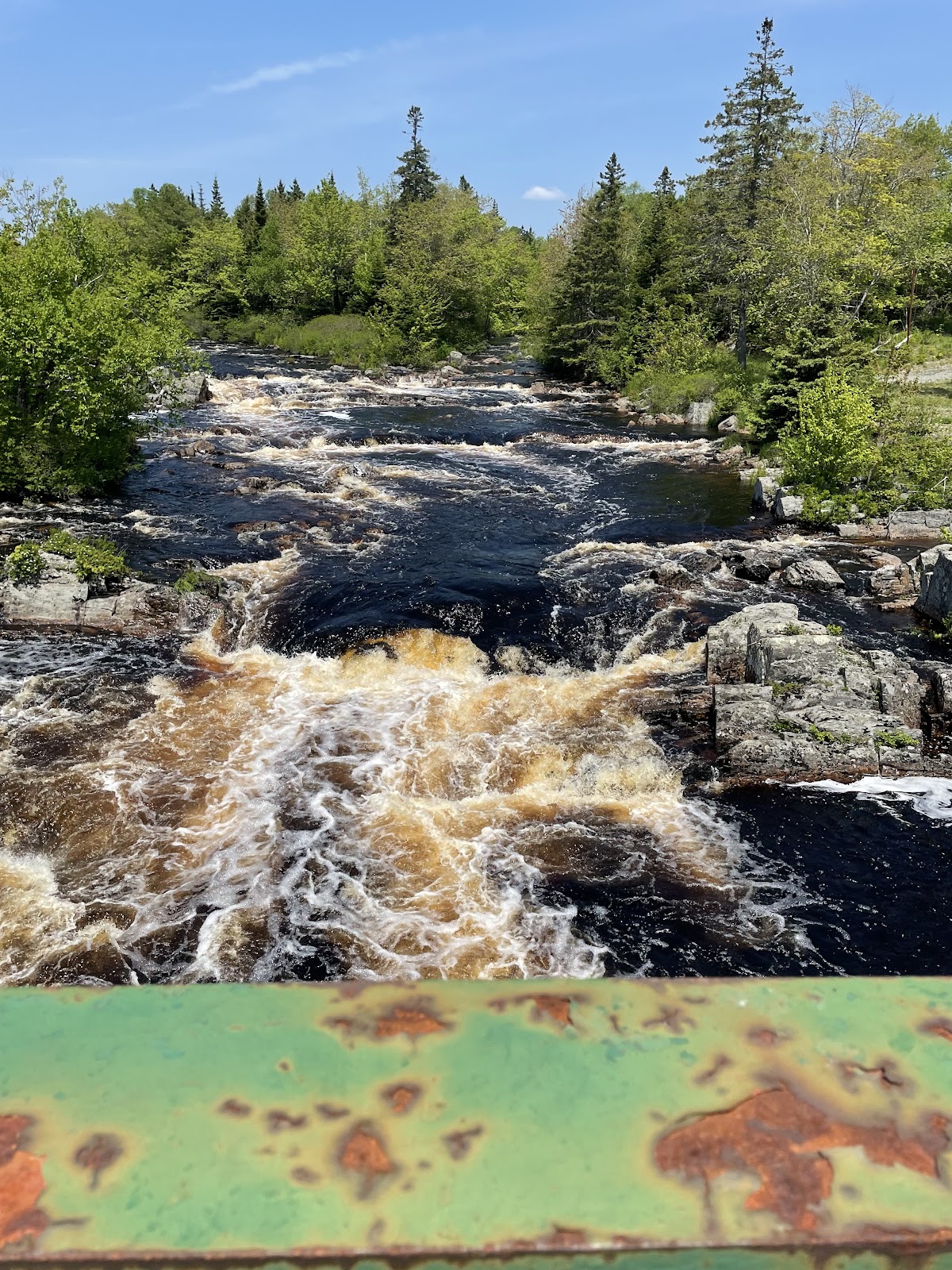
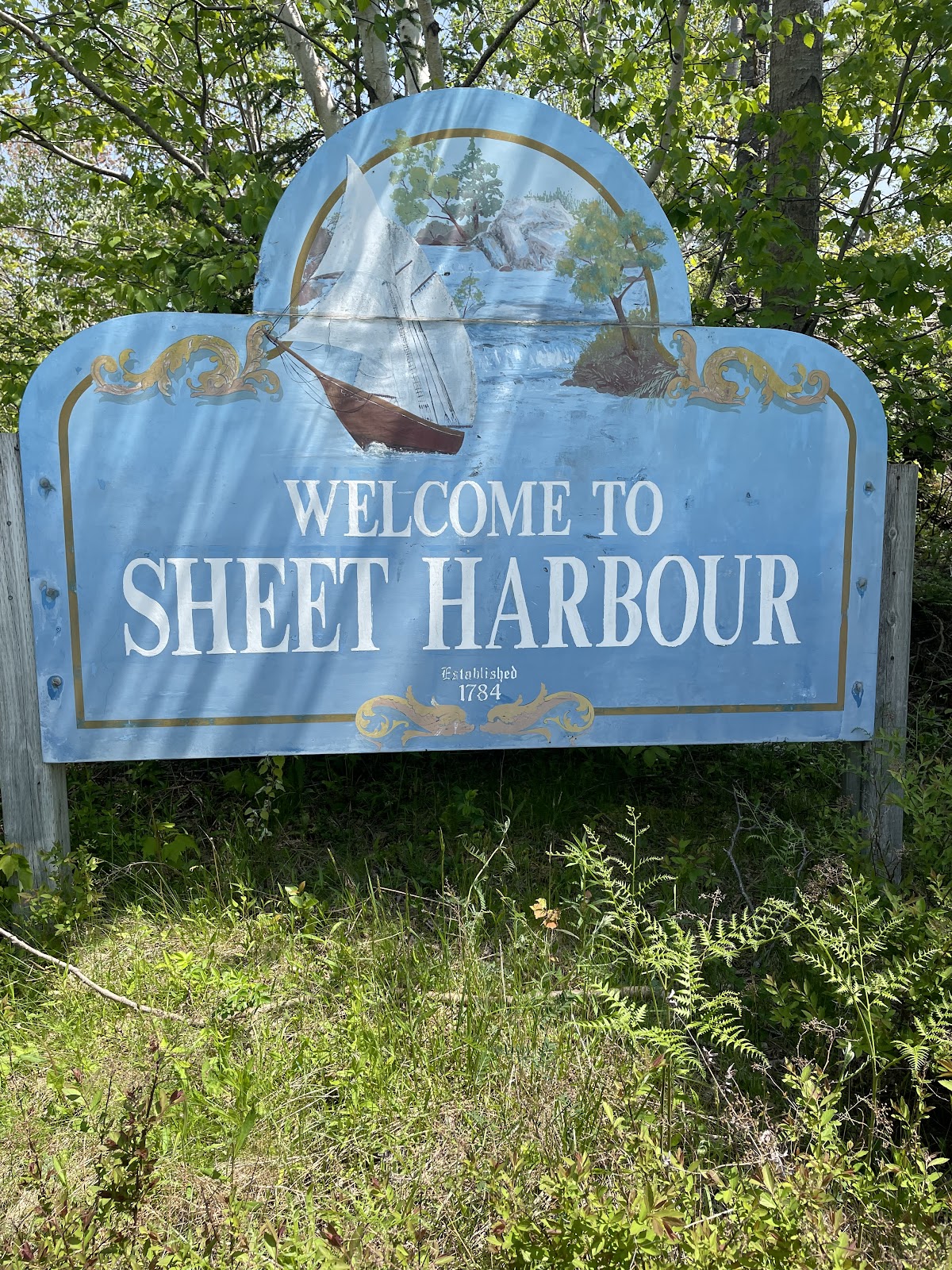


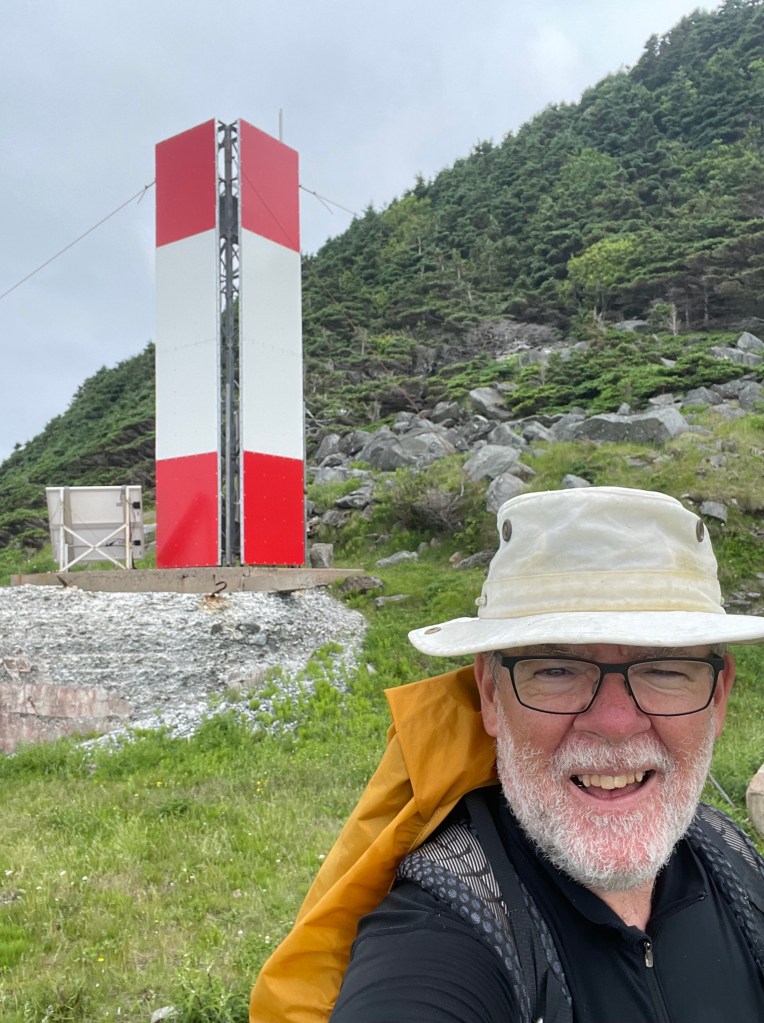


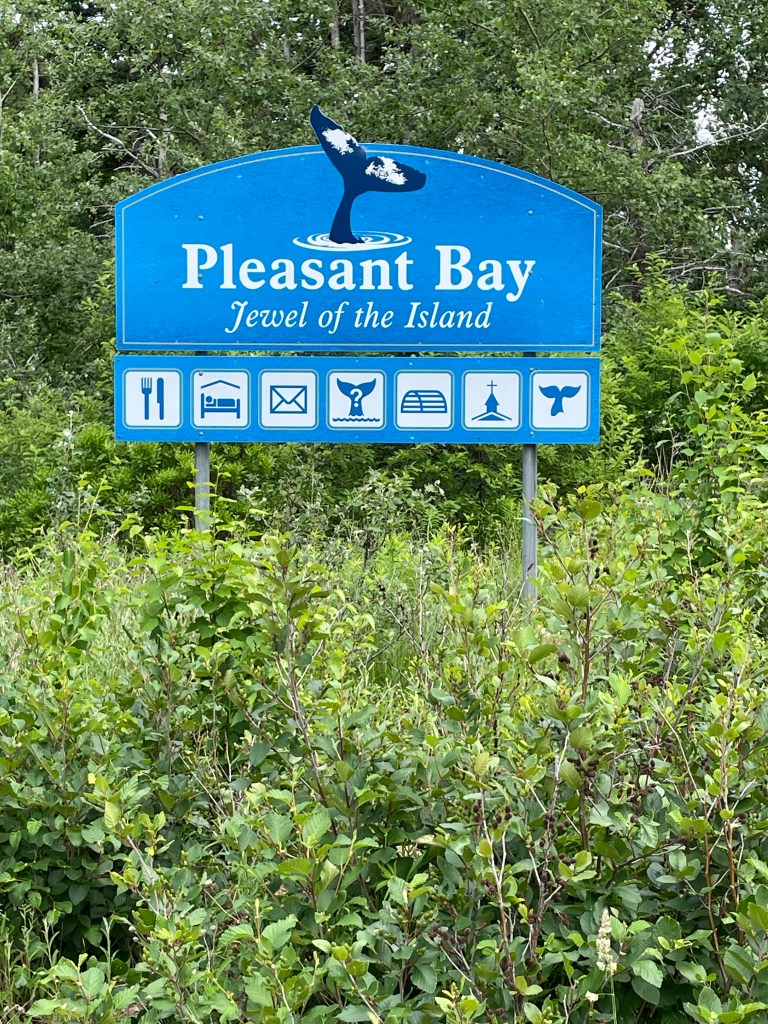

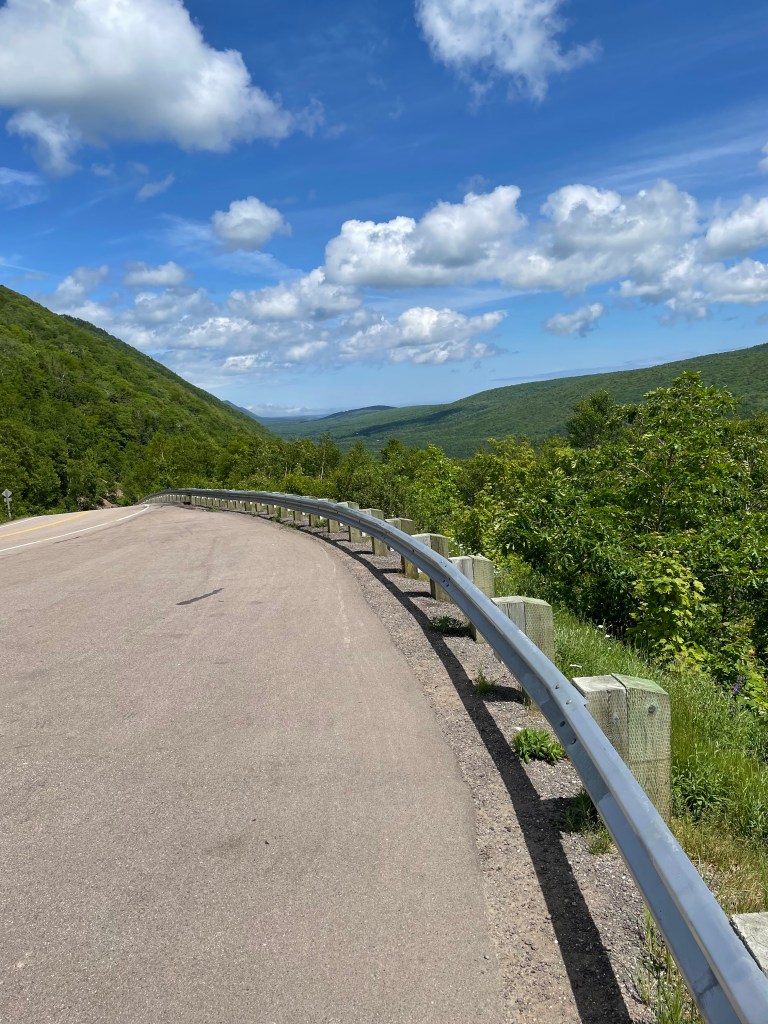

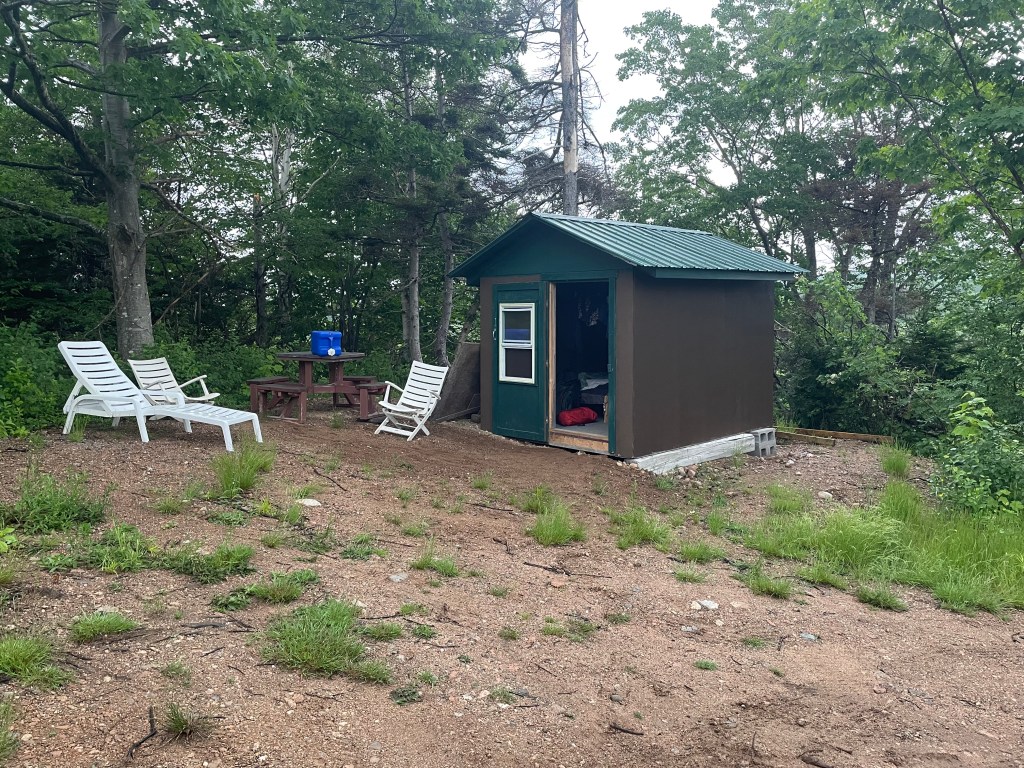

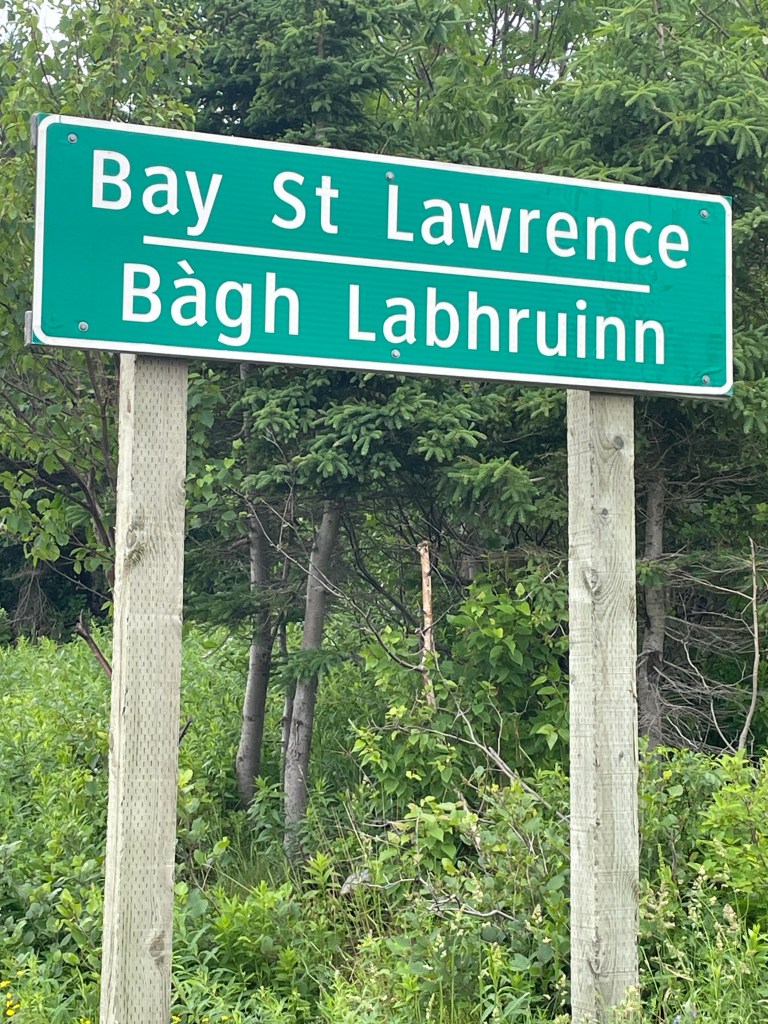
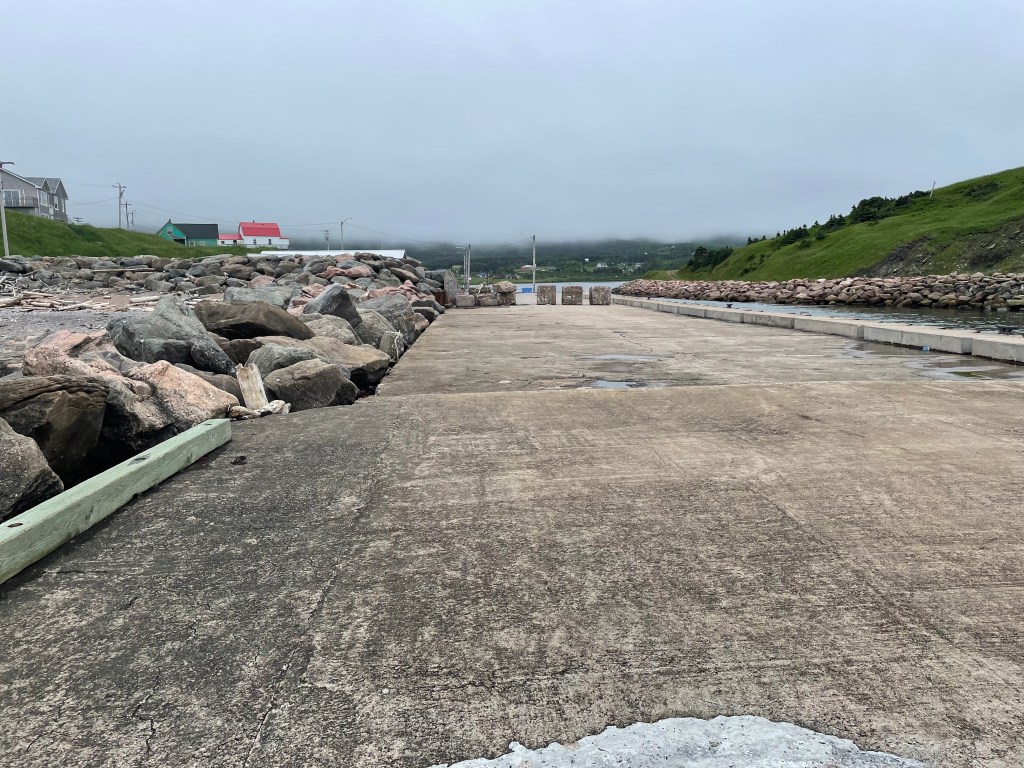

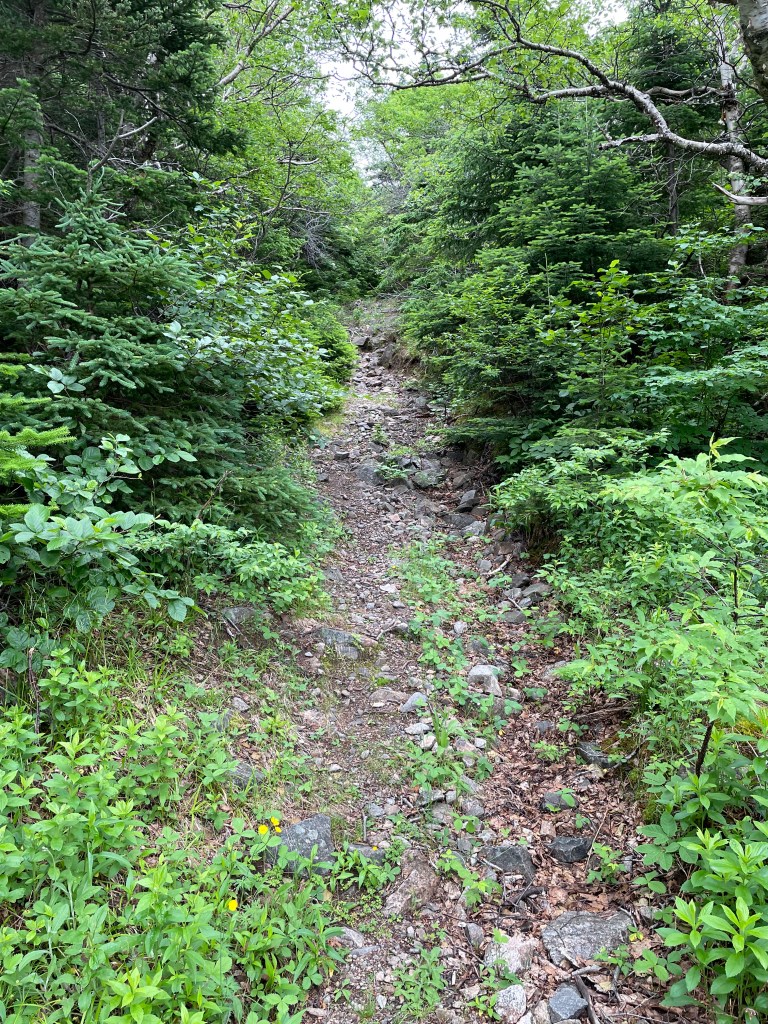
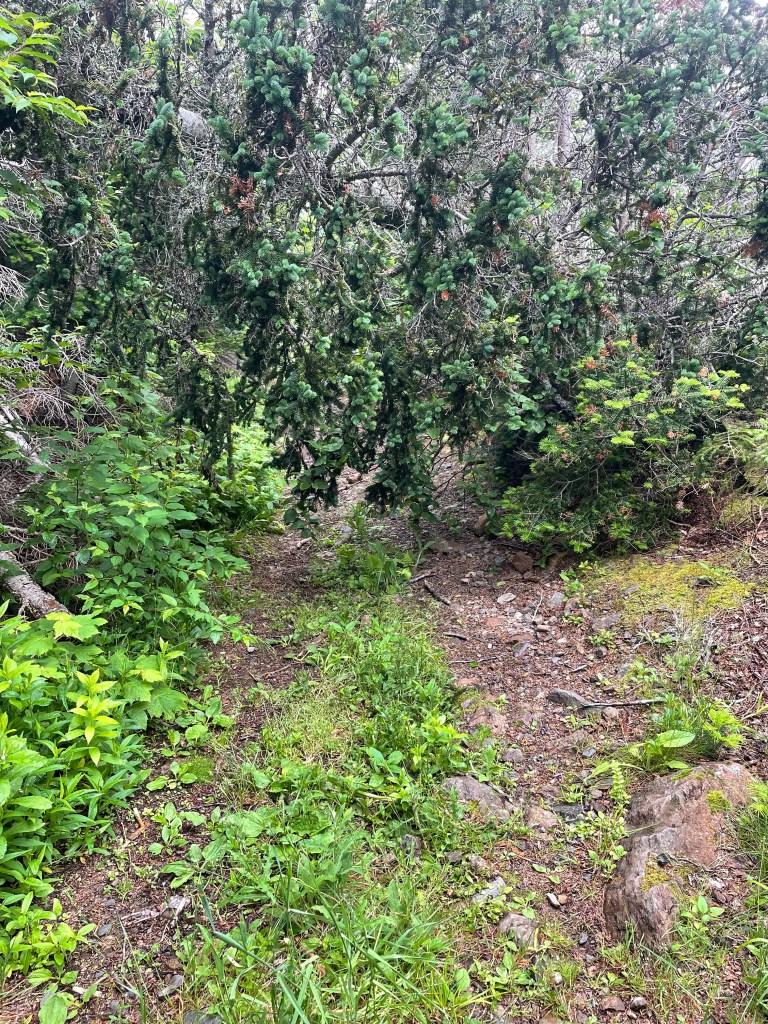
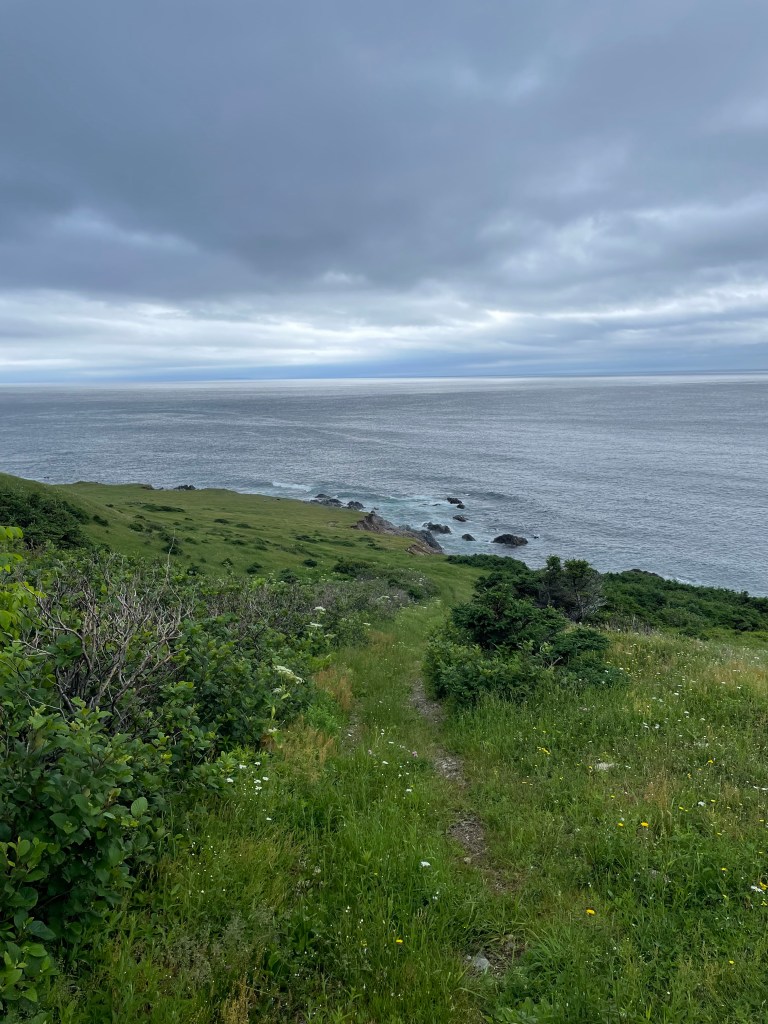


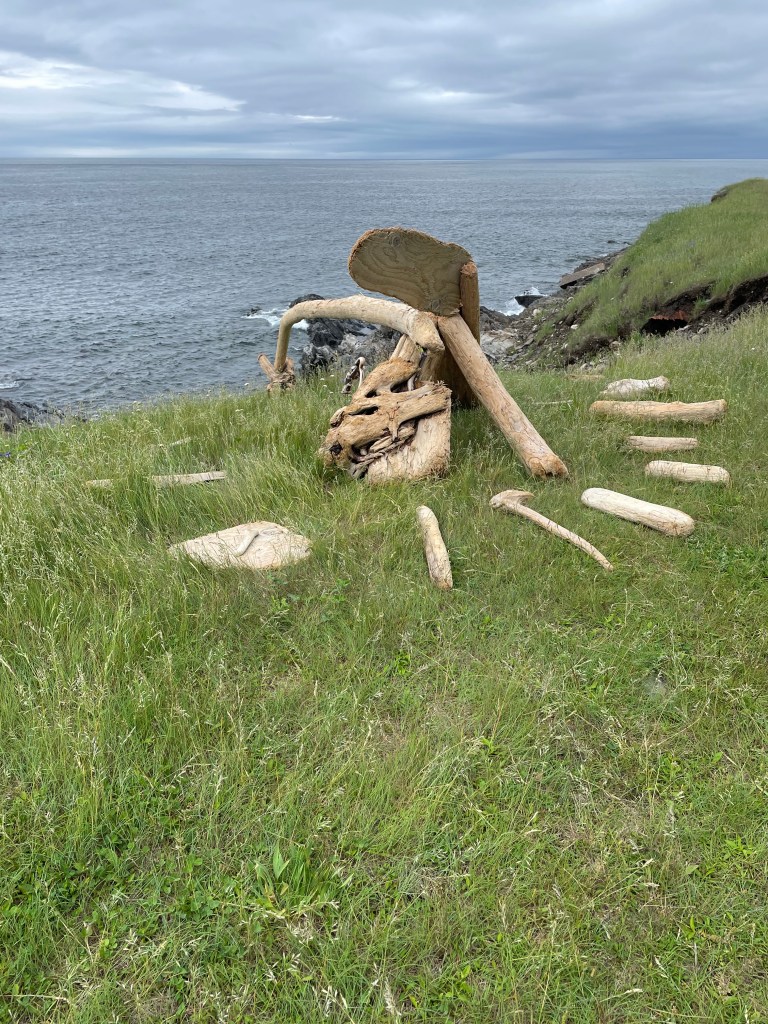


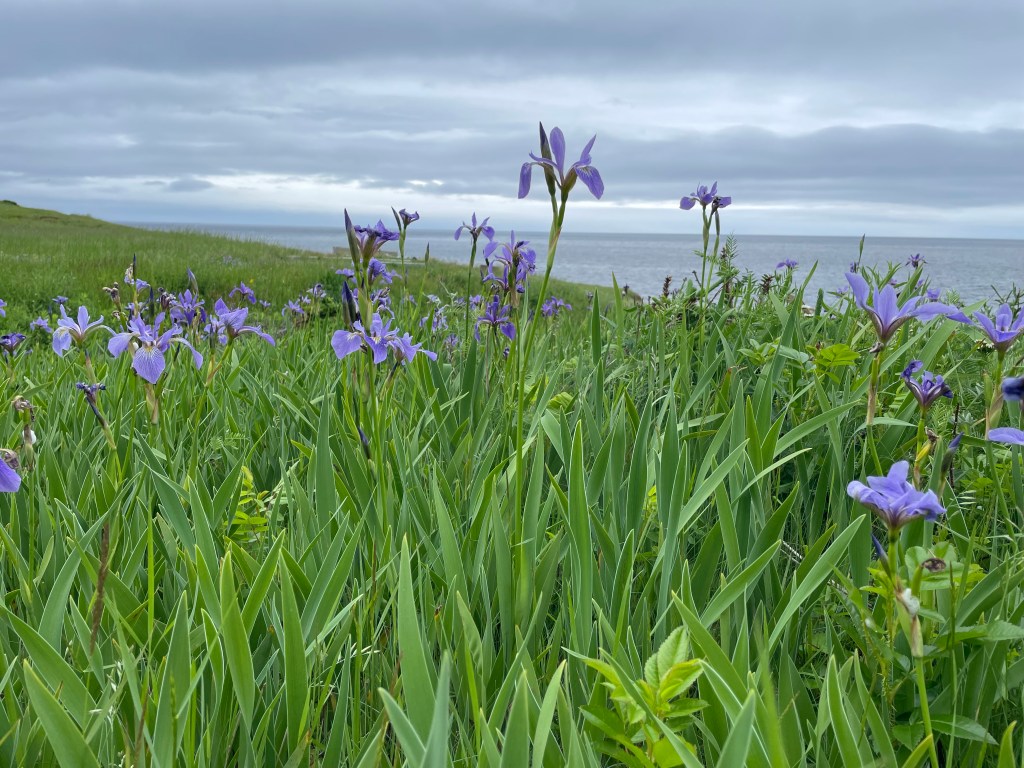
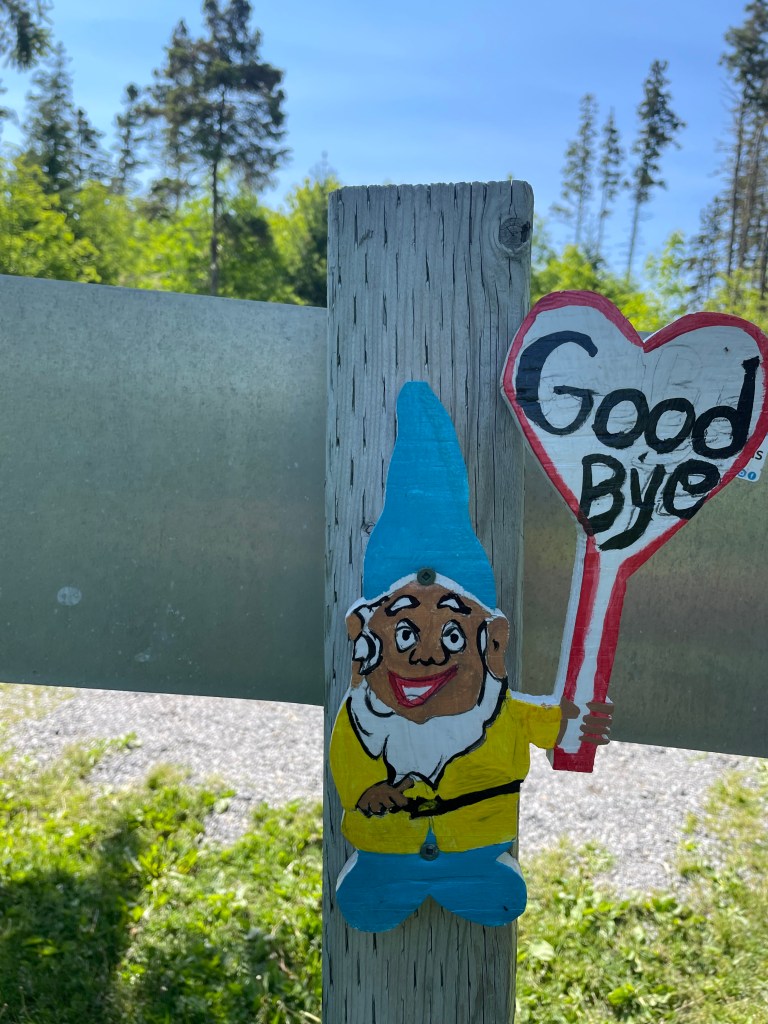


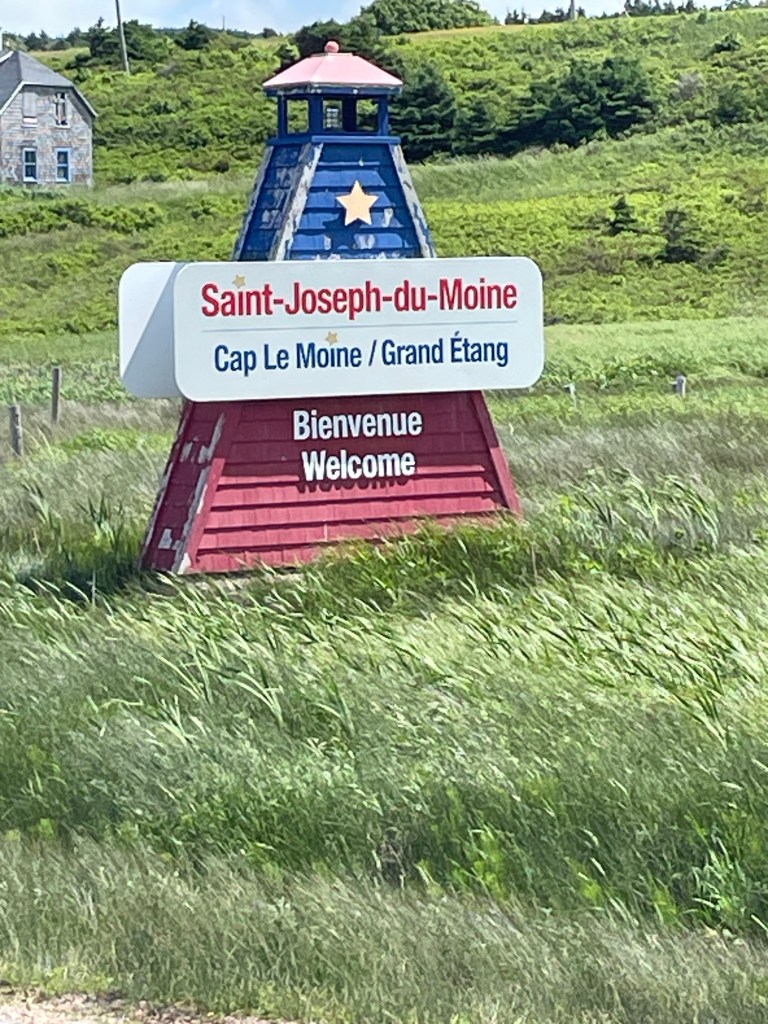
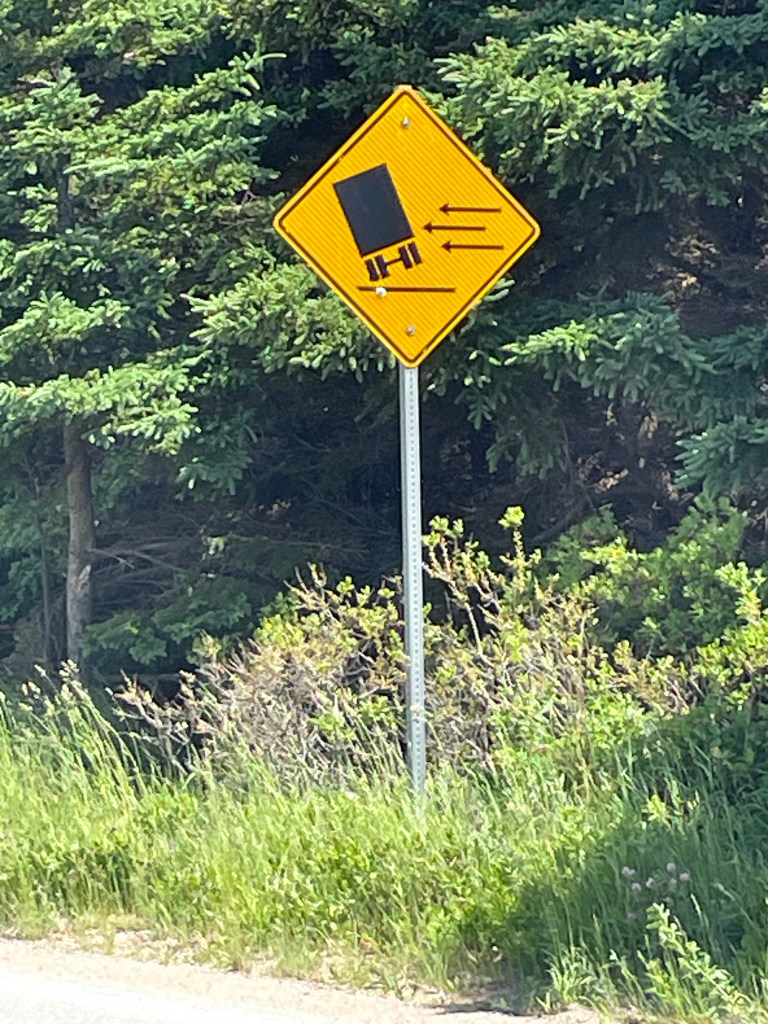
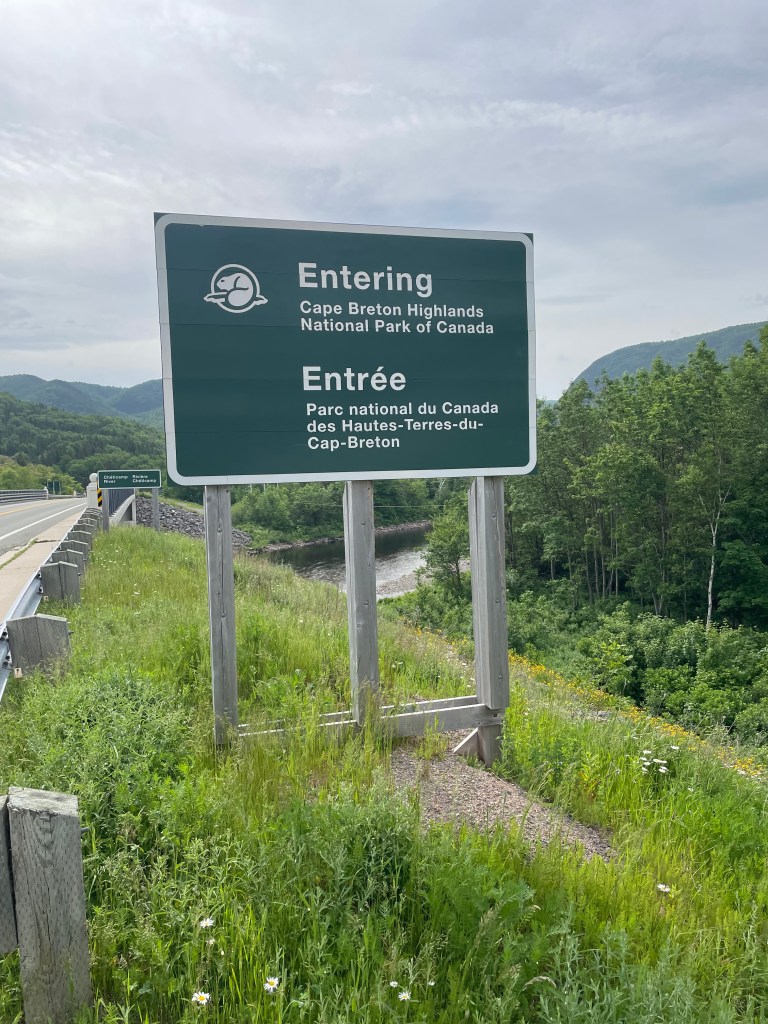


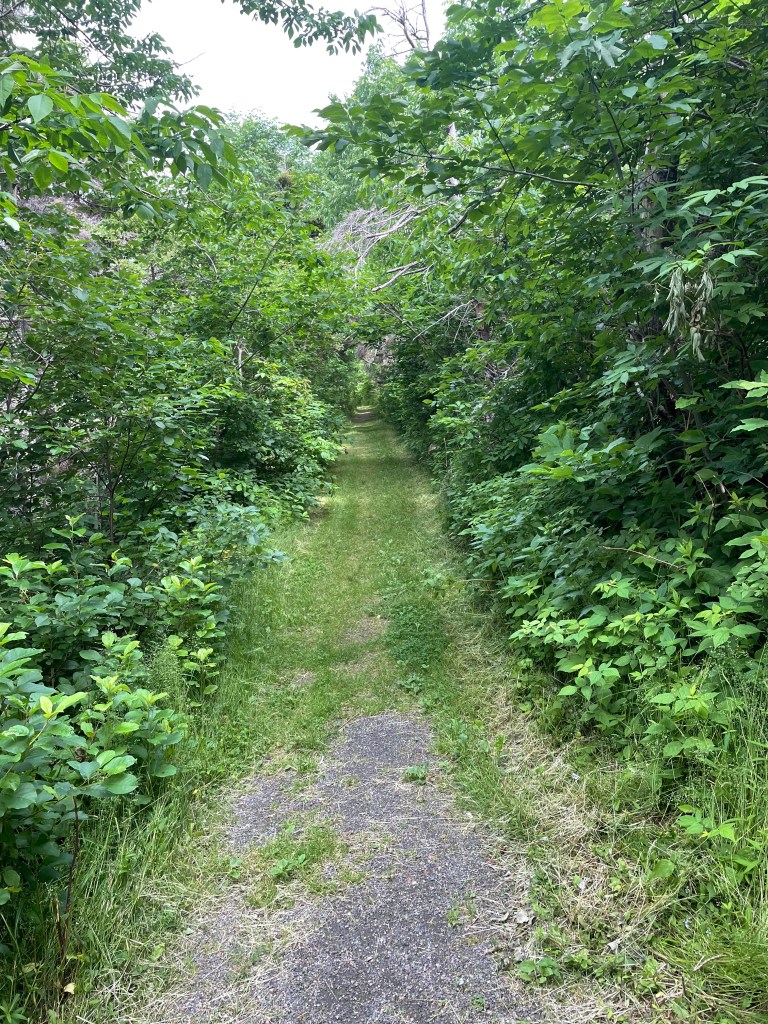
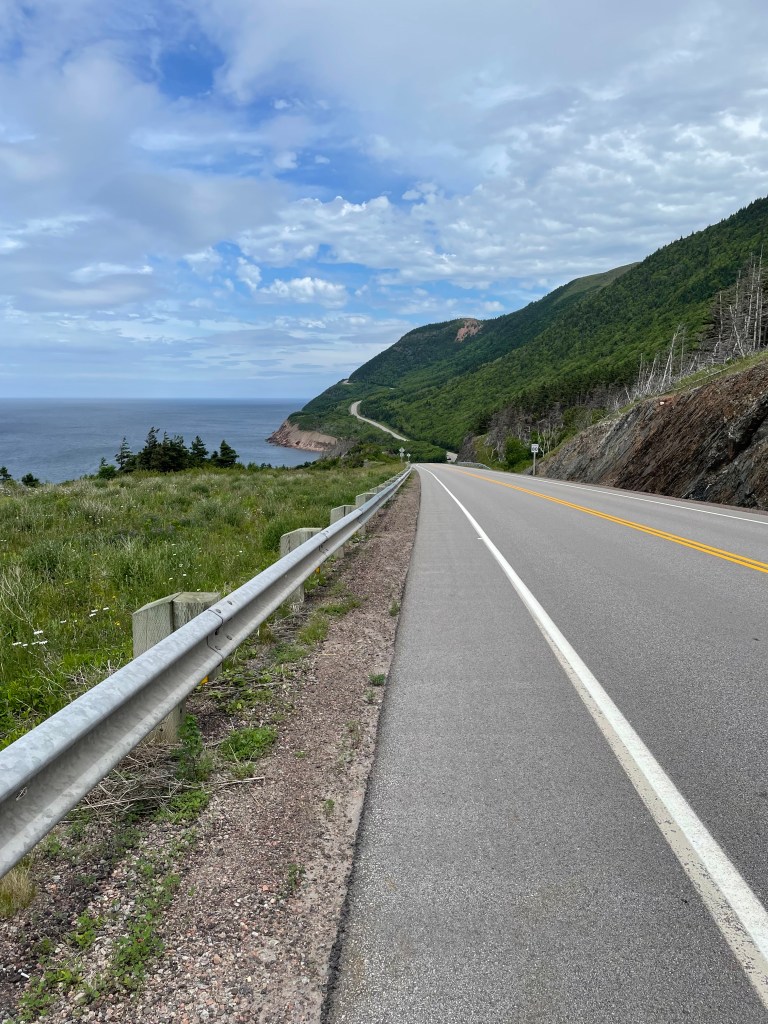

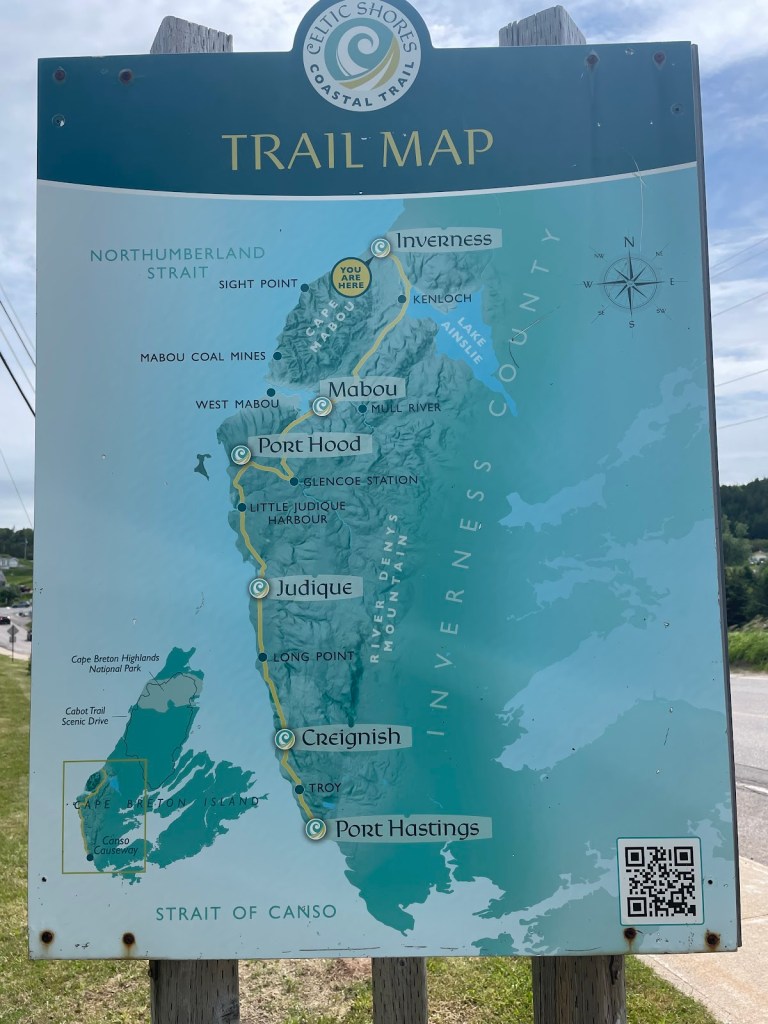


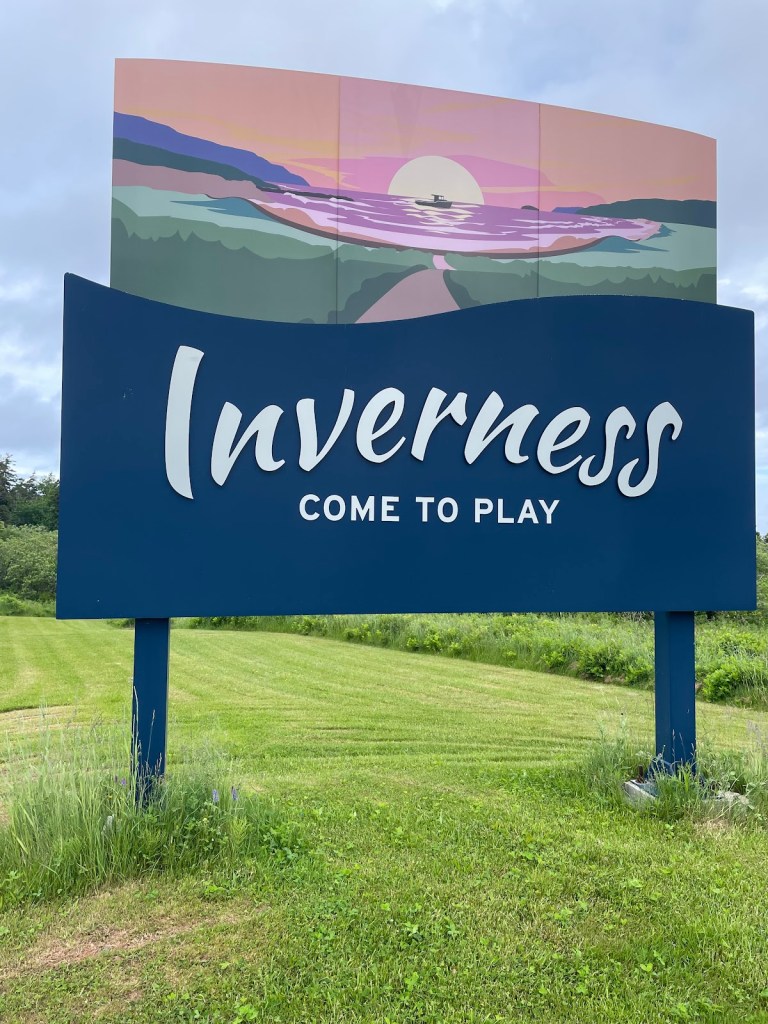
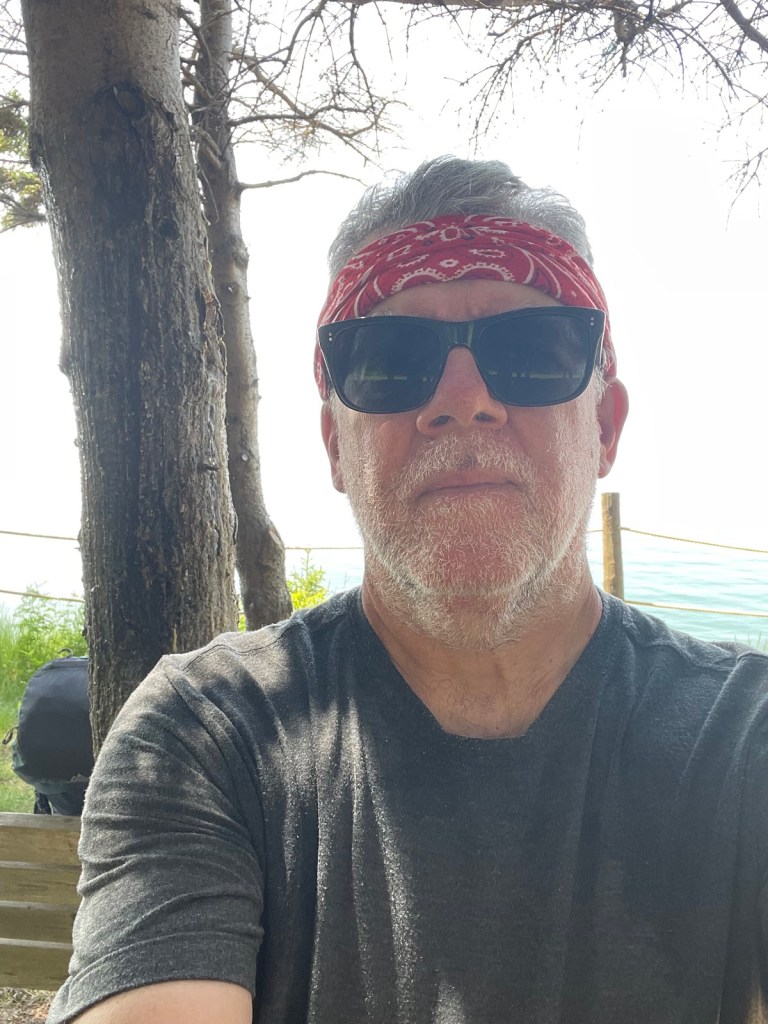


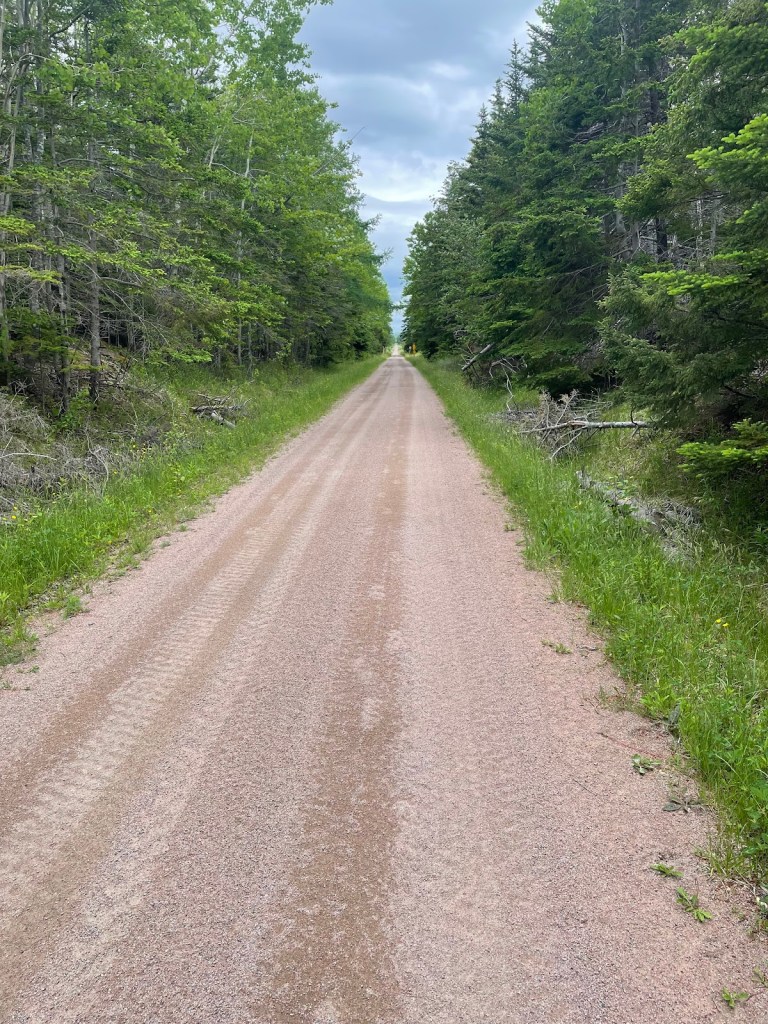

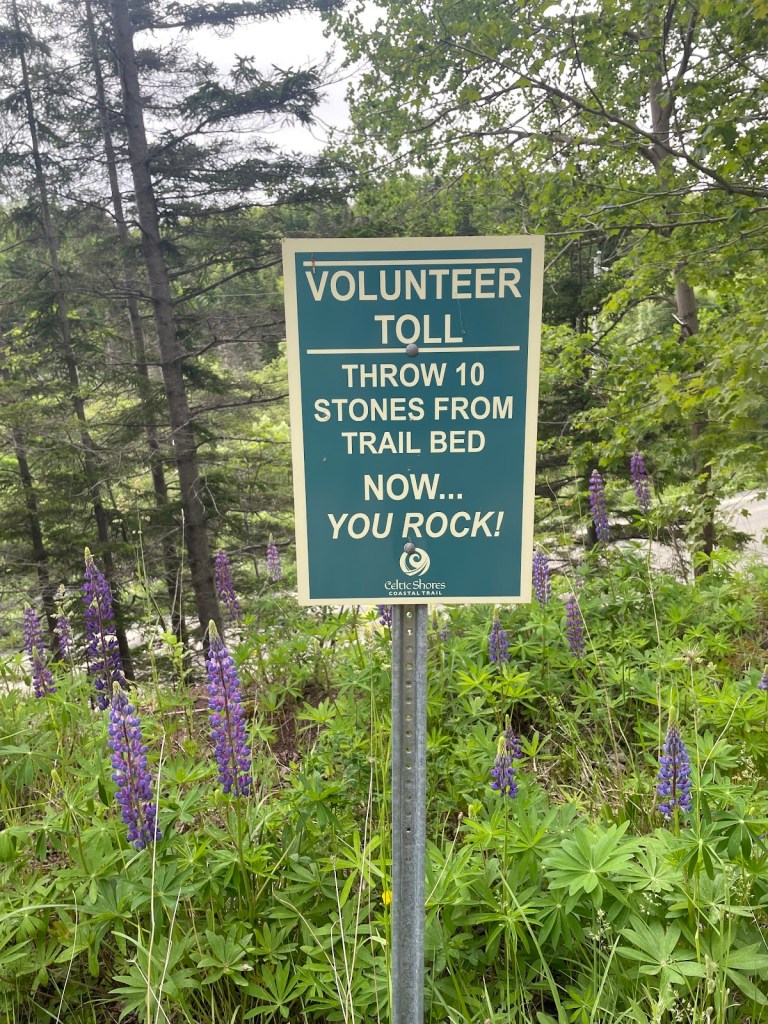
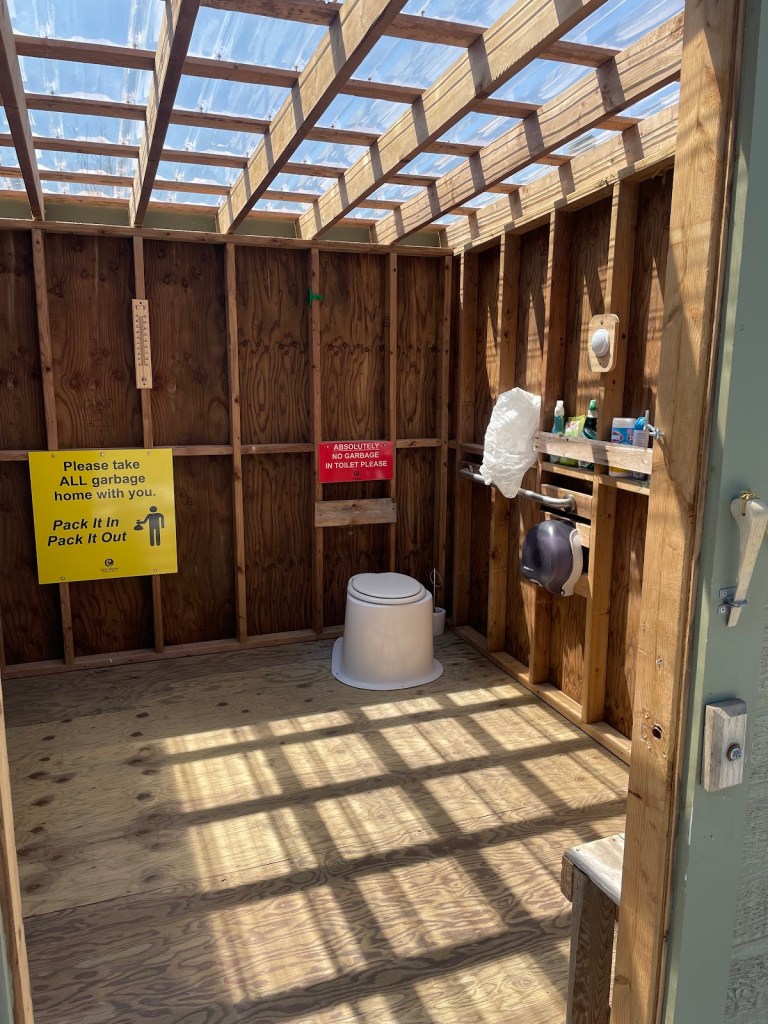
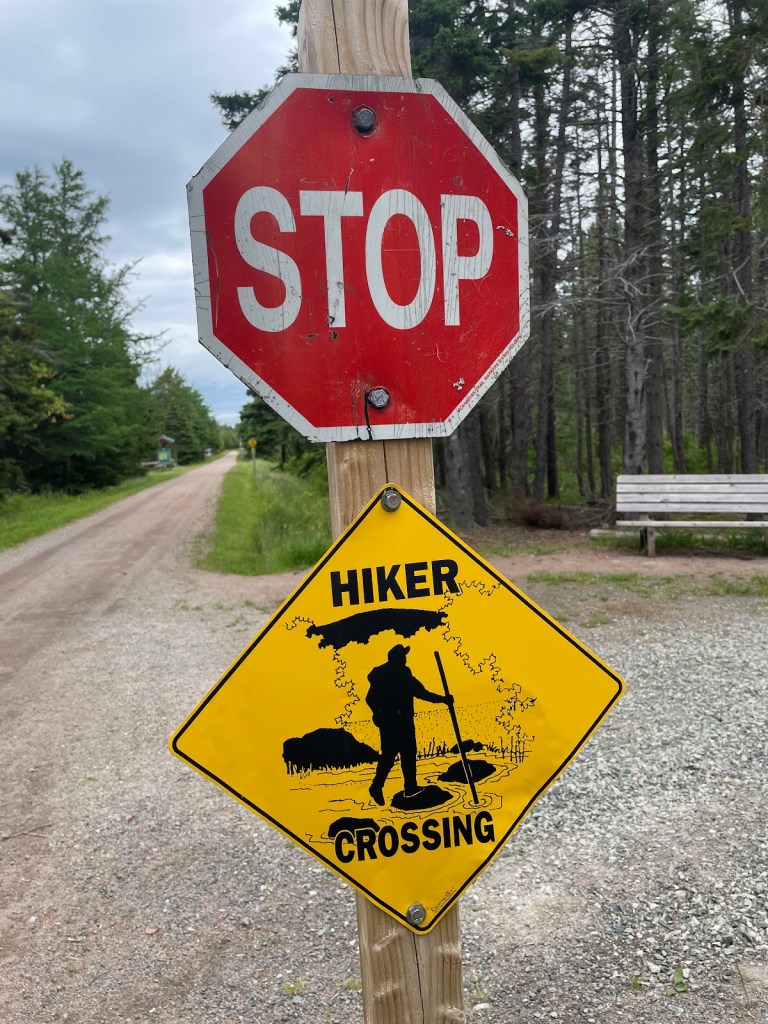
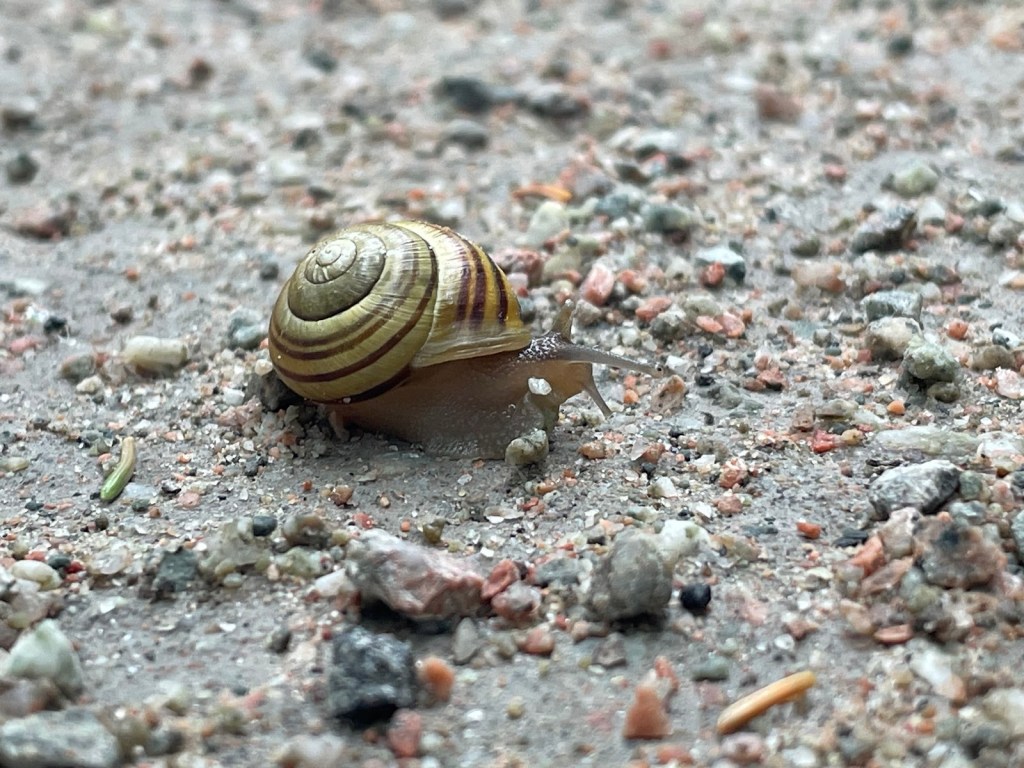
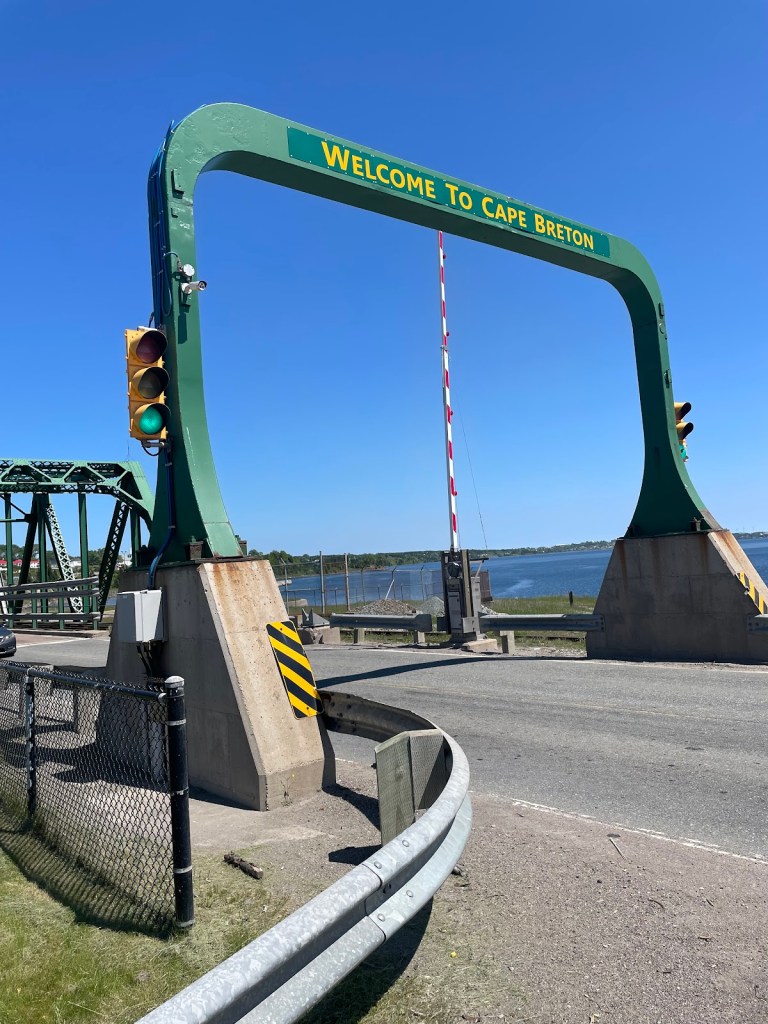


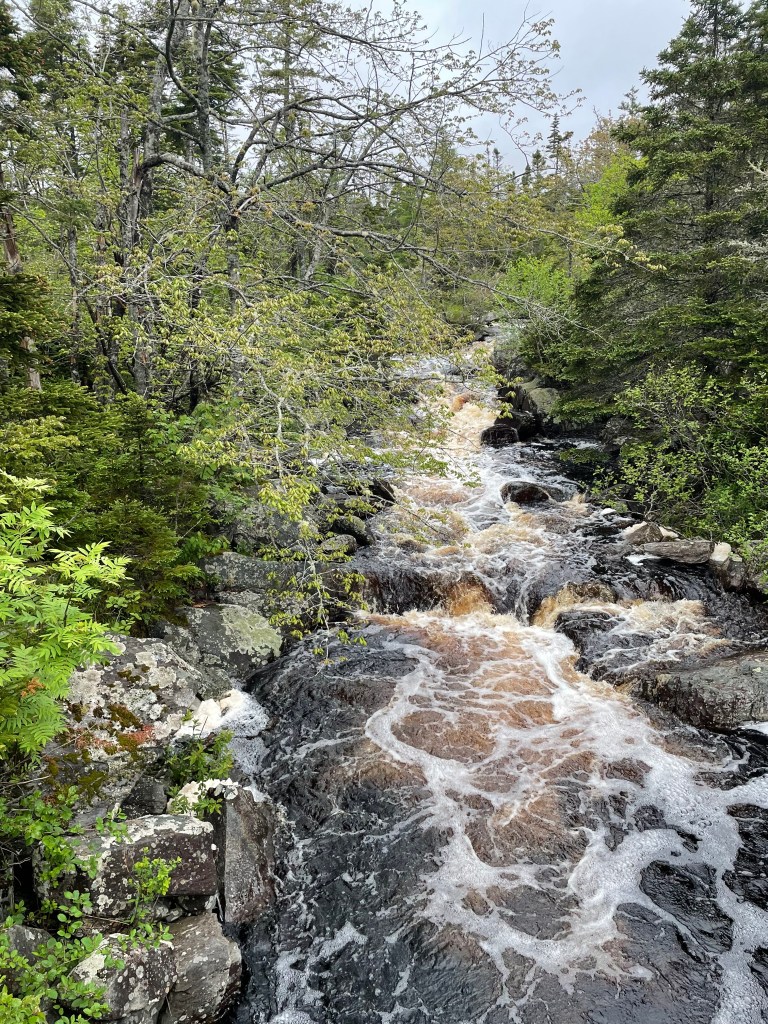

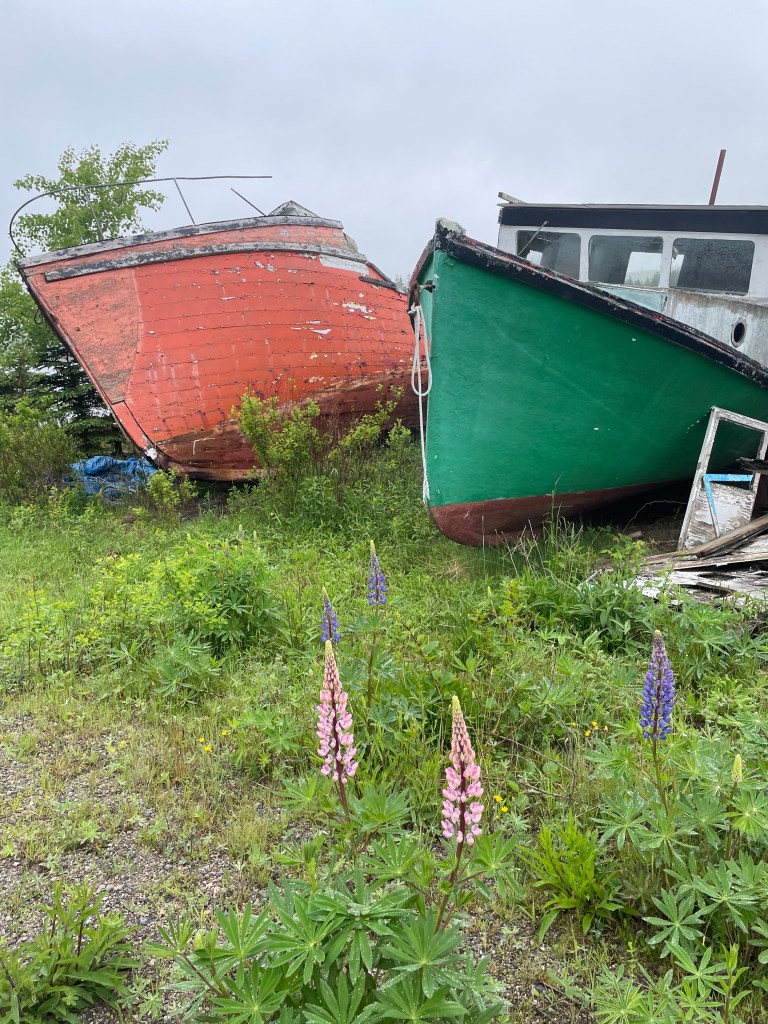

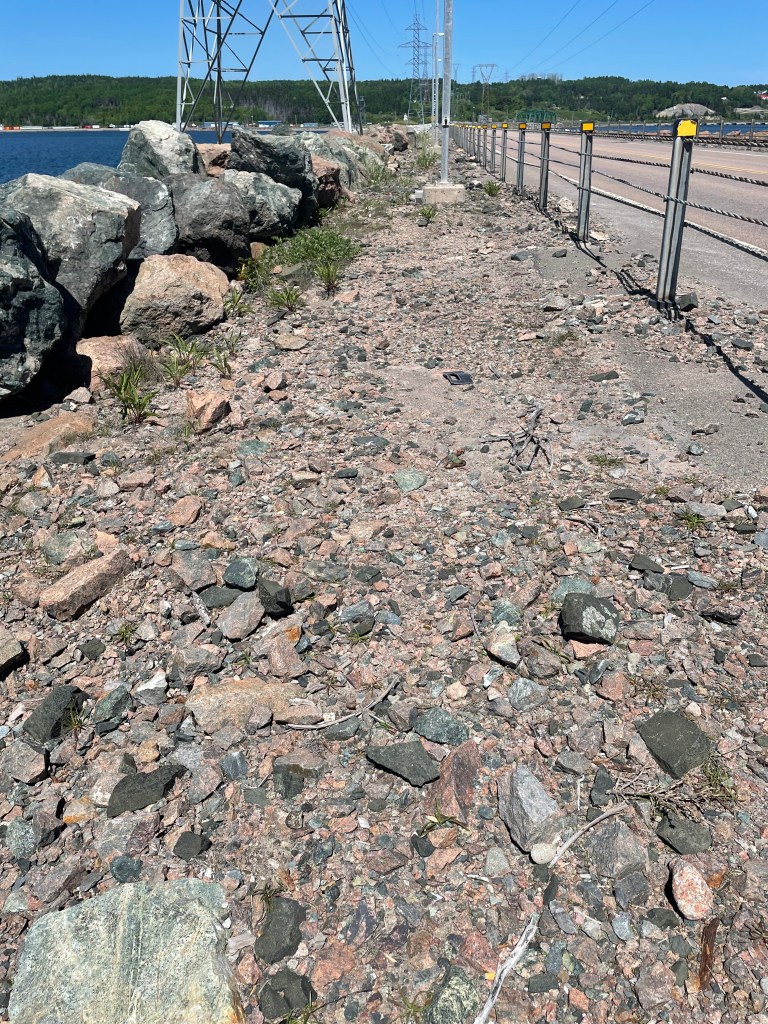
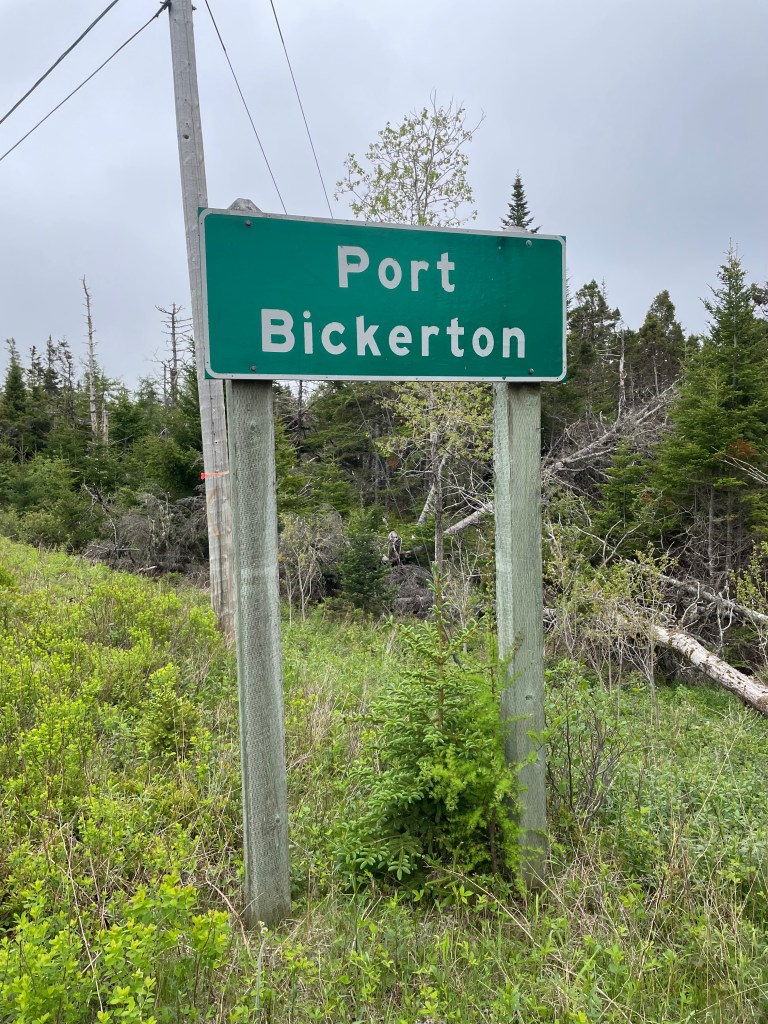

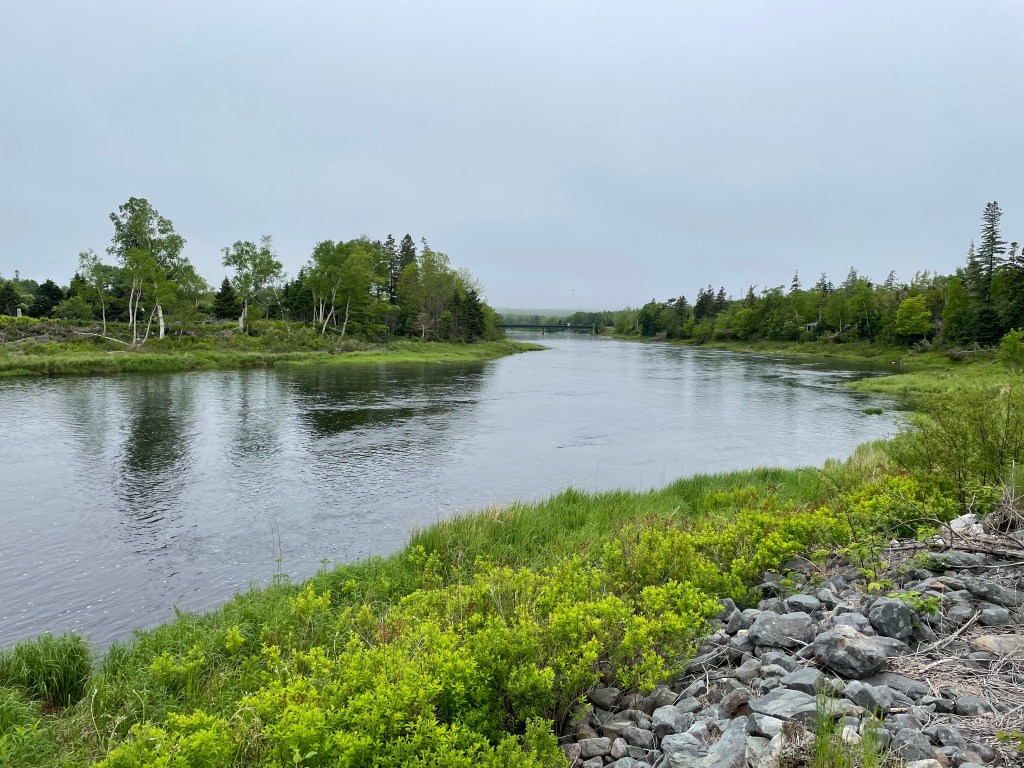
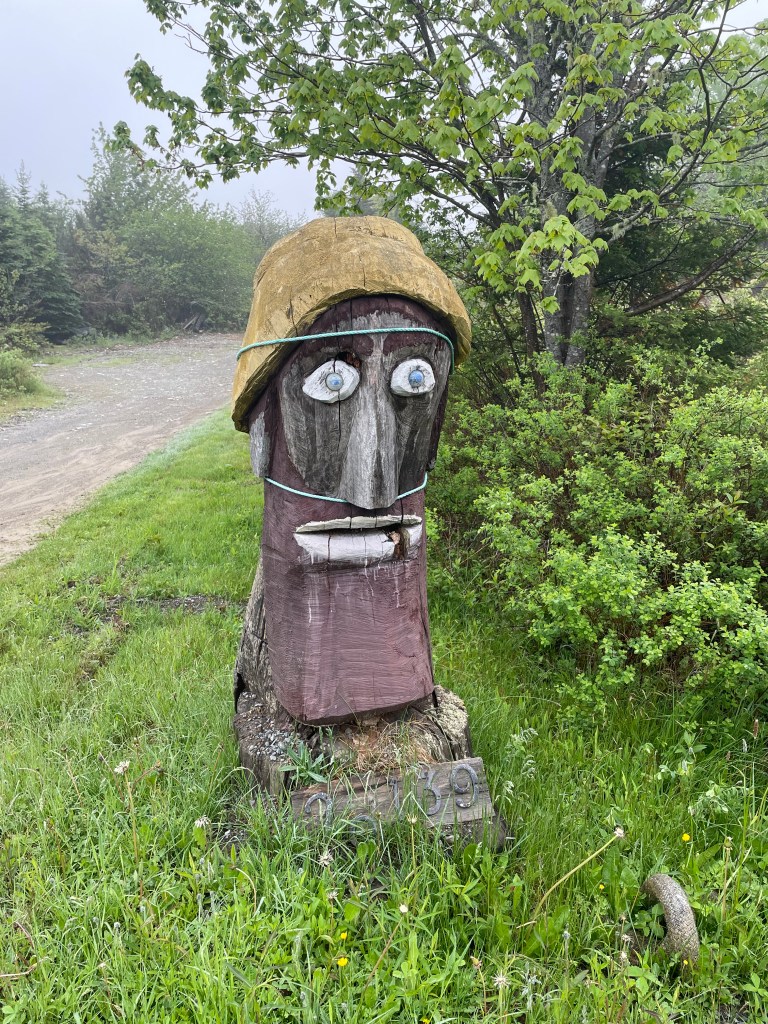


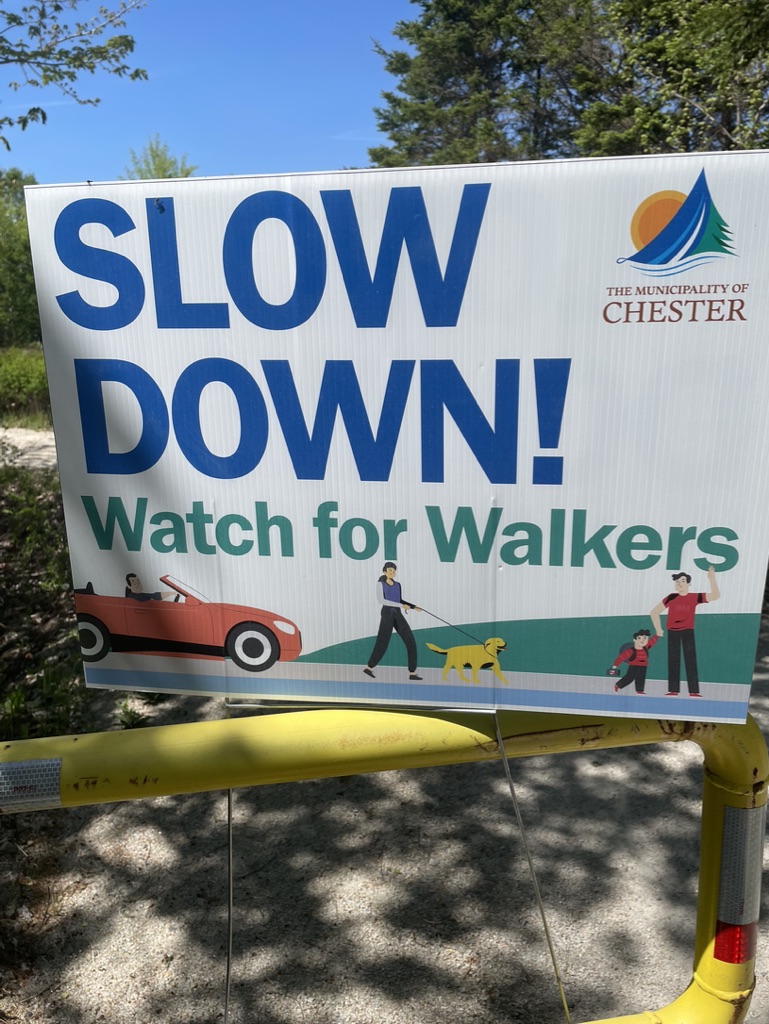


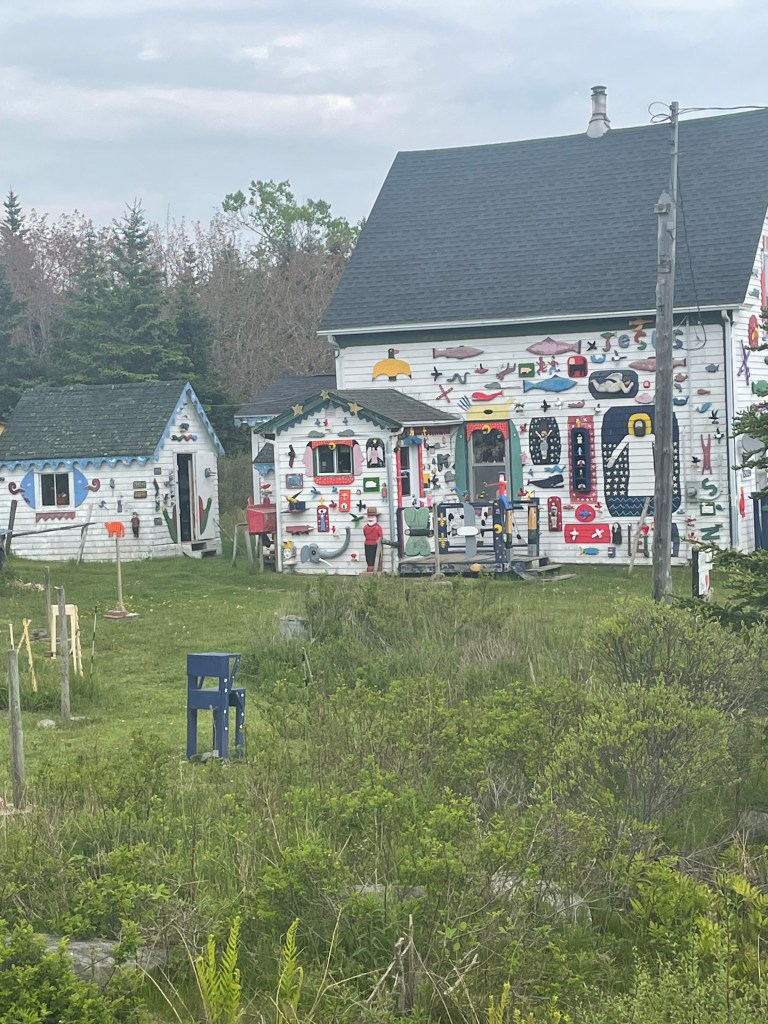


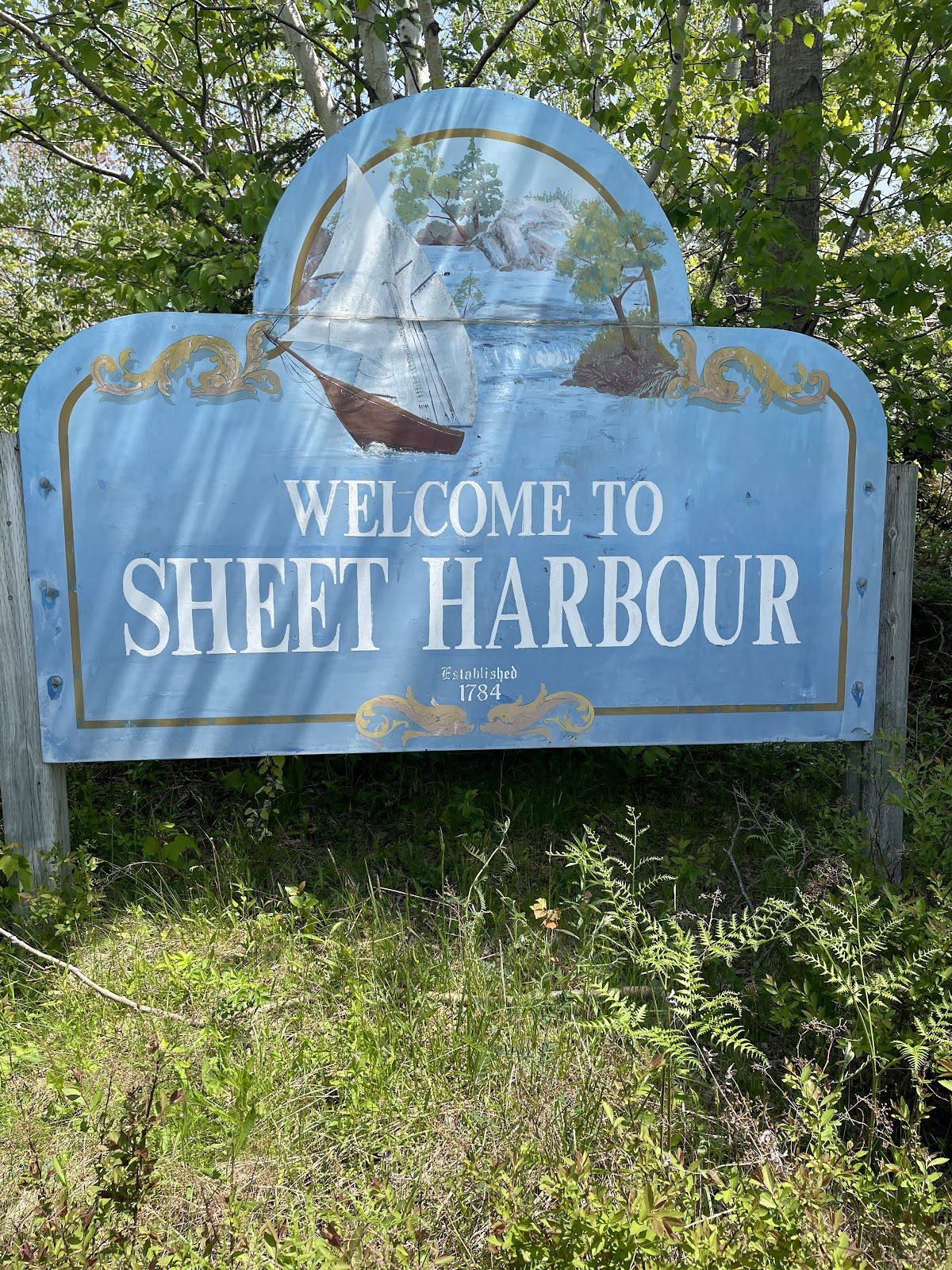


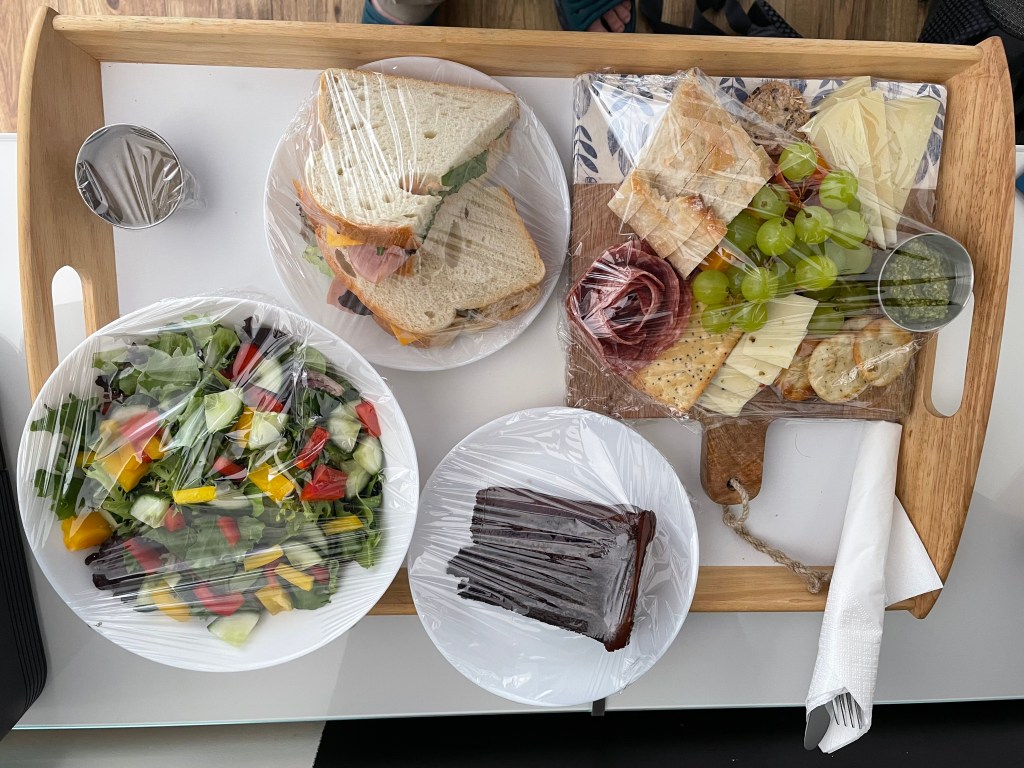


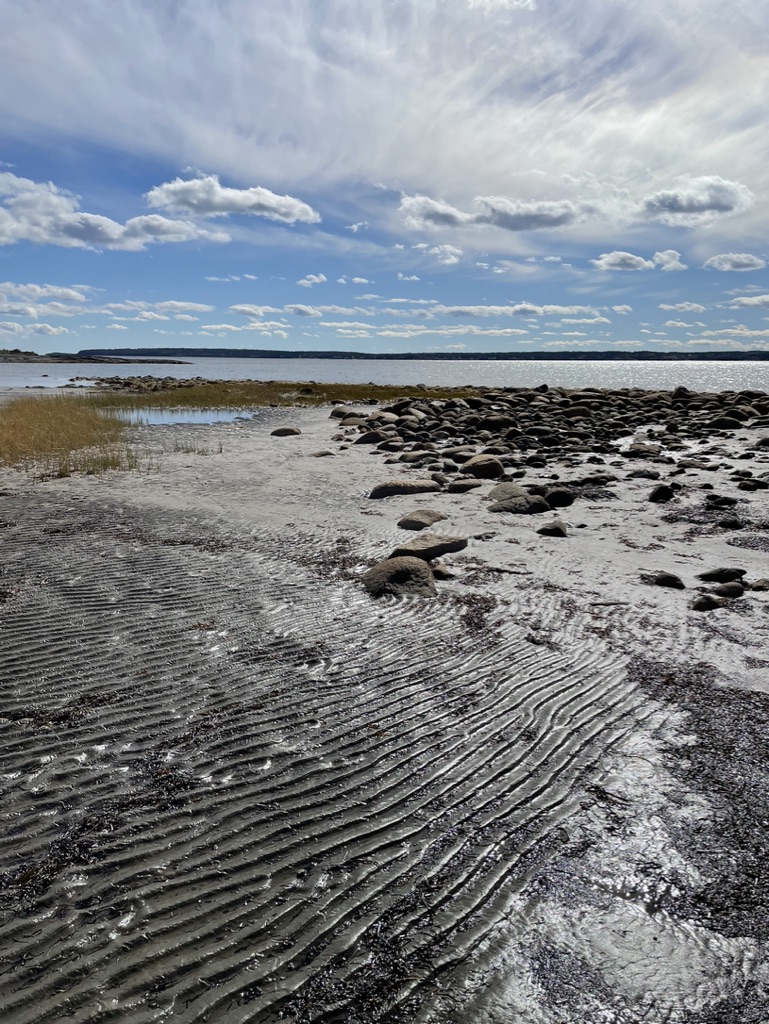
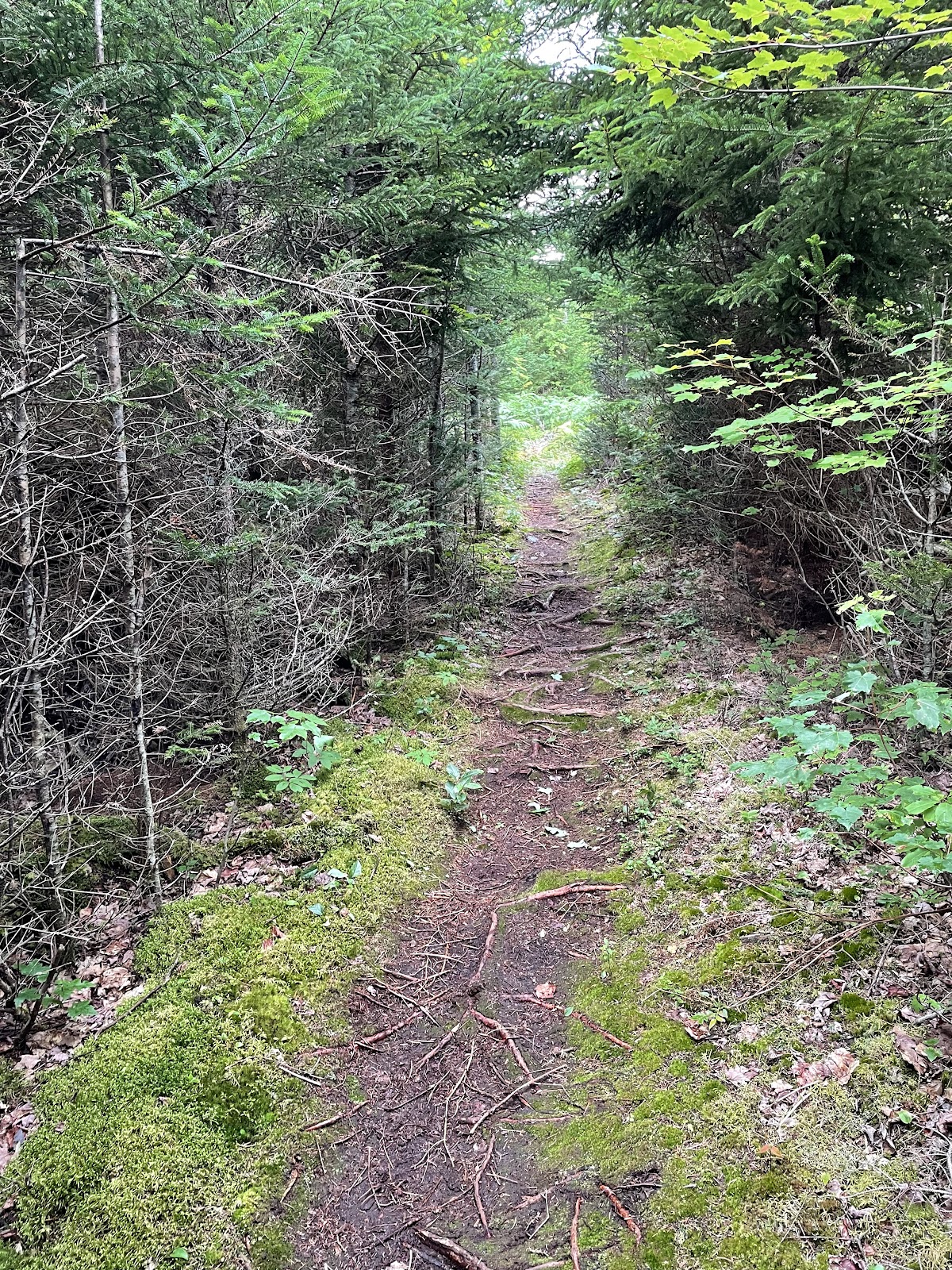
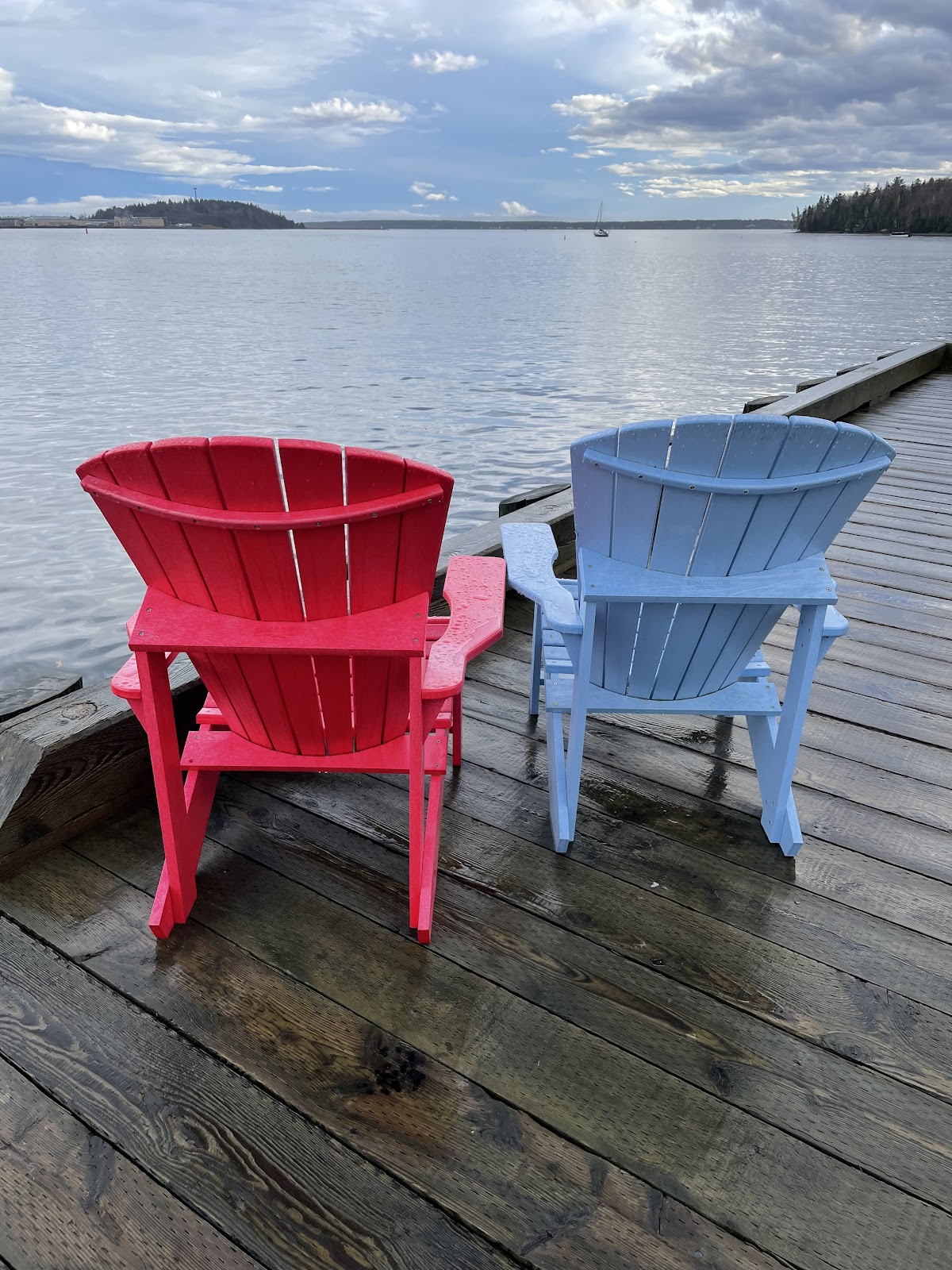
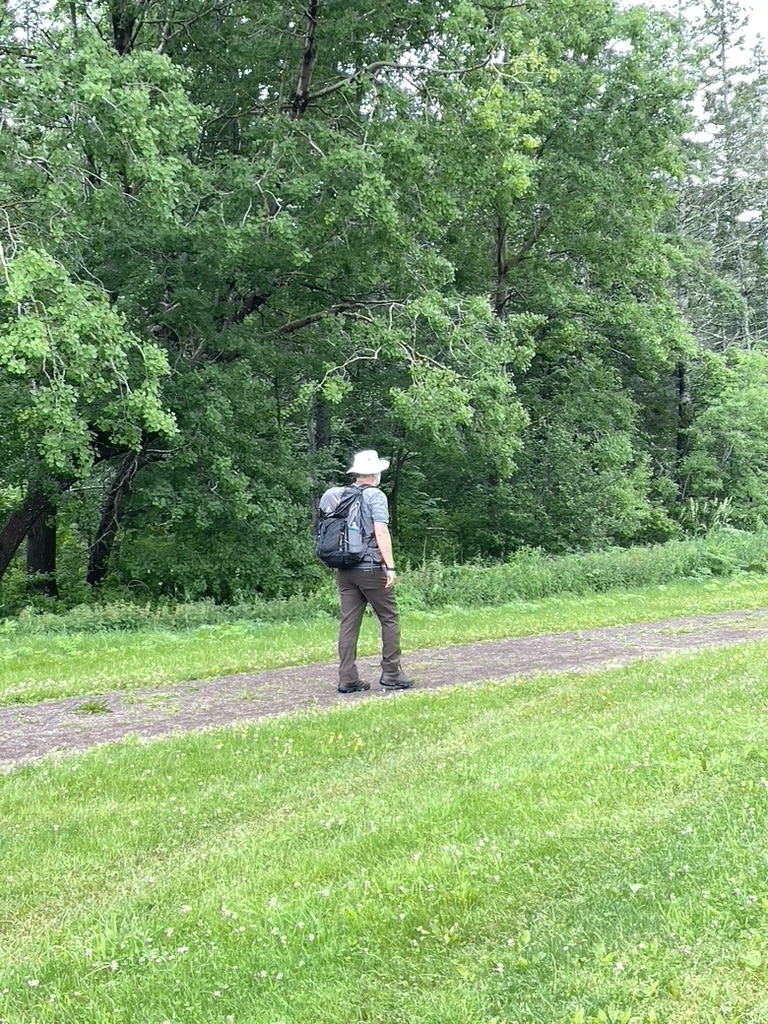
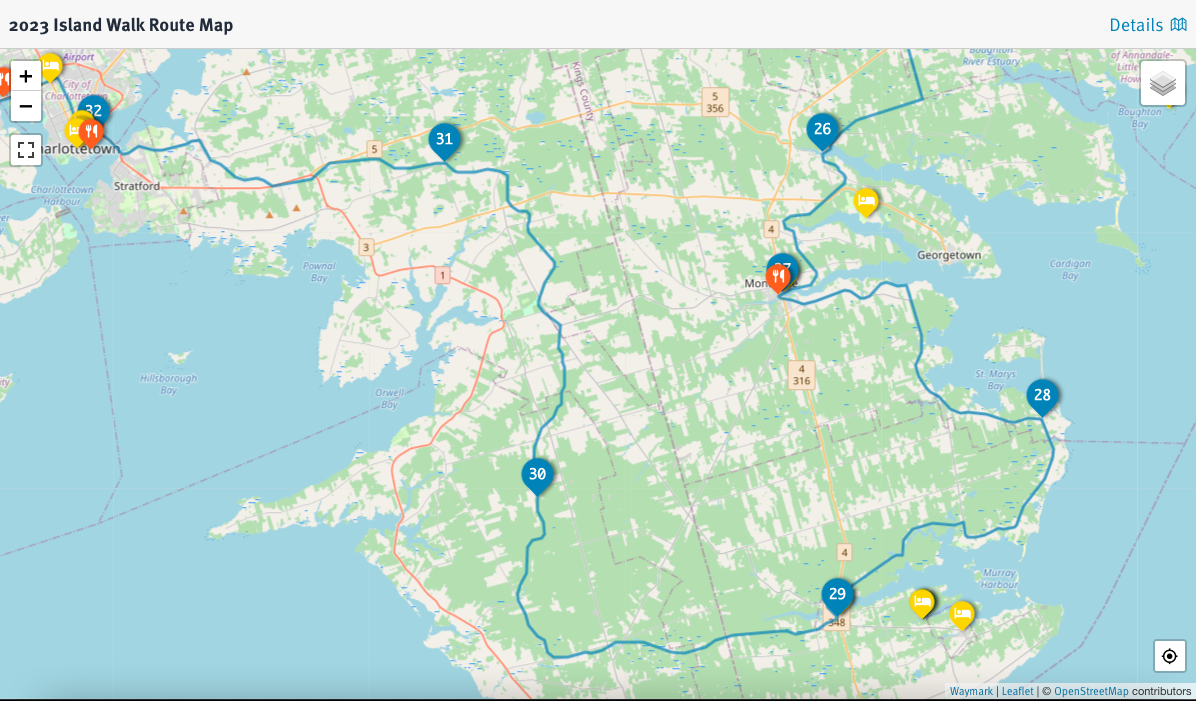
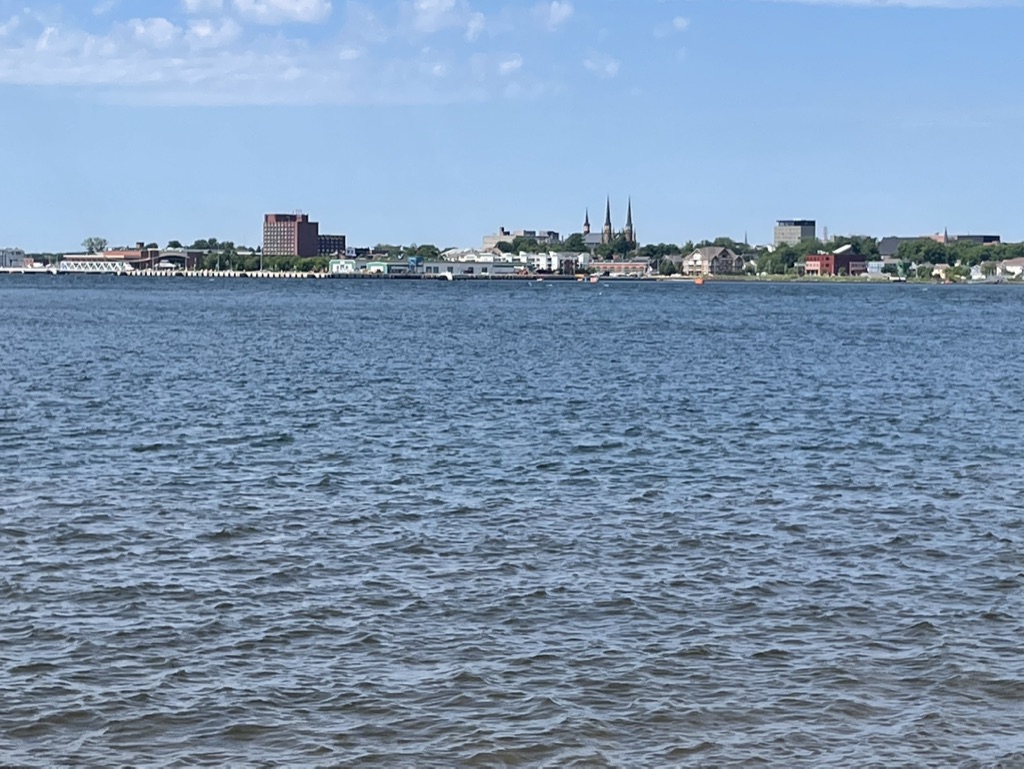
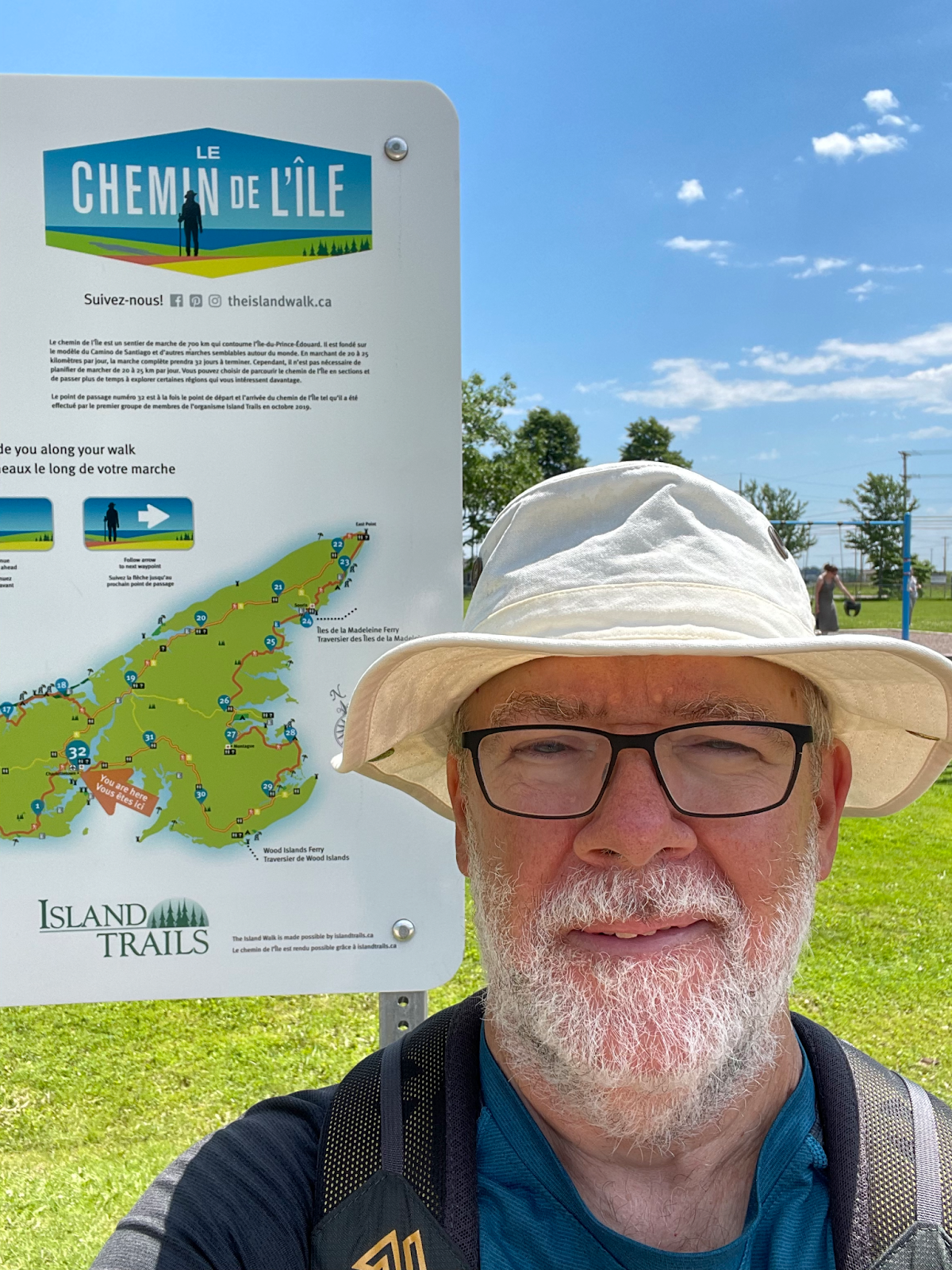
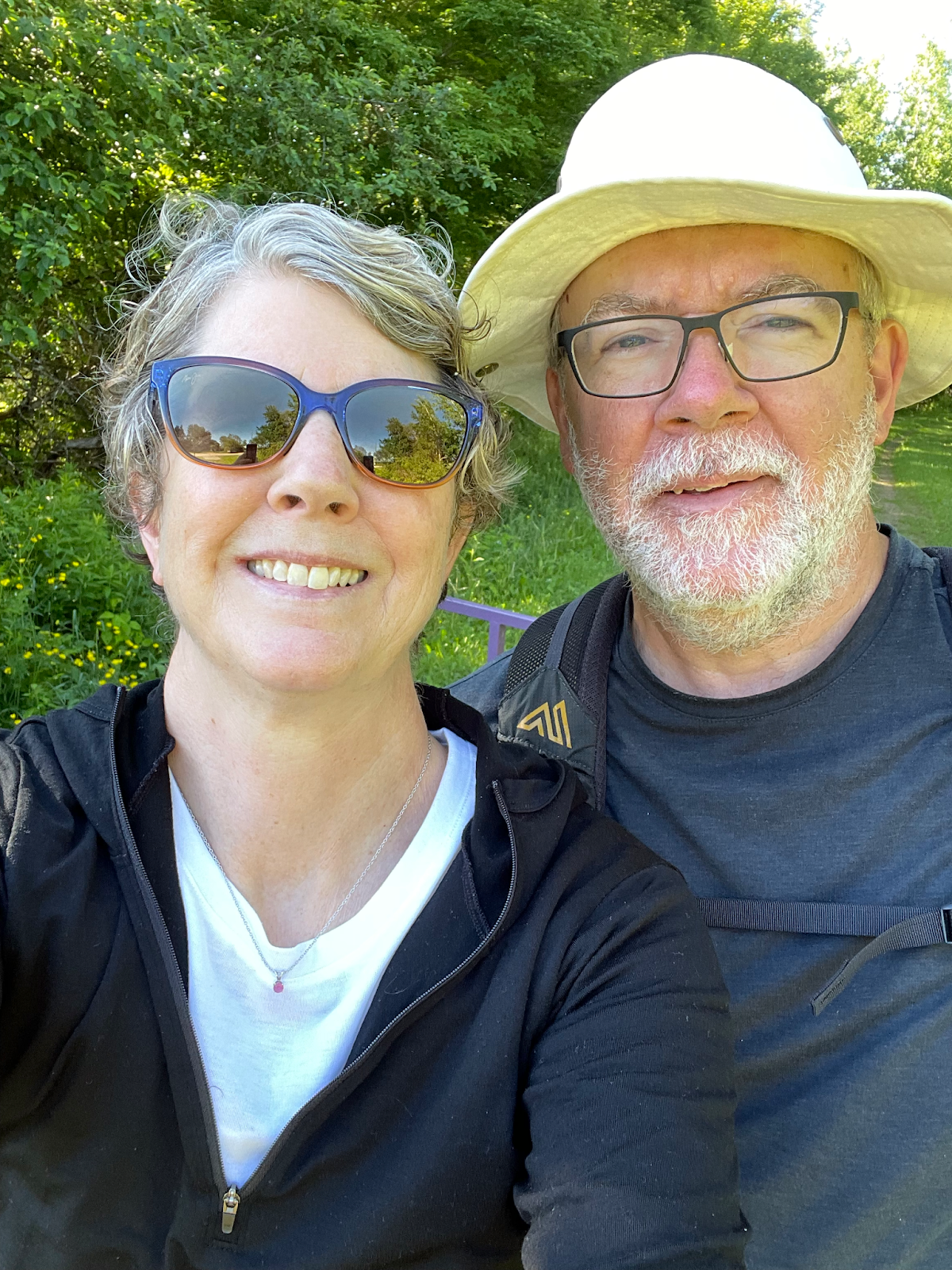
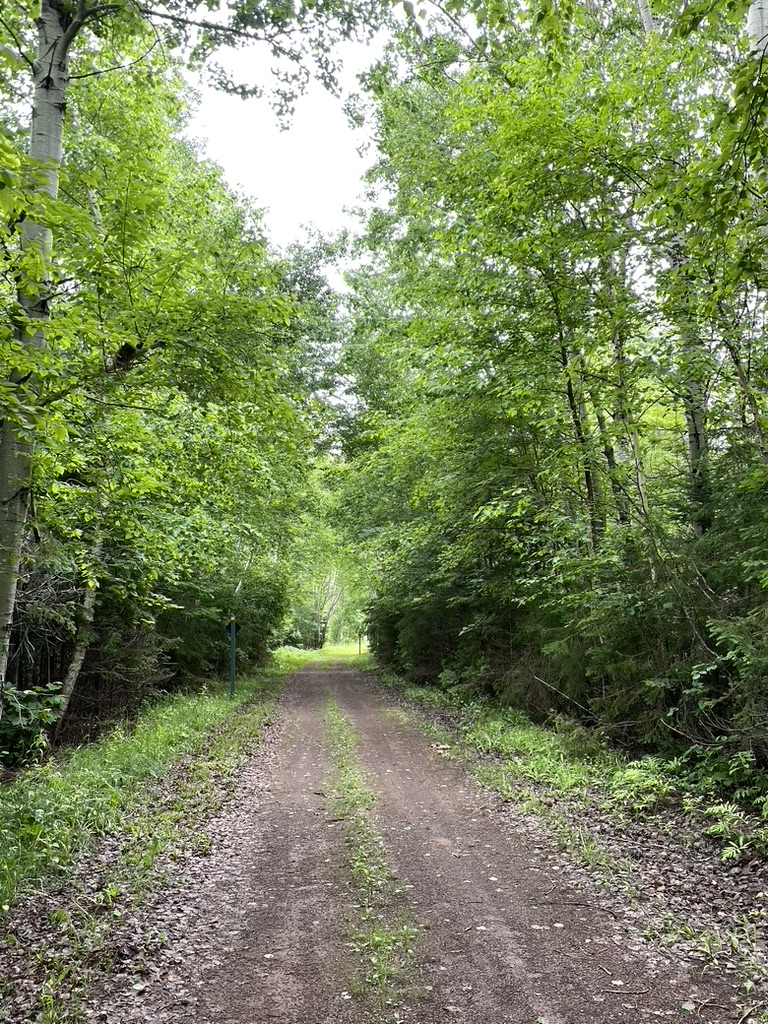
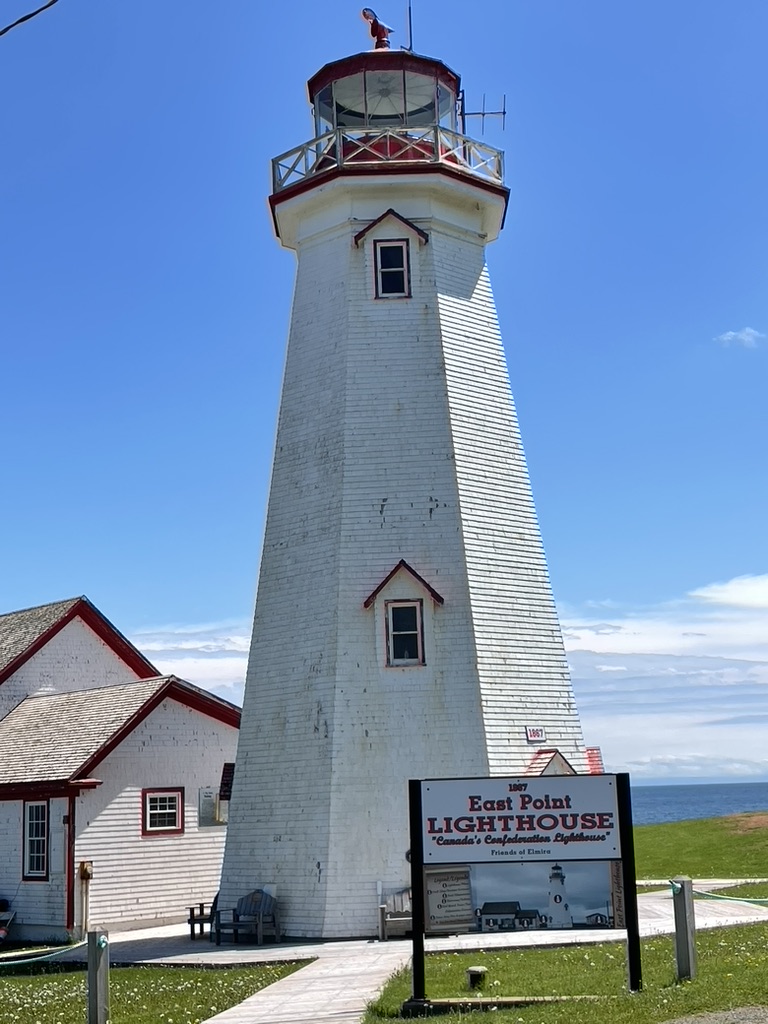
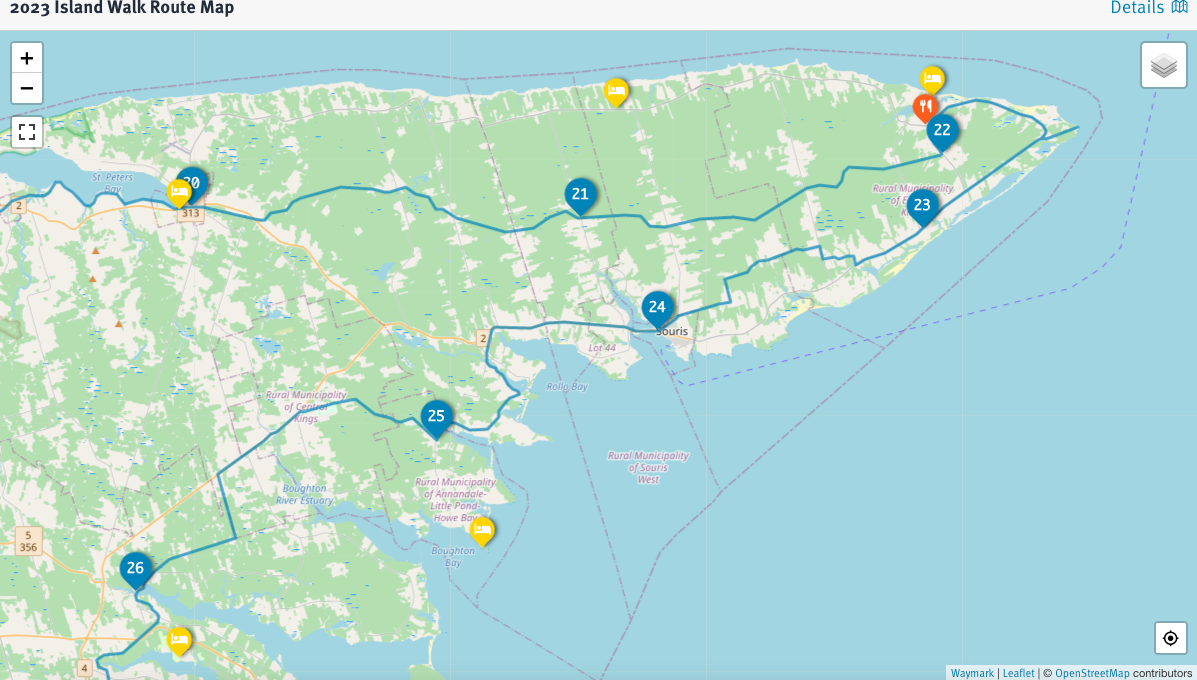
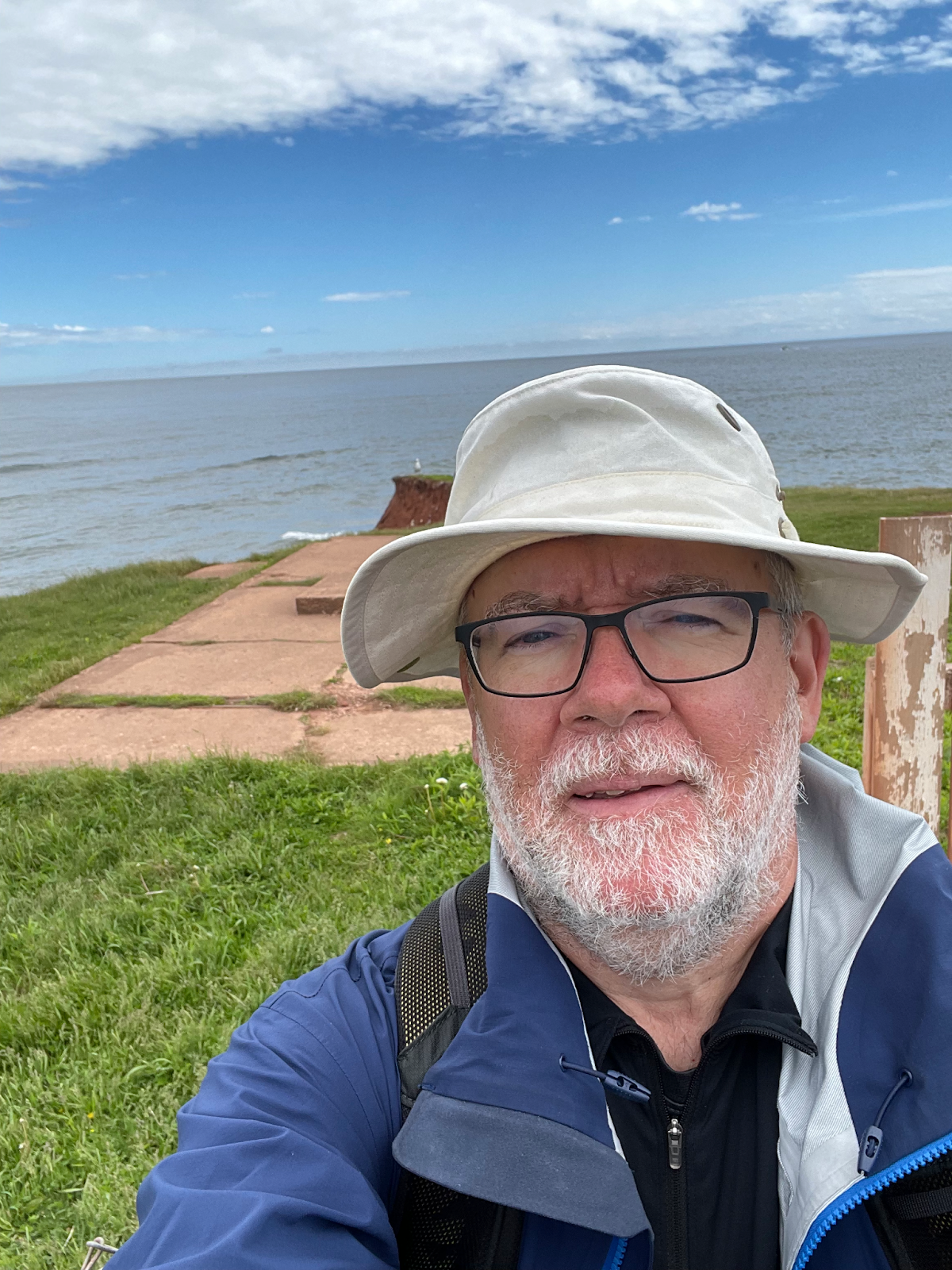
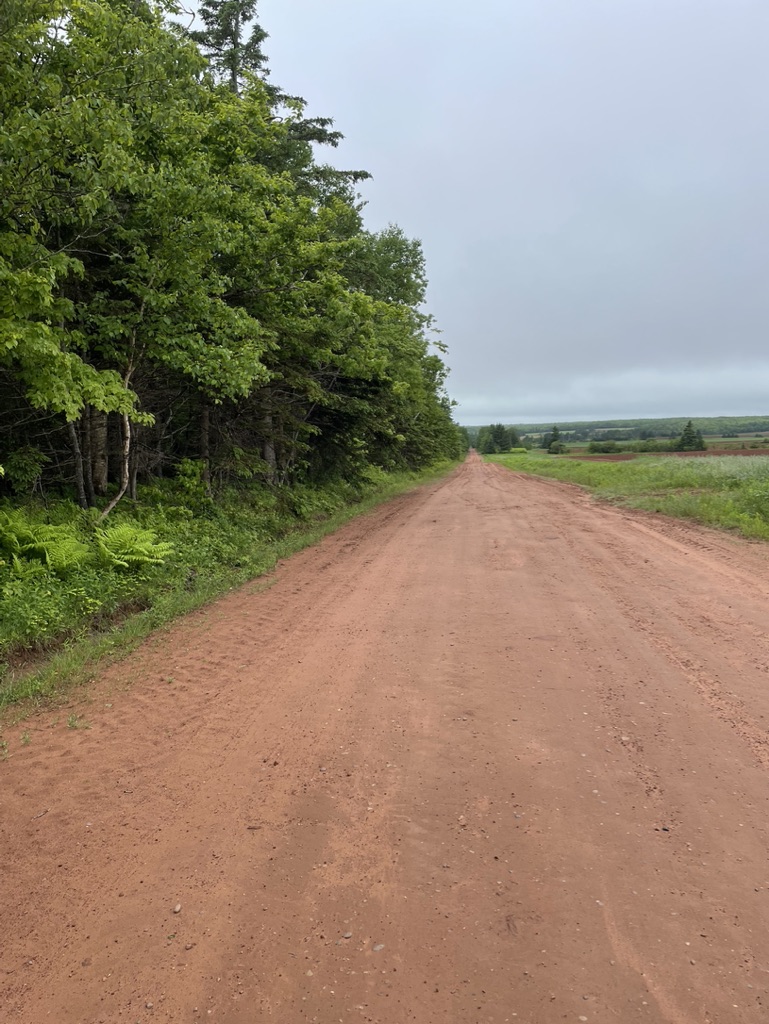
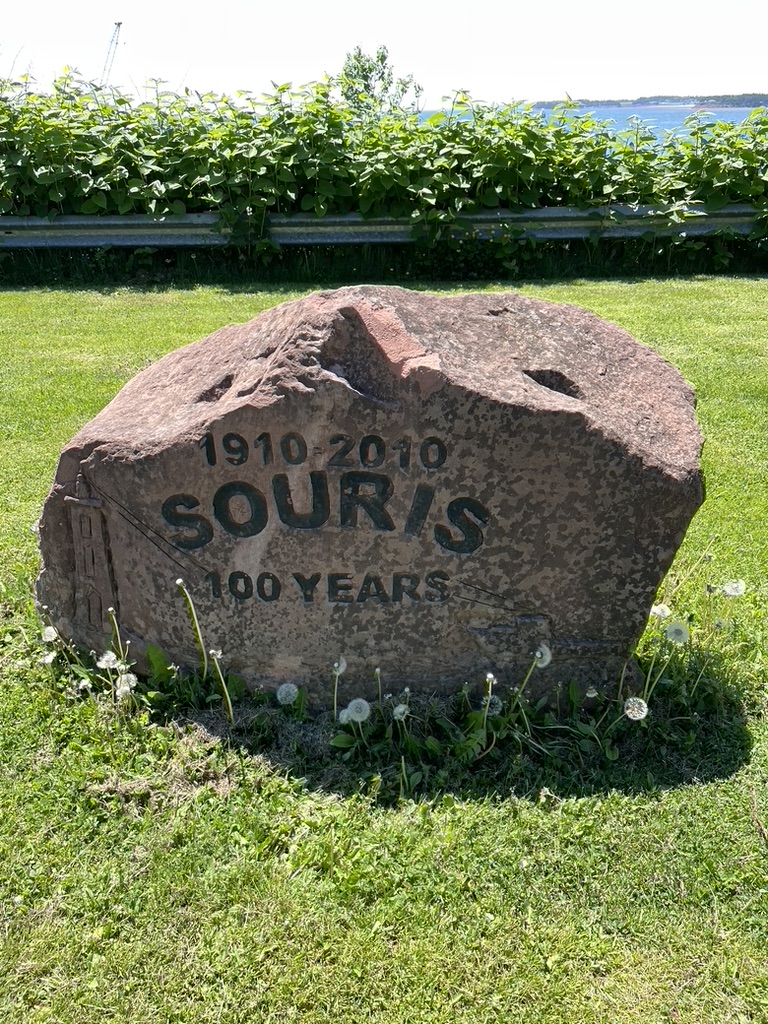
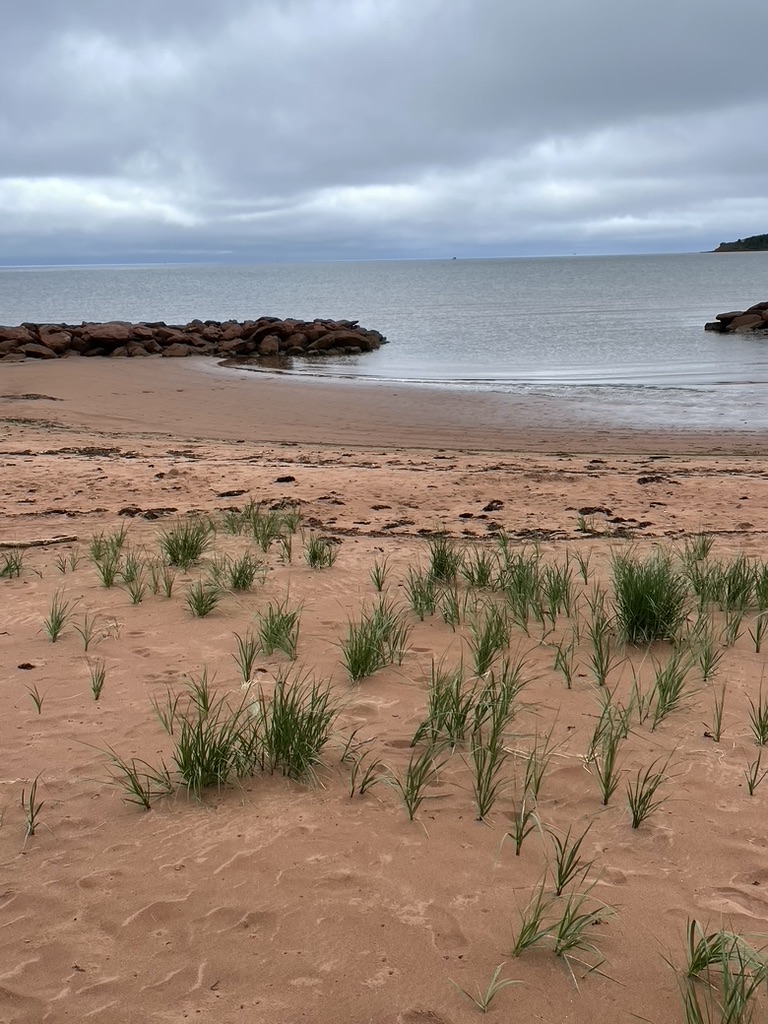
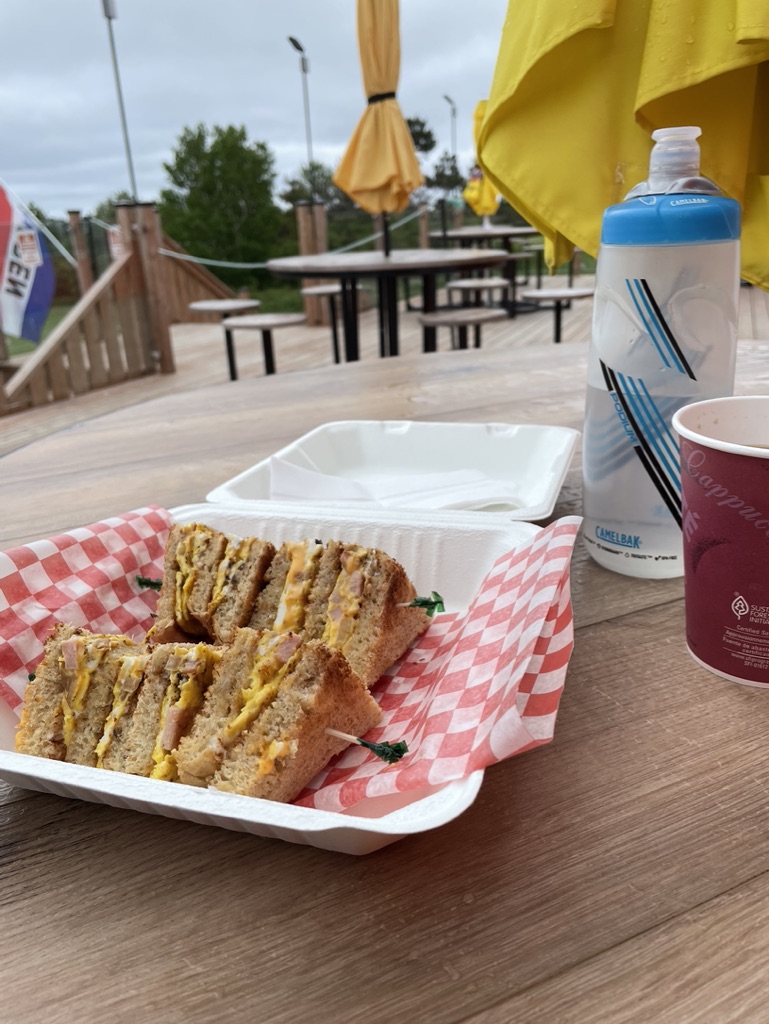
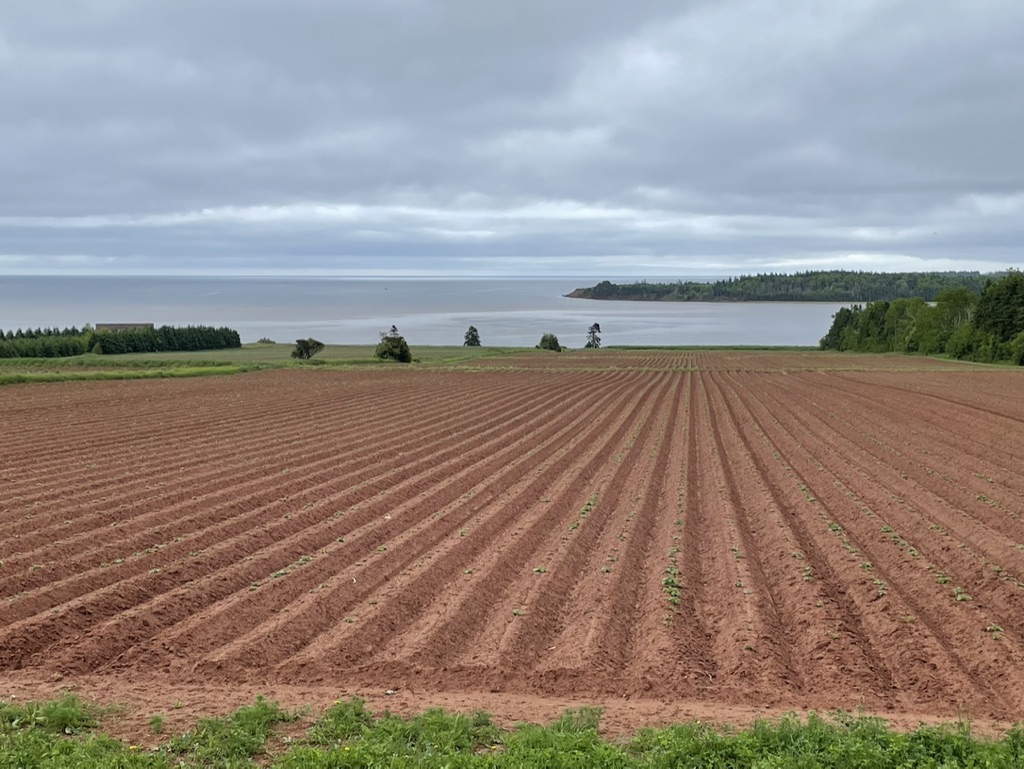
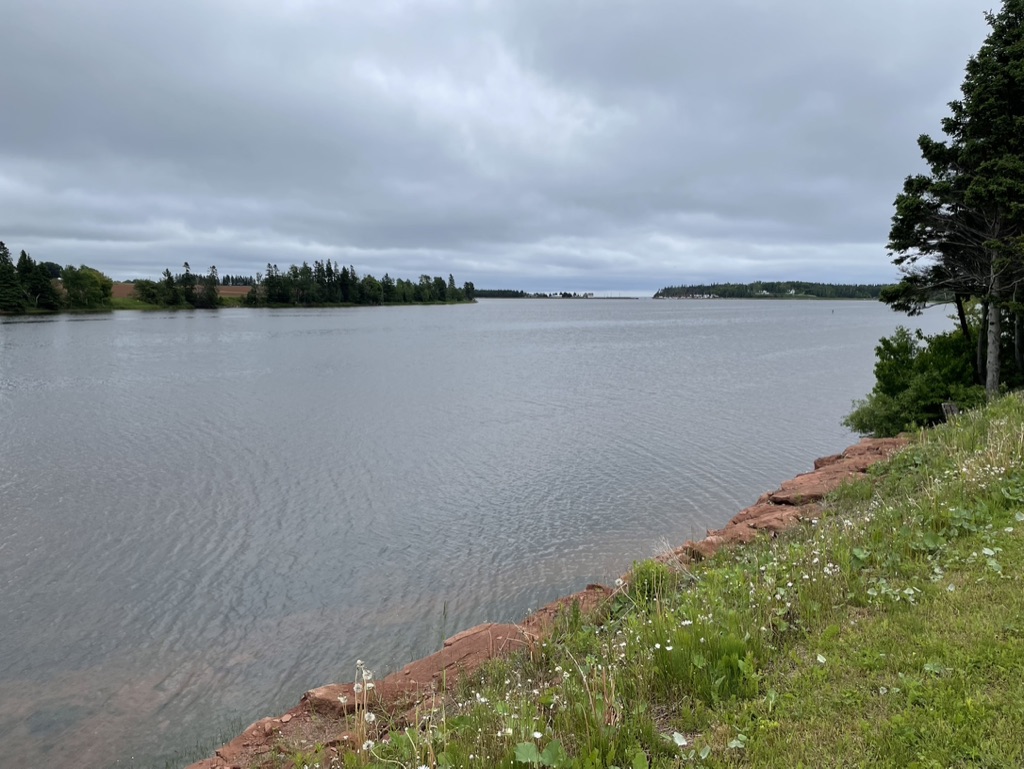
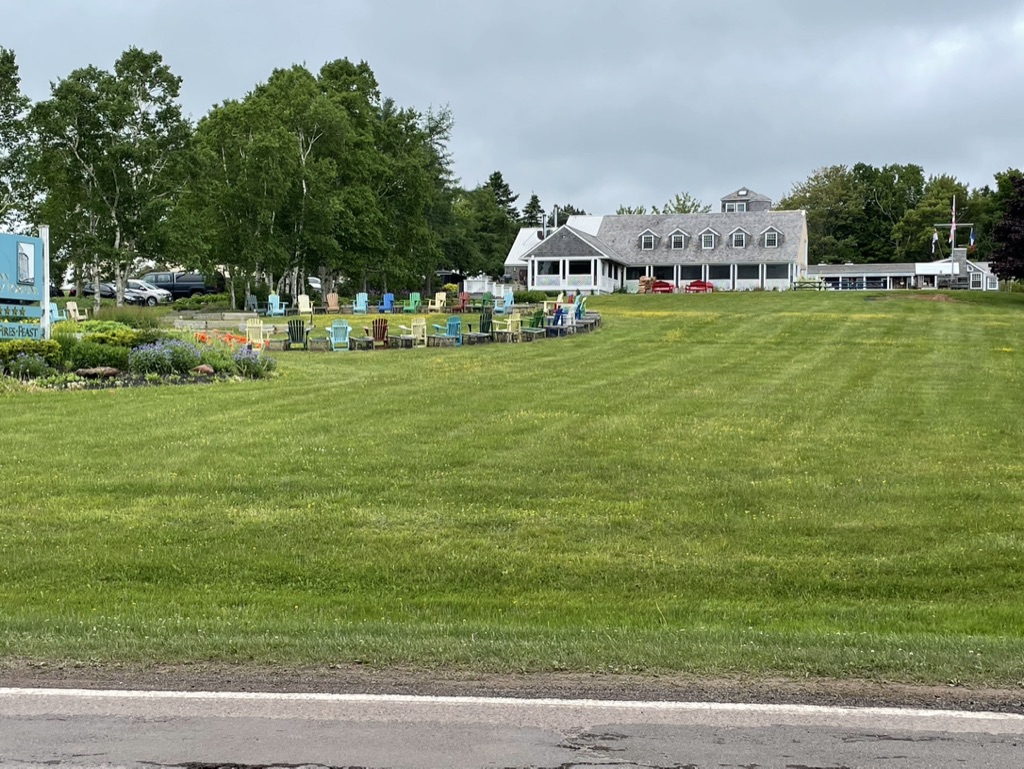
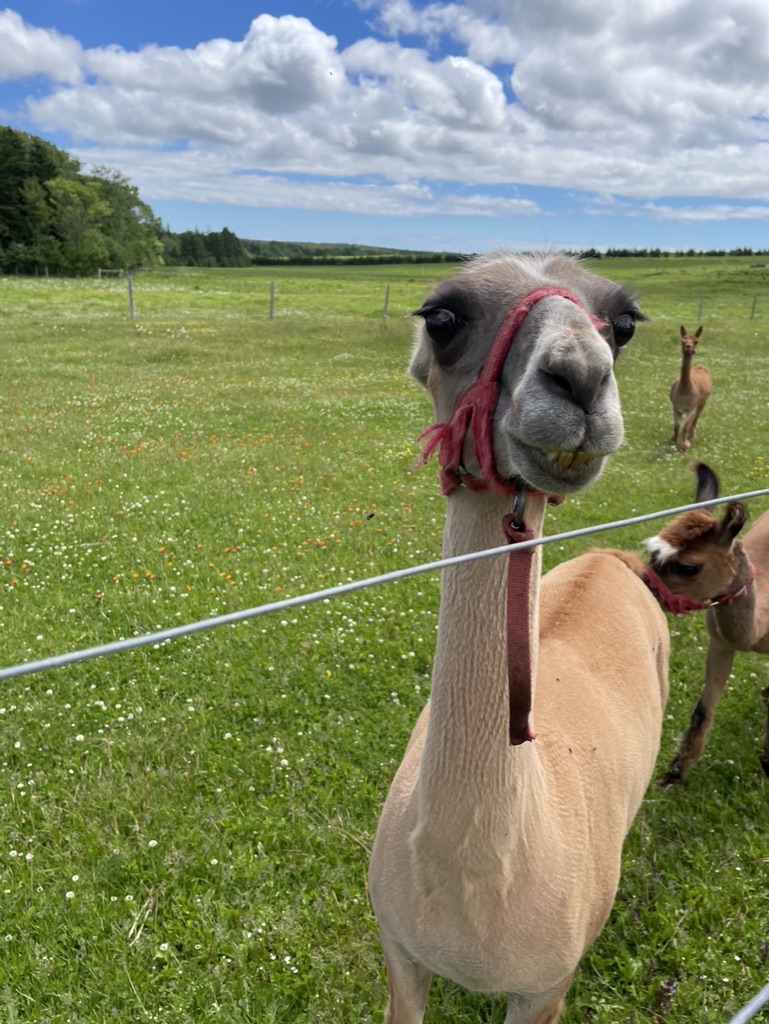
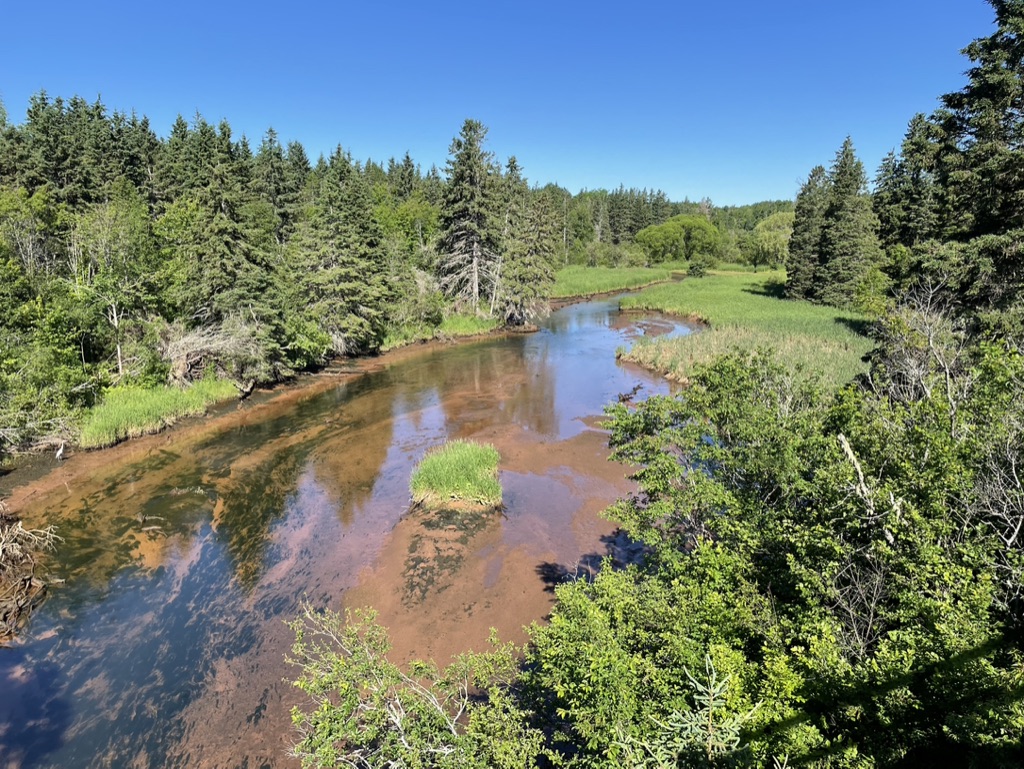
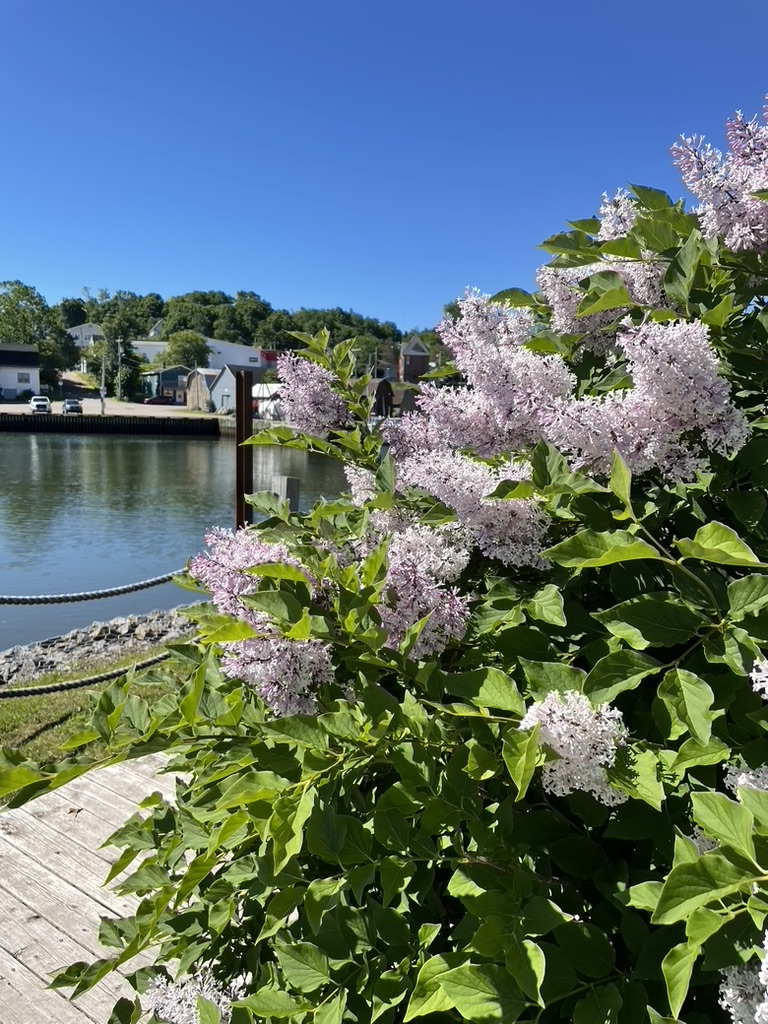
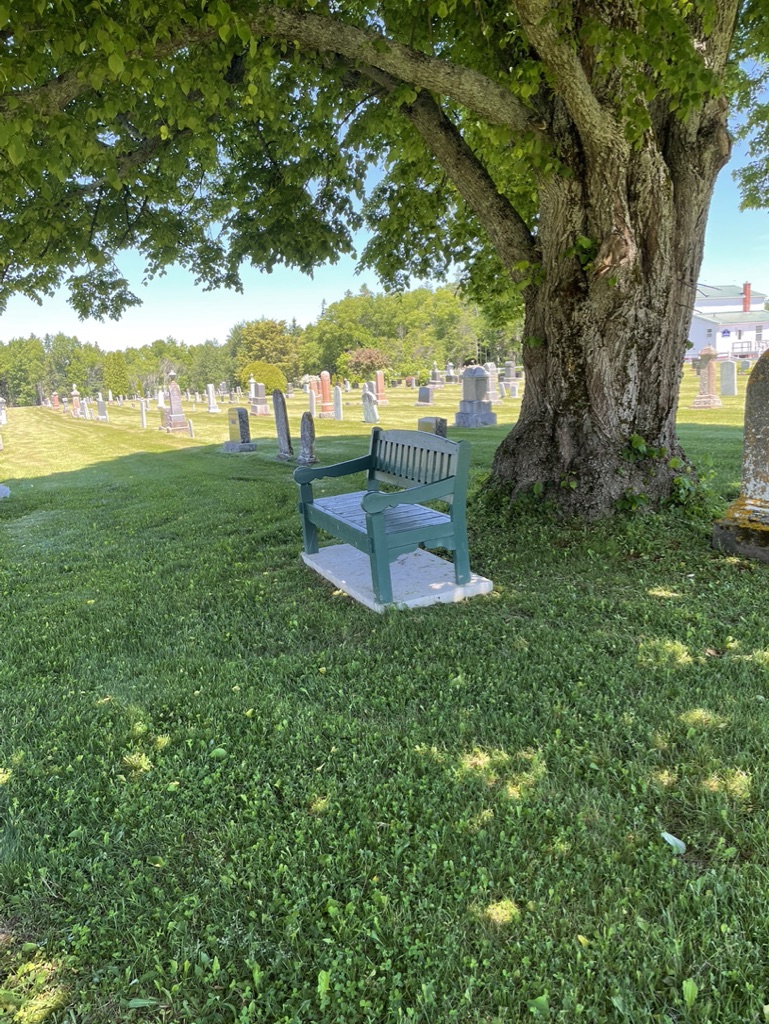
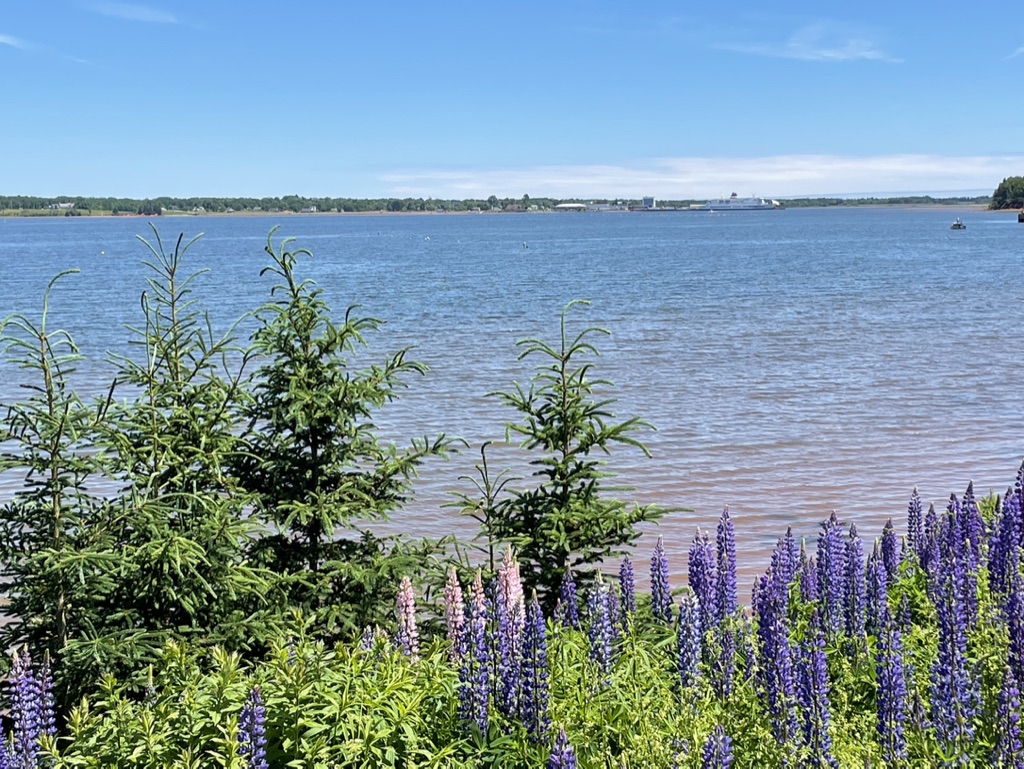
 Walkablog