This week was supposed to have seen me complete my TONotL hike, and as I wrote last week, those plans had to change when we made an unscheduled trip to Ireland for a funeral. It’s meant that this past week has been a mixed bag of walks.
Sunday – walking the strand at Portnoo in Donegal.
One of the secrets of Ireland is that while it’s a northerly climate, and it’s associated with soft rains and green pastures, there are in fact quite a few fabulous beaches. Portnoo is one of them – several km of sand and shallow waters that are perfect for sunning yourself or swimming, if you don’t mind the chill.
Monday – city walking in Dublin, wandering favourite neighbourhoods near St. Stephens Green and Marion Square, window shopping and sightseeing.
The trip had been a whirlwind, and we’d given ourselves Monday afternoon and evening in Dublin to decompress after the emotional visit to Donegal. The sun was out and it was a lovely day, perfect to find a little out of the way pub with some outdoor tables and a pint of Guinness. Dinner was equally lovely, enjoying seafood and crisp French wine at Sole. The stroll through St. Stephens Green after dinner capped off our trip, enjoying the flowers in bloom and watching the other strolling couples.
Tuesday – airports and taxis and a quick stroll around the shops back home to pick up dinner. Welcome back to Toronto summer heat.
Wednesday – since I was off work for the week anyway and had planned to spend it walking, it was off for a tour of Lawrence Park and Bridle Path neighbourhoods and on through Burkes Brook and Sunnybrook Parks.
15km of wandering up and down hills, through cool shaded forest and sun-drenched playing grounds.
Thursday – more hiking, this time the full length of the Beltline.
First west along Roselawn and Castlefield all the way to Caledonia to pick up the start of the Beltline Trail by the Canada Goose factory, and then back east on the Trail all the way through Mount Pleasant Cemetery, down the Moore Ravine into the Brickworks, and then back north up through David Balfour Park and into the Cemetery again to complete the loop. 20 km on an even hotter day.
Friday – yet more hiking, this time down to the lake through inner city neighbourhoods – Whychwood, Christie Pits, Palmerston, Little Italy, Parkdale – and along the Trillium Trail through Ontario Place, then back home through stifling city streets heavy with humid heat.
I passed through several of parks that make Toronto a fantastic place to live – Christie Pits, Trinity-Bellwoods, Coronation Park, and more. Without those green oases, the city would bake in the summer. While they were lovely to walk through, 25km on a hot muggy day wiped me out.
Saturday – after that long day Friday, it was time to take it easy, strolling in the neighbourhood and shopping for new running shoes after wearing out my old pair. It was a day to unwind and let my legs and feet rest a bit.
Overall, I did more walking this past week than I’ve done in any previous week in at least a year, and yet I only did about half of the 160 km I had planned on my TONotL walk. If I’m honest, it would have been a tough challenge to finish that walk as planned, given 30C heat and my evident fitness level despite my training walks. Clearly I need to put in more work so that when I try this in the autumn when the weather will also be cooler, I will be ready for it.
Still, a change of plans isn’t necessarily a bad thing. When life throws up the unexpected, the best path forward is to learn from the experience.
Where: Chaplin Estates, Belt Line, Mount Pleasant Cemetery, Moore Ravine, the Brickworks, Pottery Road and Pape Village to the Danforth, then back along the Danforth over the Bloor Street Viaduct and then through Castlefrank and Rosedale to Summerhill & Yonge and up Yonge to Deer Park and back through Chaplin Estates to home.
Duration: about 3.5 hours walking, and around 17 km
Weather: Spring! 18 C and sunny enough for a sunburn
My walking regime this year so far has been patchy at best. I’ve put back on some weight that I’d lost, and I’ve been feeling flabby and out of shape. My weekly target of 60 minutes of walking 5 days out of 7 has mostly gone by the wayside, and the weather has been chilly and teasing – the calendar might say spring but the temperatures don’t.
On a holiday weekend, you never know what you’re going to get. Last year on Victoria Day we had a great walk through High Park and then up the Humber River. This year we decided to walk east, and visit the Danforth and Toronto’s Greektown neighbourhood, and the weather forecast was promising.
The most direct yet still interesting route took us through familiar streets to the Beltline Trail and then east along that into Mount Pleasant Cemetery. From there we followed the Trail into Moore Ravine and down into the Don Valley into the trails of the Brickworks. On a nice holiday weekend day, there were hordes of walkers, families, dogs, bikes, runners, and self-snapping young couples. We took our time going through the Brickworks trails, and then crossed Bayview to the Lower Don Trail to head back north up to Pottery Road. Walking along that brought back memories as we passed Fantasy Farm – back in the 1980’s when I was at Glendon College we’d had several formal banquets there at which I had let down my student hair in epic fashion – and then it was the grinding climb up the hill to Broadview.
From there we meandered through back streets to arrive at the Danforth at Carlaw. The sun was out and the outdoor tables were packed. We found a spot at the Alexander the Great Parkette and grabbed takeout gyros from Alexandros to eat in the sun.
After that tasty pitstop, it was a stroll along the Danforth to Broadview, where my wife decided to hop on the subway home, while I kept walking. My route took me south on Broadview to Riverdale Park and down to one of the trails. I was trying to connect to the Lower Don Trail, but I guessed wrong and didn’t find the connector trail over the Don Valley Parkway – instead I ended up heading north and back up to Danforth at the Bloor Street Viaduct, so I decided to cross the bridge (since I’d come to it!) and cut through Rosedale to head home.
Walking through the neighbourhood, I thought about the essay my son is currently working on, on the subject of sustainability and how that is manifested in Toronto. One of his study areas is Rosedale. On paper this neighbourhood doesn’t have a large amount of green space, at least when defined in terms of public parks. And yet, the trees coming leaf and the ample yards and gardens of the large houses certainly gave a strong impression of verdancy, and the wealth displayed by the luxury cars parked in front of every house contrasted with the TTC bus stops scattered along the side streets. Does it count as sustainable if that neighbourhood has a higher percentage of Tesla’s than other areas of the city?
At the same time, there’s no question that it’s a lovely place to live. It’s always quiet and charming walking through Rosedale and it was no different on this walk. I know my way through there by now, having walked it many times, and I meandered along back streets between Castle Frank and Summerhill where I connected with Yonge Street.
Interesting fact – on Castle Frank Road, the Netherlands consulate owns a house, marked by the large Dutch flag out front. There is also a commemorative plaque beside a tree, planted in honour of the many thousands of Canadian troops who helped to liberate the Netherlands during the Second World War.
At Summerhill, Yonge Street led me up the hill to St. Clair and into the Deer Park neighbourhood, and onwards to Oriole Park. I passed a baseball game in progress that brought back memories of my son at 7 playing there. I kept going through the Chaplin Estates back to Eglinton and up Oriole Parkway to reach home footsore and sunburned.
In the end I’d done more walking in one day than I’d done in several weeks over the past few months. It felt good to be tired, like I’d worked out and deserved to sit for awhile and watch a baseball game.
It was a great spring walk, on our first really proper sunny spring day of the year, and now I need to build on that and get back into my routines. Stretching out your strides with the rhythm of walking feels good at anytime, but it’s especially sweet when it’s the first time all year you can finally go out in shorts and a T shirt.
Blog posts are a labour of love for me, and yet there is a cost to running this site and organizing my walks.If you’d like to help with that, I’d really appreciate something for my tip jar.The Buy Me a Coffee service allows patrons like you to fund writers like me. If that sounds like a worthy idea to you, then go ahead – keep buying me coffees.Thank You Very Much to everyone who has contributed already!
*****
In the early 1980’s, I attended York University’s Glendon College. It was then, and still is, a small arts college attached to the larger university, maintaining a physically separate and culturally distinct campus. It is set in the former grounds of the Wood estate on the edge of the West Don River valley at Bayview and Lawrence.
I took an Bachelor of Arts degree in English Literature with a minor in Canadian History, so my courses brought a heavy load of essays to write. I’ve always been a night owl, and as I moved through my degree I gradually organized my course schedule to take mostly afternoon classes. That let me work on papers late into the night, in fact often through the night – I would often go to bed at 6 or 7 a.m.
Come April, I’d be working on papers till the wee hours and the sun would be up by the time I pushed away the typewriter (pre-PC days!). I would be keyed up and jumpy from drinking coffee all night, so I developed the habit of taking a walk to unwind and relax before grabbing some sleep. I’d step out into a quiet, peaceful campus as the sun was coming up. Because I didn’t want to run into anyone, I would walk down into the valley and along the Don.
There was a path behind my residence that led the way down and I’d follow it, taking care to make as little noise as possible so that I could hear the birds. At that time of the morning, traffic noises were a faint distraction and it was often still, so you could hear the chirps and calls as birds awoke, and when you got closer to the river you could hear the lap and splash of the water.
In the valley, the Proctor Field House and athletic fields are bounded on the north side by the river. At that time there were walking paths on both banks, and I’d pick one or the other and follow the river downstream. Often there would be ducks or geese, and once I saw a muskrat. Squirrels skittered and racoons made their way to their nests after a night of garbage gathering. There were a couple of bridges that crossed the river, one at the west end of the campus and one at the east, so I could wander along one bank and cross to come back along the other.
It wasn’t a long walk, perhaps a km or 2, and I could be back to my room in about a half hour, relaxed and able to sleep. I rarely met another soul. Today there is just one path along the south side of the river, and the area is known as Glendon Forest. The path links to Sunnybrook Park, so there are more walkers and joggers about, and everyone seems to be walking their dog these days. But back then it felt like my own private wood, a place to think and to unwind, to escape the city and mentally return to the woods and fields that had surrounded my home outside Leamington, in South-West Ontario.
After I graduated, I rarely went back to the College and even when I did it was just for a social event in the pub. And then in 2016, 30 years after leaving, I developed some health issues that forced me to deal with the fact that I was out of shape and in dire need of exercise. I resolved to start walking, and my first destination was the Glendon Forest to walk that path along the river.
On an autumn day, the river level was low but the sun was bright in a crisp early November way. There were golden leaves falling and spiralling into the water to surf and ride the waves, and again not a soul about. As I walked, I remembered those dawn rambles and wondered why I had ever stopped walking.
It was the boost I needed – I’ve been walking ever since. I get back to the Glendon Forest at least once a season, each with its own character to savour. The walk always refreshes, and always reminds me that little walks lead to life’s long journeys.
Steeles West looking back east towards Weston Road
I’ve been working recently in the north of the city, in fact strictly speaking just north out of the city – Steeles Avenue is the city limit so where I work on the the north side of the street, I’m technically outside of Toronto in the City of Vaughan (the City on Top of Toronto, as a cheeky radio advert had it).
It’s not what I would consider to be a great walking neighbourhood such as you’d find in the inner parts of the city – there are no tree-lined streets, parks, light traffic, houses, schools, or gardens. It’s just multilane wide streets full of heavy trucks and buses and cars, laid out in a grid of light industry, office parks, strip malls, gas stations, fast food, and a strangely dense selection of Italian restaurants.
Nevertheless, it’s also quietly interesting in its own way. There’s lots of little things you notice as you walk around. One is the enticing aroma of fresh baked bread, cinnamon, apples, and spices coming from the Ozery Bakery across from the office. They are often baking in the afternoons as I’m leaving and the scent is maddening when you’re hungry.
Another is the odd numbering on the buildings. On the north (Vaughan) side of Steeles, the office address is 3700 Steeles West. On the south (Toronto) side just opposite, the address is something like 4955 Steeles West. Apparently the City of Toronto starts numbering Steeles from Yonge Street, whereas the City of Vaughan starts further west, probably around Keele, so even though you’ve travelled the same distance from Yonge the building numbers are more than a 1000 apart. Who knew.
Who also knew that the City of Vaughan is twinned with the city of Lanciano Italy? I’d often heard that Vaughan and the community of Woodbridge specifically had one of the largest Italian-born populations in Canada, so I guess that explains it.
And that probably also explains the many little Italian restaurants scattered around the neighbourhood, tucked into office towers and strip malls, and down side streets beside auto repair shops. One of them, the Volce Lounge, features homemade pizza and dancing Wed-Sun evenings – again, who knew?
Another feature of the neighbourhood are the geese. The local population of Canada Geese are numerous, voracious in their appetite for grass, and voluminous in their production of goose poo. It’s everywhere, covering the sidewalks in mini green landmines. Geese are pretty territorial, and there’s one pair that nest near the parking lot of my building – several times one or the other has been sat square in the middle of the carpark entrance, refusing to move and hissing at cars that try to squeeze by. I also saw one perched triumphantly on the roof of a car, which positively glared at the owner when he came out to shoo the goose away.
Because it’s so open and treeless, and because Steeles runs broad and open east-west with the prevailing wind from the west, it’s always breezy and it can be chilly going for a walk. When the wind swings to the north in winter, it slices icily through your warmest coat. In summer the sun blazes on all that concrete and asphalt which soak up the heat and radiate it back at you. Parking lots and road surfaces get treated with salt by the ton in winter, and rain sheets everywhere. There’s a constant roar of traffic, planes overhead, and trains in the distance, and often the bakery smells are drowned by diesel fumes and dust. It’s no one’s definition of a cozy neighbourhood.
And yet, out for a walk this week, with a little sun trying to poke through and the smell of fresh bread in the air, it was pleasantly surprising. You could hear the birds in the bushes, at least on the side streets away from the traffic on Steeles. There were a few people out walking and more sitting at picnic tables outside office buildings gathering in the sun.
Life is interesting, anywhere, and walking around I kept reminding myself that the chief joy of walking is in the pace. That provides the opportunity to notice the little things if you just let your senses (and nose) guide you.
Weather: sunny, about 10C with a bit of a chilly breeze
With the sun out on a spring day, a walk was definitely in the cards. I hadn’t walked through Cedervale since mid-winter so I thought I’d see what spring looks like so far.
The grass has started to green up with all the rain we’ve had, and over the past few days I’ve also noticed more and more buds on trees – one good warm stretch and things will pop. There are crocuses, daffodils, tulips, and bluebells out in bloom, and deep in the ravine where the trees capture the mid-day sun, the willows have started to come out in leaf.
starting to get green
It won’t be more than a few weeks and Cedervale will look like this:
It was great to see so many families out – kids playing football and baseball, cyclists, runners, dog walkers, grandparents with grandkids. You could tell everyone was itching for more warmth – there were some hardy types out in shorts along with winter coats and gloves – and the sun pouring down in the ravine was glorious. There are park benches scattered along the trail, and I passed a woman who was sitting with her face turned up the sun, her eyes closed, and a blissful expression as she soaked up rays and listened to the red-winged blackbirds.
Coming out of the ravine at Heath Street, I decided to walk up Spadina through Forest Hill village on my way home. The streets were full of energy – shoppers, strollers, seniors. There were flowers out for sale, and many houses had flower-filled planters on doorsteps. The flower theme continued as I walked along Old Forest Hill Road and then up Russell Hill Road. Gardners were out digging and raking, and many of the planting beds had been turned over and mulched in preparation for more flowers. We aren’t past the threat of frost yet – it was actually down to about 2 C overnight – so it’s early yet for bedding plants.
But it’s close, and that’s what you could feel in the air, anticipation and an antsy for spring type of feeling.
This past weekend offered two great days for walks in the early spring, and they put in mind a few random thoughts.
I was suffering from a spring cold and walking when you can’t breath is like eating when you can’t taste – you lose a vital sensory part of the experience
These were great walks to hear the sounds of early spring – the snarling farts of downshifting sports cars out for an early Look At Me (LAM) cruise, the tap-tap-tap of roofers’ shingling hammers, the gentle jazz strum of a busker sitting in the sun, and clink of a baseball on a metal bat
I was also serenaded by the Toronto Gardener’s Choir – leaf blowers took the lead accompanied by weed whackers, lawnmowers, and hedge trimmers.
Speaking of roofers, I counted 4 houses under renovation along one block in our neighbourhood, a sure sign of spring house fever
Despite my cold, I could still detect some of the signature smells of spring – wet wood from the construction sites, dust from unwashed streets, damp earth.
It was refreshing to feel the sun on my arms and face, finally warming and not just bright, and bringing out a proper sweat as you walk
The colours are faded and tired – poking through the tans, washed-out oranges, drab greens, and dull greys were little wispy promises of warmer weather to come – the whites and yellows and pinks of early flowers climbing up through old leaves
People watching reveals those still feeling the cold wearing gloves, hats, and winter coats alongside the its-time-to-get-springy types wearing T-shirts, shorts, and running shoes, not to mention a little boy who popped out of his house in pyjamas and bare feet to run down the drive and then dive in the front door
The neighbourhood wildlife scene is dominated by birds – robins and cardinals and little sparrows are impatient and competitive as they hunt for nest material and the early worms of spring
It’s still early April and we’re probably another few weeks yet from steady warm temps, green grass with leaves on trees, and the waft of barbecues in the evening. It was a foretaste and more importantly a spur to get going after a winter when I spent far too many days indoors. Can’t wait to get walking wearing shorts.
I suffer from hearing loss and tinnitus, the result of a misspent youth listening to loud music and working around machinery without ear protection. This is why I don’t often listen to music when walking – to hear the music I have to turn up the volume while wearing ear buds so that when I take them off my tinnitus is worsened for a few hours.
On the plus side, by not listening to music while walking I can hear the sounds around me, especially birds. I was out on the weekend for a walk through the neighbourhood, and I heard the distinct call of a cardinal.
That sound was early for the time of year (yeah spring!), and it got me thinking about the sounds of walking and the birds I’ve heard over the past year on my treks about the city. Though by no means a bird-watcher, I am a list maker, and I wondered how many I could check off.
With the help of a great site called All About Birds and another one called Toronto Wildlife, I was able to listen to recordings of birds and put my finger on what I had heard. Here are some of the birds I hear most often when walking about Toronto.
There are of course many more species that reside at least part of the year in the City, and were I a birdwatcher I’m sure I’d try to add them all to my collection of noted spottings. But I’m not and I don’t.
What’s more important to me is the simple appreciation of the sounds I hear whilst walking. In a post called Walkers vs Runners, I said that walkers are introspective. That’s true, though when I’m too introspective I become conscious of the tinnitus that I’ve learned to tune out most of the time – that constant buzz and ringing sound becomes intrusive and breaks the flow of thoughts. Walking and listening to the natural sounds around me lets me focus on other aural impressions, so even though I’m hard of hearing, the song of a cardinal reaches in to tap my shoulder and say, “spring is near, spring is near”.
Out for a walk today, it occurred to me that there is a special character to walks in early spring. The thought hit me quite literally, when the raw biting east wind slapped my face and chilled my ears. That’s it – the wind.
March, as the saying goes, comes in like a lion and goes out like a lamb. Here in Toronto it’s usually a pretty cold lion. When you get a snowy winter as we’ve had, that snow has to melt, and melt makes moisture which dampens the air so that what would be a brisk breeze on a sunny day becomes a bone-chiller despite the sun.
I’ve just finished a book called Where the Wild Winds Are, by Nicholas Hunt. He’s a travel writer who set out to follow the path of some of the famous winds of Europe, such as the Mistral. That put the idea of winds and walking in my mind. Despite the kick from the east wind today, we don’t have a famous wind here in Toronto. The prevailing winds are from the west, while east winds signal changes in weather and often storms. North winds come year round as fronts move through, and southerly winds happen often enough as well. We don’t have a Hogtown Hoot, or a Toronto Torrent, or a Blue Blast. We just have relatively tame, boring winds that change direction fairly often and change temperature with the seasons.
Still, that snippy east wind today did remind that it’s March and March means winter’s end and warm climes to come. March means school breaks, and the return of baseball, and thawed out barbecues. And of course, March means spring and flowers and birds and trees in leaf. March is a transitory month – a window and a promise of the season to come, and yet also a reminder and kicker to the season we’re leaving. March means change.
March also means walking is depressing and cheering at the same time. Depressing because the melt-off reveals the crud and garbage that has been hidden in snow banks, and the snow by the roads has become grey-black ice – the result of accumulated car exhaust that makes you realize you’re breathing that in as you walk.
March roadside loveliness – Eglinton West near Avenue Road
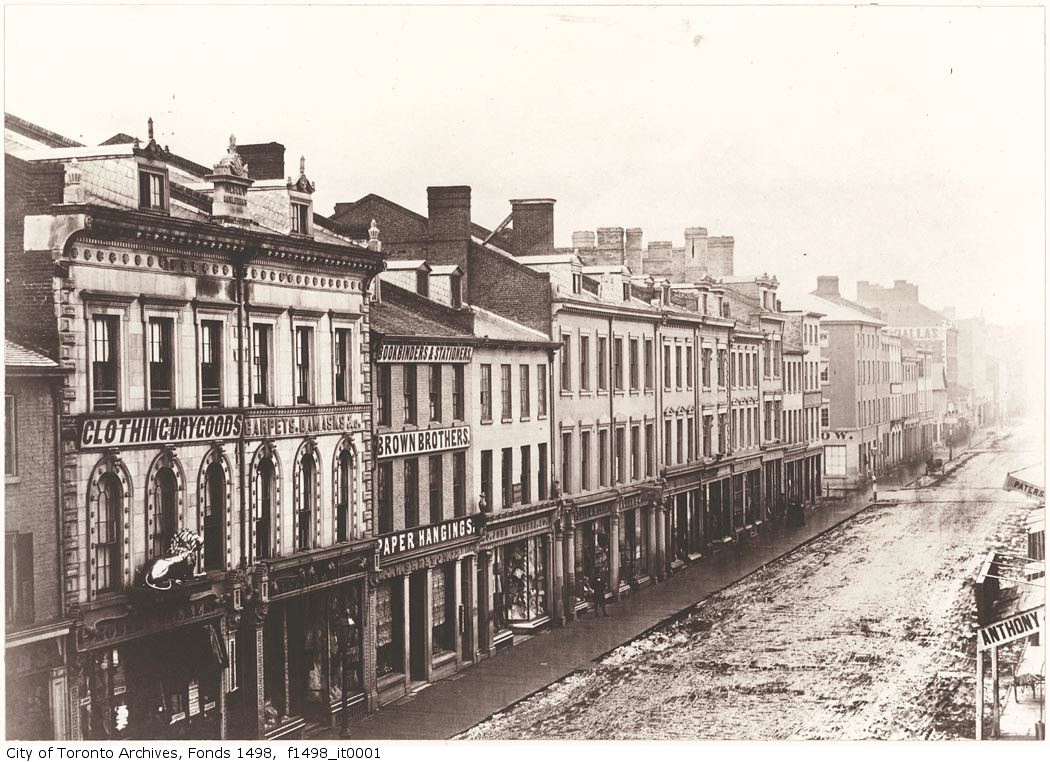
Nothing changes – Toronto, about 1856 – must be about March, you can see the puddles and bits of snow on the edge of the road
And yet cheering because when the sun is out, and early season birds are singing, you feel the promise of warmer days to come. Sometimes that chill breeze swings around to the south and becomes a warm breath. Then people are bouncier, cheerier, positively bursting for spring – you get the early shorts-wearers even if the temperature is 0C, and teenagers toss winter clothes aside and head out in T-shirts to show off pale arms.
March is often a tough month for walking, because the ground is melting and muddy, with water and slush everywhere combined with hidden icy patches. Sidewalks are often still narrowed by snow banks, and park trails aren’t cleared yet. The wicked gust that chills your walk also lifts the moisture and dries the ground, slowly but inexorably.
So in March, I try to get out as much as I can, but it’s a chore more than a fun walk. I just tell myself that April is around the corner and then May will bring greens, reds, and yellows to replace the browns and greys of winter and early spring, so I grin and bear it, put my head down, and march past the lion.
In the spring of 2018, I was settling into semi-retirement – actually more retirement than semi. I spent my time walking, doing the shopping, cooking, and catching up on my reading. I was also mapping out some longer walks to explore Toronto, and decided to take 2 days and hike the trails along the East and West Don Rivers.
In the past I’d walked south along the East and West Don and the Lower Don, from Sunnybrook Park down to the lake. I had never, however, gone up the East or West Don north from Sunnybrook Park. Looking at a map, the first challenge was picking routes – there are no trails along both branches of the river for several inaccessible stretches due to private ownership of land. That meant I had to plan how to get around these while walking as much as I could through the public parks that surround the river, especially north of Sheppard Avenue. The East and West Don rivers actually extend north of the city proper, but this walk was about trails in the City so I wasn’t going north of Steeles.
As a result, I decided to go north up the East Don jumping off from the Betty Sutherland Trail south of Sheppard and hiking on up past Finch Avenue to the Finch Hydro Corridor park, which runs east-west for 20+ km across the top of Toronto between Finch and Steeles Ave. From the East Don at the Hydro Corridor park, I would go west over to Yonge Street and then subway home. That way, the next day I could subway back to Finch and pick up where I’d left off to go west on the Hydro Corridor to connect with the West Don River at G. Ross Lord Park and walk down that back to the residential area around Armour Heights (Wilson Avenue and Avenue Road). By splitting it up, it meant I’d walk around 20-23 km each day and around 45 km in total.
Once I had decided on the route, I just had to wait for a couple of nice days, and I found them May 23-24. Preparation was simple – a lunch, some water, and a light jacket each day. My walk took me through a series of Toronto parks:
Part of the fun of this walk was that it covered a gorgeous pair of spring days – sunny skies and low 20’s, perfect for walking. We had a bit of a late spring that year, so the early flowers and spring wildlife were still in full form – walking through marshy areas and listening to the chirping frogs and calling birds was a highlight.
It was also a chance to explore parks that I had never visited, especially to the west of Yonge. G. Ross Lord and Earl Bales parks, in particular, are huge and varied in terrain – meadows, forests, hills, flats, lakes, ponds, marshes, and rivers. They are great examples of the City of Toronto’s Parks Department boast, that we live in a “city within a park”. G. Ross Lord is worth a day all by itself – if you like cricket, it has several pitches plus training facilities that let you play or watch to learn more about the game.
The other side of the coin for a walk like this was the sense of frustration that fabulous resources like the Don river valleys are inaccessible in many places because of private development, especially golf courses – the Rosedale Golf Club, Don Valley Golf Course, Flemingdon Park Golf Club, and Donalda Golf Club all block the opportunity for continuous trails along the East and West Don rivers.
These golf courses date back prior to WW2, when the lands north of Lawrence Avenue were being developed residentially and there were still many areas of farmland up to Steeles Avenue. Wealthy golf clubs could buy land in the river valleys that wasn’t suitable for houses, and yet be conveniently located within city limits.
These clubs today sit on highly valuable land, and even though golf seems to be declining in popularity it would be naive to think that the City of Toronto could easily afford to buy them for public use, with so many competing demands on the tax payer’s purse. Still, since one of those golf courses is actually owned by the City (the Don Valley Golf Course), it would be great if the West Don Trail could be extended through it to connect Earl Bales Park with Jolly Miller Park at Hoggs Hollow.
After that, it’s a stretch I know, but perhaps the private golf clubs could be persuaded to open trail access through their properties to complete the chain of trails through the many public parks along the East and West Don. I’m all for respecting property rights, and I’m not saying they’d have to sell the land – just provide a right of way for a trail along the river through their property. Surely course designers can figure out how to allow play while providing mixed use trails.
Despite the frustration, walking the Don in all its forms is one of the highlights of trail walking in Toronto. For many years, the Don was either ignored and industrialized, or segregated and cut-off from public use. It’s only in the past couple of decades that Toronto has woken up to the fact that we have a tremendous resource available to us, and that combined with the Humber river system to the west and the Rouge River to the east, we have a chance to see what the land looked like before the city took shape. Walking Toronto along these trails really means you’re not walking in the “city” so much as walking through the forests that are the lungs of the city.
Turtle day!
If you have chance, walk at least part of the Don. It’s as much a part of the City’s history as any of the perhaps more famous parts like Mount Pleasant Cemetery, Casa Lima, or the Brickworks, and we take it far too much for granted. Hike it, bike it, walk it, stroll it, or run it but one way or the other use it.
Yonge Street runs from Lake Ontario north through middle of Toronto and continues onwards north of the city to Barrie on Lake Simcoe, more than 100 km in total. The portion within the City of Toronto is roughly 18km long, and I decided to walk a chunk of that, from the start of Yonge down at the harbour north to Eglinton Avenue. To shorten the trip, I took the subway to Union Station and then walked south along York Street to get to Queens Quay and the official start of Yonge, right at lake.
Looking south over the harbour at the bottom of Yonge Street
From there, I headed straight north all the way up to Eglinton, about 7.5km or so.
Looking north straight up Yonge from Queens Quay
Yonge is to Toronto what Broadway is to Manhattan – it connects the city north to south, and it forms the centre not just of the city but of much of its history. It’s the main east-west dividing line, with many streets having East and West sections based on Yonge. It’s also a cultural divide – you’re an east-end person or a west-end person, and often you hardly cross Yonge but stay in your respective half of the city.
As you go north from the lake, you travel through time. Some of the oldest parts of the city are along Yonge, and some of the newest as well if you all the way up to Steeles. If you are standing at Queens Quay, you would have been under water a 100 or so years ago. About a km north of what is today’s lakefront is Front Street, and it’s called “Front” because it was at the lake’s edge when the City was laid out back in the early 1800’s. Decades of construction have built not only the tall buildings which line Yonge today, it’s also created excavated soil used to backfill the harbour to create new land. In 1900, my walk would have been shorter than it is today.
At Yonge & Front, there is the Hockey Hall of Fame housed in a former Bank of Montreal branch that’s reputedly haunted by the spirit of a teller who worked there.
The Hockey Hall of Fame at the NW corner of Yonge & Front.
Continuing north, you start to pass the subway stations to measure your progress – King, Queen, Dundas, and onwards north. Between Queen and Dundas is the Eaton Centre, which reminded me of the years when I worked for the Eaton’s department store chain in their headquarters at Yonge & Dundas back in the late 1980’s. That store is long gone, replaced by a Nordstrom’s, but the shops of the Eaton Centre are still there, and the corner still has a preacher on his soap box sermoning, a few hot dog vendors, and a drummer guy pounding away. What is new is Dundas Square, the plaza the city decided to build because that corner has long been a focal point for celebrations – when the Toronto Bluejays won the World Series in 1992 and 1993, the intersection was closed for a spontaneous street party.
Dundas Square – desperately channelling Times Square and coming up short
Keep going north from Dundas and the stretch of Yonge up to Bloor is a bit grittier and shabbier than the rest of Yonge. It’s been like that for decades – there were head shops, strip clubs, and dive bars here from the 70’s and despite repeated attempts to “clean up Yonge” it’s still resisting gentrification. And yet gentrification is a tidal wave that broaches no resistance, evidenced by the scaffolded caves you must pass through along the way, where yet more condominiums are shooting up – I think I went through at least 5-6 of these along the way.
The cave-lined streets formed from the scaffolding around yet another construction site along Yonge
Once you get north of Bloor, you pass through Rosedale, one of the wealthiest areas of Toronto. The shops, bars, and restaurants reflect that upscale feel. It’s all very familiar to me though, because we lived on Yonge north of Davenport for several years in the mid-1990s. There used to be a series of shops known locally as the 5 Thieves – a butcher, a fishmonger, a greengrocer, a cheesemonger, and a bakery. This was Rosedale’s local market, and while the shops weren’t much to look at from the outside, their products were top end and well out of our price range back then. Today there are 3 Thieves left, and the shops are cleaned up, but the tradition of quality continues. You can often spot local chefs picking up things as you browse.
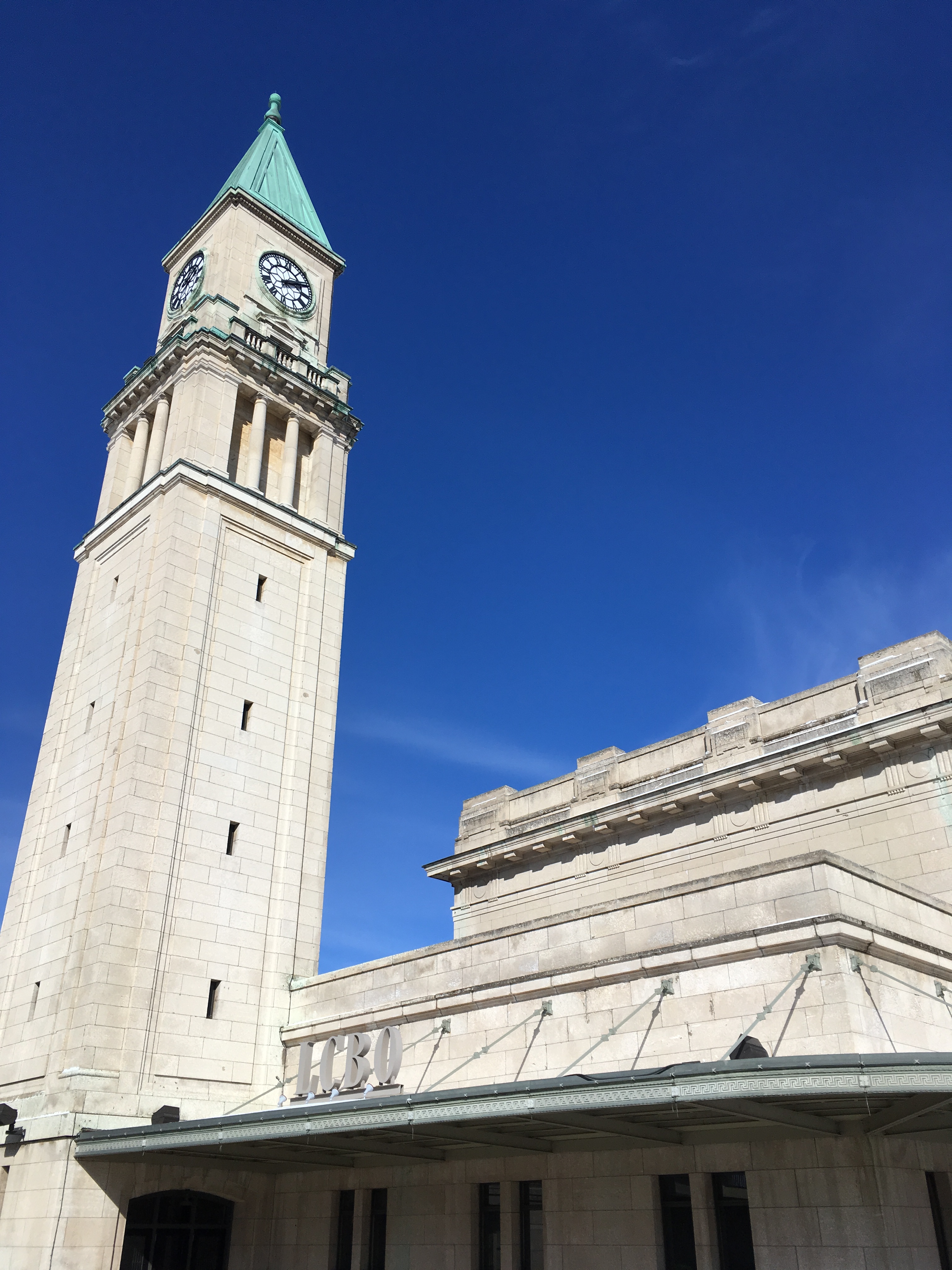
Just north of the Thieves, you pass one of the flagship stores in the LCBO chain, the former Summerhill Canadian Pacific Rail station. It was built in 1916 and yet only lasted as a train station until 1930. It sat empty for years until a tasteful renovation turned it into a retail outlet in the early 2000’s, complete with the former ticket windows and mosaic tiled floor.
The former Summerhill CN Rail station, now an LCBO outlet
Continuing up the street, you notice that while you have been climbing continuously since the lake, you’ve come to a section where Yonge rises more steeply between Summerhill Ave and Rosehill Ave. This slope occurs because thousands of years ago, at the end of the last ice age, this was the shoreline of a much larger lake called Lake Iroquois that later shrank to what is today Lake Ontario. This slope runs east-west roughly north of Davenport for several km, and is the height of land which gives Casa Loma its views and provides the excuse for the Baldwin Steps.
Crossing St. Clair Ave and continuing north, you pass the entrance to Mount Pleasant Cemetery. It’s one of my favourite walking areas in the city, an oasis for reflection and calm. I always think of my friend Paul when I pass here. Cheers mate.
Just past the cemetery entrance, Yonge Street dips between Heath Street and Merton Street – that’s because you are passing through what was once a ravine formed by Mud Creek. That dip means that, for my son, his route to school near St. Clair is uphill in both directions from our home.
When you arrive at Davisville, you enter our former neighbourhood. We lived in the area for 13 years and the shopkeepers are old friends who wave as I keep going north. Visit Carlo the Pasta Guy (as we called him) at Pasta Pantry for homemade sauces and pastas, and Carlo Celebre (the Cheese Guy) at La Salumeria for sandwiches, cheeses, salamis and much, much more. Together they kept my son in pasta and cheese, no mean feat.
From there it’s only a few more blocks to Yonge and Eglinton. My first apartment was just a block from here, back in the mid 1980’s, and then the area was known as Young and Eligible. My soon-to-be-wife and I had an early date a place called Daiquiri’s on the corner of Yonge & Eg. Today that bar is gone, replaced by the inevitable condo, and the intersection itself is, to be blunt, a mess – Yonge & Inexplicable. The Eglinton Crosstown rail link will, supposedly, someday, with luck, we think, I hope, finally be finished. Until then, the intersection is a vast construction zone.
Yonge & Eglinton, not so much Young and Eligible as Yonge & Restless-to-be-Finished
Thinking about it, in walking Yonge today I walked through 40+ years of personal history. In the late 1970’s my family visited Toronto for the first time in my life, and as a teenager from hicksville southern Ontario, Yonge was an explosion of commerce, colour, and chaos. In the 1980’s, Yonge and Eg was my backyard and local neighbourhood. In the 1990’s that was Yonge & Davenport. In the 2000’s and 2010’s, home meant Yonge & Davisville. I worked at 200 Yonge Street for years, rode then and ride now the Yonge subway line, and have continued to shop up and down Yonge. It’s all there, on one long messy stretch of road.
On my walking bucket list, I have a plan to walk the length of Yonge Street, from the lake to Barrie. Today was just a small taste of that. It’s still the heart of the city, and it’s still gritty and slushy on a February day when a wind from the north will freeze your cheeks – but walk it. Yonge is the backbone of Toronto – east and west of Yonge are the neighbourhoods where Toronto lives, but Yonge is how the city travels, where the city shops, and where it celebrates..







 Walkablog
