There can be a peacefulness to walking, a calmness that comes from repetition. Step, step, step, step – there’s a rhythm to it. Like chanting a mantra or focusing on your breath, walking can be meditation.
In those moments, your conscious mind turns off and your focus is inwards. I’ve had walks where minutes will go by and I’ll suddenly look up and realize that I’ve covered kilometres without noticing.
When that happens I’m not startled so much as awakened. There are stages to your sleep, during which your mind cycles through dreams and recharges itself. When you awake from a good sleep you’ve been rejuvenated and refreshed. When you return to your conscious self after meditation it’s a similar feeling, of mental freshness and readiness for new experiences.
Walking as meditation is not something that I can force to happen. I have to be open to it, to settle into a repetitive pattern of step, step, step. Little intrusions – my foot hurts, I’m thirsty – break that pattern. It’s partly why I don’t like to listen to music as I walk – I want to tune into the walk.
Letting the calmness of steady walking envelop you takes a discipline that we all have though seldom tap. Using that skill and honing it to become proficient is one of the great benefits of walking, so that walking as meditation becomes a tool in life’s toolbox. We all get stressed at some point or other, to some degree or other, yet we all have the ability to turn inwards towards calmness. Walking can help you get there.
Walking, upright on two legs, is one of the defining characteristics of humanity. We are evolved to walk – almost everything about your body, from the weight distribution of your upper and lower torso to the joints of your feet, ankles, knees, and hips, to the balance-providing structures of your inner ear, are fine-tuned by evolution to optimize the bio-mechanics of walking.
That evolution means that walking is one of the most natural ways to get around, whether it’s across a room or across a city. In doing that, you expend energy and that can be considered as exercise, even though you may not think of it as “working out”.
For most people, when they think about walking as physical exercise it implies more than just putting one foot in front of the other for a few minutes. Usually there is some duration target you have in mind, or a distance, or the number of steps. There is the notion of getting your heart rate up from your resting pulse rate to something higher, of genuinely working up a sweat.
When I started walking with a purpose, almost any walk became exercise, because I was so out of shape that I would be huffing and puffing after just a few minutes. Now that I am in better shape, I have to set out to exercise through my walking – duration and route become key. A good workout can come when I do at least 60 minutes, with lots of up and down hills, and ideally also carrying a load.
Walking for exercise is also, to a degree, walking with pain. The phrase “feel the burn” is real – when you are pushing your body hard, your muscles are using up the energy stored in your cells, and when you’ve reached the limits of that energy your muscles will let you know it. An exercise walk becomes a real workout for me when I have to grit my teeth to power through, going up a hill or at the end of a long walk. I’ll have a dialogue going in my head – “come on, come on, come on” – and sometimes out loud too if it’s a tough push. My heart rate goes up, and then I know I’m exercising.
There are times when I want some exercise but not a hard workout. In those cases, a walk becomes physical exercise for me as long as it’s more than about 20 minutes in duration. Less than that, and I’m probably just walking to do something – get to the subway or the shops, so over 20 minutes starts to feel like I’m going beyond walking as a utilitarian activity. Having said that, if I stitch together several short walks like that – 10 minutes here, 15 minutes there – so that I get up into the 45-60 minute range, then I’ll give myself credit for some exercise.
That’s the beauty of walking as exercise. It can be a light workout or it can be a hard one. It’s easy to vary up or down, to suit that day’s schedule, weather, and your mood. Picking a great neighbourhood to walk through means it’s not boring exercise either – it’s far more interesting to be out in the sun listening to the birds while you workout than to be grinding away on a treadmill in a gym.
There is another aspect of walking as exercise that I like. What I hadn’t anticipated when I started walking was the notion that the exercise I was getting would often be as much mental as physical. Mental exercise for most people comes in several ways – solving a puzzle, devising a plan, creating a song or play or poem. Walking can facilitate that – by planning a walk, especially a long one, finding an interesting and challenging route; or in staying alert when walking through high-traffic areas or tricky ground; or trying to remember the names of trees, flowers, birds, and insects as I pass.
When I was in my 20s, 30s, and 40s and even into my 50s, my friends would joke about my lack of exercise and I’d reply that my body was a temple where every day was the Sabbath. My exercise was reading a good book. Physical exercise was for those kinds of self-absorbed people who cared more about their physical appearance than their mental fitness.
A health scare changed that for me, and made me take more seriously the need to look after myself. That’s when my lifelong love of walking took on a new meaning and purpose, and walking as exercise became one of my goals. I’ve learned to appreciate walking more as a result, as this new dimension added to those other dimensions about walking that I’ve always enjoyed – walking a meditation, as immersion, as exploration.
There are prizes in life, though we don’t always earn them, or deserve them when we get them. Who wants the prize of being the last one out of the office every night?
Walking can be a prize, when the act of going for a walk is the reward you’ve saved for yourself for accomplishing some task or other. I’ve had days when I’ve been churning and working away at something, expending mental energy to complete a task at a deadline. I’ve been bursting with physical energy but have kept at the task at hand because it had to be completed by a deadline.
The release of walking afterwards, of paying myself back with the reward of a walk, has been very satisfying. You know when you have earned something, by saving for it. You’ve set a goal and achieving it is the prize.
Walking as a goal is that feeling of reward, and it’s more than that too. The prize of release from your desk is a part of it. The other part is being able to uncoil, stretch your legs, open your mind and senses to a different set of surroundings, and shift mental gears. Walking as a goal means appreciating that the act of going for a walk is a prize worth having. It can also mean that a walk of a certain kind is part of that goal – setting the target of walking 10 km, 20 km, or more – and then achieving it.
I like these kinds of walks, where I make a plan and I do it. It’s purposeful walking and its satisfying.
Location: Toronto – from Sherwood Park to Allan Gardens via the Don Valley trail system
Duration: 3 hours, about 15 km
Weather: Sunshine and blue skies, but crisp at -7C with a -12C wind chill
Today’s walk was about exercise and stretching out on a fine winter day. I wanted to get at least 3 hours or so, and needed to end up at my nephew’s place downtown near Allan Gardens.
I decided to get there via the Don Valley trail system, so from our home in the Avenue Road & Eglinton area I went east on Briar Hill Avenue to Yonge Street, then kept going east on Sherwood Road to Sherwood Park. In the park I took the Burke’s Brook trail east to Bayview Avenue.
Burke’s Brook Ravine trail – doesn’t look like January!
From there it’s safest to cross Bayview at the crosswalk at Kilgour Road, and then I could continue east on Kilgour all the way to its end, where I connected with the access road down into Sunnybrook Park. I walked through the west end of the park past the dog run area to the bridge across the West Don River.
Sunnybrook Park entrance – bridge across the West Don
Then it was east through Sunnybrook Park into Wilket Creek Park, almost to Leslie street, crossing the creek itself at the bridge where it joins the West Don River, and then turned south to follow the trail parallel to the river.
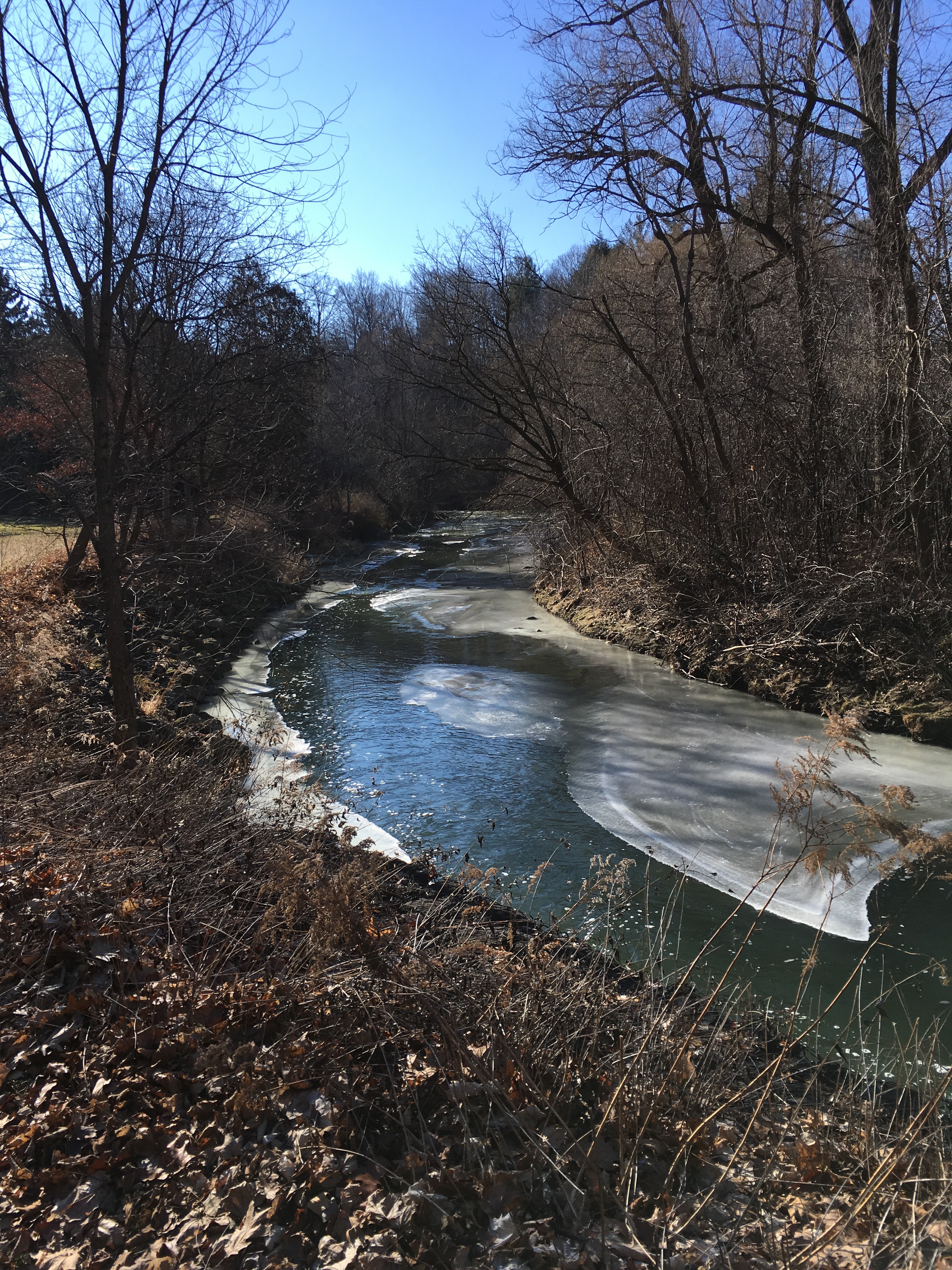
West Don River at Wilket Creek Park
The trail goes under Eglinton Avenue into E.T. Seton Park to become the West Don Trail. At the north end of this park is a disc golf course, and there were a few players out today since there was no snow.
The 1st tee at Toronto’s only disc golf course at the north end of E.T. Seton Park
I kept going south to the trail junction to the Taylor Creek Trail under Don Mills Road and through to the Lower Don Trail, which is where the East and West Don rivers join into the Don River.
Confluence of the West and East Don Rivers on the Lower Don Trail
The Lower Don Trail continues south along the east side of the river to Pottery Road, and you can either stay on the east bank and follow the main trail, or cross to the west bank and take the side trail along Bayview Ave, which is what I did in order to go to the Don Valley Brickworks for a quick pit stop.
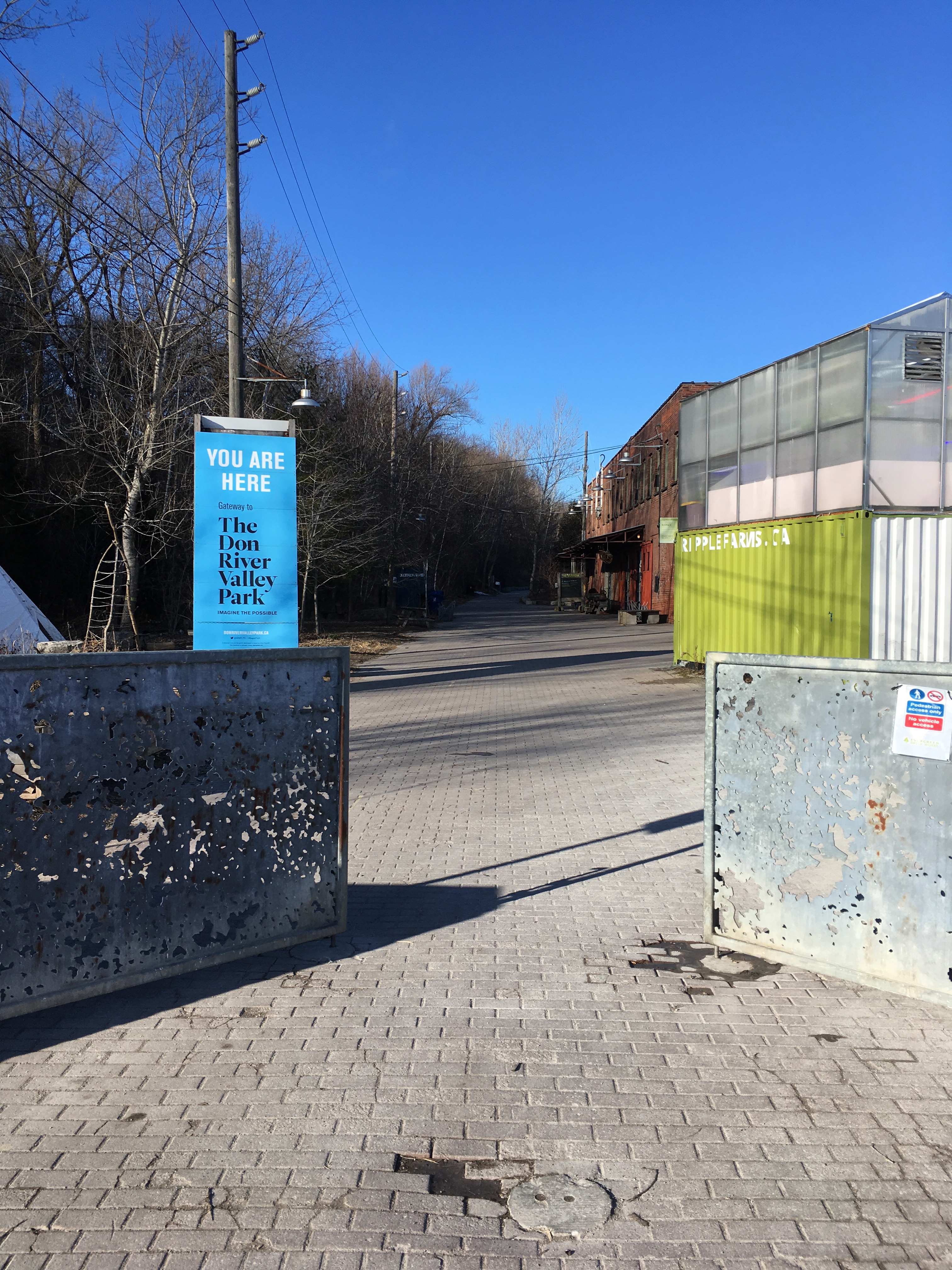
Entrance to the Don Valley Brickworks
I left the Brickworks along the lower Beltline Trail to turn west and north a bit into the Yellow Creek Ravine system, where I connected with the Milkman’s Lane trail up into Rosedale.
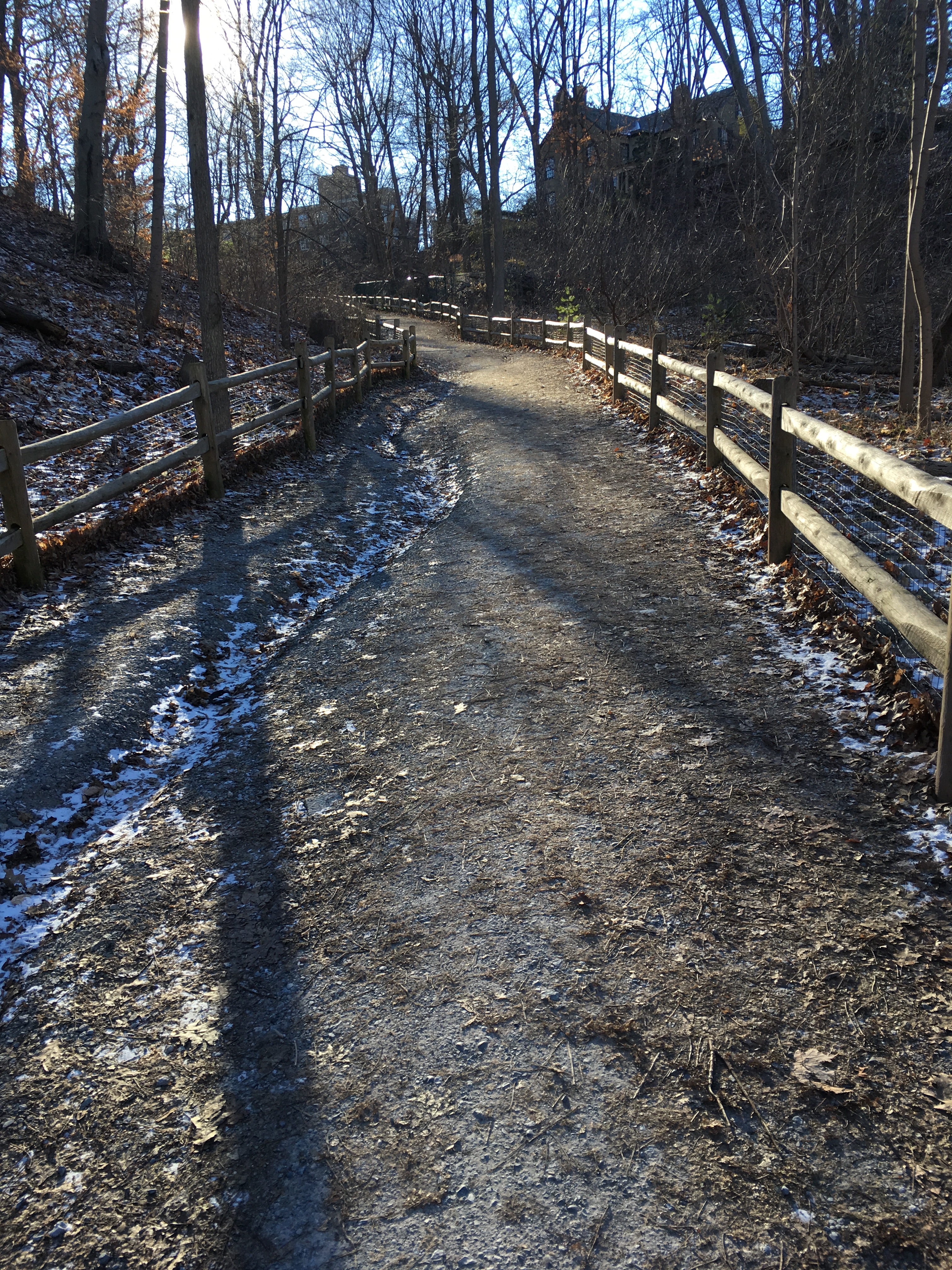
Milkman’s Lane climbing up into Rosedale – trust me it’s steeper than it looks
Once up that hill (stiff climb), I connected with Glen Road and went south across the Rosedale Valley on the Glen Road pedestrian bridge and under Bloor street to the south end of Glen Road to connect with Howard Street and over to the west to Sherborne Street, then south on Sherborne to Carlton Street to end at Allan Gardens.
All of that made for a long walk. My pace was pretty good, and I had worked up quite a sweat even though it was a cold day. That’s actually one of the harder things to manage when it’s cold – if you start sweating then you’ll get chilled as soon as you stop walking, so you’re better to wear layers and remove them as needed to stay warm but not sweating. I didn’t do that so by the time I got to my nephew’s I was actually over-heated for this weather.
The great thing about the walk was the weather. I’ve done more or less that same route in summer, and the walk through E.T. Seton Park, in particular, can be brutal when the sun is blazing down. Today, though it was cold it was good walking weather and the trails were dry and free of ice. Walking the Don River trail system covers several of my favourite routes and if I hadn’t had a destination today I would have kept going all the way to Corktown Common.
The history along the way is wonderful. You pass through former country estates (Sunnybrook), former mills and farms (Todmorden), former brick foundries (the Brickworks), and very different neighbourhoods ranging from Rosedale (one of Toronto’s richest) to St. James Town (not one of Toronto’s richest).
As I’ve said before, Toronto’s park and trail systems are amongst my favourite jewels of the city. Do this walk any time of the year, and you might see deer, coyotes, hawks, falcons, ducks, geese, raccoons, squirrels, chipmunks, skunk, turtles, frogs, and fish. Were it not for the traffic noise from the nearby roads, you could be fooled into thinking you’re out on a country walk. And yet, you can get into any part of this system via public transit. I love it. Walk the Don and find out for yourself.
We’ve all done it at some point. We’ve all decided that the best thing to do at some particular moment when we should be doing something else is to go for a walk.
It happens to me a lot. I’ve often worked right up to deadlines, handing in my essays at university in the middle of the night the morning before they were due. I’ll be in the office or at home, and there will be something that I am supposed to be doing. I’m not ready to do it though – maybe not mentally, or maybe not physically, or both. I won’t be able to put my finger on what it is that I need to do to trigger the start, and it will become distracting in itself. Why am I not just diving in?
When that happens, going for a walk seems like a good idea. Just get out, start putting down steps, and see what happens. Sometimes that walk helps trigger thoughts, plans, ideas – the repetition of step, step, step is metronomic and keeps thoughts flowing like music to a beat. Sometimes it’s also like a ticking clock that’s saying time is passing, building pressure to break down whatever mental barrier is holding me up.
Walking as procrastination is one of those activities you do when you tell yourself you’re a person who works best under a deadline. Counting down to that deadline so that you’re getting closer and closer to a crisis is a deliberate means of setting off a flight or fight response. You put off the task by walking in order to trigger the adrenaline rush that helps you to stop “flight” and start “fight”, to dive into your task and keep going.
Is it helpful to walk as procrastination? Probably sometimes it is – you need to prepare and walking (exercising) releases endorphins that calm your mood and reduce anxiety. Think of it as stretching and warming up ahead of a workout. As long as that procrastination doesn’t continue indefinitely, you’ll get to your goal eventually and in the meantime you are getting some exercise.
Location: Cedarvale Ravine/Nordheimer Ravine and Yonge Street
Duration: about 2.5 hours, 12k
Weather: Partly sunny, 0C and a chill north wind
The route started from home at Avenue Rd/Eglinton, and proceeded west along Roselawn to the Allen, then south across Eglinton down Everden into Cedarvale Ravine. I kept going south through the ravine to St. Clair, crossed that and then went down through Nordheimer Ravine to Boulton Drive, then south to Boulton Parkette, across Poplar Plains Road and back north to Cottingham, and then east along that to Yonge. From there I went north up Yonge to Manor Road, and then back west through the Chaplin Estates neighbourhood to Avenue Road, and north to get home.
I like walking through Cedarvale and Nordheimer, in any season. Today was a bit tough as there was a lot of ice on the paths, so the footing was tricky. Nevertheless, it always feels like an escape from the city into the countryside, as you walk through the trees and beside marshland. In spring and summer it’s alive with red-wing blackbirds, and in the fall the autumn colours are fantastic. In winter, there’s an outdoor ice rink in the park, and when there is snow there’s sledding on the hills. Whenever I walk through these parks, I can’t help but think that but for the persistence of many people, Toronto would have lost them back in the 1960s.
Torontonians today may not have heard of the Spadina Expressway, but they will have heard of the Allen Expressway and may have wondered why this road ends after just a few kilometres at Eglinton Avenue. The answer is that the Spadina Expressway was planned to continue the Allen Expressway south, through what is today the park system of Cedarvale and Nordheimer Ravines, and onwards south along Spadina Avenue all the way to the Gardiner Expressway down by the lake. That would have created a ring road around downtown Toronto, along with the Gardner to the south, the Don Valley Expressway to the east, and the 401 to the north.
While this plan seems terrible when looking back from today, I am sure that at the time to those who planned these roads, it made a lot of sense. Cars were symbols of freedom in the 1950s and 1960s, representing the ability to go where you wanted, when you wanted to. Cities around the world were building ring roads around city centres, and doing so in Toronto would have seemed like a modern approach in keeping with contemporary urban planning. Nevertheless, by the 1960s people were beginning to realize that cars, and the roads they required, came with costs. Toronto had seen many of its heritage buildings pulled down and replaced in the 1940-1970 period, and the thought of losing vibrant downtown neighbourhoods along Spadina along with the parklands and natural environments of the parks galvanized a response led by a new generation of urban thinkers such as Jane Jacobs.
I am grateful that these advocates were so passionate and vocal, and were able to carry public opinion. The trails and parks that we have today are amongst the jewels of Toronto, and are literally the lungs of the city. Walk through them and enjoy them, and never take them for granted.
When walking, one observes, and when walking in the city one is forced to observe drivers. Drivers, unfortunately, do not always observe walkers.
Some drivers are oblivious to walkers, either focused on their destination or their bloody phones. I’ve had several close calls, when drivers focused on car traffic haven’t noticed me standing 2 meters away. I always try to make eye contact with the driver as I cross at an intersection – if I can see your eyes, hopefully you can see me.
Then again, some drivers are out to be seen, what I refer to as Look At Me (LAM) drivers. They are often in expensive cars, or loud ones, or ideally both. Recently, we had a sunny but chilly afternoon, about -3C, and yet a sports car convertible passed me with the top down, downshifting with loud farts in order to shout LOOK AT ME IN MY EXPENSIVE CAR THAT I CAN DRIVE THE WAY I WANT TO AND SCREW YOU.
LAMitis is term I use for those who cannot abide being ignored. These are people with a pathological need to be looked at. They are the epitome of the selfish, self-conscious driver, the one with the music that’s not to your taste pouring out of open windows while they sit at red lights; or the one with bling and chrome and lights and wide tires and rumbling exhaust; or the one with the I-make-so-much-money-I-can-burn-it burning more petrol than a supertanker as their beast idles with the AC on full.
Aside: Walkers never have LAMitis. Runners always do.
Some drivers are careful and look out for pedestrians, and kids, and parents with strollers, and bikes, and squirrels, and much else. They often drive Hondas and Toyotas and Fords. They never seem to drive Bentleys or Lamborghinis.
Some drivers seek form over function. They emerge with perfect hair from clean, expensive cars, often with small dogs or groomed children in tow. They see walkers and pity them.
Other drivers are the opposite, seeking function over form. They are often distracted by their work and their vehicle is just a means to get them to that work. They usually drive pick-ups or vans covered in dust and dirt.
All drivers should see walkers, yet often don’t. On the other hand walkers must see drivers because of those drivers who should but don’t. My father had a saying – when you are crossing the street, don’t assume you have the right of way just because the light is in your favour because, he said, “while you might be right, you could end up being dead right”. Walkers are wary, at least long-lived ones are.
Sometimes when I walk – often really – my mind tunes out of its tumult and I go into a sort of trance. I’m not consciously thinking of anything, it’s more like my mind becomes a blank slate and impressions occur as I walk. “That tree is leaning awfully close to that house”; “who paints their car that colour?”; “was that a hawk or a falcon’s cry?”
My word for this is immersion – the act of allowing yourself to merge into your surroundings and letting that melding mould your thoughts. It’s not mindfulness in the meditation sense, and it’s not meditation. Rather it feels like bathing in a stream, where you lie still and the water plays on you, except when walking you are the stream, the current.
I love that feeling. You are alive and aware yet reactive rather than proactive. In my working life as a project manager, I have to be proactive, to think forward and sideways and anticipate and plan and organize. There is no space for immersion because I’ll get run over by events – one can’t stand still in the middle of the road.
Walking is the opposite of work for me because of that sense of immersing myself in my surroundings. There is no plan, there is just “be”.
It’s why I like to walk alone – it’s harder to immerse in the walk when in company because I’m conscious of the other person even if we aren’t chatting. Walking in company can be contemplative and certainly can be exercise, but it can’t be immersive. There is only one path at a time and it’s the one I’m on at that moment in that place, and I want to get everything out of that I can by immersing myself into that walk.
There are many things I like about walking in Toronto. Of course since I live here you could say I have no choice, but even if I didn’t live here I’d find these things fascinating were I to visit and wander. Here’s just a few of the many things that make walking Toronto so much fun.
1. Sidewalk dates. Within the city, it’s been the practice for many years to stamp the concrete used for the sidewalks with the year they were laid. Thus you get a time capsule view of the age of the neighbourhood you’re wandering through. Also, when sidewalks are repaired the new stretches have new dates, so you can see a history of renovation in the neighbourhood by comparing the dates almost house by house – sidewalks are often pulled up to put in new drains or driveways when homes are renovated – so without knowing anything else you can see the evolution of the houses. When I walk, I like to look out for the oldest sidewalk dates I can find, and especially look for those older than I am. I was born in 1963, and the oldest I’ve seen thus far is from 1958 (Avenue Road and Hillcrest), in the Lytton Park neighbourhood. Considering our winters and the amount of salt tossed about, that’s pretty impressive.
2. Ravines. Toronto’s park system is one of the city’s crown jewels, and some of my favourite city walks have made extensive use of the trails through the ravines that cross the city. The Moore Park ravine, the Cedarvale Ravine, the Don Valley, the Humber Valley, and Taylor Creek are just some of the trail systems I’ve explored. Use them, enjoy them, respect them, and protect them.
3. Neighbourhoods. Toronto, like any city, has a diverse set of communities, but what sets Toronto apart is that these are formed by the many people who have come to Toronto from around the world. The city is one of the most diverse in the world, and that diversity is a massive strength and a source of endless inspiration. A random 10k walk across just about any part of the city will take you through a dozen “countries” where you can sample foods, hear languages, and people watch with endless fascination.
4. Seasons. Ok, all places are subject to seasonality. Still, Toronto’s latitude means that we get the full effects of 4 distinct seasons. Wags will point out there are only two seasons on the roads (construction and winter) and only two seasons recreationally (summer and hockey). Ignore them and focus on what you see when you walk. Spring takes you from cold rains in March through April showers and May flowers. Summer sees parks in full bloom starting in June and into the heat and humidity of July and then the dryer heat of August. Autumn starts warm in September and leads to the rich colours of October and the grey skies in November. Winter’s greyer days and short nights in December lead to cold clear days in January and February. Every month is distinct in its weather and that is played out in everything you see on your walks – the trees, the rivers and creeks, the parks, the people. You can walk the same path 12 times over the year and get 12 very different experiences just because of the seasons. Don’t get me wrong, when it’s -20C or +30C the walk can be a slog, but it’s never boring.
5. Dogs. I have to confess that while I like dogs (and children), that goes more for my dog (and child) than than yours. My dog (and child) is perfectly behaved, it goes without saying. Yours, on the other hand – let’s just say that while you may not be able to judge a book by its cover, I suggest that you can judge a person by the behaviour and appearance of their dog. Nevertheless, watching dogs and even more so watching dog owners is an endless source of fun. Why do people put dogs in clothes? Why do they put them in strollers!?! Why do people have multiple dogs? Why do people with big cars have small dogs and vice-versa? Who puts blingy jewelled collars on dogs? What self-respecting dog lets them? Why does the dog-to-people ratio increase with the value of the houses in a given neighbourhood, and what does it say about that neighbourhood? Has anyone ever measured the relationship between the number of Starbucks in a neighbourhood and the number of dogs? So many questions ….





 Walkablog