Slog Walking

This past couple of weeks have been winter walking at its worst. We’ve had large dumps of snow, rain, freezing rain, sleet, slush, mush, and gusty winds. The streets are sloppy and the sidewalks are worse. Plus I’ve been busy at work and driving to a customer’s office 5 days a week.

It adds up to a bad time for walking, and after 10 days or so of this I was feeling it. My back hurt from sitting too much, and I just needed some air. I wasn’t sleeping well either, so my energy levels were way down. I felt stifled and listless, and it reminded me of what I used to feel like before I started walking back in 2016. I dread getting on the scale for my Sunday weigh-in this week, I’m sure I’ve put on a few pounds just from getting out of my routine.

Winter will do that to you, there are going to be days when the weather doesn’t cooperate. Work will do that too, days when you’re just too busy to get out. Combining the two is the worst.

Today I managed to get out for the best part of 2 hours and it felt good to be stretching my legs. Even so, there’s still a lot of ice about on sidewalks, and the weather today made it tricky – it was below freezing at about -4C but the sun was out so there was a lot of melt-water leaking onto the sidewalk and that froze as soon as the sun shifted and shade covered the area. You had to be careful and pick your way, looking out for dry stretches and penguin-walking through the wet/icy parts.

I know that too much salt is bad all around – it kills grass, ruins the sidewalk, destroys your boots, and fouls the meltwater that runs off to the lake. Still, I was hoping that people would spread it liberally today, and while some people did, others ignored it and hoped for the best. That’s the trouble with winter walking in Toronto – you have to be on your guard all the time because just when you assume that your footing is good, you’ll slip on a patch of ice.

Getting a walk in when the elements conspire against you – that’s slog walking. Baseball pitchers & catchers report for sprint training this coming week, the first sign of spring. Play ball.

Walks in Winter

Today was a day for a winter’s walk, January cold and about 15-20 cm of snow overnight. When you get out early on a day like that, especially on a Sunday when people are up later anyway, you appreciate the city in winter and the clean fresh face it wears this time of the year.

I hadn’t realized how much snow we had gotten overnight until I went out – the sidewalks were still covered in snow in many places and the roads were also covered except where cars had made paths to follow. It made for a more strenuous walk than usual for our neighbourhood but it was quite cold so the exercise was welcome to keep the blood flowing.

I headed north from our place, into the Lytton Park and Chatsworth neighbourhoods. There is a school called Glenview near us, and when our son was younger we would go there to go sledding on days like we had today. Seeing other younger parents brought back memories of his adventures then.

At the bottom of the hill at the school and east out the back of the schoolyard is the Chatsworth Ravine, and that was gorgeous in the sun with a fresh coat of snow.

Chatsworth Ravine park

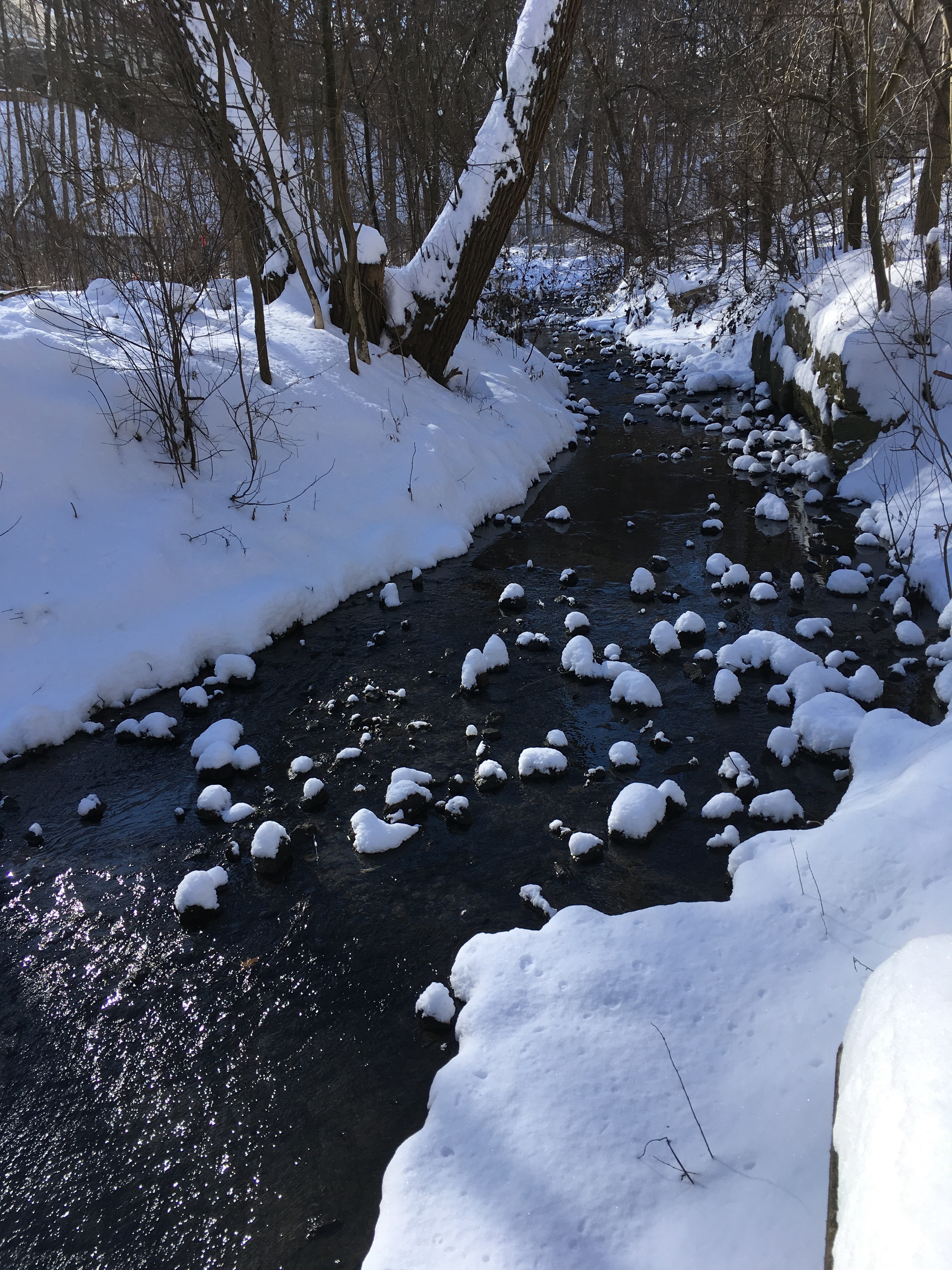
As I followed the trail through the ravine, I could hear the sounds of digging out – the scrape of snow shovels and the hum of snow blowers. There is also a small creek flowing through the park (Burke’s Brook) and it hadn’t frozen over so there was the ripple and splash of that as well.

Burke’s Brook in Chatsworth Ravine

From the ravine I kept east to Duplex and up the stairs, crossing the road to Chatsworth and then down the hill to Yonge. From there I crossed and went into Alexander Muir Park, and along the trail east through the ravine under the Mount Pleasant bridge and then up Glengowan into the Lawrence Park neighbourhood. This is a lovely part of Toronto, with mature trees heavy with snow, brick and stone homes dating back to the 1920’s and 1930’s, and quiet streets that reward a wanderer with the sounds of birds and squirrels.

By the time I climbed the hill on Glengowan and looped back north up onto Dawlish, I was pretty tired after slogging through the snow, so I went west back to Mount Pleasant and then south to Blythwood, so that I could go west back to Yonge and make my way home.

Today brought many things to mind about walking in Toronto in winter:

  • the smell of wood smoke in the air
  • the excuse-me shuffle as you pass others heading the other way on the narrow shovelled portion of the sidewalk
  • the curse of unshoveled stretches and the blessing of clear patches
  • salt, salt, salt in some places and ice, ice, ice in others
  • the friendly nod and smile as you pass homeowners digging out
  • the glad-it’s-not-me thought when you see a snowed-in car
  • the crunch and squeak of cold dry snow underfoot
  • the uncertain navigation of drivers without winter tires
  • the laughter of children rolling down hills and their excited shrieks on sleds and toboggans
  • the snow hush muffling the streets, as traffic sounds are deadened

You know a city by it’s sounds and smells and people and streets, and in winter all of these change. Toronto in spring, in summer, in autumn are different places, and winter has its own character too. I’m like many people in the city, I like it when the sun is out and when it’s cold I can’t wait for spring.

And still, I have to admit it’s beautiful, in any season. I read an article on the BBC news website today, about words in Japanese that have no direct translation into English. One phrase in particular came to mind as I walked in the snow – “mono no aware”, which the BBC article translates as “the ephemeral nature of beauty – the quietly elated, bittersweet feeling of having been witness to the dazzling circus of life – knowing that none of it can last”.

Snow melts, we all know that, and even before then the wind and sun play upon the surface, sculpting the shapes and casting shadows that change with the movement of trees and boughs. No two moments in a snowy landscape are the same and no amount of photography can capture them all. Standing still, absorbing, you take them in and let them go like breaths, exhaling clouds.

Mono no aware. Snow in the city. Winter calm.

Walking to Work

For much of my career, I have been able to walk at least part of the way in travelling to work. The ability to do that is something that I have always factored into what makes a given role attractive or otherwise. I’ve tried the car-commute thing, and the long train ride thing, and it’s just not that pleasant. I’d much rather walk to work, just as I’d much rather live in a walkable neighbourhood, or visit a walkable city.

Having said that, it’s true that walking to work is a different type of walking. You have a destination, and usually are on a schedule so there’s often deadline pressure too. It’s walking with a purpose, a utilitarian walk rather than an exploratory or meditative one.

Walking to work is of course very different to walking from work, because walking from work often means you are walking to home. In fact the everyday language we use for this is a clue – we say we’re “walking home”, not “walking from work”. “Home” is the key word. When we talk about our travel, we use the phrase “walking to work” rather than “walking work” as we would say “walking home”. Why? The “to” gives the work-bound walk the destination, the purpose, and that makes it a utilitarian journey. I walk “to” work to accomplish something. I “walk home” because I have already accomplished something and home is my reward.

There are times when the walk to work is a trudge, a slog, a drag of the feet. You know you have to go in and yet you’re dreading it. Other times it’s kind of mindless, a repetitive act completed on autopilot. For many people, and I am one, the walk to work has become part of their exercise routine, so those morning steps clocked on my fitness tracker count towards my daily and weekly goals.

And then there are those days you savour, when the walk to work is a pleasure, a brilliant start to a day looked forward too. Sometimes that’s just the weather – who doesn’t like walking on a gorgeous spring morning or a crisp autumn day? Best of all are when it’s that lovely day plus the sheer anticipation of digging into some challenge that I’m ready to tackle. My steps are light, my stride is confident, and my energy is up.

Can you fake that? Convince yourself that all is good and the walk to work is going to be great, even when you don’t really feel it? I’m not sure, or at least I can’t do it. That’s why when I do have that feeling I relish it, to make the walk a warm-up to what I am sure will be a great day.

That’s the thing about walking to work. It’s necessary, so we take it for granted. And yet it’s going for a walk, so why can’t we bring the same eagerness to it that we bring to walking for other reasons? Why can’t walking to work also be walking for pleasure?

A walk to work is after all still a walk, and that means it’s still a chance to explore, meditate, and exercise even if it has a utilitarian purpose. Whether or not you are looking forward to what happens when you get there, the walk to work is a journey, and journeys are opportunities to learn something about the world. There have been many grey, foul-weather days when walking was not pleasant or even possible, and there may be days to come for me when perhaps I won’t be able to walk so easily or even at all. Walk when you can, while you can, because you can, even if it’s walking to work.

I tried to keep that thought in mind this morning, slip-sliding slushily in a cold, sleety rain with a hunched slog into a chill wind. “Embrace the journey”. That comes more easily some days than others.

Walking as Exploration

On the Myers-Briggs personality assessment scale, I am an INTJ – introverted and analytical, a planner. I’ve always had an imagination and an inner dialogue, and I love to immerse myself in a good book.

Those traits go back to my earliest memories of childhood play – I loved to explore while making up a story for myself. I was the frontier explorer, the daring soldier, the lifesaving paramedic, as I ran about the neighbourhood and made blanket forts in the basement.

Part of that too came out in walking to explore. When I was about 9 we moved to a new home and neighbourhood, on the edge of the small town in south-west Ontario where I was born. Surrounding our little sub-division were fields, orchards, gravel pits, and small forests and I could literally run wild. I would roam for hours on my own, imagining that I was lost in the woods or was blazing a trail to a new land. In that environment, walking was exploration every day.

As I grew older, and later moved to Toronto to attend university, that need to walk about and explore my surroundings found new expressions. I attended Glendon College, a small campus of York University set in the Don Valley. Behind my dorm was a trail down into the valley to the Don River, and along the river there were other trails. I have always been a night owl, and would usually write essays and assignments into the small hours of the morning. By 5 or 6 a.m. I would be ready to take a break, and would go for walks along these trails. I’d be the only person about and the city would be quiet, and I could go back to those childhood days when I was alone in the woods and exploring.

Later after I graduated, one of my early jobs was working for a software vendor in a role that saw me travel to customer sites around North America. Whenever I would arrive somewhere new, I would be itching to go for a walk and learn about that city. I explored Montreal, Chicago, Boston, and Denver (loved them), and Des Moines, Newark, and Poughkeepsie (not so much). We also travelled for pleasure, and were able to explore cities and landscapes in Europe, Canada, the US, Australia, and New Zealand. In all of these places, I would wander about, exploring markets and shops, bars and restaurants, people watching and absorbing the pulse of the place.

I still remember the first time I went to London. I was there working on a project out in the suburbs near Croydon, and couldn’t wait for the first weekend to myself. I took an early train to Blackfriars, and spent the day walking from the Tower through the City to the Inns of Court and onwards along the Embankment, then to Trafalgar, along the Mall to Buckingham Palace and through St. James Park into Kensington and to Harrods. And then of course I did it all in reverse back to the train. I must have covered at least 15 km that day and loved every moment.

Walking as exploration has been my favourite activity since I was a child and it’s still the primary reason I walk. Whether it’s exploring my local neighbourhood in Toronto, ranging out through Toronto parks and trails, or wandering while on holidays – all walks are journeys into the feel and history and spirit of a place. When I talk about walking as immersion, I’m submerged in the stream of consciousness of the walk. But when I am walking as exploration, I’m immersed and yet wakeful, absorbing my surroundings – the sounds, smells, people, cars, dogs, buildings, birds, trees, and the whole shebang of that place and then I’m that little kid again exploring the woods and fields behind the house.

That’s why I walk.

Walking as Escape

Do you walk towards something, or do you walk away from it? When it’s the latter, then walking is escape – from cares, from responsibilities. How often have you decided to go for a walk because there is something nagging at you, some task to be done, some confrontation to avoid?

Walking to get away, like running to get away, is a response to pressure. It can be literal escape – the duck down a side corridor at work because someone you want to avoid is coming the other way. It can also be metaphorical escape, in fleeing pressure.

Or it can be liberating, an escape from a mental cage – walking to escape the confines of the house or office on a sunny day when you are bursting to stretch your legs. That escape is thrilling, it’s energizing. We’ve all felt it, that release of energy. It’s the relief you get when you can get off the plane after a long flight – that feeling of release when you’re let out of the aircraft and are walking towards the baggage carousel, of finally being able to uncoil and unwind – that’s walking as escape.

Walking to escape isn’t quite the same as walking as procrastination. That’s also about avoiding things to be sure, but procrastination is about putting things off. Escape is about breaking free and not going back. Walking as procrastination actually builds pressure because you know you’re going to have to do the thing eventually. Walking as escape means leaving that pressure behind, that sense of responsibility.

We use the phrase “care free” to describe that sensation, and it’s no accident that “free” is part of the phrase. Freedom may be temporary, perhaps we’re on metaphorical parole from our cares, but that sense of freedom that comes from a good walk is one of the best parts of it.

Walking as Meditation

There can be a peacefulness to walking, a calmness that comes from repetition. Step, step, step, step – there’s a rhythm to it. Like chanting a mantra or focusing on your breath, walking can be meditation.

In those moments, your conscious mind turns off and your focus is inwards. I’ve had walks where minutes will go by and I’ll suddenly look up and realize that I’ve covered kilometres without noticing.

When that happens I’m not startled so much as awakened. There are stages to your sleep, during which your mind cycles through dreams and recharges itself. When you awake from a good sleep you’ve been rejuvenated and refreshed. When you return to your conscious self after meditation it’s a similar feeling, of mental freshness and readiness for new experiences.

Walking as meditation is not something that I can force to happen. I have to be open to it, to settle into a repetitive pattern of step, step, step. Little intrusions – my foot hurts, I’m thirsty – break that pattern. It’s partly why I don’t like to listen to music as I walk – I want to tune into the walk.

Letting the calmness of steady walking envelop you takes a discipline that we all have though seldom tap. Using that skill and honing it to become proficient is one of the great benefits of walking, so that walking as meditation becomes a tool in life’s toolbox. We all get stressed at some point or other, to some degree or other, yet we all have the ability to turn inwards towards calmness. Walking can help you get there.

Walking as Exercise

Walking, upright on two legs, is one of the defining characteristics of humanity. We are evolved to walk – almost everything about your body, from the weight distribution of your upper and lower torso to the joints of your feet, ankles, knees, and hips, to the balance-providing structures of your inner ear, are fine-tuned by evolution to optimize the bio-mechanics of walking.

That evolution means that walking is one of the most natural ways to get around, whether it’s across a room or across a city. In doing that, you expend energy and that can be considered as exercise, even though you may not think of it as “working out”.

For most people, when they think about walking as physical exercise it implies more than just putting one foot in front of the other for a few minutes. Usually there is some duration target you have in mind, or a distance, or the number of steps. There is the notion of getting your heart rate up from your resting pulse rate to something higher, of genuinely working up a sweat.

When I started walking with a purpose, almost any walk became exercise, because I was so out of shape that I would be huffing and puffing after just a few minutes. Now that I am in better shape, I have to set out to exercise through my walking – duration and route become key. A good workout can come when I do at least 60 minutes, with lots of up and down hills, and ideally also carrying a load.

Walking for exercise is also, to a degree, walking with pain. The phrase “feel the burn” is real – when you are pushing your body hard, your muscles are using up the energy stored in your cells, and when you’ve reached the limits of that energy your muscles will let you know it. An exercise walk becomes a real workout for me when I have to grit my teeth to power through, going up a hill or at the end of a long walk. I’ll have a dialogue going in my head – “come on, come on, come on” – and sometimes out loud too if it’s a tough push. My heart rate goes up, and then I know I’m exercising.

There are times when I want some exercise but not a hard workout. In those cases, a walk becomes physical exercise for me as long as it’s more than about 20 minutes in duration. Less than that, and I’m probably just walking to do something – get to the subway or the shops, so over 20 minutes starts to feel like I’m going beyond walking as a utilitarian activity. Having said that, if I stitch together several short walks like that – 10 minutes here, 15 minutes there – so that I get up into the 45-60 minute range, then I’ll give myself credit for some exercise.

That’s the beauty of walking as exercise. It can be a light workout or it can be a hard one. It’s easy to vary up or down, to suit that day’s schedule, weather, and your mood. Picking a great neighbourhood to walk through means it’s not boring exercise either – it’s far more interesting to be out in the sun listening to the birds while you workout than to be grinding away on a treadmill in a gym.

There is another aspect of walking as exercise that I like. What I hadn’t anticipated when I started walking was the notion that the exercise I was getting would often be as much mental as physical. Mental exercise for most people comes in several ways – solving a puzzle, devising a plan, creating a song or play or poem. Walking can facilitate that – by planning a walk, especially a long one, finding an interesting and challenging route; or in staying alert when walking through high-traffic areas or tricky ground; or trying to remember the names of trees, flowers, birds, and insects as I pass.

When I was in my 20s, 30s, and 40s and even into my 50s, my friends would joke about my lack of exercise and I’d reply that my body was a temple where every day was the Sabbath. My exercise was reading a good book. Physical exercise was for those kinds of self-absorbed people who cared more about their physical appearance than their mental fitness.

A health scare changed that for me, and made me take more seriously the need to look after myself. That’s when my lifelong love of walking took on a new meaning and purpose, and walking as exercise became one of my goals. I’ve learned to appreciate walking more as a result, as this new dimension added to those other dimensions about walking that I’ve always enjoyed – walking a meditation, as immersion, as exploration.

Walking as a Goal

There are prizes in life, though we don’t always earn them, or deserve them when we get them. Who wants the prize of being the last one out of the office every night?

Walking can be a prize, when the act of going for a walk is the reward you’ve saved for yourself for accomplishing some task or other. I’ve had days when I’ve been churning and working away at something, expending mental energy to complete a task at a deadline. I’ve been bursting with physical energy but have kept at the task at hand because it had to be completed by a deadline.

The release of walking afterwards, of paying myself back with the reward of a walk, has been very satisfying. You know when you have earned something, by saving for it. You’ve set a goal and achieving it is the prize.

Walking as a goal is that feeling of reward, and it’s more than that too. The prize of release from your desk is a part of it. The other part is being able to uncoil, stretch your legs, open your mind and senses to a different set of surroundings, and shift mental gears. Walking as a goal means appreciating that the act of going for a walk is a prize worth having. It can also mean that a walk of a certain kind is part of that goal – setting the target of walking 10 km, 20 km, or more – and then achieving it.

I like these kinds of walks, where I make a plan and I do it. It’s purposeful walking and its satisfying.

Walking as Procrastination

We’ve all done it at some point. We’ve all decided that the best thing to do at some particular moment when we should be doing something else is to go for a walk.

It happens to me a lot. I’ve often worked right up to deadlines, handing in my essays at university in the middle of the night the morning before they were due. I’ll be in the office or at home, and there will be something that I am supposed to be doing. I’m not ready to do it though – maybe not mentally, or maybe not physically, or both. I won’t be able to put my finger on what it is that I need to do to trigger the start, and it will become distracting in itself. Why am I not just diving in?

When that happens, going for a walk seems like a good idea. Just get out, start putting down steps, and see what happens. Sometimes that walk helps trigger thoughts, plans, ideas – the repetition of step, step, step is metronomic and keeps thoughts flowing like music to a beat. Sometimes it’s also like a ticking clock that’s saying time is passing, building pressure to break down whatever mental barrier is holding me up.

Walking as procrastination is one of those activities you do when you tell yourself you’re a person who works best under a deadline. Counting down to that deadline so that you’re getting closer and closer to a crisis is a deliberate means of setting off a flight or fight response. You put off the task by walking in order to trigger the adrenaline rush that helps you to stop “flight” and start “fight”, to dive into your task and keep going.

Is it helpful to walk as procrastination? Probably sometimes it is – you need to prepare and walking (exercising) releases endorphins that calm your mood and reduce anxiety. Think of it as stretching and warming up ahead of a workout. As long as that procrastination doesn’t continue indefinitely, you’ll get to your goal eventually and in the meantime you are getting some exercise.

Walkers vs Runners

I can sum up my theory of runners versus walkers with this graphic:

Walkers are modest, runners are arrogant.

Walkers wear sensible shoes and have destinations.

Runners brag about their shoes and go in circles to sweat with purpose.

Walkers value the journey and the things they see along the way.

Runners value the sweat and the exercise and don’t see anything they pass, including walkers.

Runners hydrate, walkers drink water.

Runners enter The Zone, walkers immerse.

Runners compete, walkers contemplate.

Runners carb load, walkers eat.

Runners exercise, walkers journey.

A runner spends hundreds or thousands of dollars on shoes, compression socks, tights, shorts, shirts, weather gear, heart rate monitors, hydration systems.

A walker buys clothes and shoes to wear while getting about his/her business.

Race walkers are weird runners.