PEI’s Island Walk Part 4 – Kensington to North Lake

Blog posts are a labour of love for me, and yet there is a cost to running this site and organizing my walks.If you’d like to help with that, I’d really appreciate something for my tip jar.The Buy Me a Coffee service allows patrons like you to fund writers like me.  If that sounds like a worthy idea to you, then go ahead – keep buying me coffees.Thank You Very Much to everyone who has contributed already!

*****

In June 2022, I completed the 700 km Island Walk, around Prince Edward Island. You can read about that walk over several posts, starting with this one.  

This was before Hurricane Fiona caused so much damage on the Island, impacting many of the places which I had visited.  Some of what I describe below may have changed by the time you do the Island Walk, but please, don’t let that stop you.  PEI needs your tourist support as it recovers.

This post is about days 14-19 of my walk, between Kensington and North Lake.  The links below have the details from the Island Walk website for the Sections that I covered.  

Note, by the way, that the section #s on the official website are somewhat confusingly labelled based on each start point, and since the overall walk start point is also the finish point, the 1st section is labelled as “32-1” with its accompanying web page titled as Section 32 (because it starts at the end of the last section, which is section 32) and goes to the end of section 1; thus the 2nd section is labelled as “1-2” and its webpage is titled Section 1, and so on.  Whatever, the links below reflect the sections as I walked them.

I highly recommend that you use the Island Walk website and its directions for the details of the official route, since that route can change from time to time such as for detours around major road works.  That said, I also encourage you to use the official route and its sections as a starting point.  Find your own pace, detour as and when your fancy takes you, walk the sections in whatever order seems sensible, and remember – everybody walks their own camino.

If you are planning on doing the walk in chunks spread over several months or years, this portion is self-contained and covers the most scenic and popular portions of the island, including the famous Ann of Green Gables and Prince Edward Island National Park along the north shore.

Anne of Green Gables Country

Day 14 of my walk dawned to rain, which was forecast to continue all day.  I had known when I started the journey that sooner or later I’d have a walk-all-day-in-the-rain day, so in a back-handed way I was actually looking forward to demonstrating my resolve.  A little rain can’t stop me!  But within limits – I’m a pilgrim, not a martyr, so mostly I just wanted to get it over with.

And deep, deep down, more than anything else, I was excited.  First because this was Halfway Day, when I would complete Section 16 of the 32 sections of the Island Walk.  And second, this was my last solo day – Ann was joining me the next day, and I was keen to see her and to prevail upon her patience in acting as my transport Sherpa the rest of the way.
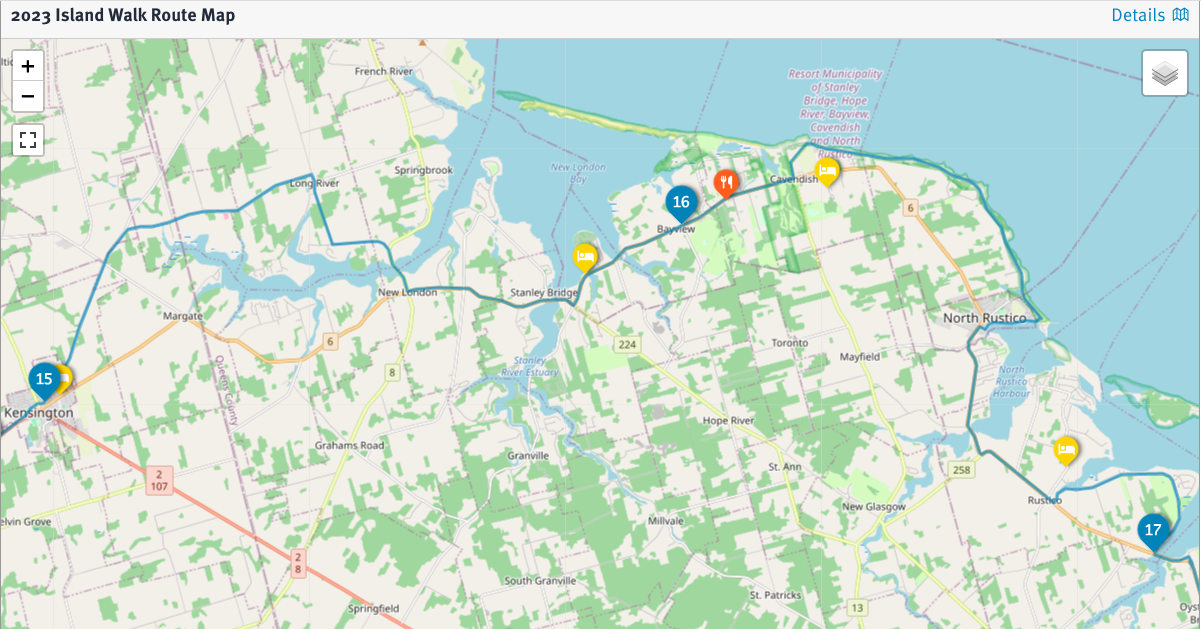
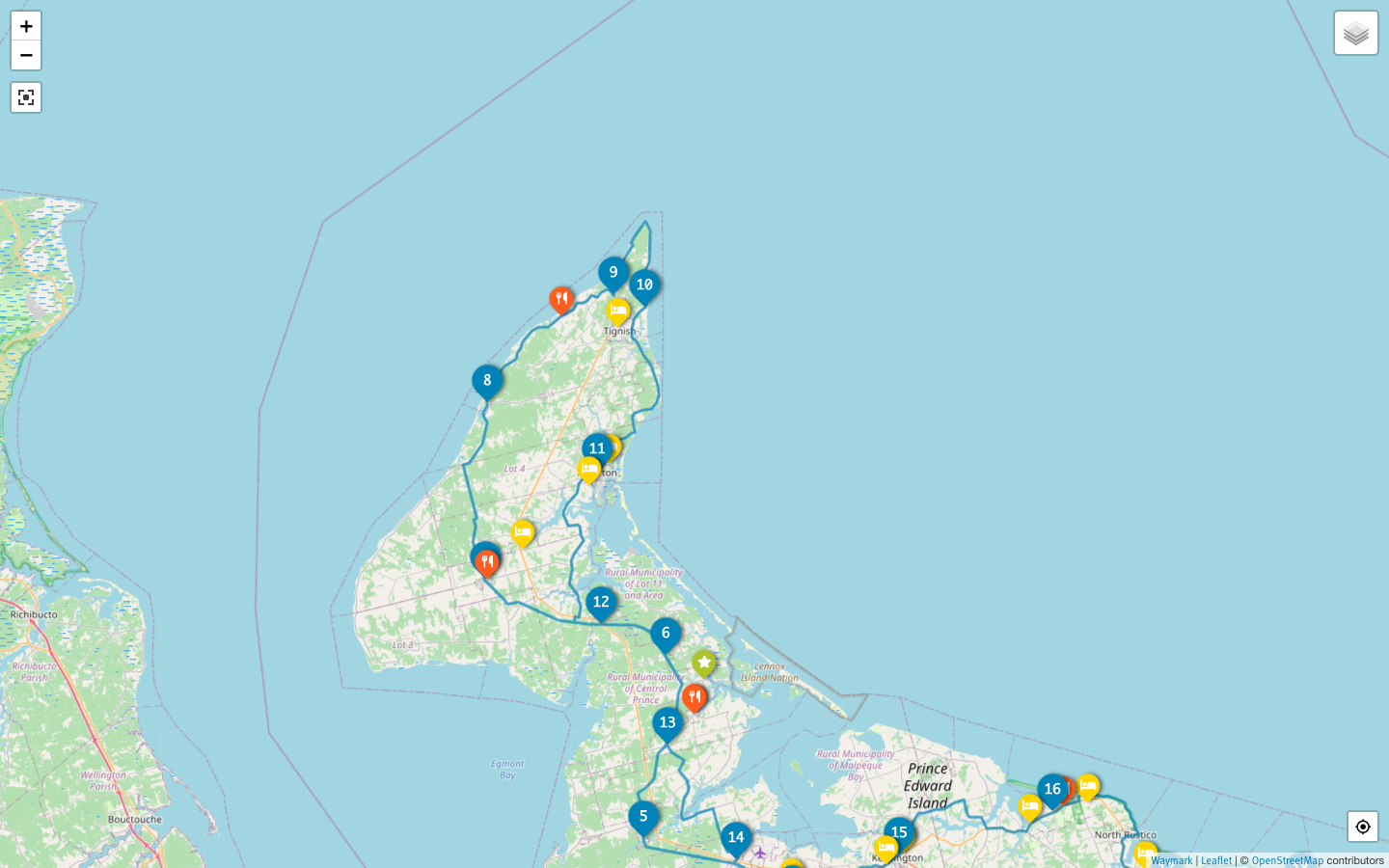
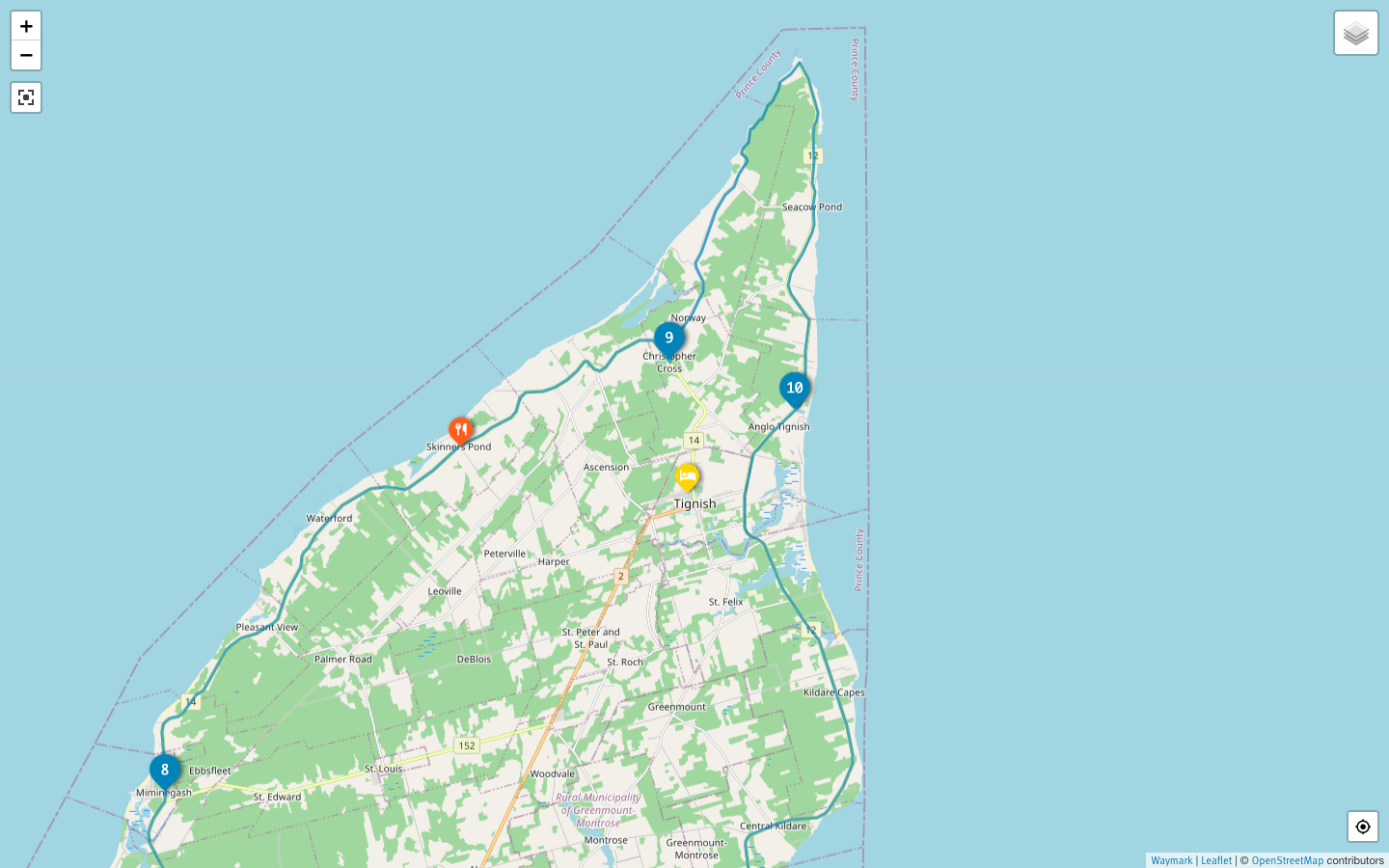
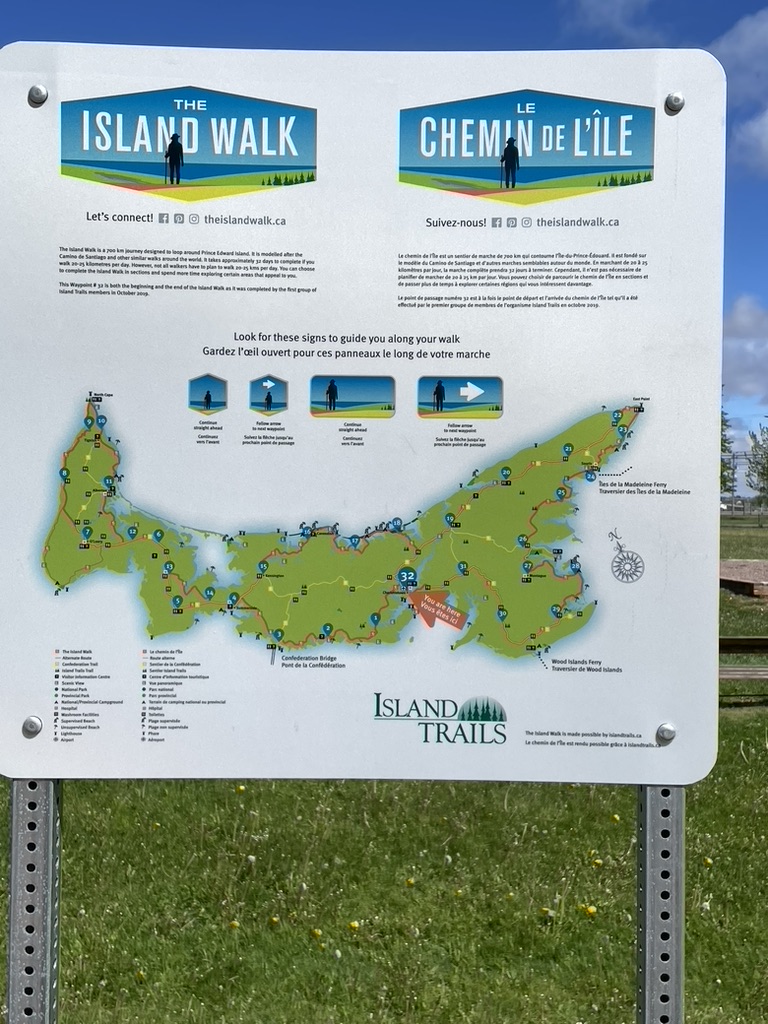
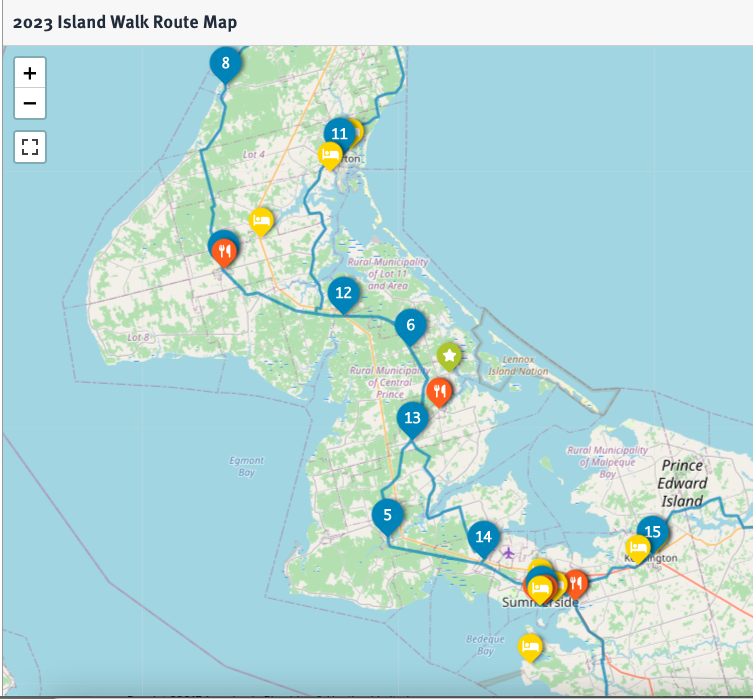
Screen capture from the Island Walk website. Copyright © 2023 An Island Trails project

Since I was walking out of my hotel in Kensington to the start of Section 16 down by the old train station, I needed no drop-off that morning.  Instead, I had arranged for Stanley MacDonald, who’d provided driving services for me over the past few days, to pick me up at the Tourist Info centre in Cavendish, about 5 and half hours of walking away, so all I had to do was get there.

I packed a top-to-bottom change of clothes into a dry bag that went into the bottom of my pack along with the usual snacks and water and lunch and a fleecy.  I put on my rain gear, tucked the rain cover onto my pack, took a deep breath, and stepped out into the wet. 

The Island Walk website describes Section 16 as “a road walk with spectacular ocean views, fishing villages, and a National Park.”  That Section ends at Bayview, just outside Cavendish, so my goal was to complete all of it and then continue for the first 2 km of Section 17 to reach the Tourist Info office.  That made for about a 26 or 27 km day, not too bad on a dry day, and adding those couple of kilometers would mean that for the next day, I could dawdle along the beach between Cavendish to North Rustico – that would be the candy.  To earn it, though, I had my eat-your-roughage day in the wet.

Road walking can be tedious at the best of times, and wind-driven rain doesn’t improve things.  Sights are subdued in dull light and mists, and puddles must either be skirted past, jumped over, or squelched through.  Thankfully, traffic was relatively light on Route 101 heading north east out of Kensington, and drivers were courteous in giving me a wide berth to avoid splashes.

At Burlington, I turned off of Route 101 onto the smaller Route 234 heading east, and found even less traffic.  The rain was steady, voluminous, a keep-the-farmers-out-of-the-fields drenching.  No rain gear keeps you completely dry – any level of exercise has you sweating underneath, and eventually it “wets out” as the water-resistance is overwhelmed and starts to let water seep through the saturated material.  I hit that point about an hour and a half into the morning.

I plodded along, and noticed a car slowing as it passed me, then pulling over.  The driver reversed a bit to meet me and rolled down her window.  She had a kindly, grandmotherly face framed by silver hair, and a concerned look on her face as she asked if I needed a lift.  “No thank you”, I said, “I’m actually doing this on purpose – I’m doing the Island Walk”.  Raised eyebrows, a slight frown.  “Well you get yourself a nice hot cup of tea and some dry clothes as soon as you can”, she advised, and drove off shaking her head at the madness of tourists.

Two hours in, reaching Long River and turning onto the Long River Road to head south, I was ready for a rest break.  During my nightly recon of the route, I’d noticed a church that I reckoned must be nearby, and quickened my steps as the steeple came into view.  My heart sank when I saw that it had been closed and the front steps removed.  There were no picnic tables or benches outside, and no other obvious place to sit, just an old and tired chestnut tree that drooped like my spirits, but offered a grudging bit of shelter while I stood and ate an energy bar.   

Leaving that modest comfort, I turned east onto Marks Road.  A wave of gloom lowered over my shoulders as I looked down at the road surface, which faded from pavement to gravel to red dirt mud within a few meters.  Looking up from the mud, my mood plunged further, as looming in front of me was the steepest hill 
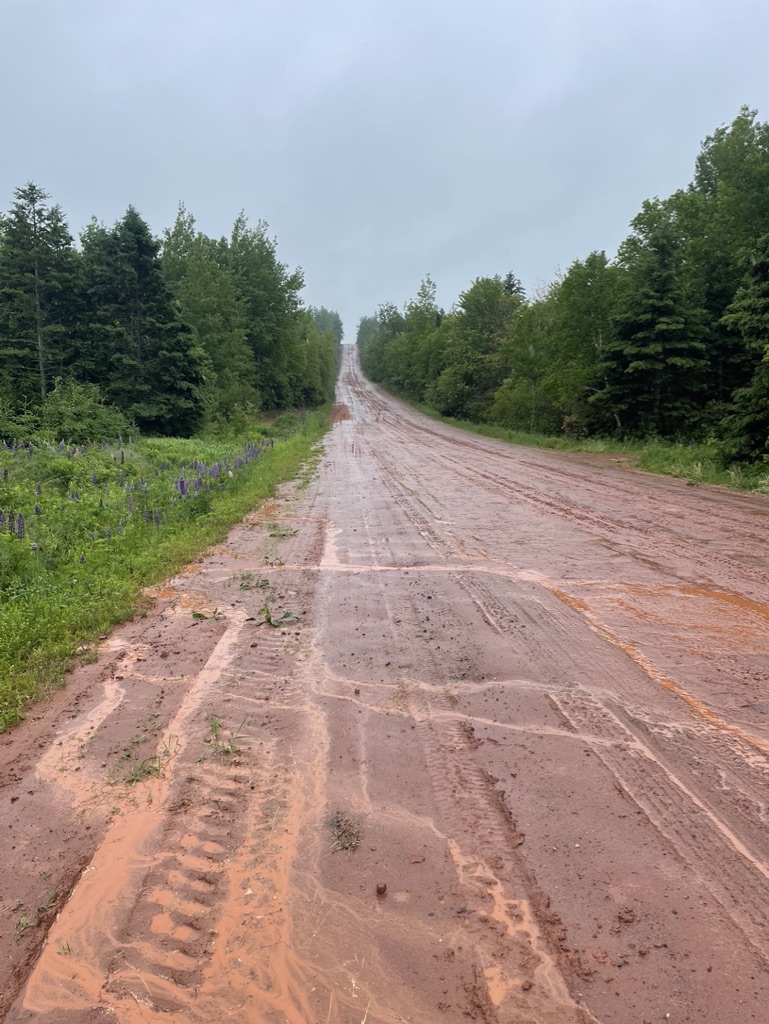
I’d seen on the island so far, just as the rain increased in intensity.  Rust-red muddy rivulets cascaded down its slippery surface.  I trudged slowly upwards, thinking, “please, please, please, don’t let a truck come bounding over the hill just now”. 

Cresting the rise at last, I paused to look back over my shoulder.  My imagination tried to fill in the gaps in what might have been a lovely view, now obscured by hazy mists and foggy grey clouds.  Nothing for it but to continue, following the Island Walk markers as they led me onto Route 20 towards New London.  

After about 2 and half hours, soaked with sweat but growing chilled, I desperately wanted a proper, dry, rest break.  Just after crossing the Long River, I started to climb the hill out of the valley, and saw the Sou’west Cafe out of the corner of my eye.  It looked open, though it was only about 11:00 and early for the tourist season. 

I splashed up to the door and sloshed myself inside, to stand there puddling and steaming as I looked around.  There were no other customers, just two servers setting up for the afternoon.  “Table for one?”, they asked.  They ignored my dripping, pointed me to a table, and brought me a very welcome pot of tea while I stripped off my soaked outer layers.   

It took more than a few minutes to re-energize on caffeine, and steel myself to re-don my wet rain gear.  I reckoned I was about 2-3 hours from Cavendish, and the rain wasn’t letting up.

Continuing on Route 20, within a kilometer I came to New London and passed the Lucy Maud Montgomery birthplace museum.  It wasn’t a day for diversions, however, and it didn’t even look open, so I continued onto Route 6 towards Stanley Bridge.  Tour buses appeared, with the early season Anne of Green Gables crowd, who stared out of their foggy windows at the madman in the blue rain gear trudging beside the road.

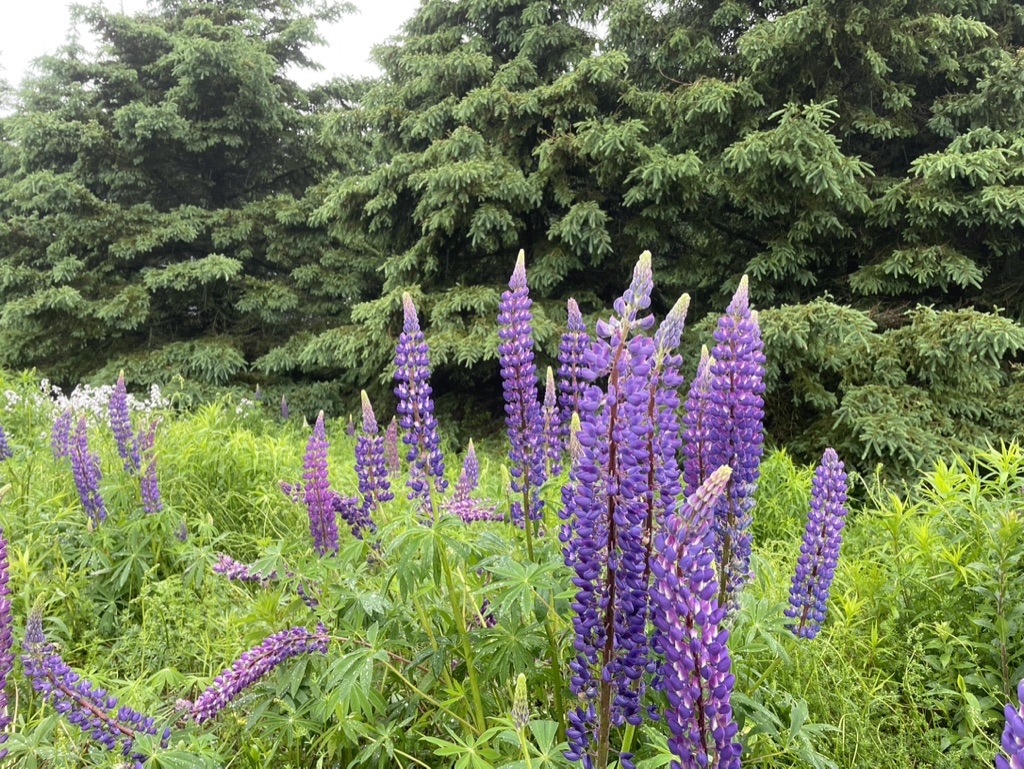
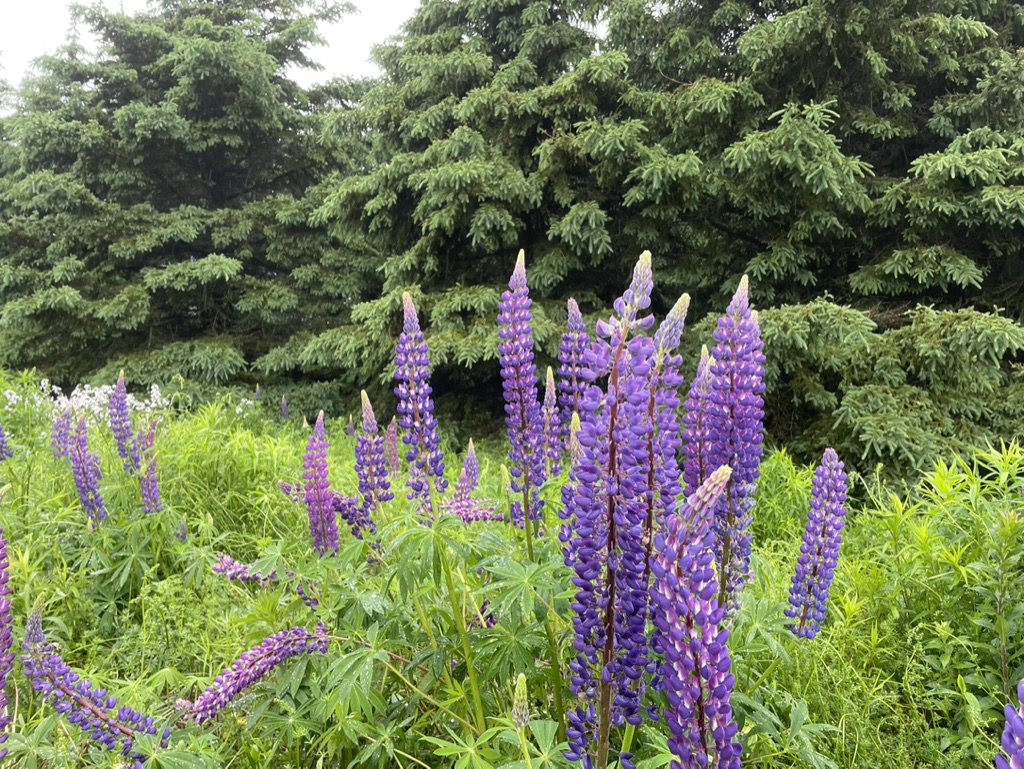
Past Stanley Bridge, the road turns northeast and climbs slowly up low rounded hills towards the community of Bayview.  The consolation of rainy days is that colours deepen, drops of water shine amidst palettes of greens, greys, and auburns, purples, pinks, and creams.
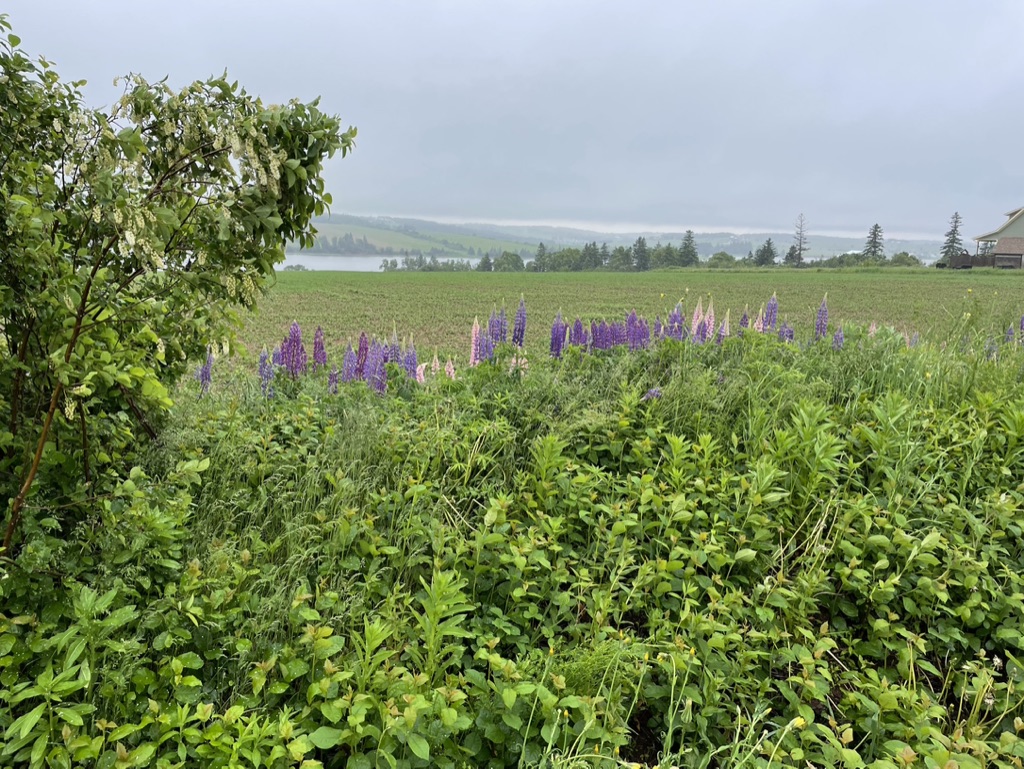
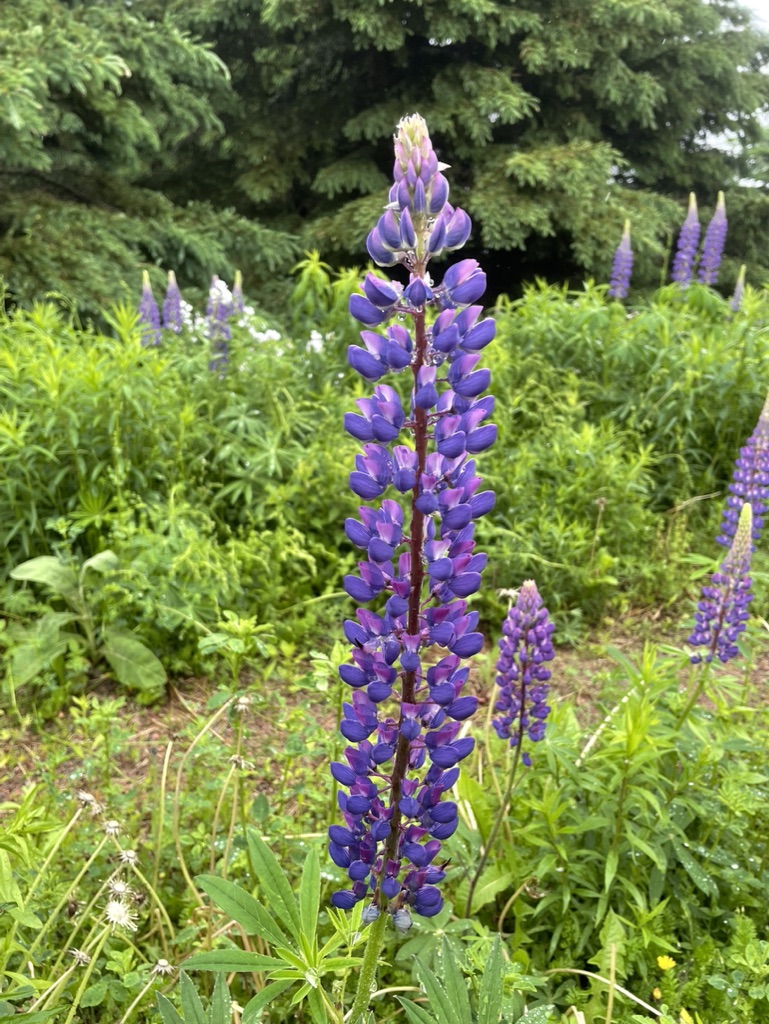
I stepped off the road a few times to try to find the perfect picture of lupins.
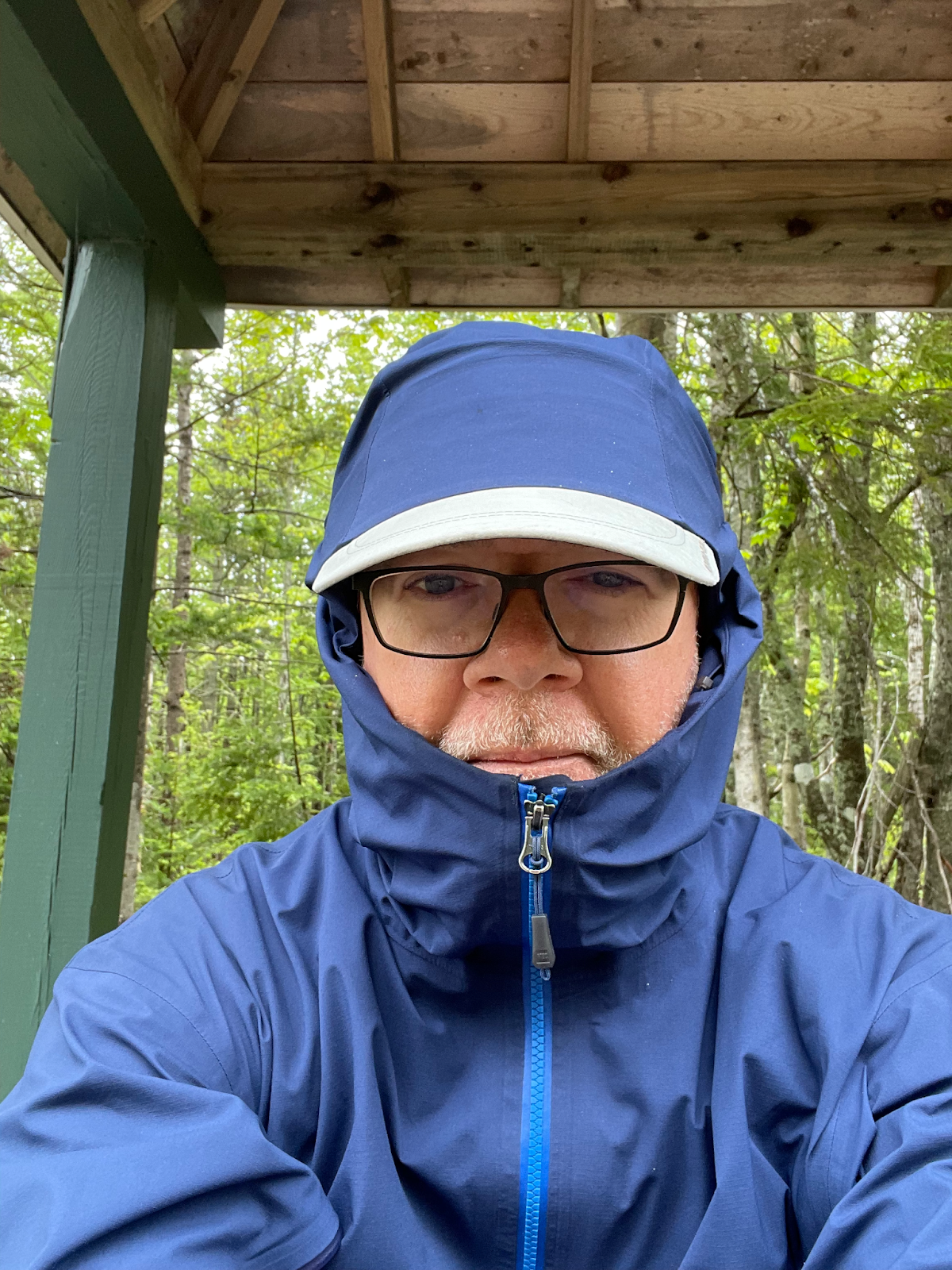
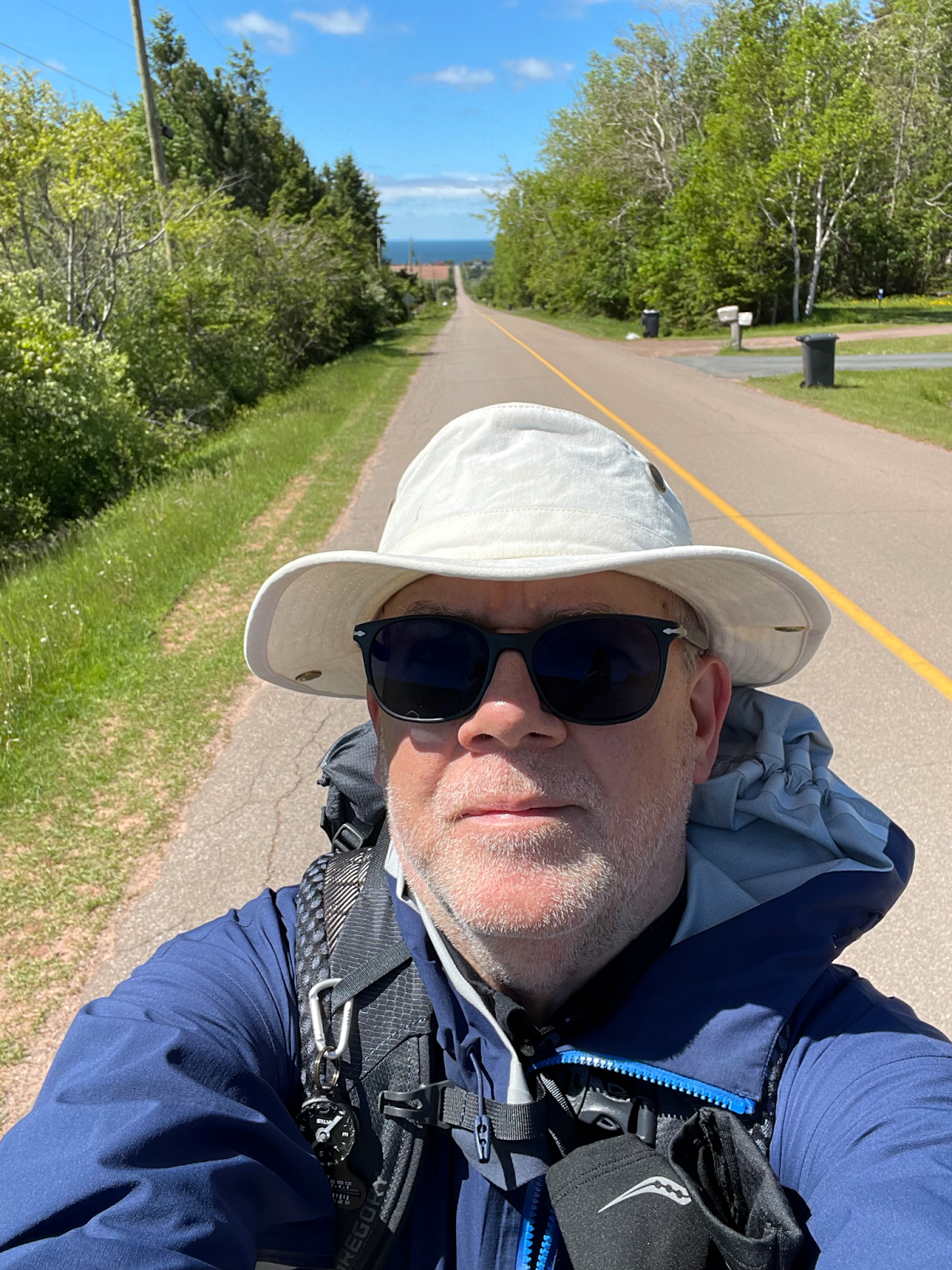
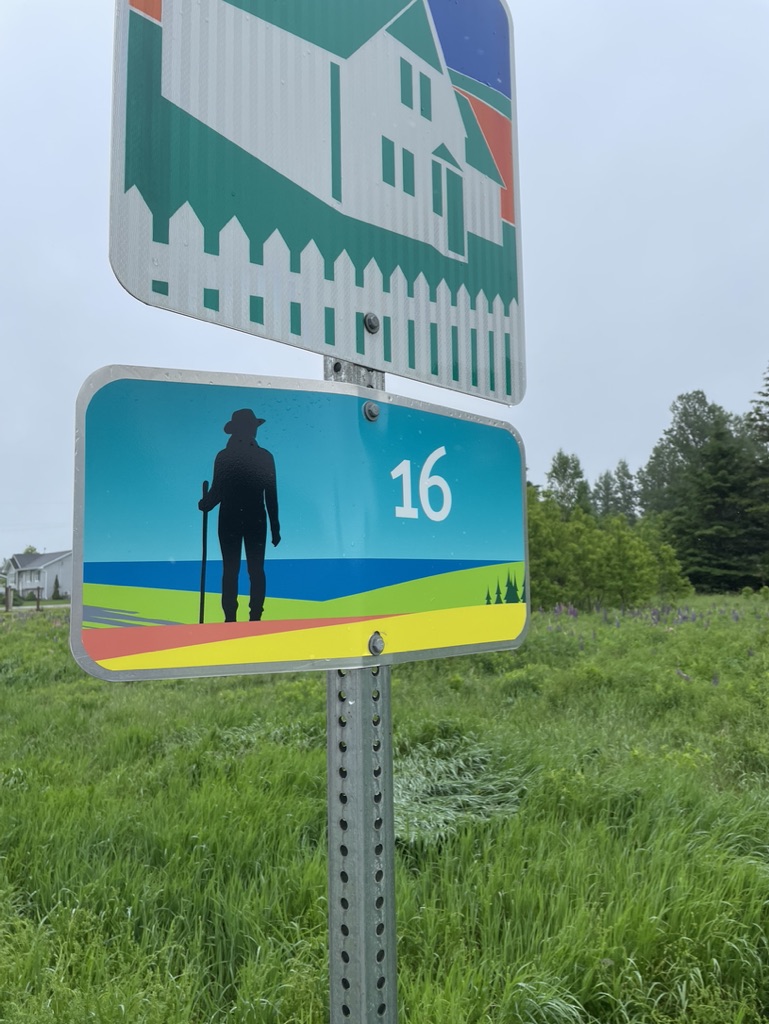
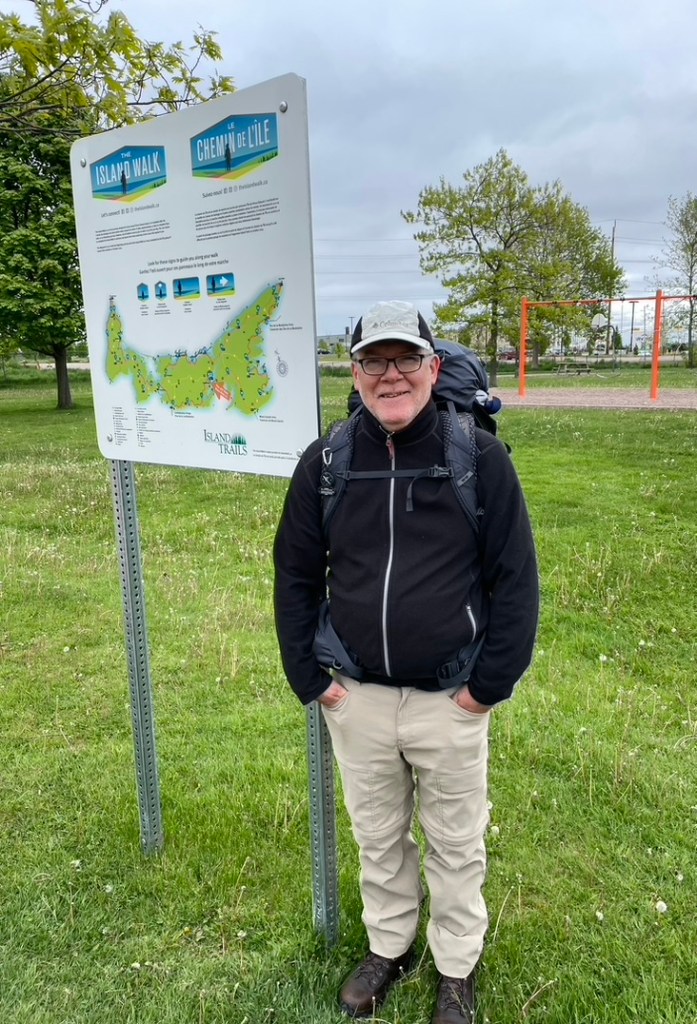
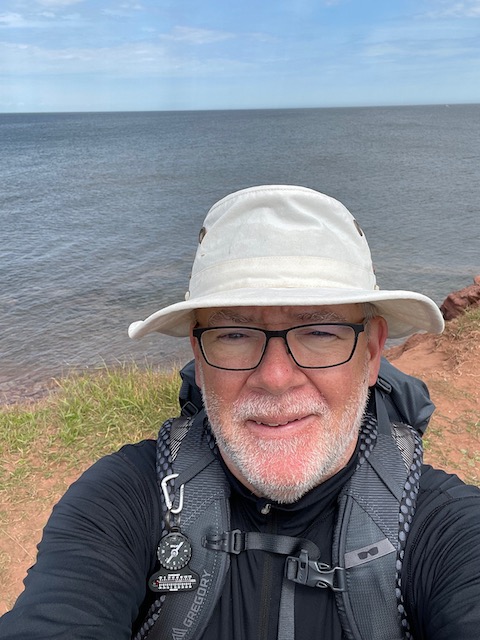
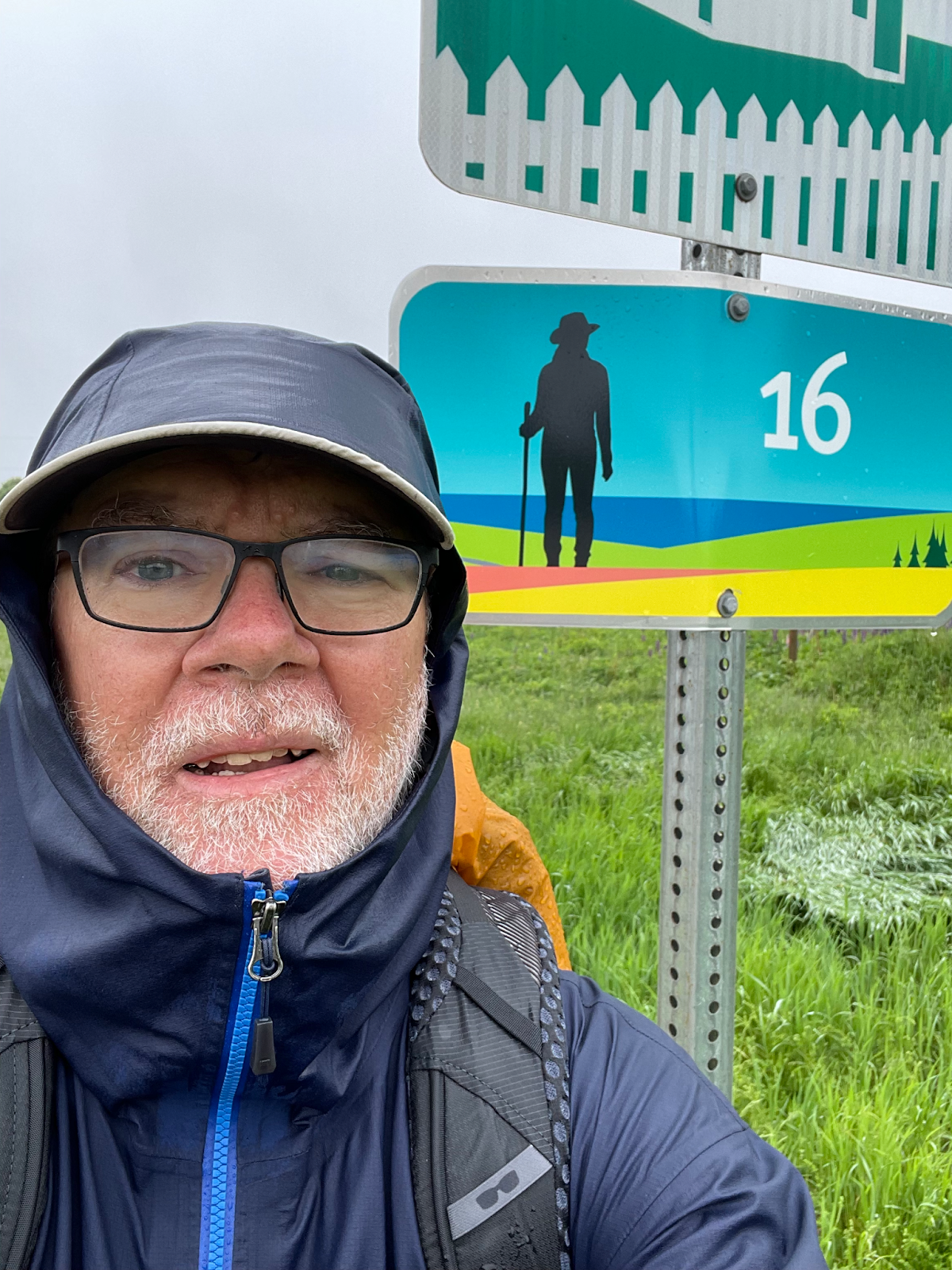
With a deep sense of relief at the thought that I was now close to Cavendish, and an even deeper sense of accomplishment, I stopped by the Island Walk marker sign that indicated the end point of Section 16, and took a soggy selfie.  
By now I was on the outskirts of Cavendish, along a stretch of Route 6 that’s lined with tourist shops, cafes, sightseer-lunch-specials, hotels, motels, campgrounds, and golf courses all hawking Anne of Green Gables in one form or another.   I had about another 30 minutes to go to reach the Tourist Info centre.  By this point, touristy tat was irrelevant – my only focus was reaching that goal.  I trudged, splashed, climbed, and plodded to reach Cawnpore Lane, turning at last towards the sea at the top of a hill, and finally catching sight of the Tourist Info building.

I must have looked pretty forlorn as I staggered through the doors.  There were just two staff on duty, and no tourists other than my wet self.  I dumped my pack from slumping shoulders, shrugged off the soaked outer layers, grabbed the dry bag from my pack, and sloshed off to change.  

I felt much more human when I emerged from the washroom in fresh clothes, able at last to look around at some of the posters and maps, and form actual words in actual sentences to speak to the two staffers.  “I’m doing the Island Walk”, I said.  The attendant smiled ruefully –  “We’ve had a few others earlier in the season, but not many.  You’ve picked a good day for it.”  
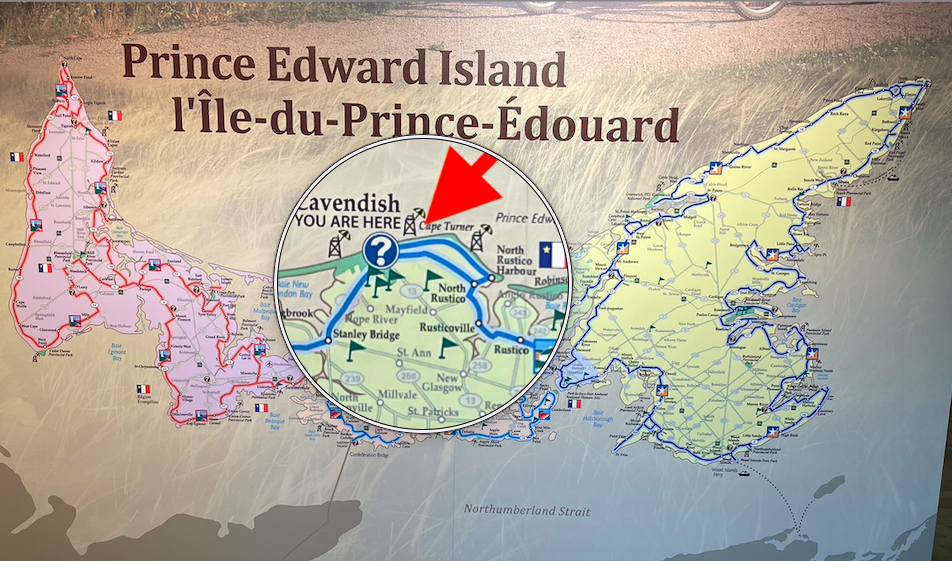
They kindly left me alone to eat my lunch while I slowly warmed and dried, still feeling bedraggled and spent.  It was only then that I looked at my watch, to realize that I was nearly an hour ahead of the pick-up time I’d arranged with Stanley.  The miserable weather had pushed me along faster than I’d realized.  

Fortunately, when I called Stanley he happened to be nearby on other business, so it wasn’t long before I was back in my hotel.  Everything I’d worn, my pack, my boots, were scattered about the room and over every chair, crowded near the heating, and I collapsed after a long hot shower.  What a day.

The North Shore

The next morning, after packing up and checking out of my hotel, I looked out for my ride. I had booked a local taxi, as I’d said thank you and farewell to Stanley the night before; he was off all day with some passengers from the first cruise ship of the season. When the taxi arrived, I once again answered the inquiring look at my pack with the explanation that I was doing the Island Walk. Has no one on this Island heard of it?, I thought.

I marvelled at the change in the weather, which overnight had warmed by 15 degrees overnight and shed the gloomy rain for blue-skied sunshine and warm breezes.  I was eager to continue along Section 17, which the Island Walk website calls “a walk along a paved hiking trail, followed by a beach walk into North Rustico and a road walk to Cymbria.” 

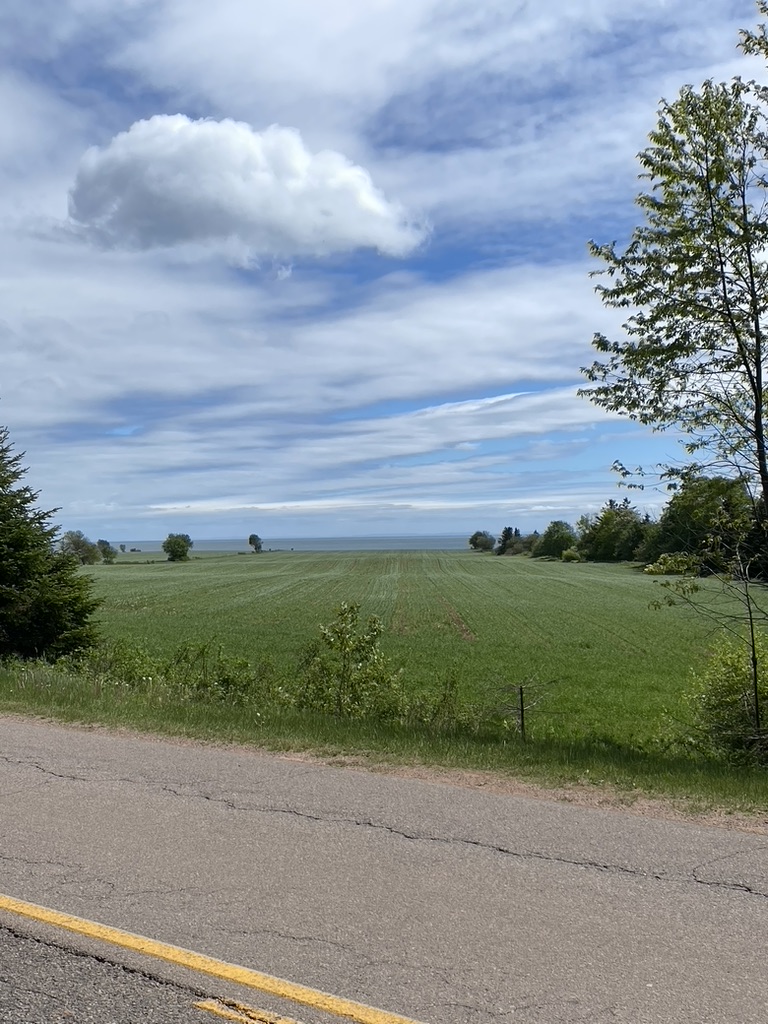
After a short walk north up Cawnpore Lane from the Tourist Info centre, I entered Prince Edward Island National Park, the sea glinting beyond dune grasses and shoreline trees.  The roadway here parallels the shore, and the walking/biking trail parallels the road.  The views over the water were sublime, with fishing boats chugging close to the shore trailing an escort of gulls wheeling above.  
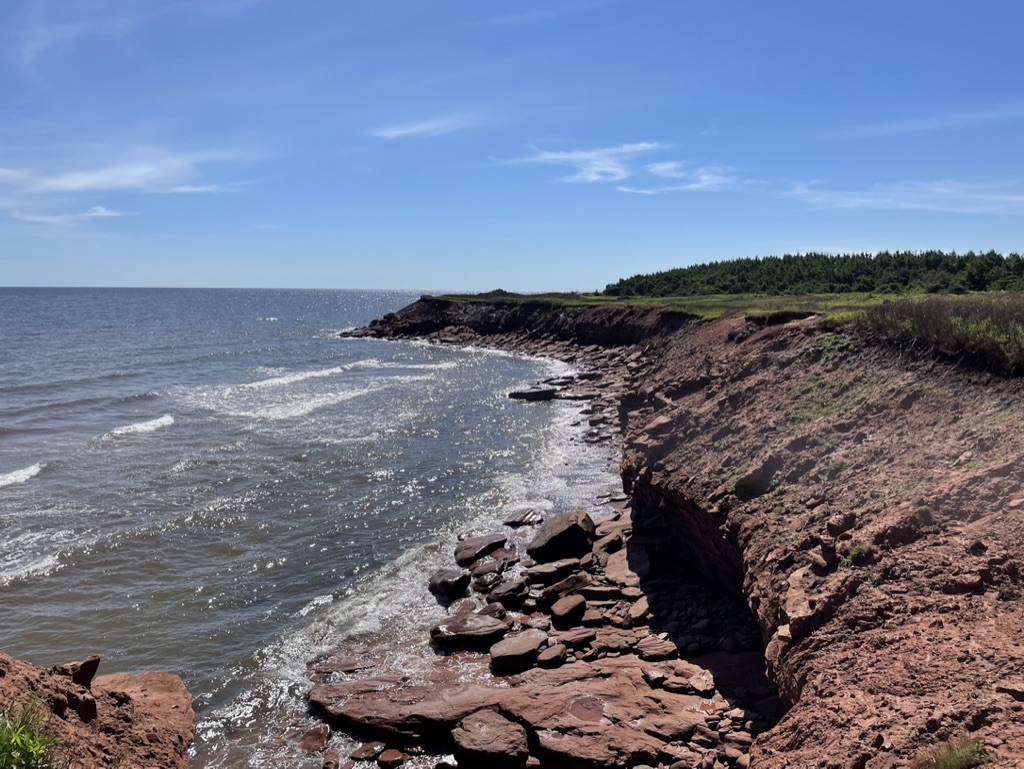
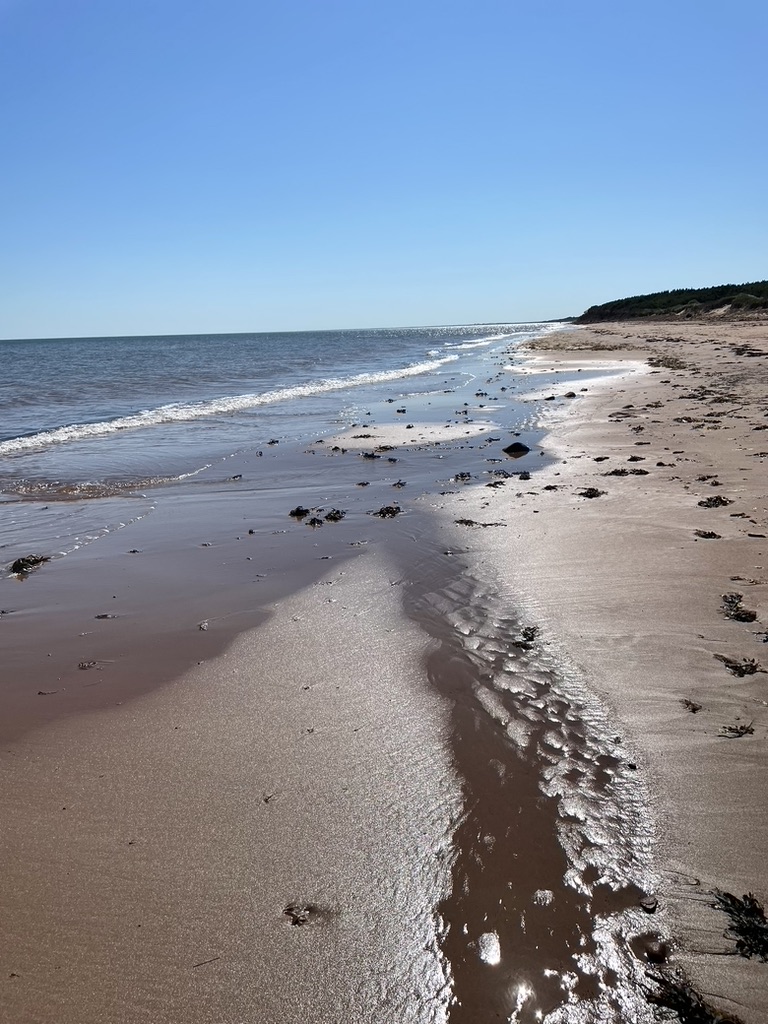
I couldn’t help giving up on the trailway after a few kilometers, instead descending to the beach.  The tide was out, leaving firm sand to follow all the way to the North Rustico harbour.  
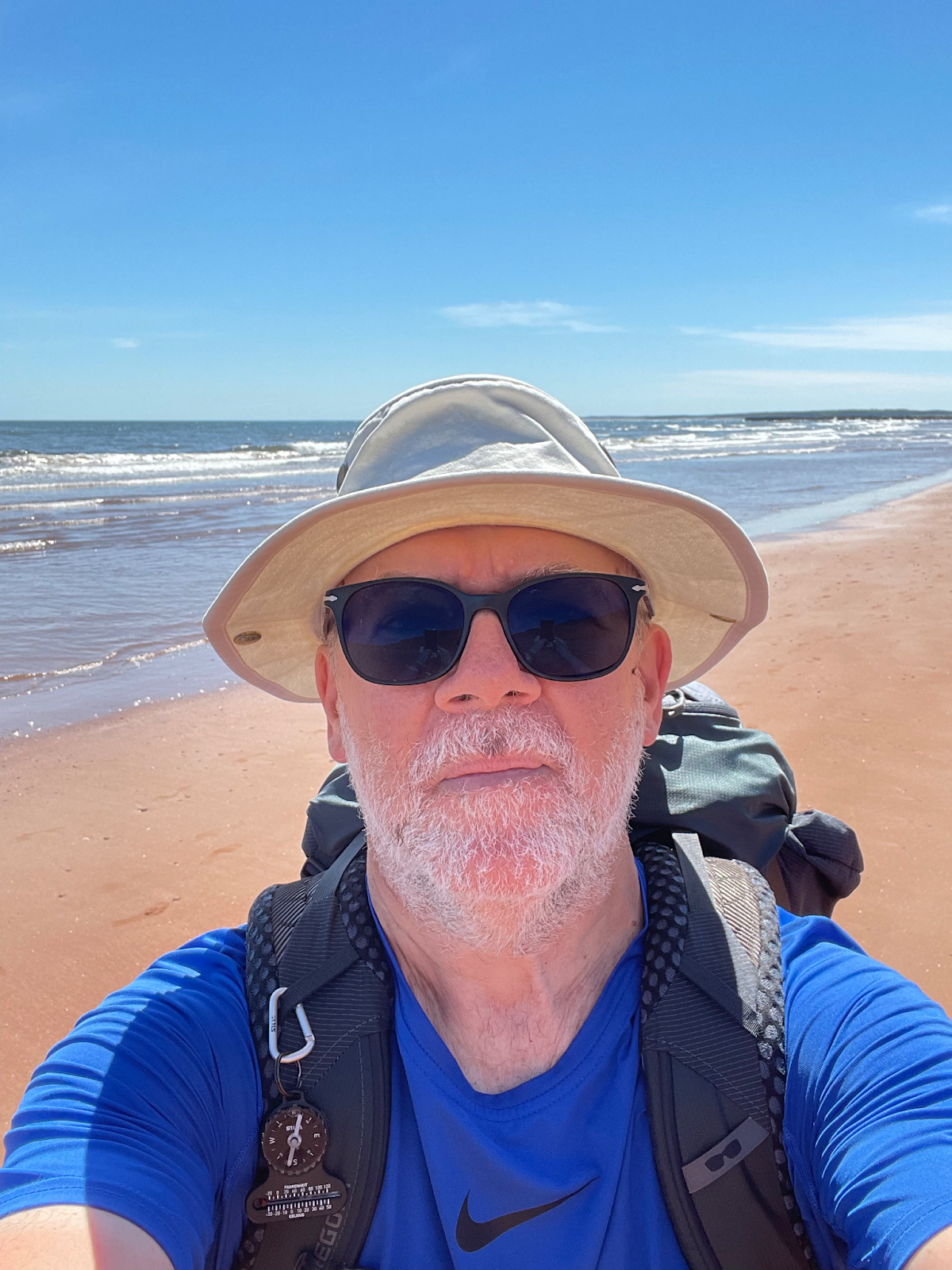
It was magical, the best part of the walk so far.  The hazy blue of the sea blending to a whitish, greyish horizon, and then upwards the haze thinning and fading into a cloudless azure sky.  Gulls, sandpipers, and a few fishing boats offshore.  A few people off in the distance, but otherwise just my thoughts and a bottomless well of contentment; the pilgrim’s peace.

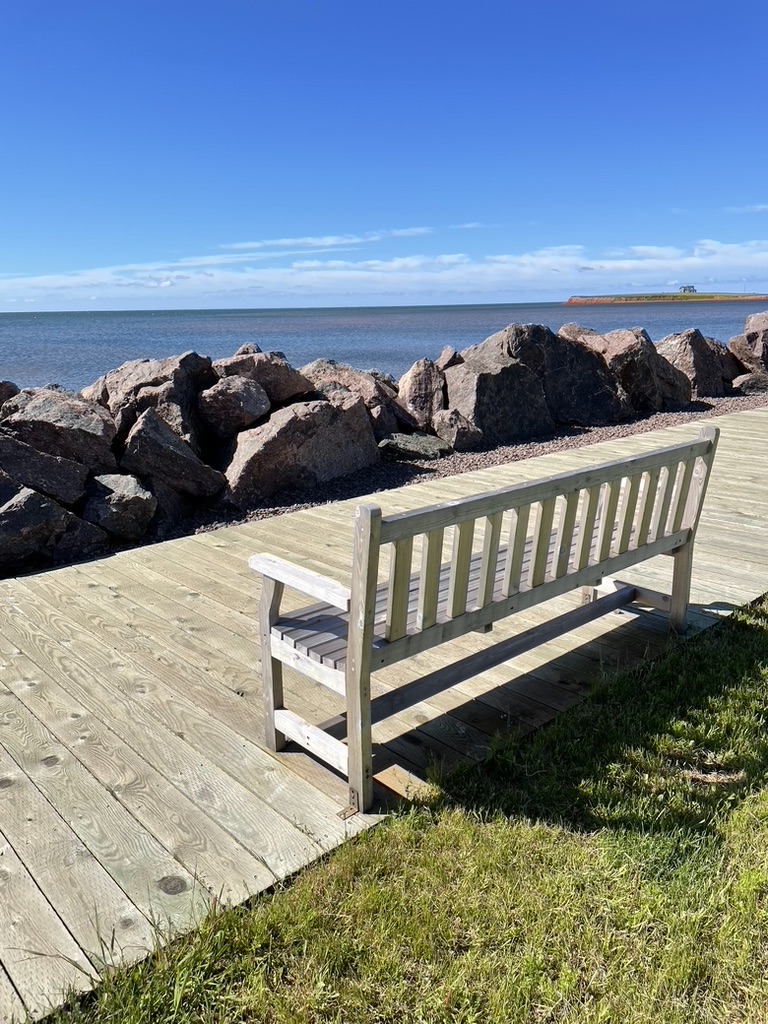
A timeless, effortless stretch.  And then as all things must, an ending, as the mouth of the harbour forced a turn off the beach, past the Blue Mussel Cafe where Ann and I had enjoyed fabulous shellfish fresh from their own mussel beds a few hundred meters away, just before I started the Walk – it was tempting, and I might have stepped in, but I was on a schedule.  I followed the road southwards towards North Rustico itself, and in compensation, soon came upon a beautiful wooden boardwalk 
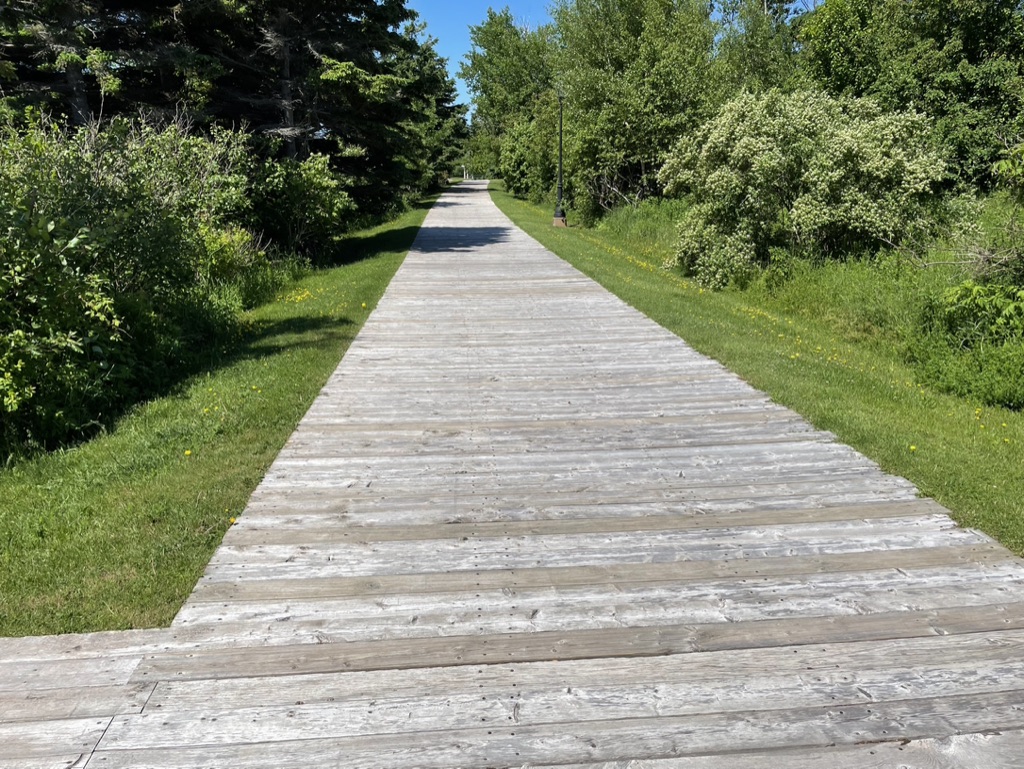
which lined the harbour for about 2 km towards the town.  I stopped here at a bench overlooking the water, and savoured my picnic lunch.  
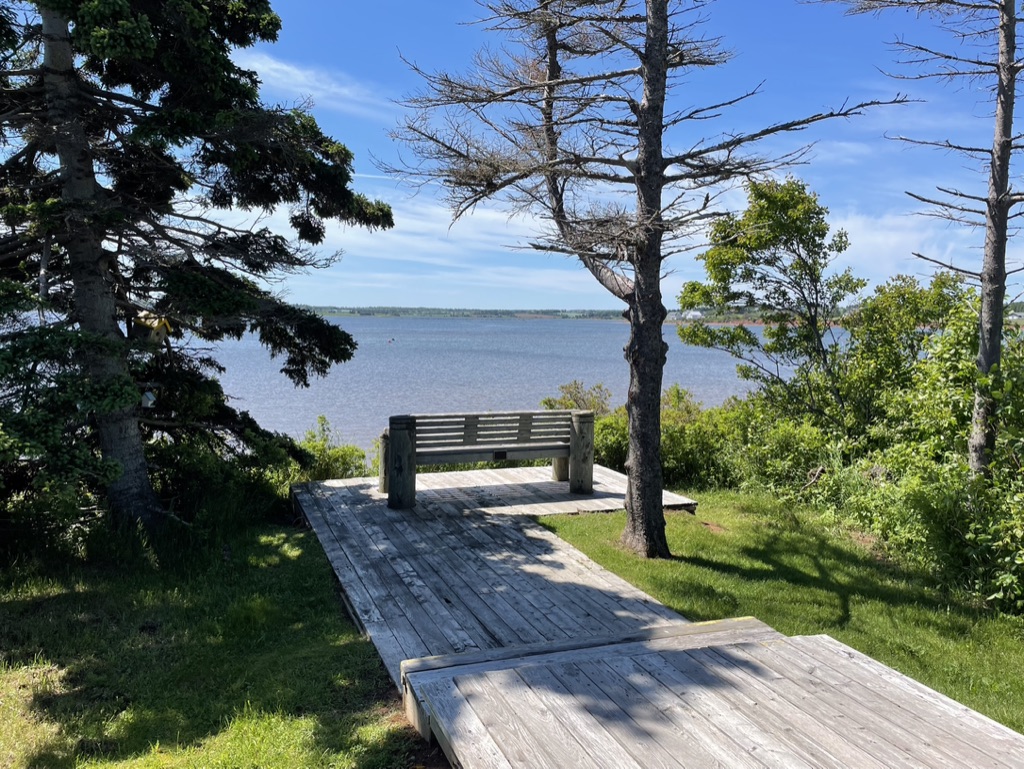
I couldn’t believe the contrast between the previous day’s saturated slog and this day’s sunshine.  Basking, face turned up the sky, eyes closed, I tried to soak up everything – the warmth, the quiet, the journey.  Thinking of Ann and meeting up with her once again, got me back to my feet.  

The Walk route takes you from the harbour boardwalk up through the park and into the town of North Rustico proper (where, by the way, there are a number of shops, restaurants, and places to stay), and once onto Route 6, it follows the road southeast towards the Hunter River bridge at Rusticoville.  

Continuing from there, you climb the hill and follow Route 6 towards South Rustico, to then turn north along Grand Pere Point Road for a nice little 5 km loop diversion past marshes and fields and pastures
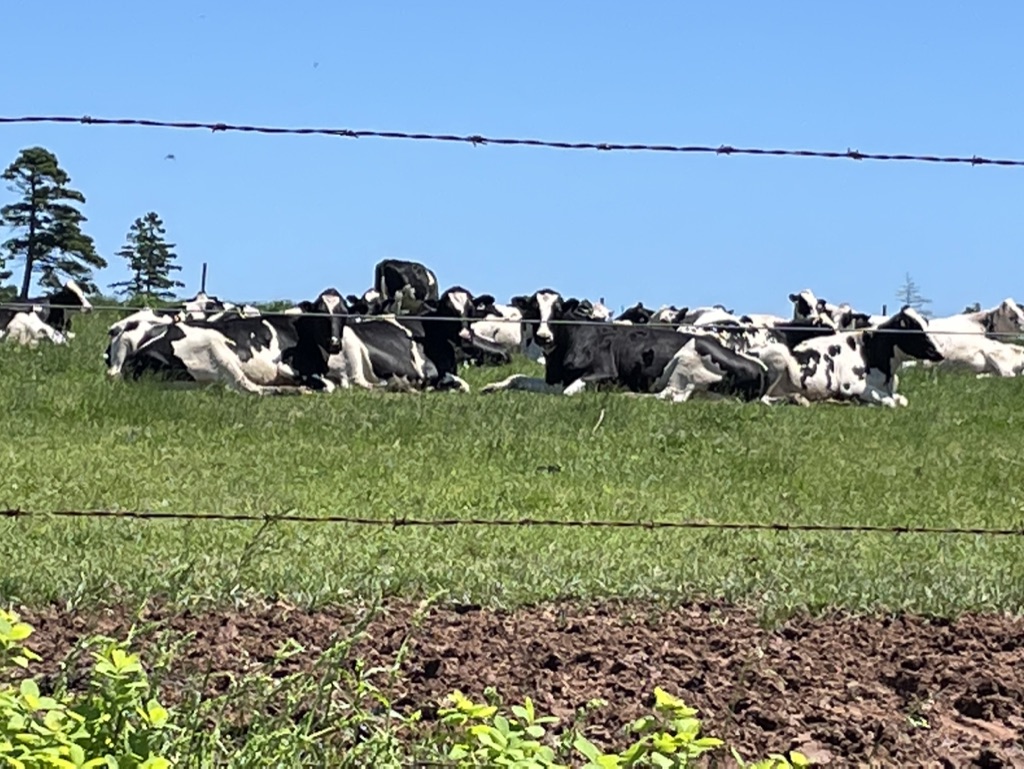
and then a golf course (where I stopped on a bench in the shade for a water break), before rejoining Route 6 again, at the bridge at Cymbria which completes Section 17.  

By now I was flushed and sweaty, feeling the day’s distance with a full pack – a few more kilometers to go.  From Cymbria, following Route 6 once more, I completed the first couple of kilometers of Section 18, till I reached the crossroads at Oyster Bay Bridge.  There, outside the petrol station by the roundabout, Big Mamma’s Pit Stop takeaway offered a tempting chicken quesadilla.

I’d only taken one bite when Ann pulled up, and after a quick hug, she sat down at the picnic table with me while we demolished the food and got caught up on news.  From there, we headed to the accommodations we’d booked in Murray Harbour.  It was good to be a team again.

When I’d looked at the 2nd half of the route in late spring while researching the Walk, it had seemed to me that making a base somewhere around Montague would be best, since that’s relatively central to the remaining Sections over the eastern end of the Island.  Unfortunately, I’d reached this conclusion relatively late in the day, only a few weeks before I started, and by that point I couldn’t find any cottage or house to book in that area – something I wanted since it would be our base for 2 weeks.  

So instead of Montague, we landed upon a converted church hall in Murray Harbour, now an AirBnB.  It turned out to be a great choice as far as the home itself, but since Murray Harbour is further west and south than Montague, it did mean we had some long drives ahead of us to reach the eastern end of the island.

That evening, we chatted about what I’d seen so far, and about what was to come.  But I felt like I was in a bubble, unwilling to emerge back into everyday life, and I doubt I was good company.   

The next morning, day 16, Ann drove me back to Oyster Bed Bridge, to resume where I’d left off on Section 18 – “A road walk in the Park, with great Gulf views.  Lots of opportunities to beach walk.”  This follows Route 6 east for a bit, and I had just set off when a van pulled up alongside me.  

The driver and his wife wondered if I was doing the Island Walk – “Yes, day 16 for me”.  We chatted briefly, as they explained about some of the lovely scenery ahead of me, and they wished me well as they drove off.  They were amongst the first Islanders I’d met who seemed quite familiar with the Walk, because, as I learned, they had done it themselves and were good friends with one of the original Walkers (Bryson Guptill) who had first mapped the route back in 2019.  It felt great to be recognized as part of the Island Walk club. 
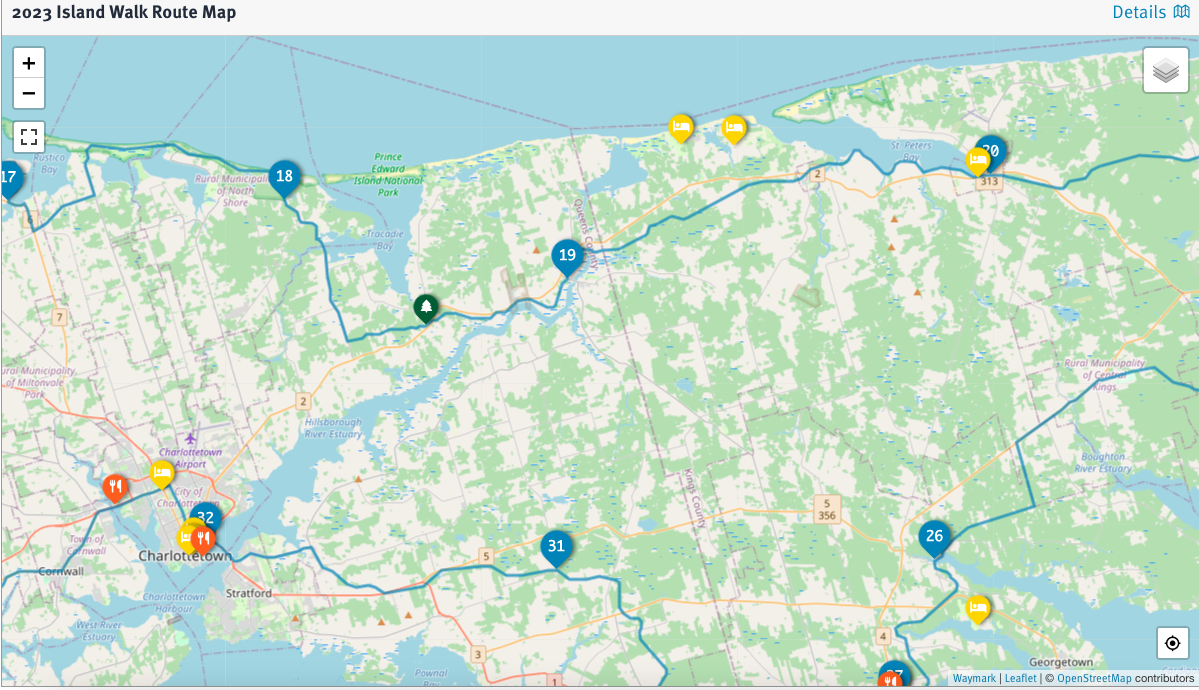
Screen capture from the Island Walk website. Copyright © 2023 An Island Trails project

Continuing along Route 6, quite soon I reached the turn to the north where I re-entered Prince Edward Island National Park, and rejoined the trail along the water’s edge.  The weather again featured gorgeous sunshine and warm breezes, carrying me along with the infectious energy of early summer.  At Cape Stanhope, 
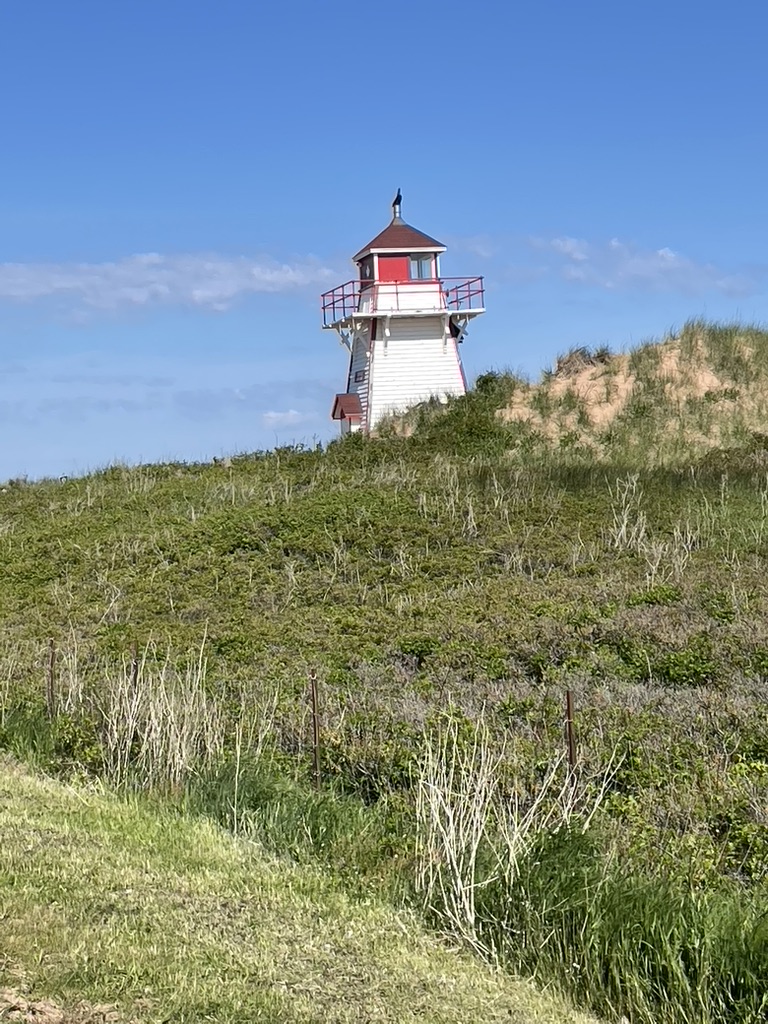
tired of the paved walking/cycling trailI, I cut down to the beach as I had the day before, 
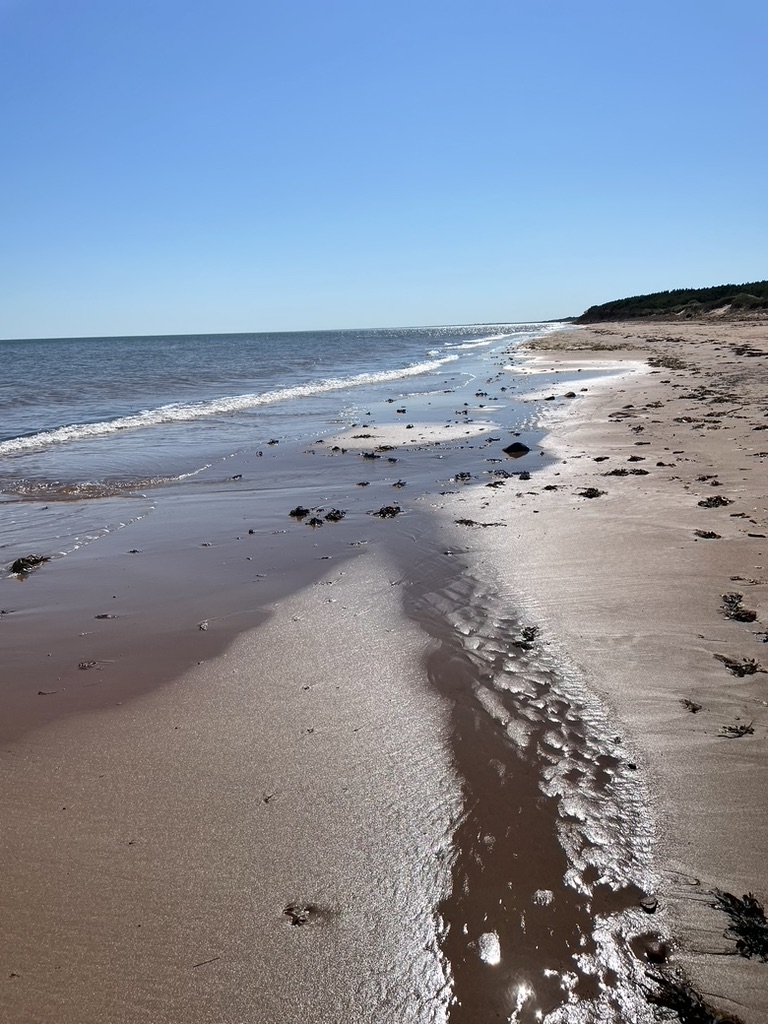
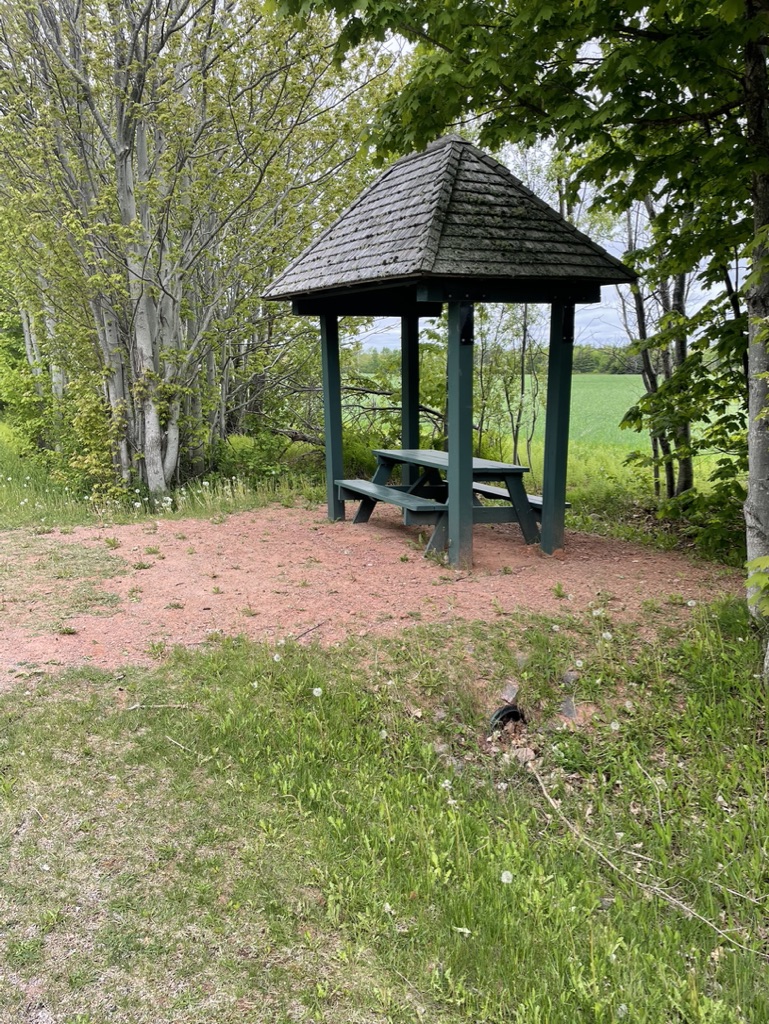
and once again strolled along the hard-packed sand for several kilometers.  Near the Dalvay-by-the-Sea resort hotel, I emerged from the beach to find a seat under a shaded picnic shelter, a relief from the now-hot sunshine, and savoured a picnic lunch.  Glorious.

From Dalvay, the route resumes on roads, heading south to exit the park and rejoin Route 6, completing Section 18.  I had more planned for my day, however, continuing from here to target the first part of Section 19, “a road walk to the Confederation Trail, then trail walking through marshes.”  I planned to do about half the Section that day, and had arranged for Ann to pick me up where the route rejoined the Confederation Trail at Bedford Station.  
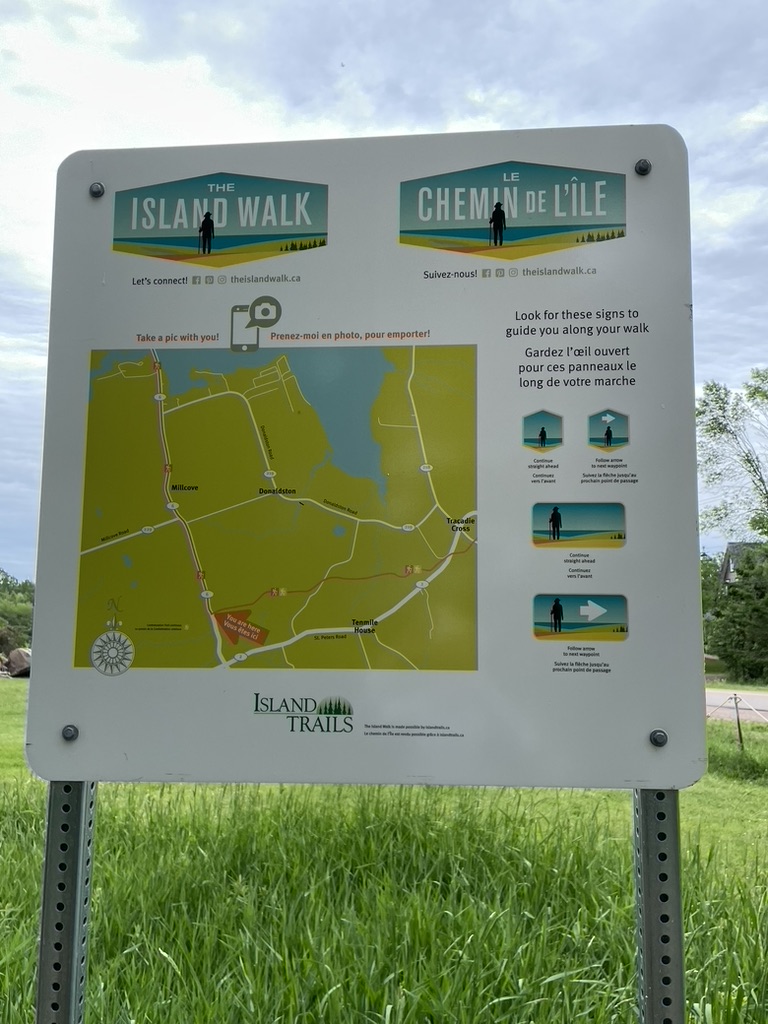
The warm morning sun had by now become a blazing 30C afternoon, and turning inland away from the sea I had lost the fresh ocean breeze.  By the time I reached Grand Tracadie, it was a proper hot summer day, and my energy levels had melted like a snow cone in the sun.  

I found a shaded picnic table in a little community park, and had a welcome break.  From there, the Confederation Trail crossed Route 6 about an hour down a gently undulating road, past farms and fields, green and lush with promise.  I poured myself sweatily into the car when I reached it, and turned the air conditioning to full for the ride back to Murray Harbour.   

Back on the Trail to Morell

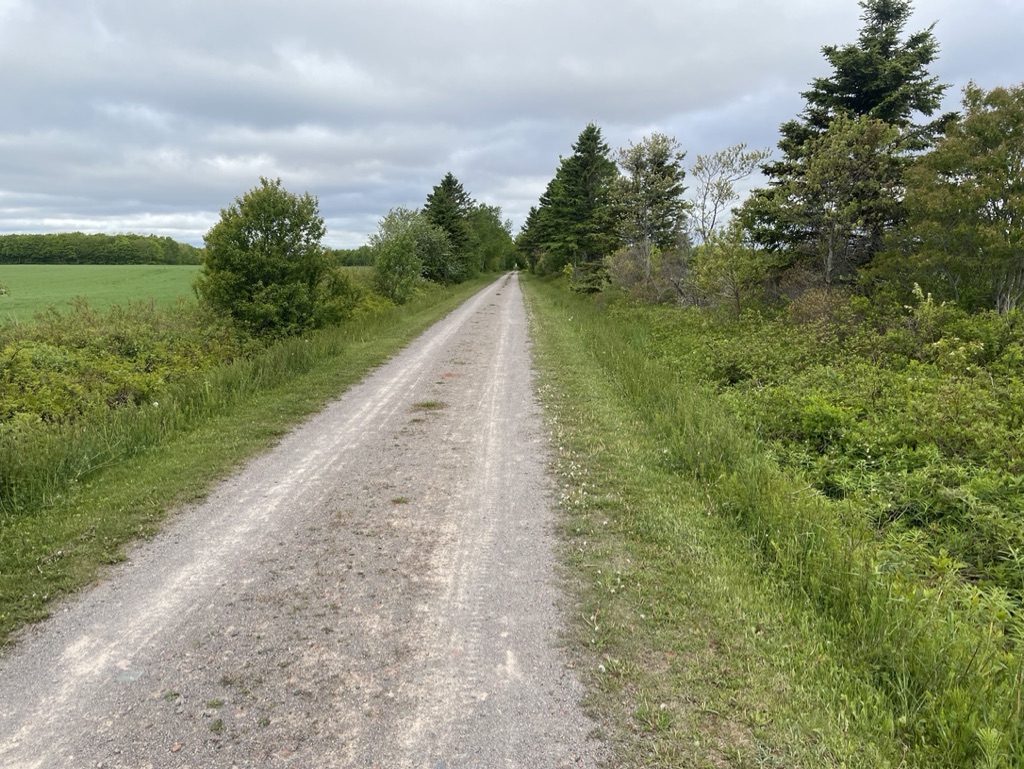
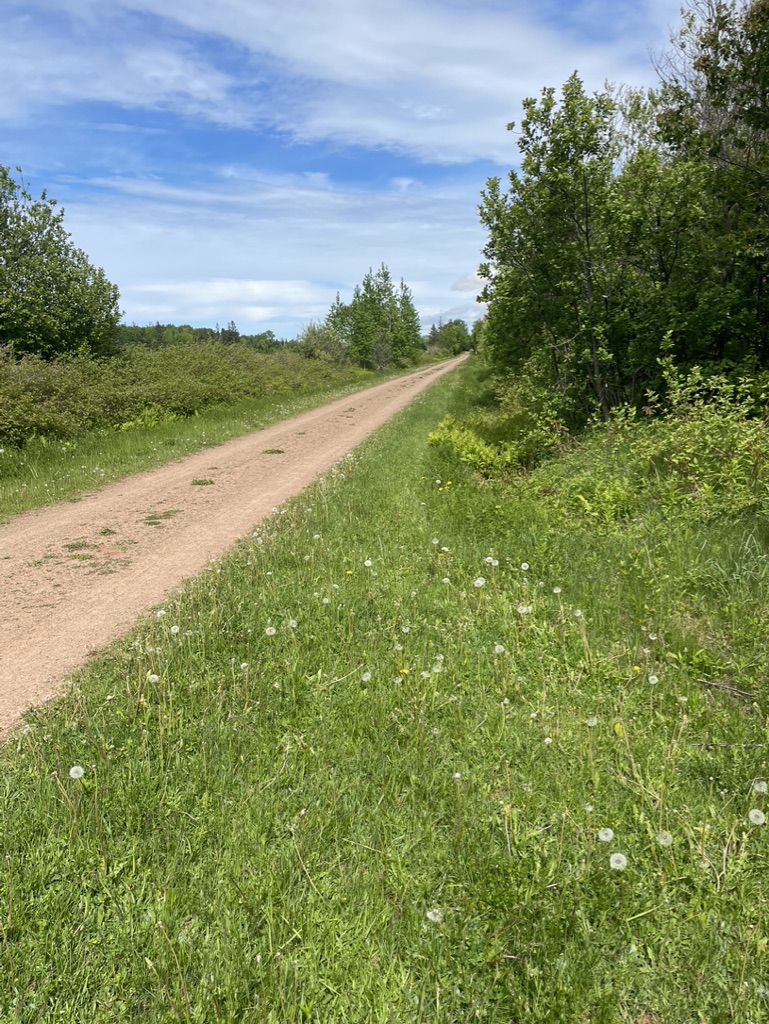
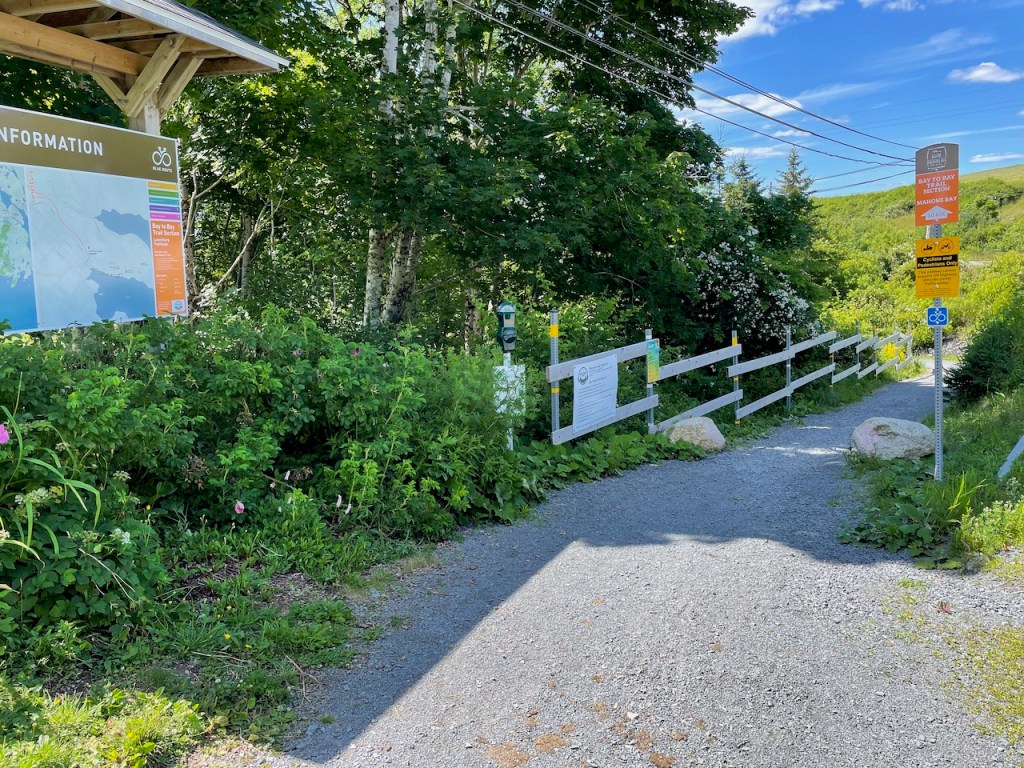
The next day was cooler and there was some rain in the air.  After days of road walking, it was a relief to get back onto the Confederation Trail at Bedford Station to resume Section 19.  There was a bit of a breeze to help divert the bugs, and the flat gravel surface felt kinder to my legs and feet than the crumbled asphalt of highway shoulders.  

After 2 weeks of walking, I had by now settled into a pace that I could pick up without thinking.  On the flat, my stride was a steady 110 steps per minute, about 6500 steps per hour, and measuring off the map confirmed that that many steps equaled about 5 km.  And since I measured out my route each night to confirm the next day’s total distance, I could work out from that total how many steps were needed to cover it and how many hours were needed.  

This is how I worked out my target pick-up times for Ann.  As I walked, a glance at my step counter thus told me how far I’d come and how far I had to go that day, so I could text her to adjust the pick-up time if needed.

And that morning, with only a short water break sit-down needed on a cooler, easier day, my step counter told me I was making great time.  I reached Mount Stewart to complete Section 19 just around mid-day.  There, I took advantage of the In the Mix Bakery cafe, which occupies part of the old train station, and voraciously scarfed a proper, old-fashioned, fry-up breakfast.  I reckoned I’d walk off the cholesterol.

Tummy and water bottle filled, I headed back out onto the Trail, aiming for Morell, which is about halfway through Section 20.  Sated from lunch, I was obviously eggs-and-sausage muddled as well, because I was about 5 minutes down the Trail when I realized I’d left my water bottle back at the cafe.  Kicking myself for a ninny, I retraced my steps to retrieve it, and then hurried off to make up the delay.  Still, in hindsight I don’t recall any other time when I left something behind after a rest stop.

As I continued along the Trail, my original quick pace slowed until I was stopping frequently for a rest.  I seldom eat an eggs & sausages breakfast anymore, because it’s just too heavy for my middle-aged digestion.  Fried foods in my diet had given way over the past few years to fresh fruit and veg, a little grilled meat or fish, lentils, and brown rice.  My stomach was churning and gurgling (churgling?) like an old washing machine by the time I reached Morell to meet up with Ann, making for a butt-clenching ride back to Murray Harbour and a dash for the toilet.  Lesson learned – your teenage constitution is in the rear-view mirror.  Stick to your fruits and veggies.

Morell to North Lake

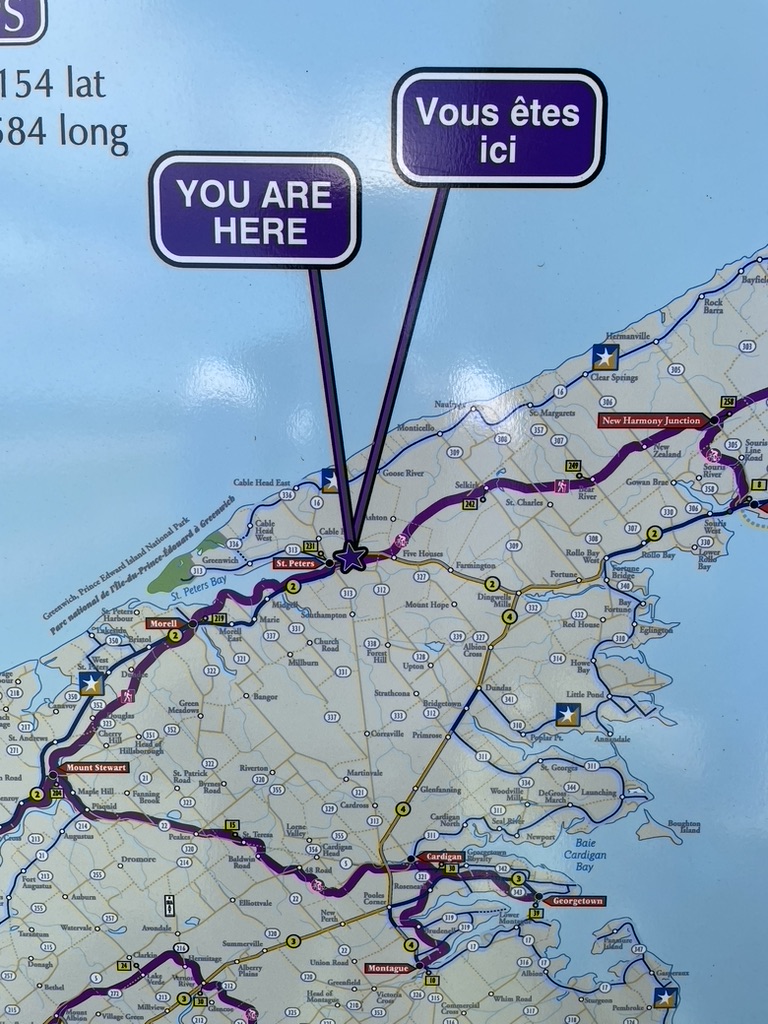
I felt better the next morning, Day 18, and looked forward to completing the remainder of Section 20 between Morell and St Peter’s Bay – “One of the most scenic sections of the Confederation Trail past bridges, fields and spectacular views of St. Peter’s Bay where you can see two lovely white clapboard churches.”   This is the only part of the Confederation Trail that’s close to the shore, and the bloggers I’d read who’d done this had raved about it.

Ann dropped me in Morell, to continue on to St Peter’s Bay by herself to explore.  Still early in the tourist season, I had the Trail mostly to myself.  Peaceful, quiet walking, the views were lovely, though I couldn’t help feeling a bit let down.  It was a bit lower-case when I’d expected upper, “wow” instead of “WOW”.  Still, a charming yet sedate morning’s walk, like a stroll with your elderly auntie.
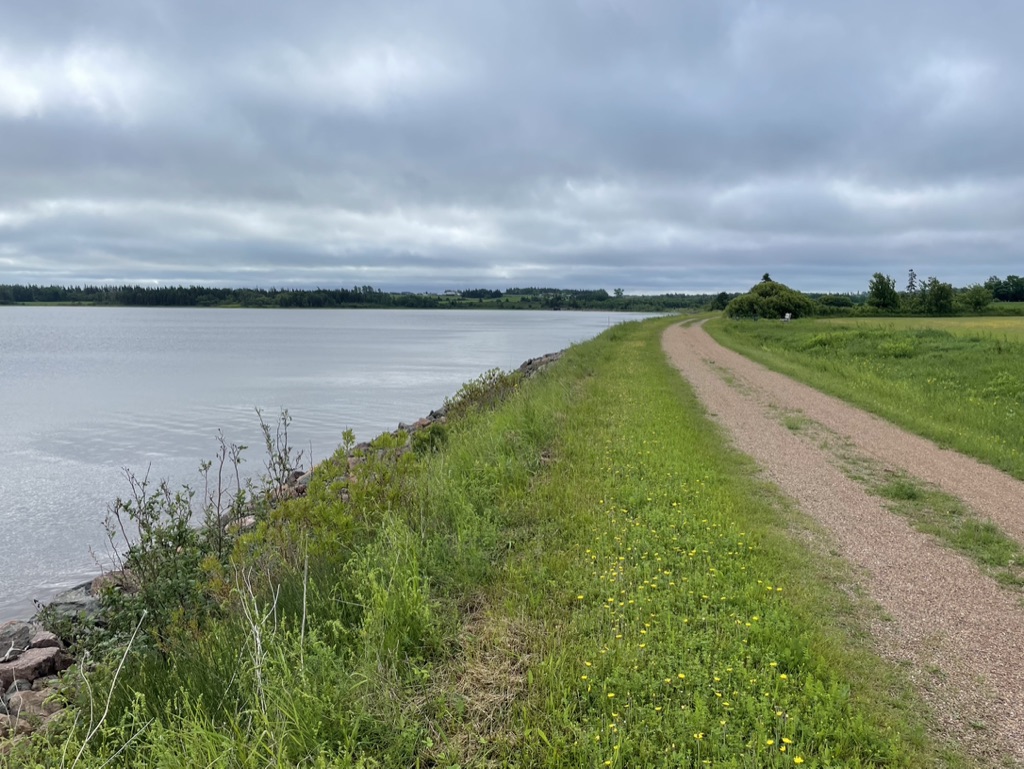
Near St Peter’s Bay, I passed a woman who was working in her garden which backed onto the Trail.  She looked up and smiled, to ask if I was doing the Island Walk – “I walked the Dalvay to East Point portion last year – glorious.  You’ll love the rest of this”, she said.  I was just happy that someone had noticed that I was doing the Walk without my having to say so.  Hurray! 

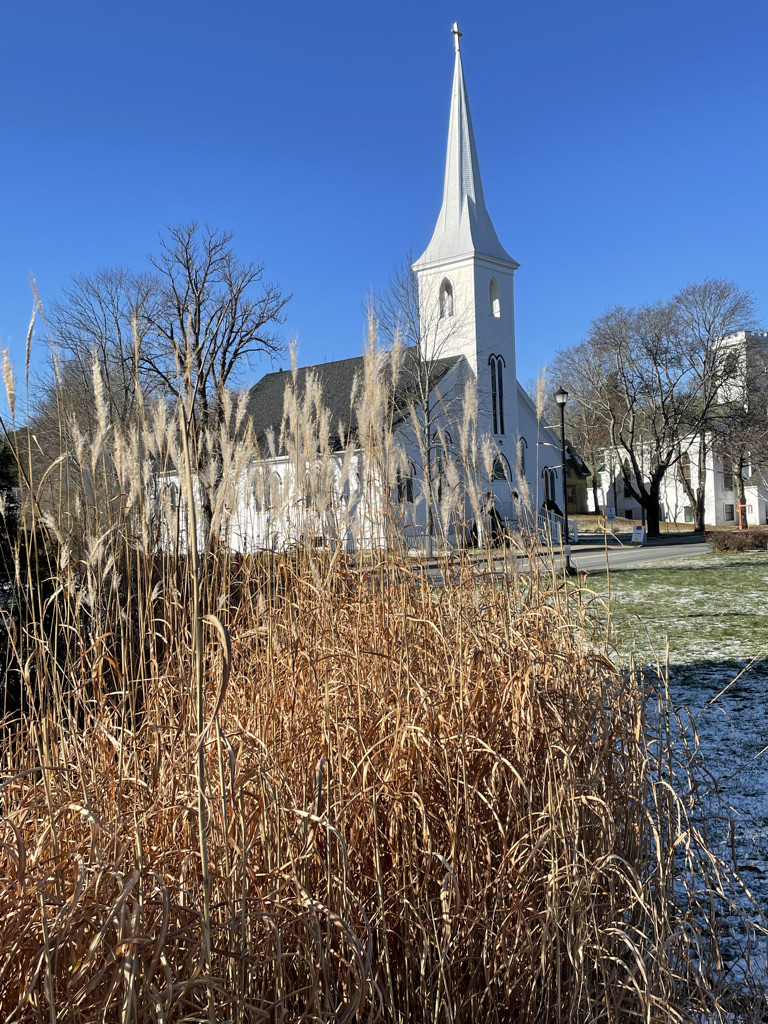
Coming along the shore of St Peter’s Bay, there are two largish white wooden churches, and I found it amusing that one is high on a hill looking down on the other – no rivalry there I bet.  
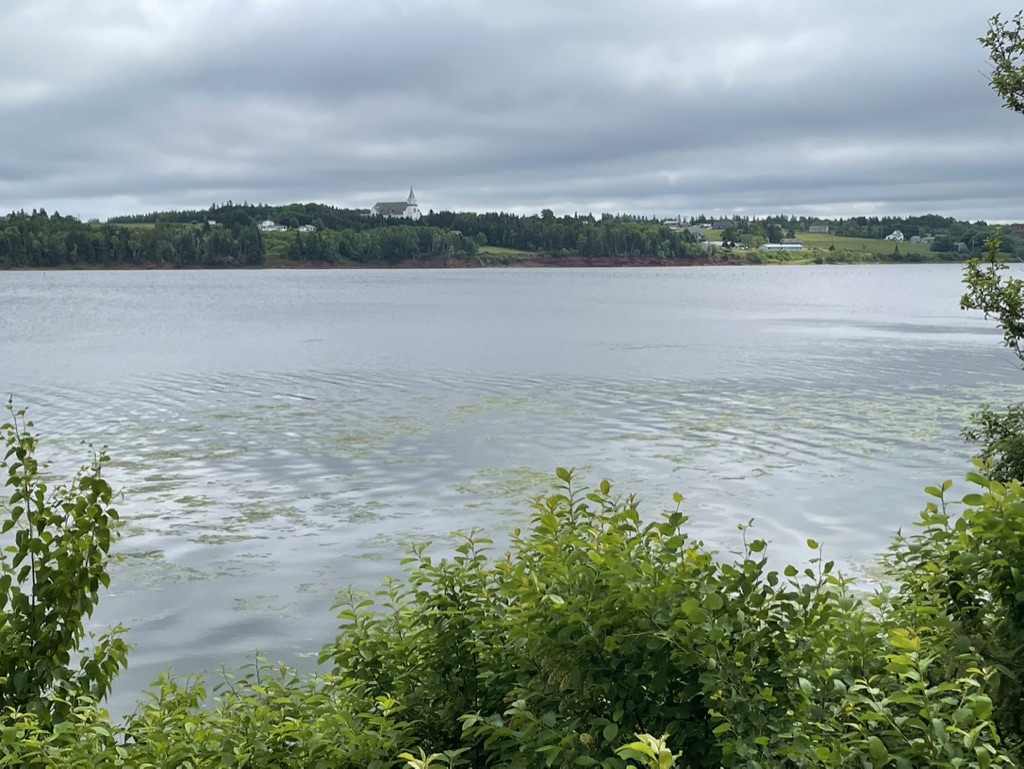
The Trail crosses the highway here and finishes Section 20 at the old rail station.  Next to it there’s a small cluster of shops (including a very clean public washroom), and as importantly for me, the Black and White Cafe.  It wasn’t yet mid-day and I’d only been walking for a couple of hours, but I decided to stop for an early lunch anyway.  The breakfast burrito looked enticing, and with that and a proper large coffee I popped outside to enjoy them sitting by the water.  

While I was eating, a couple appeared and claimed the other picnic table.  I watched with interest as they produced from their knapsack, with an elegant flourish, a dozen fresh oysters and a bottle of wine, which they slurped happily while basking in the sun.  My pack held granola bars.  Good on them.

Rested and recuperated, I rose to set out on Section 21, “a peaceful walk through a forested section of the Confederation Trail.”  
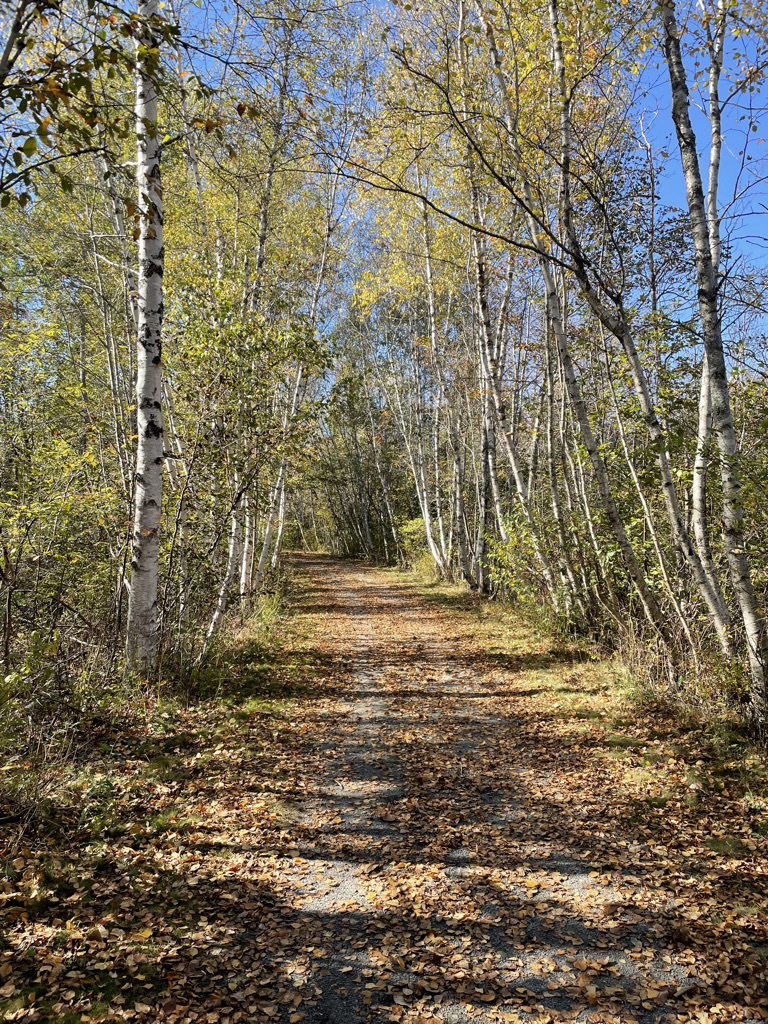
The path from St. Peter’s Bay leads gently uphill past small farms, peaceful in the sunshine, but while I was the only human on the trail, I was also the only lunch available for clouds of mosquitoes. 

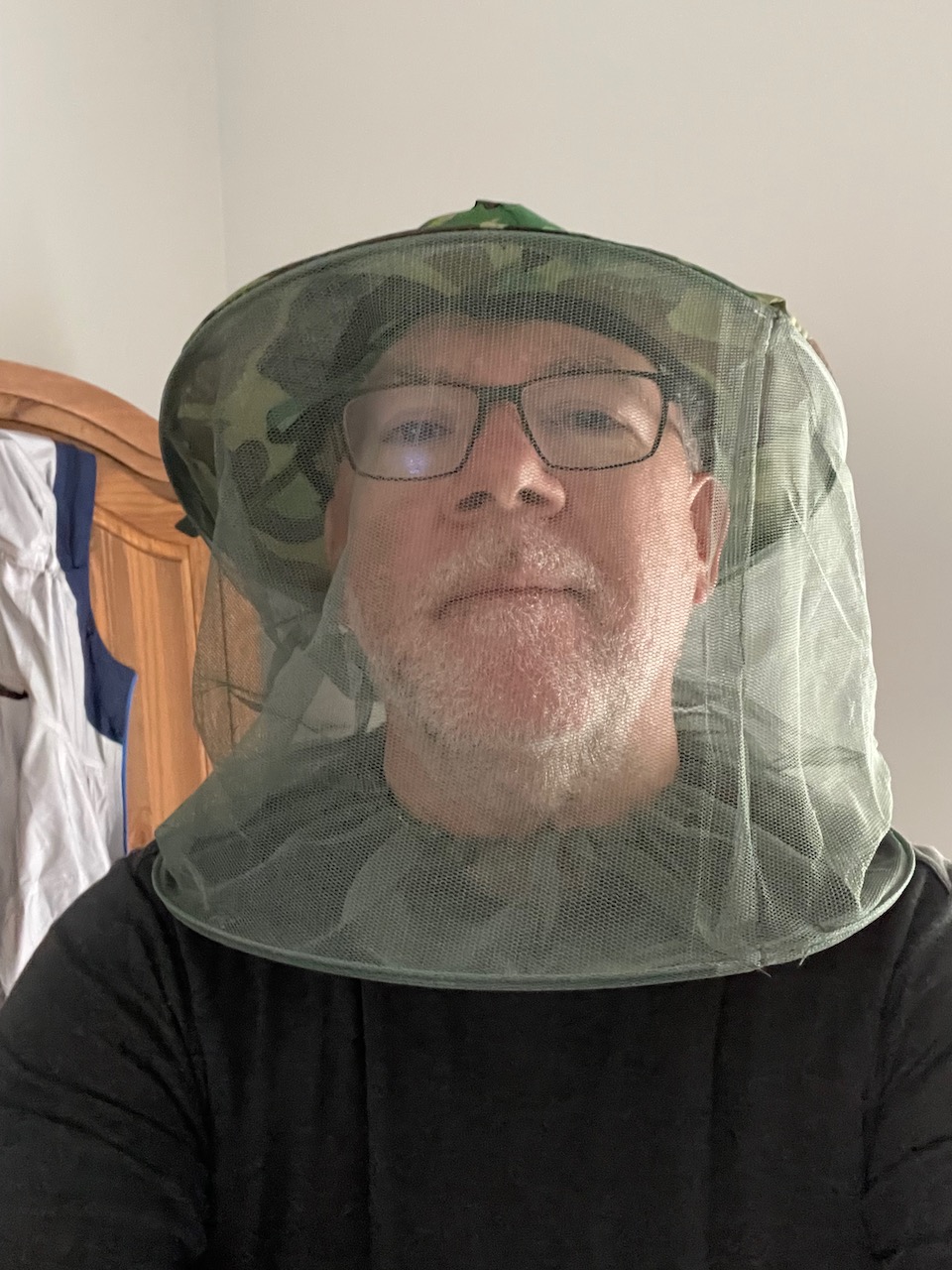
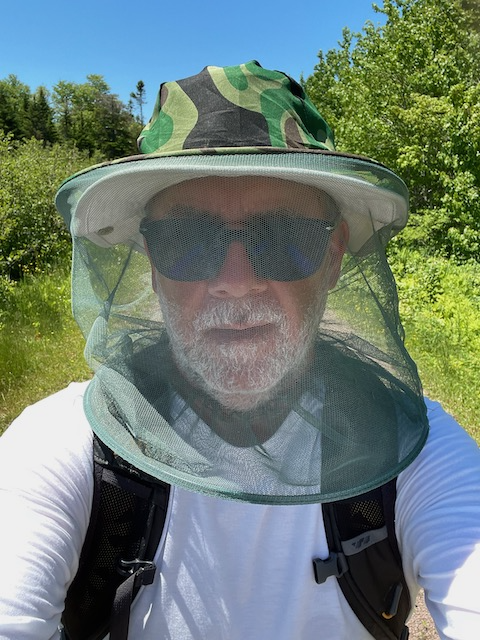
I dug into my pack for the $4 bug hat I’d purchased in Alberton, and wore it for the rest of the afternoon.  
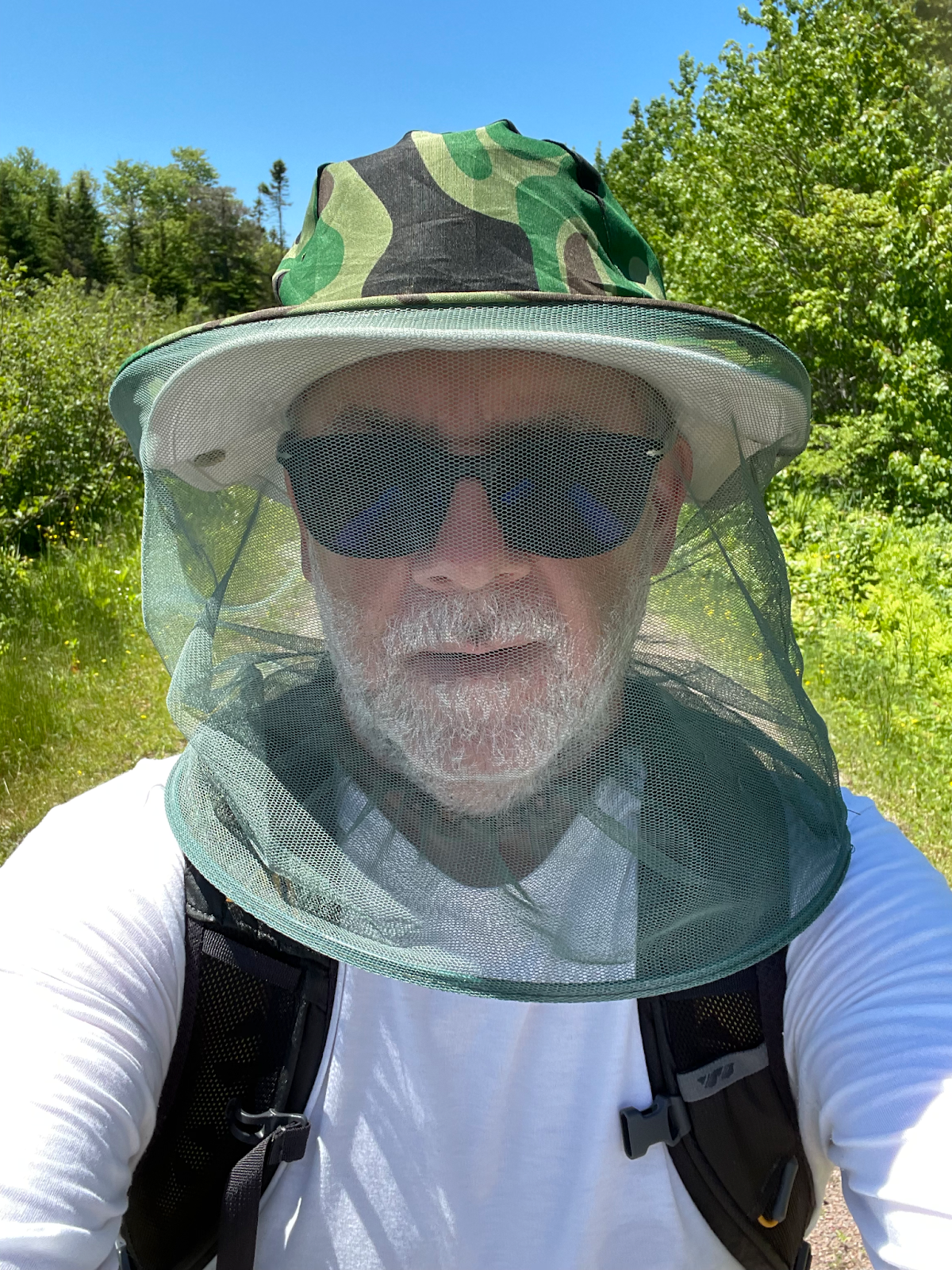
​​​​

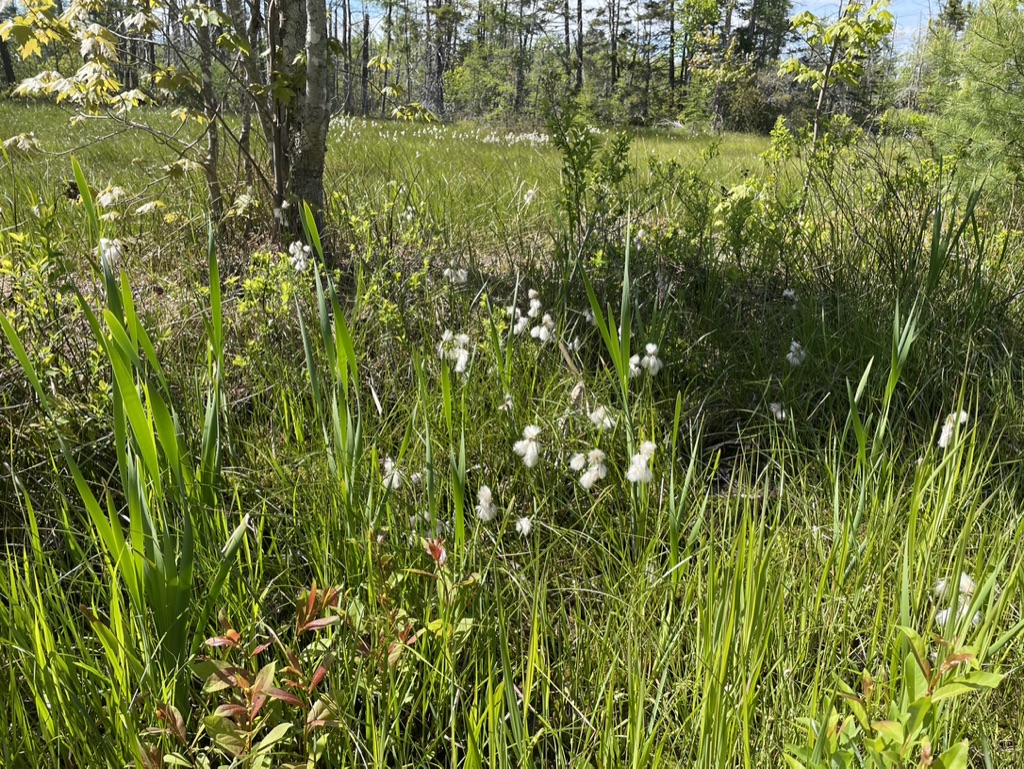
The breeze was blocked by the trees on either side of the Trail, and it was bordered by bogs and bushes though with occasional open spaces blessed with sun, 
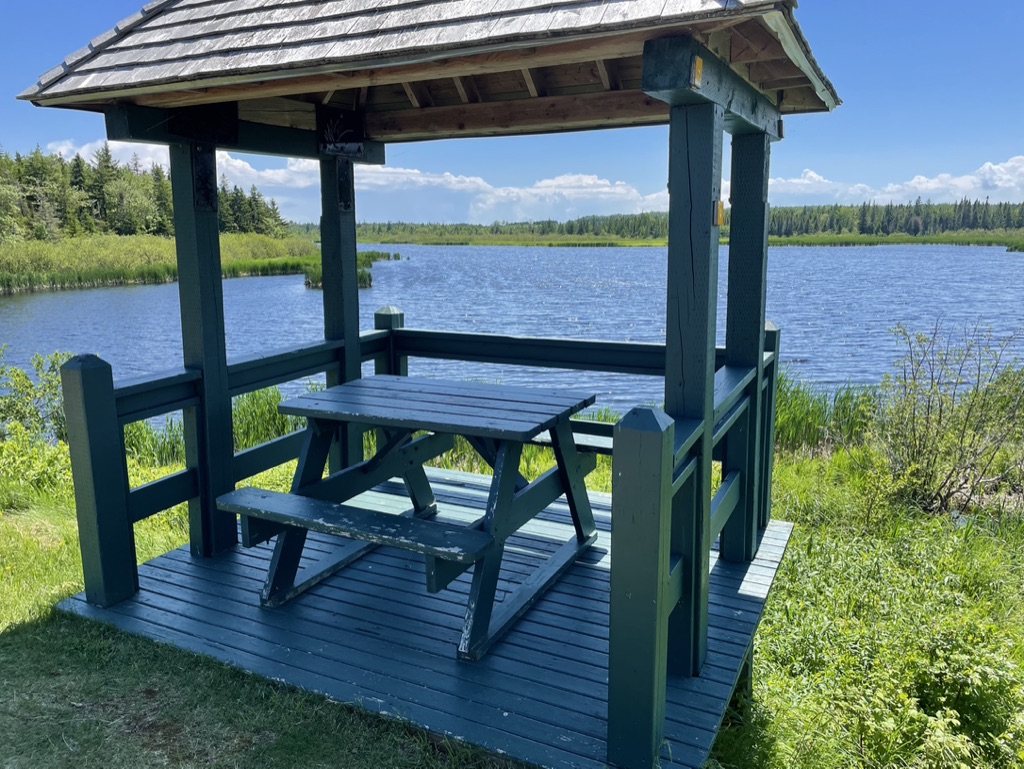
which I took advantage of for my rest stops.  Otherwise, it was brisk walking, swatting and sweating under the hat.   

Along here, walking in a bit of a mental fog, relaxed and zoned out, I was startled by a brown blur dashing at me low to the ground.  It took a moment to realize it was a hen grouse, 
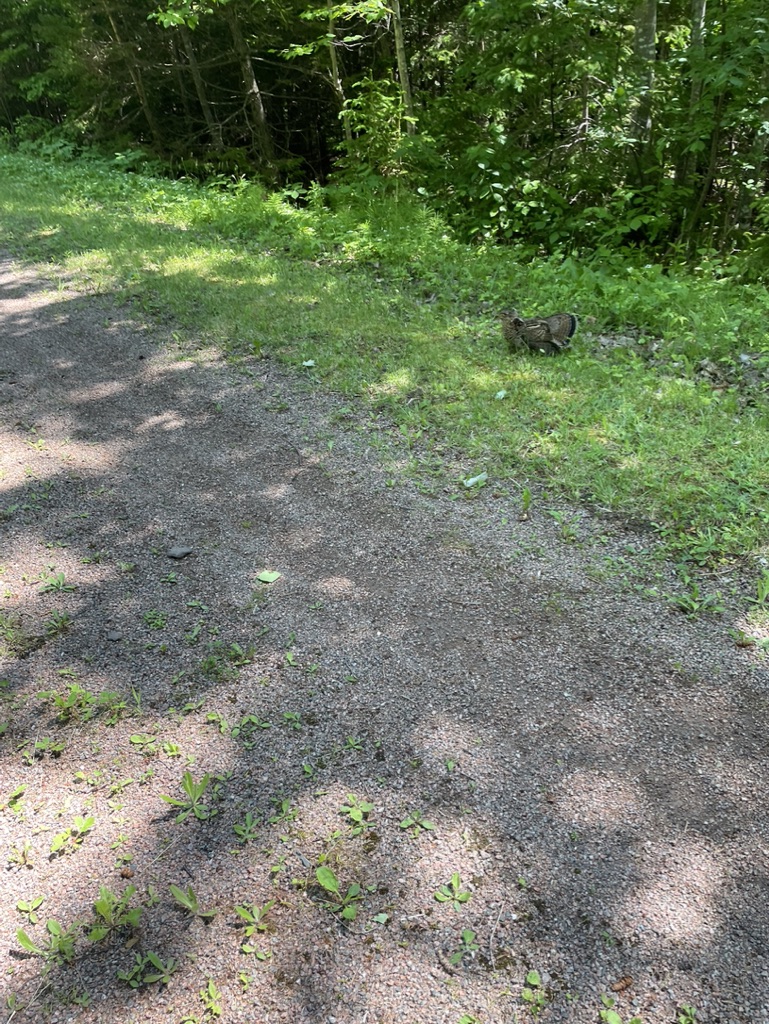
fluffing her feathers and dragging a wing as she tried to distract me, a threat from her chicks.  She made a couple of passes, and kept up a constant cooing until I was safely out of the way.  Looking back over my shoulder, I saw her shoo her young across the path into the deep brush.

Between the mosquitoes and the dark grey clouds I could see building behind me, I was moving along ahead of schedule, so I texted Ann to let her know.  I reached her at my pick up point three-quarters of the way through Section 21, where the Trail crosses Bear River Road, about 5 minutes ahead of a dousing, and we drove through showers back to Murray Harbour.

The next day, knowing the relative lack of scenery on the Trail, I decided to do a longish 27 km day and finish this portion of my journey by completing the rest of Section 21 from Bear River Road to New Zealand, then walking all of Section 22 to Elmira, (the eastern end of the Confederation Trail), and finally to make a short start on Section 23 to finish the day at North Lake. 

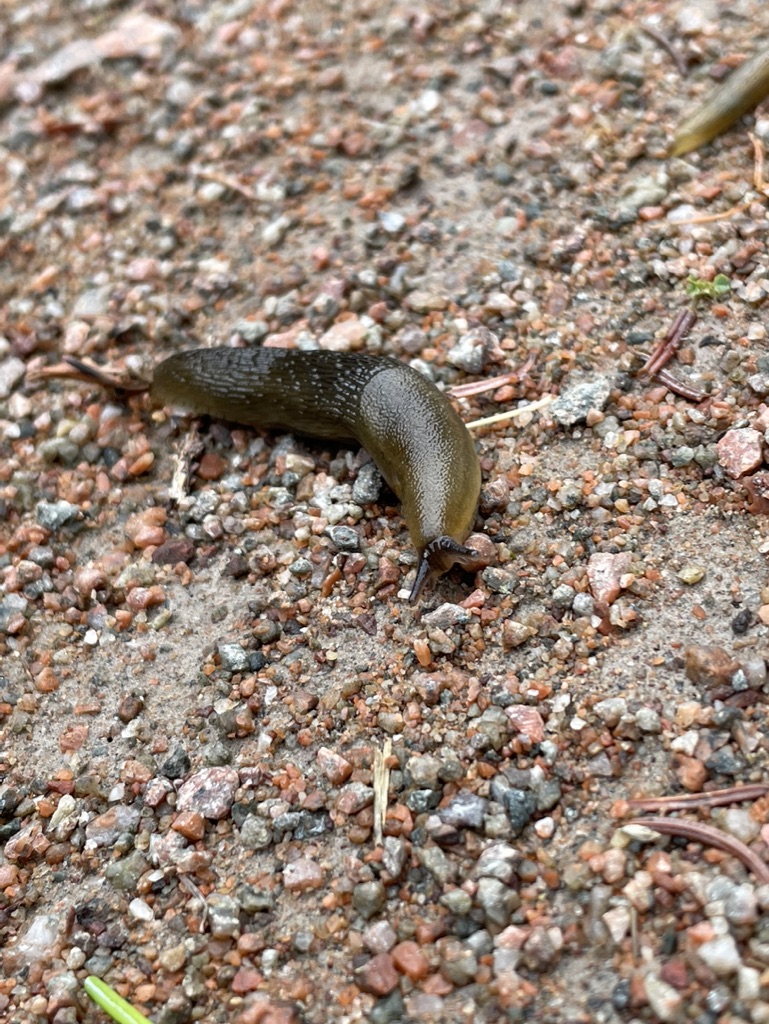
Ann dropped me off at what felt like the back of beyond at Bear River Road, and I started with a brisk pace.  The dew had been heavy overnight, following the rain, and everything felt lush and dense.  I was struck, as I had been several mornings when walking the Trail, to see so many fine fat little slugs making their way along.  Their slow, patient, persistent slither held a metaphor for my journey. 
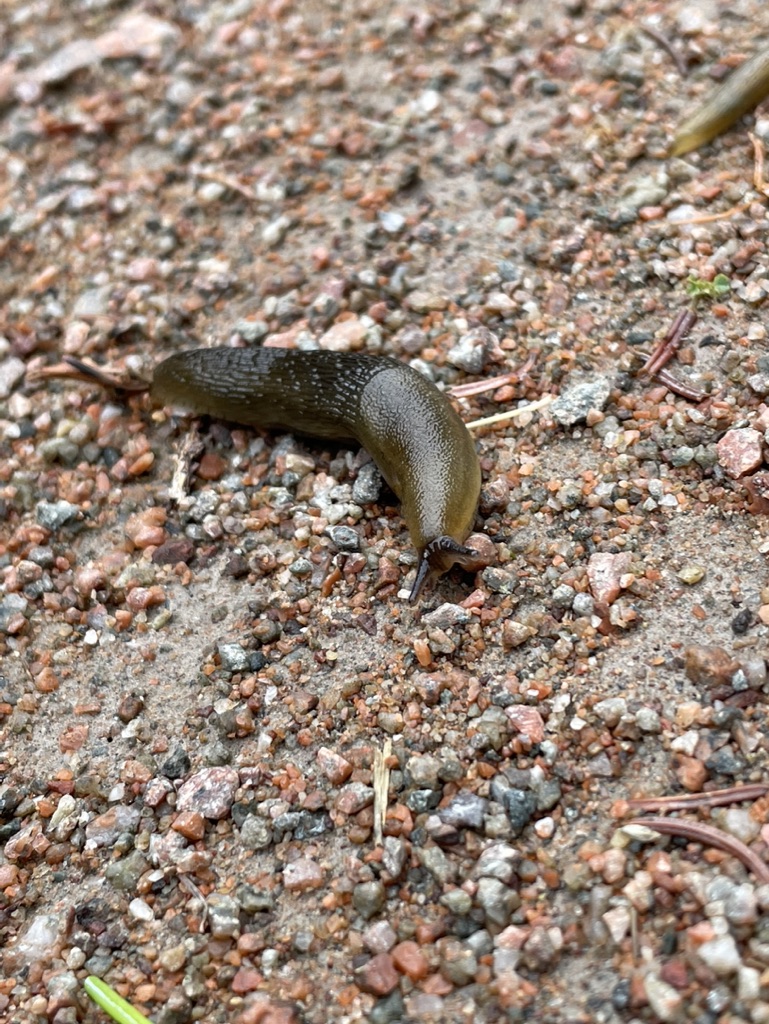
I finished Section 21 in about an hour, at New Zealand.  I was undeservedly amused by this, since I’ve been to the country of New Zealand several times and it doesn’t look a bit like this part of PEI.  Bloody colonials naming everything after the old country regardless of the aptness of that comparison.

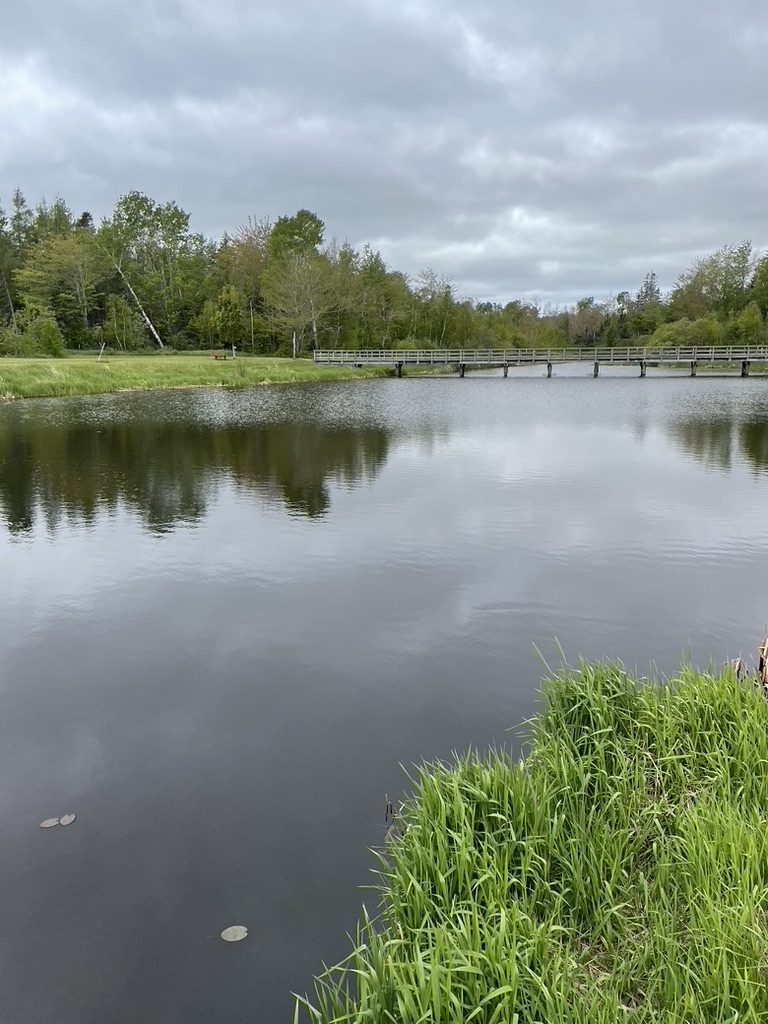
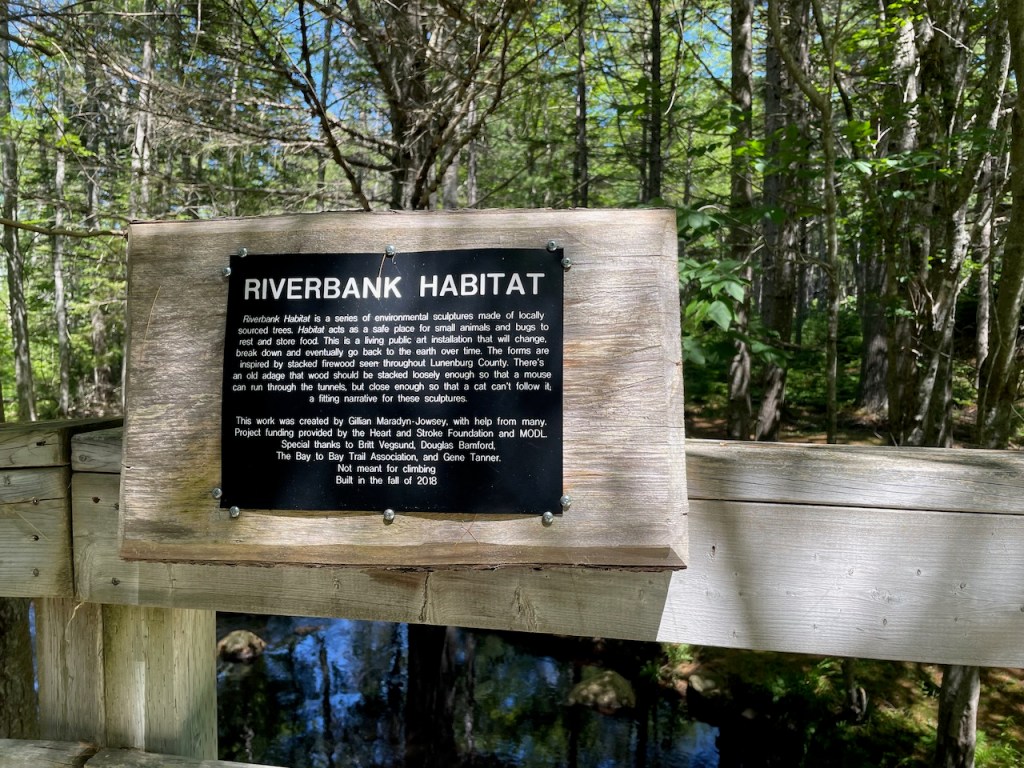
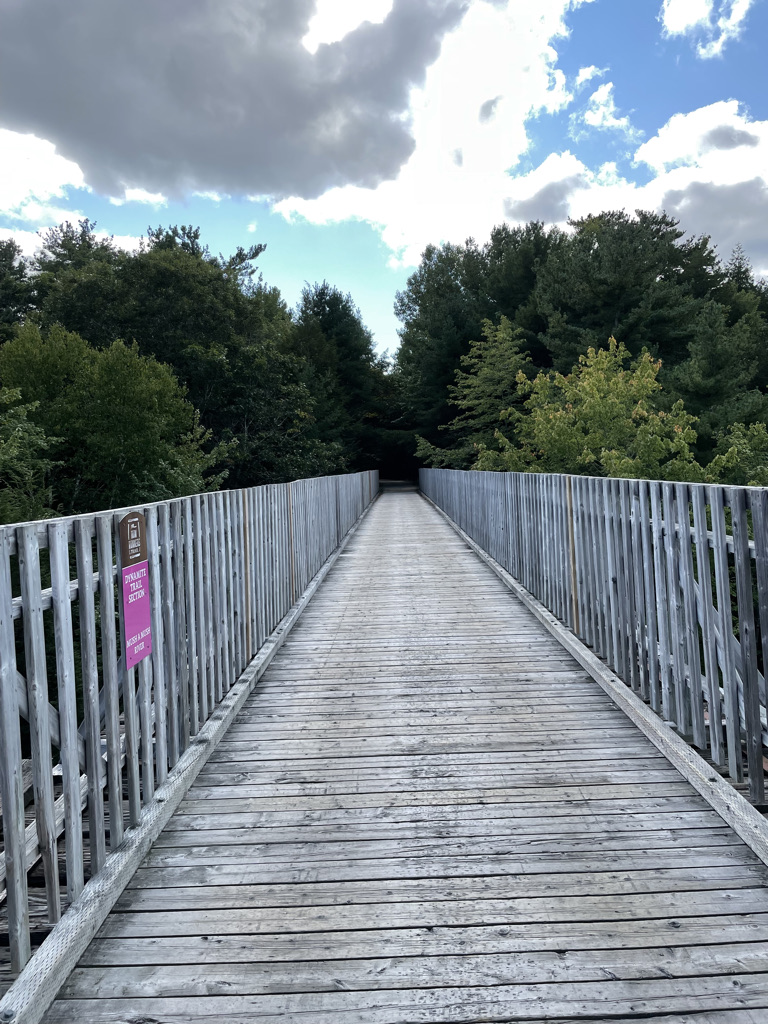
From New Zealand, Section 22 continues a “a walk on the Confederation Trail through a bird sanctuary and nature, including a spiritual spring next to the trail.”  It was a similar walk to the day before.  I had my bug hat on within the first 100 meters and wore it all the way to the ocean breezes at Elmira.  Every rest stop brought swarms, with brief respites when the Trail edges opened out onto grassy fields.  I did find a delightful little wooden bridge over a stream which made a fine morning rest stop.  
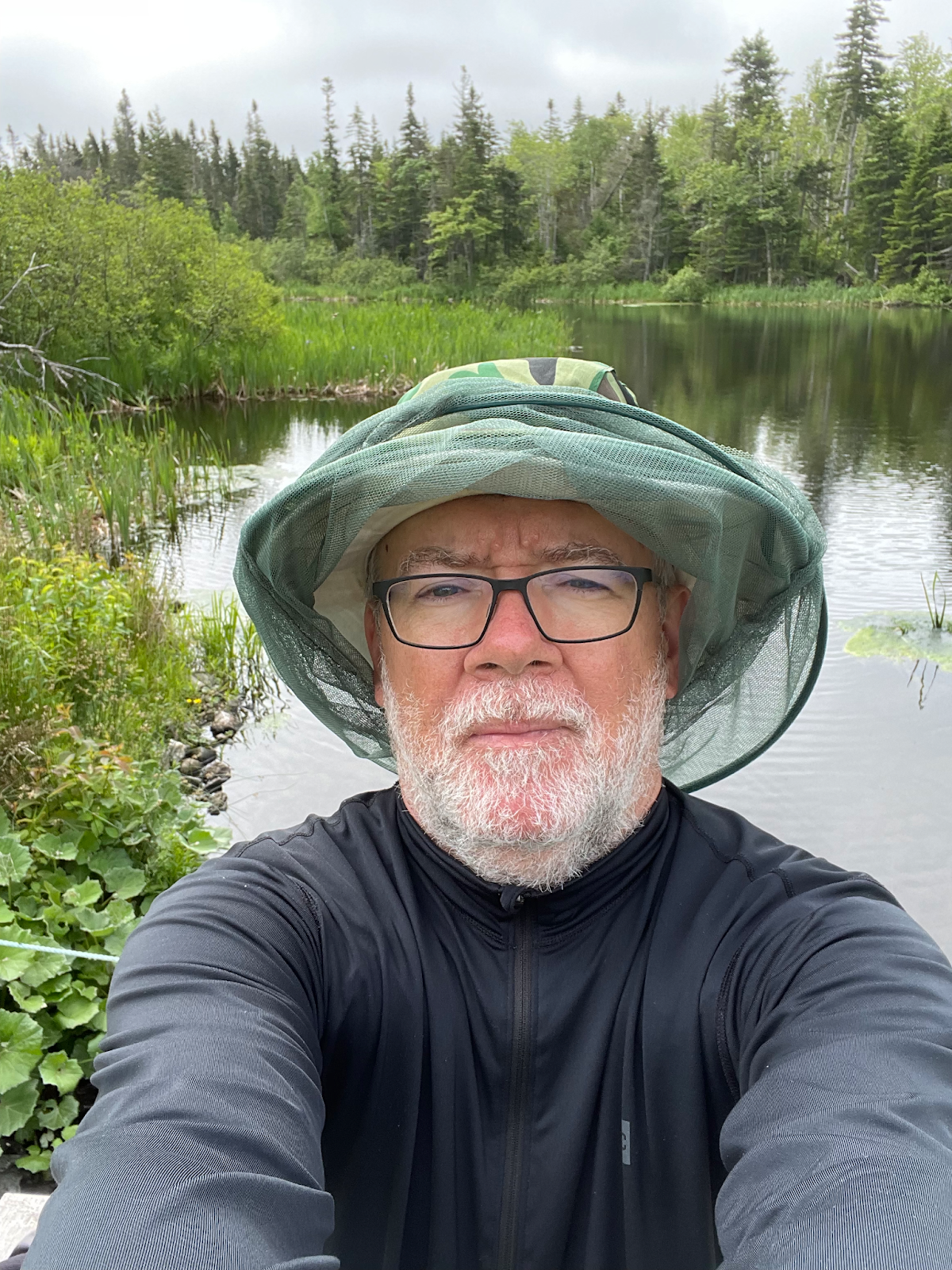
And I also met a little friend along the trail – a baby skunk.  When I spotted it, just a couple of meters in front of me, my brain frantically searched to recall whether skunks are born with fully developed spraying apparatus (no, not at birth), or whether they develop this ability as they matured (yes, at a few weeks old), though that was irrelevant since I couldn’t tell how mature the little thing was anyway.  I didn’t want to find out first hand if this particular skunk could spray, but he or she was curious about, or perhaps dismayed by, this strange creature looming over it.  It crouched and stared up from the middle of the path.

“OK little buddy, time to move along”.  Nothing.  “Shall I slide over this way?”  Nothing.  But the rustling in the grass beside me might have been Mother Skunk, so I scuttled left while the little one scurried right, and we both continued our ways along the Trail without me getting anointed, pilgrim though I might be. 

The day passed quickly.  While the Trail is easy walking, there’s little to see other than trees and bogs on either side.  A pleasant diversion was the spring mentioned on the Island Walk website.  An old wooden hand-painted sign pointed to the right, and up a little dirt lane to a clearing.  There another sign pointed towards a small green pool, bubbles erupting like gentle frog farts from the spring below the surface.  There was an old china mug there hanging from a tree branch.  I passed on filling my water bottle, and instead drank in the calm of the leafy shade. Briefly.  The bugs liked it too.

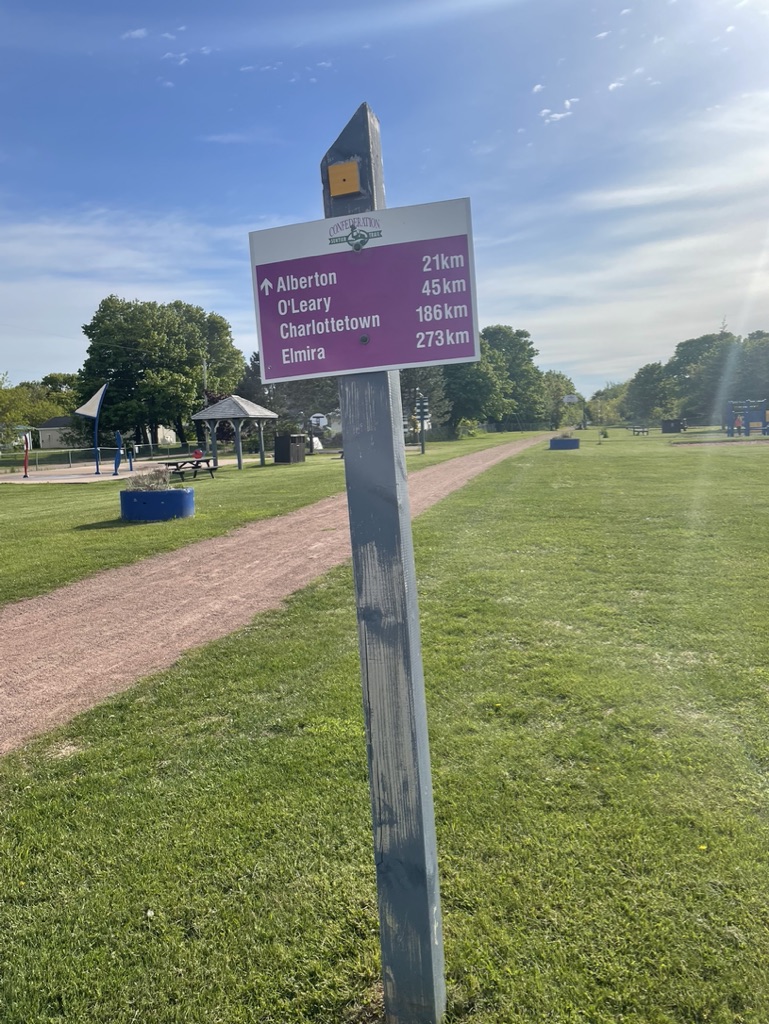
I reached Elmira well ahead of schedule, completing Section 22.  There’s a cute little park, the Elmira Railway Museum, and a picnic area here, to mark the end of the Confederation Trail.  
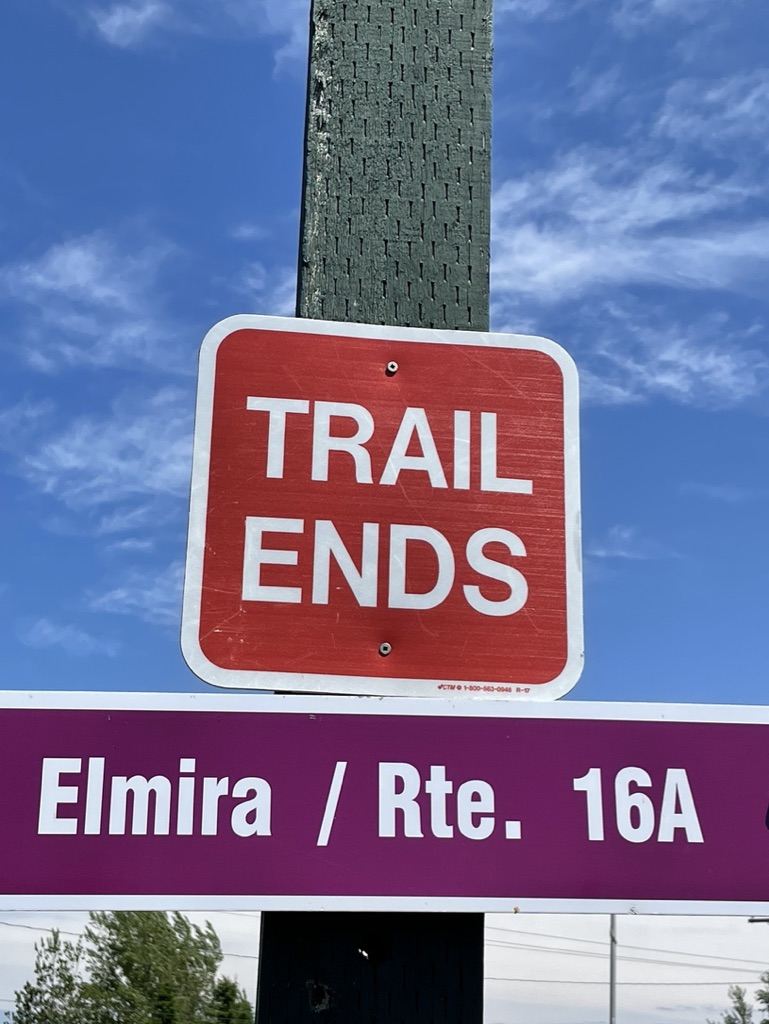
There was no one else around, and the buildings were closed.  I sat for a long rest in the breezy sunshine solitude, glad to be away from the bugs.  Pilgrims peace, once more.

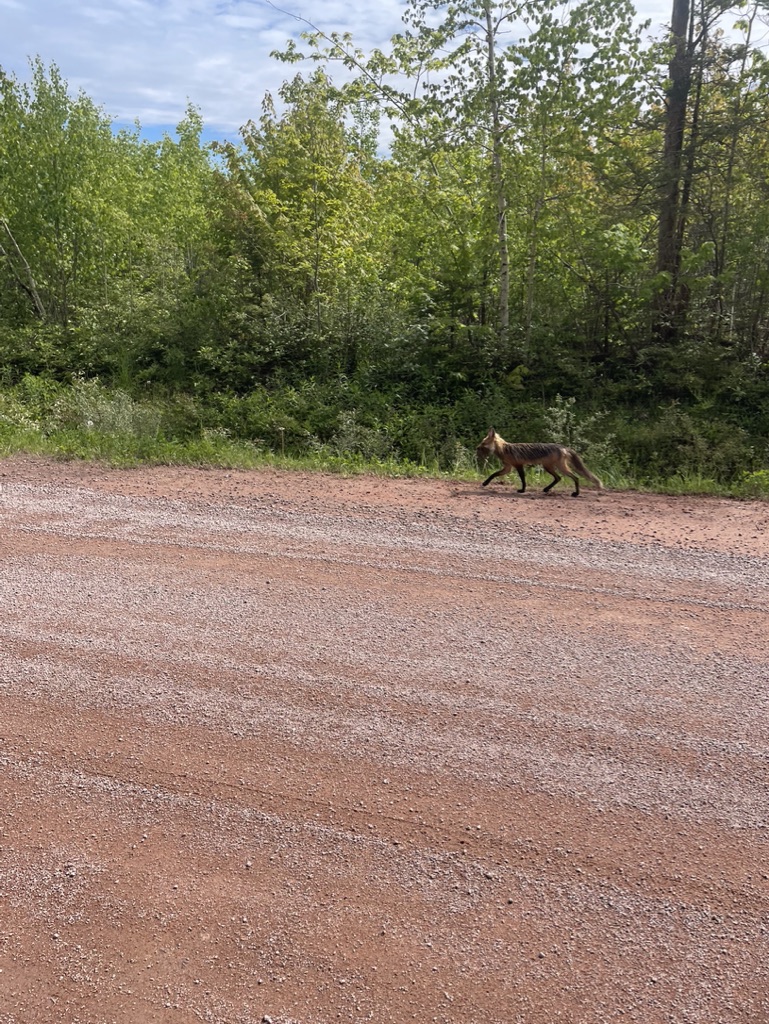
Reluctant to get up, I rose at last to start on Section 23 to reach Ann at North Lake.  It was a short couple of kilometers, with the sea coming into view and a fine breeze to cool me off.  We met by an old schoolhouse just off the highway, where together we watched a fox trot nonchalantly down the road.  
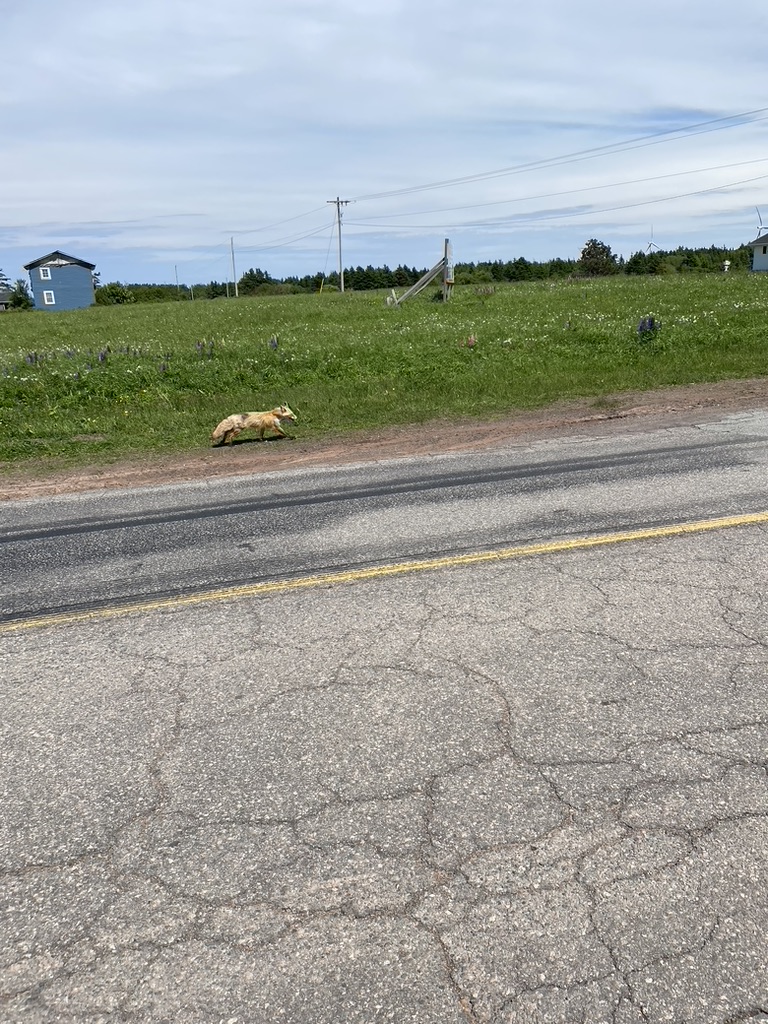
It seemed a good omen, to see a creature normally wary, but now careless of our presence.  We drove off back to Murray Harbour, the longest pick up run of the trip, more than an hour along quiet roads.  The glass of wine at dinner that night went down very nicely.

And with that, I finished the fourth part of my walk.  I had visited some of the most scenic parts of the Island, the iconic red sand beaches and the rolling fields of Anne of Green Gables country, and had moved on from there to complete the eastern portion of the Confederation Trail.  I was eager to walk the next morning, when I would turn the corner at East Point to start working my way back to Charlottetown.

Day 14 – Kensington to Cavendish

  • The worst weather of my journey – solid rain with chilly, gusty winds, All. Day. Long.
  • Completed Section 16 and part of Section 17 
  • Daily GPS distance = about 27 km, elapsed time 6 hours
  • Fitbit daily stats = 30 km, 40,100 steps, 348 exercise minutes, 195 flights of stairs

Day 15 – Cavendish to Oyster Bed Bridge

  • Sunny and fine, a perfect day for walking with a lovely breeze
  • Completed the rest of Section 17, and a couple of km of Section 18 
  • Daily GPS distance = about 26 km, elapsed time just over 6 hours
  • Fitbit daily stats = 29.4 km, 39,400 steps, 340 exercise minutes, 59 flights of stairs

Day 16 – Oyster Bed Bridge to Bedford Station

  • Sunny day, hot, breezy
  • Completed Section 18 and the first few km of Section 19
  • Daily GPS distance – 29 km, elapsed time just under 7 hours
  • Fitbit daily stats – 28.7 km, 38,500 steps, 339 exercise minutes, 48 flights of stairs

Day 17 – Bedford Station to Morell

  • Decent day, warm, showers in the afternoon, but enough breeze to mostly keep the mosquitoes at bay
  • Completed the rest of Section 19 and then the first half of Section 20
  • Daily GPS distance – 29 km, elapsed time just under 7 hours
  • Fitbit daily stats – 31 km, 41,500 steps, 358 exercise minutes, 41 flights of stairs

Day 18 – Morell to Bear River Road

  • Pretty good weather, coolish at first and some clouds, later sunny and warm
  • Completed the rest of Section 20 to St. Peter’s, then most of Section 21 to Bear River Road
  • Daily GPS distance – 30 km, elapsed time 7 hours
  • Fitbit daily stats – 31.4 km, 42,100 steps, 369 exercise minutes, 34 flights of stairs

Day 19 – Bear River Road to North Lake

  • Sunny weather but not enough breeze to shake the mosquitoes
  • Completed the rest of Section 21, then all of Section 22 to Elmira, and the first 3 km of Section 23 to end at North Lake
  • Daily GPS distance – 27 km, elapsed time 6 hours
  • Fitbit daily stats – 29.1 km, 38,900 steps, 326 exercise minutes, 22 flights of stairs

Suggestions

Kensington, North Rustico, and Souris are the biggest places in this part of the Walk, and those towns, along with Morell, Mt Stewart, and St. Peter’s Bay, have accommodations and restaurants nearby.  I think it’s feasible, with some adjustment to daily route lengths, to walk from accommodation to accommodation between Kensington and St. Peter’s Bay. 

After St. Peter’s Bay, as with the other parts of the Walk, I suggest booking something for a couple of days in one of the bigger communities and then arranging pick-up and drop-off transportation to the walk route – Souris would be the obvious choice I think.  

In my case, since my wife was with me and could do the driving, we stayed in Murray Harbour while I did most of this portion.  Admittedly, it was a bit out of the way for North Lake, but the place we stayed at was a lovely spot nonetheless.   Regardless of where you stay, I’d strongly recommend booking accommodation well ahead, however, especially in high season, since there aren’t a ton of places to stay.

Kensington, North Rustico, and Souris are all big enough to use as a base for several days, with grocery shops, restaurants, pharmacies, bakeries, etc. so that you can keep yourself supplied and looked after.  You’ll have to plan your route and accommodations carefully to take advantage of these bigger towns.

As for transport, in this part of PEI, you can use one of the Charlottetown taxi companies that cover most of the middle and east end of the island, but that can be expensive – expect rates in the region of $2 per km.  I did not use them, since my wife was with me and she did the driving.

Other transportation options exist as well.  There are some tour operators, who provide services such as I received from Stanley MacDonald in an earlier part of the walk.  There is also the T3 bus network, which can get you to/from some of the points on the Island Walk route, but it may be of limited use by the time you’re in the middle of the Trail out by New Zealand.  Check their website for full schedule info.

As for sustenance, for some of these sections there will be places to stop for lunch, such as at Cavendish, North Rustico, Mount Stewart, Morell, and St Peter’s Bay.  In other parts, especially once you’re back on the Confederation Trail, you’ll need to pack a lunch, and of course, I would always recommend taking some snacks as well.  Don’t forget your water – there are some places between Kensington and St Peter’s where you can fill up your bottle at a lunch stop, but on the Confederation Trail you’ll need to pack it.

As for bio pit stops, in this portion of the Walk you’re partly on roads, and partly on the Confederation Trail.  The really touristy parts of PEI are in this stretch, so coffee shops, museums, restaurants, and towns with public washrooms are frequent between Cavendish and North Rustico.  On the road sections outside of the touristy bits (e.g. past North Rustico), there are some stretches of road with forest whereas other stretches are pretty open, so plan your water consumption accordingly.  Finally, wherever you are on the Trail, you’re back to improvising, i.e. stepping off into the bushes as needed.  

Finally, while early in this part of the Walk there are churches, community centres, and museums where you can stop for a rest, there are other long road stretches where those things are harder to find and you’ll have to improvise.  When you are on the Confederation Trail, there are benches and picnic tables every few km, so you’ll be fine there.

Next – North Lake to Murray River


Other Posts About this Journey


If you feel like supporting my blog, you can buy me a coffee.
PEI’s Island Walk Part 3 – Tignish to Kensington

Blog posts are a labour of love for me, and yet there is a cost to running this site and organizing my walks.If you’d like to help with that, I’d really appreciate something for my tip jar.The Buy Me a Coffee service allows patrons like you to fund writers like me.  If that sounds like a worthy idea to you, then go ahead – keep buying me coffees.Thank You Very Much to everyone who has contributed already!

*****

In June 2022, I completed the 700 km Island Walk, around Prince Edward Island. You can read about that walk over several posts, starting with this one.  

This was before Hurricane Fiona caused so much damage on the Island, impacting many of the places which I had visited.  Some of what I describe below may have changed by the time you do the Island Walk, but please, don’t let that stop you.  PEI needs your tourist support as it recovers.

This post is about days 9-13 of my walk, between Tignish and Kensington.  The links below have the details from the Island Walk map for the Sections that I covered.  

Note, by the way, that the section #s on the official website are somewhat confusingly labelled based on each start point, and since the overall walk start point is also the finish point, the 1st section is labelled as “32-1” with its accompanying web page titled as Section 32 (because it starts at the end of the last section, which is section 32) and goes to the end of section 1; thus the 2nd section is labelled as “1-2” and its webpage is titled Section 1, and so on.  Whatever, the links below reflect the sections as I walked them.

I highly recommend that you use the Island Walk website and its directions for the details of the official route, since that route can change from time to time such as for detours around major road works.  That said, I also encourage you to use the official route and its sections as a starting point.  Find your own pace, detour as and when your fancy takes you, walk the sections in whatever order seems sensible, and remember – everybody walks their own camino.

If you are planning on doing the walk in chunks spread over several months or years, this portion is pretty self-contained and covers the central portion of the island.


Leaving Tignish

The previous few days, starting from Miminegash and continuing up and around the North Cape  and back to Tignish, had been my favourite stretch so far.  After a bit of a tough start, I had settled into a better rhythm, setting manageable distances each day and walking on now-toughened feet and strengthened legs that were just “good-tired” at the end of the day, rather than “dead-tired”.

With those lessons learned and some wonderful memories formed, I was ready to move into the next stretch of the walk, through the middle of the Island.  Still, parts of the next few Sections overlapped with the chunks of Confederation Trail I’d already walked.  Memories of the mosquitoes I’d met there, which had already driven me batty at times, plus the monotony of straight lines, unvarying green verges, and limited views of the sea or countryside, didn’t exactly inspire me to go back for more.

But that was the route.  The Walk takes you through PEI’s many regions, to show you its many guises, to teach you that there’s more than red earth and potatoes to the place.  You can’t have all highlights; like an over-egged pudding, it would be too rich, too overwhelming.  Sometimes you have to eat oatmeal.

Still, I brightened at the realization that I’d turned a corner;  literally, with the major milestone of the North Cape now behind me, and metaphorically, with my revamped plan and now-settled pace and fitness.  I was at the western end of the Island, and its full length stretched out to the east.  To get there, I had to head back across the middle of the island towards Kensington.

Screen capture from the Island Walk website. Copyright © 2023 An Island Trails project

The morning of day 9 was overcast, with a low grey sky that held moisture and a threat of rain, yet also a bit of breeze which I hoped would keep my winged nemesis at bay.  Section 11 is about 26 km, from Anglo Tignish to Alberton, but since I had done the first few km of that Section the day before, in walking back to Tignish from North Cape, that morning retraced my steps back to Route 12 on the east side of town, where I turned south towards Alberton.

The website says that this Section offers “a peaceful road walk beside the Gulf, with great side trip possibilities out to Kildare Capes.”  The scenery here is low-key, as it is in much of PEI – low hills, green fields, bushes and trees, and a few glimpses of the sea.  Route 12 doesn’t follow the shore too closely, rather it’s set back a kilometre or two, and often you can’t see the water at all.  I guess that’s where the suggestion to side-trip to Kildare Capes comes from.  I’d looked it up the night before and didn’t see anything that seemed too attractive, so after a cursory consideration, I decided to skip the Capes.  Sometimes when you’re in a zone, you just want to let it flow.

So I walked on, steady, unhurried, before finally taking a break after more than 2 hours, at the small 150-year-old white-painted wooden Christ Church, tucked into the trees off the road, which offered a welcome set of steps for a rest.  

It was indeed very peaceful – I’d lost track of days, but I reckoned it was a weekday, yet there was little traffic.  Just a hum drifting off the water, muffled by the intervening trees, and I recognized the sound of lobster boat engines.  I said a silent thank you to the church community.  

Around noon, after more greenery, more little farms, more trees, more glimpses of the sea across grassy fields, I came to Jacques Cartier Provincial Park.  I turned in thinking perhaps the washrooms would be open, and looked around for signs of life.  No one about.  The office at the gate was closed, and while there were one or two RVs parked on campsites, the morning’s quiet persisted here as well.  It seemed that I had the place to myself.

I followed my nose towards the water – the salty seaweed tang of open water – and found a picnic table overlooking the narrow beach.  Lunch was contemplative, thinking about Jacques Cartier and his 16th century expeditions to Canada, which helped to pave the way for later waves of Europeans.  The local Mi’kmaq people must have been surprised to see him.  And who’s now sitting here?  Not their descendents, at any rate.

The only activity came from the fishing boats off-shore.  I watched them ply their trade for a bit,  before unfolding my joints to get up.  There were washrooms open and water taps available, a welcome relief, and I continued on my way without seeing a soul.  

After lunch, the rhythm of walking again took hold, and I settled back into my zone.  I couldn’t tell you now what I thought about or what particular sights I saw.  I was on auto-pilot, content to just walk and let the steps count off.  Before I knew what had happened, I had reached Alberton and the end of the Section.  

With a start, I came out of my trance.  Glancing at my watch, I was shocked to see that I was more than an hour ahead of the time I’d arranged for a pick-up back to Tignish.  I hadn’t felt that I was pushing at all, nor did I feel very tired, and yet I’d just finished about 24 km.  I decided to get a bit of a headstart on Section 12, and continued down the main road through town to Dock Corner which put me up by about 1.5 km for the next day.  Then I turned and walked back into town, to sit on a bench in front of the local historical society building, a charming, wooden, former church, and watched the passersby for a bit.

Bored with that after just a few minutes, I headed back toward the business section to do some grocery shopping.  Still with time to kill, next I popped into the local dollar store, and there found something I hadn’t known that I desperately needed – a bug hat, which turned out to be the best $4 I’ve spent in a long time.

Relishing that purchase, I did a leisurely amble about, found a donut shop for my now-required day-end large black tea, and used a quiet park bench to sit while I called home for a chat with Ann, and then checked up on the next day’s route.  The day’s walk had been easy, and the next day’s route looked simple enough as well.  It’s a lark, this, said my brain.  Hubris.  

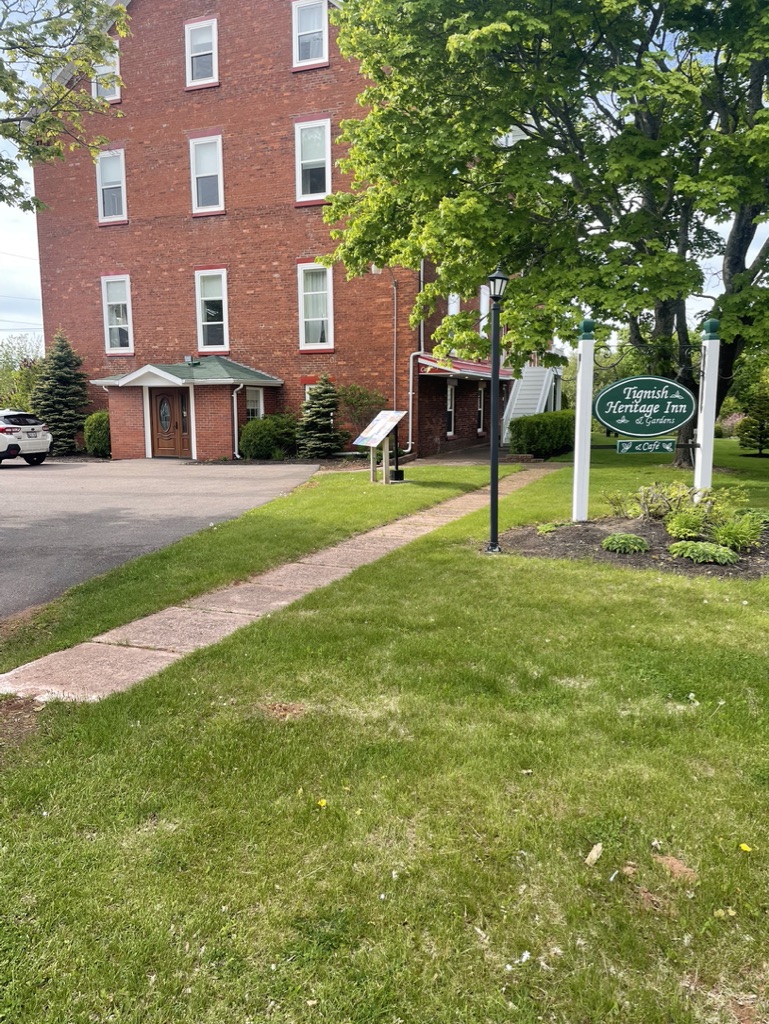
Soon enough, Barbara from the Tignish Heritage Inn arrived to collect me.  She took me on a bit of a tour back to Tignish, pointing out some of the farms in the area while we chatted.  I learned that she and her husband had only recently moved to PEI from Ontario, and we compared notes as newly planted come-from-aways in our respective maritime towns.  It was a pleasant way to end my stay in Tignish, a place that I liked more than any of the others I passed through on the Walk.  

The morning of Day 10, I checked out of the Inn on what I had come to think of as a full pack day, and after my drop-off at Dock Corner, immediately wandered over to see what was commemorated in a small park by the side of the road, where a stone plinth bore an official looking plaque.  

It seems that on a nearby farm, Robert Oulton and Charles Dalton created the silver fox fur industry and made Alberton the epicentre of that dubious fashion.  I suppose that’s appropriate for a town named after Prince Albert, Prince of Wales and later King Edward VII, the namesake of the Edwardian age.  And quite a contrast to the modern windmills churning not far away at North Cape.

The Island Walk website states that Section 12 takes you back to the Trail, to Portage – “Views of quiet bays and harbours at Cascumpec, then back on the Confederation Trail.”  That little blurb sums up this section quite accurately.  

Mussel and oyster beds stretch out over the waters of Cascumpec Bay, 

with low hills rising on either side and white farm houses perched amidst neat green lawns and sheltering trees.  You’re following Route 12 here, up and down gentle hills and round enough curves to keep it interesting.  Still quiet as the day before, little traffic, and breezes to ruffle the trees.  

Some excitement though – I stopped to eat my picnic lunch sitting beside one of the little bays, and two armed fisheries officers appeared, looming over my rocky perch from the roadside above to ask if I was fishing and did I have my license?  No license, just lunch, I said, and after a cheerful “have a nice day” they were off.

The walk resumed, I soon reached the end of Route 12, where it joins the busy Island-spanning Route 2.  I dodged briskly across the highway and followed Route 2 back to the  west for a few hundred meters, then turned south to follow what the map called Percival Road.  The first 100 meters were PEI standard issue red-dirt, which then gradually faded and turned into two deep muddy ruts through knee high grass, impassable to vehicles.  

After following this past a half-burned, hillbilly garbage pile, I was relieved to see the signs marking the Confederation Trail – I was half-convinced that I was on some farmer’s private lane instead of a public road.

But having reached the purple gates marking the Trail, I welcomed trudging on the straight flat gravel after several days of road walking.  It was a short hour’s walk to finish Section 12 at the crossroads at Portage, and again I was about an hour ahead of my planned schedule.  I wiled away the time reading the information plaque I found there, and learned Portage gets its name from the fact that canoeists could traverse this narrow part of the island with a 5 km portage connecting the north and south shores because of the deeply inset bays on either side.

Section 12 ends at Portage, and I had arranged a pick-up from a fellow named Stanley MacDonald, who did tours of PEI from his base in O’Leary.  Stanley proved to be a wonderful guide.  I guessed that he was in his 70’s, and he still loved to rove about the island pointing out bits of history on the way.  That evening, on the drive to my new accommodation base in Kensington, we chatted about the Island Walk, what I’d seen so far, and what was to come as I continued, the very archetype of the friendly Islander that I’d hoped to meet.

After reaching Kensington, I took a little bit of time to wander about the town.  It’s a comfortable, prosperous looking place, with some history to explore, little shops and larger grocery stores, some nice restaurants and coffee shops, and just generally all the things you need if you want a base for the Walk in the middle of the Island.  I stayed at a place called the Victoria Inn, and they offer a few self-contained kitchen suites, which proved to be perfect for what I needed.  

Back on the Trail

The next morning, Day 11 for me, Stanley gave me a lift from Kensington back to Portage and I set out on Section 13, “a Confederation Trail walk through Ellerslie and on to Northam”, which is true enough and sums up everything you need to know – more Trail.  But I was blessed with a fine day for it, because the steady breeze swept the mosquitoes off to bother Cape Breton, and on that flat surface I chuntered along at a brisk but steady pace, reaching the end of that Section’s 20 kilometers at Northam after about 4 hours.

I had planned to continue past Northam on the Trail in order to start the first few km of Section 14, to end my day at Richmond Station.  Since I was well ahead of the pace I’d planned and very early for my pick-up time, I sat at a picnic table in the sun and ate an orange in a lordly and languid manner.  

While doing that, I checked the map to see how far I had to go.  Only then did I realize that I had assumed that Section 14 of the Walk retraced the earlier Sections along the Confederation Trail between Northam and Wellington and hence would pass by Richmond Station.  In fact it does not.

Screen capture from the Island Walk website. Copyright © 2023 An Island Trails project

Instead, when following the Walk route in the eastward direction, at the end of Section 13 at Northam you leave the Trail.  Section 14 then follows back roads towards Miscouche.  That put my planned pick-up at Richmond Station about 5 km away from Grand River, in the middle of Section 14, where I now realized I should stop for the day.

I shot a mildly panicked text off to Stanley, to change my day-end finish to a crossroads at Grand River, rather than Richmond Station, and waited anxiously for him to confirm that he had gotten the message.  

Fortunately, he picked it up quite soon, and my languid mood having quite evaporated by this point, I set out at a brisk pace down dirt roads that meandered through farms and fields and small pockets of woodland.  I reached the crossroads with my cheer restored by sunshine and warm breezes.  There I hung about by a stop sign for a bit, looking out for Stanley’s car and waving to the locals who passed and asked if I needed a ride.

That evening, I made a point to reconnoiter my route both on my GaiaGPS map app and the Island Walk website.  I went over it turn by turn, memorizing its navigation, and mentally checking for parks, churches, schools, gas stations, and the like that could offer a resting spot.  After the embarrassment of nearly wandering off-stage, I wanted no further missteps.   This nightly map run-through became my habit the rest of the way.

Summerside Redux

The weather forecast for Day 12 promised the first proper summer heat of the walk so far.  I made sure to top off my water bottles, and packed oranges and fruit as well.  Stanley picked me up once again, and drove me from Kensington back to Grand River.  My goal was to complete Section 14, which ends in Miscouche, and then do the first half of Section 15, to end my day in Summerside.

All of Section 14 is road walking – “First, a quiet walk along Country roads and fields, then a road walk along Grand River, followed by a red dirt road into Miscouche”, says the Island Walk website.  Stanley’s route to my drop-off point took us along part of what I was about to walk, and as we drove along, I noticed 3 walkers heading east from Grand River towards Miscouche, apparently following the Walk route; it looked like they would be about 30 minutes ahead of me.   He dropped me off with a wave, and I started in their footsteps.

The sunlight beating down upon my hat was already toasting my scalp by 9 am, yet the steady westerly breeze pushed me along and cooled me down as I followed Route 12 as it meanders south and east and across the Grand River.  I half-wanted/half-didn’t want to catch up to the party in front of me.  I had grown used to my solitary progression, immersed in the landscape and in my own thoughts.  I’ll walk slowly, I said to myself, and took frequent pauses for pic snaps.

After a few kilometers, the pavement gave way as I turned onto a dirt road bordered on both sides by thick stands of birch and maple, with lupins poking up along the roadside, leaving me to walk in a muggy stillness with the breeze stirring the leaves 10 meters above my head.  

The moist conditions on the shallow verges were a perfect breeding ground for my old nemesis, the mosquitoes, and unconsciously I accelerated to try to outrun them.  Soon I turned a corner and looked up a gentle slope to see the 3 walkers a hundred meters ahead of me, just finishing their rest break by the side of the road.

I stopped as I came abreast, to take a short break myself.  We chatted, and I joined them as they set out again.  I learned that they were a couple from New Brunswick who had been born on the Island, along with their friend who still lived nearby.  They were doing the Walk in chunks over a period of months, and that day’s section was to be their last for the summer, as they wanted to avoid walking in the heat.  

Since they had two cars between them, they had worked out a hopscotch routine, driving both cars to the day’s finish to leave one there, and then continuing on to leave the other car at the day’s start.  That way, they were able to drive to and from accommodations for each Section of the Walk, which gave them a lot of flexibility.

We paced along companionably for about 2 hours, including a stretch of Section 14 outside Miscouche that looked more like an overgrown farmer’s lane than a public thoroughfare, but which nonetheless appears on the map as Deroche Road.  

As we walked and chatted, my earlier misgivings about disrupting my solitary wanderings were set aside, and I realised it was quite nice to have company for a bit.  We shared stories about the Sections of the Walk we’d done so far, and tossed about ideas for improvements.  We all agreed that there was work to do to arrange rest stops and water stops, and at the same time we also agreed that the Walk was a fantastic way to get to know the Island. 

I also learned that two of this group had also done the Camino Portuguese a few years earlier, and we compared the Island Walk to that of the more established Camino.  I was also interested in that Camino route itself, as I had had thoughts of trying it myself, and I peppered them with questions about their experiences.  It made for a fun morning. 

Still, I found after a few minutes of walking together that our respective walking paces were slightly different, and I found that my short legs needed a faster pace to keep up with these experienced walkers.  That had us striding into Miscouche sooner than I expected.  There I took a snap for them standing by the Section 14 end sign, as they finished their half of the Walk for the season.

Both my overall journey and my day’s planned stretch still had some distance left to run, but Miscouche looked like a great spot for a lunch break.  When walking westbound along the Trail earlier in my journey, I had passed the town, and had seen nothing of it other than a church spire.

Now, having arrived I thought it looked like a cute little place.  There isn’t too much there, though I did see a nice looking B&B and a couple of shops.  If I had been following the route Section by Section, then ending here and spending the night would have been pleasant.

But with places to get to, I bought a coffee at a nearby shop and stepped into the shade of a leafy red maple to eat my lunch at a picnic table in the park area outside the St. John the Baptist Catholic Church.  

It was only after I’d been there for a bit that it occurred to me that it was a Sunday.  Losing track of time on the Walk was a frequent occurrence.  I relished that.

Lunch concluded, I reluctantly turned my attention to Section 15 – “A secluded walk along the Confederation Trail into Summerside, past city streets and bungalows beside the trail, then a rail trail walk past potato fields into Kensington” – runs from Miscouche to Kensington.  That day, I was only going to do the first 10 km of it, to reach Summerside.  By doing so, I could use the following day for what would be the closest I’d have to a rest day, needing just a short 3-hour, 15 km walk to finish Section 15 into Kensington. 

Setting out from my shaded rest, I stepped into summer heat, following Miscouche streets for a few blocks to rejoin the Confederation Trail.  Here I retraced the steps of Section 5 that I’d walked on Day 4, then with quite different weather, and with the same countryside appearing new to me when viewed from the opposite direction.  

I clipped along at a steady pace, thinking of ice cream in Summerside, and taking frequent water breaks as the afternoon heat continued to build.  The 10 kilometers evaporated quickly, and I was soon entering the city.  The old rail line passed through residential areas as it curved towards the old main rail station down in the middle of town near the seaside.  Despite being an early summer Sunday, there wasn’t a holiday feel to the place, as it wasn’t quite yet the full summer tourist season, and the foot and road traffic was light with many of the more touristy spots still closed.

As I walked, my phone rang.  It was the support person from the T3 bus network.  I had emailed a pick-up request the previous day, to journey from Summerside back to Kensington, and had timed my day around the bus schedule, which showed a 4 pm departure.  I’d made it to Summerside in plenty of time, well before 3:00, with visions of a cool patio serving refreshing beverages.  That proved to be a mirage, however, as the T3 person explained that in fact the bus only runs Monday to Friday.  Quelle drag.  

With that disappointing news, I changed my mind about hanging about in Summerside and instead called a taxi to take me back to Kensington.  My longed-for cool, refreshing beverage sipped slowly by the seaside became a cup of tea back at my hotel.  At least I had an early evening to rest.

Into Kensington

Day 13 dawned grey and overcast, with steady rain predicted to start around mid-day.  Since it was now a Monday, I was able to catch the T3 bus in Kensington to return to Summerside, for what turned out to be the only time I used it on my travels.  It was a pleasant ride, and very cost-effective at just $2 for a one-way journey.  

In hindsight, by the way, I wished that there were more connections with the Walk route, as I would have used it more.  I understand that there’s little call for stops at say Northam along the Confederation Trail in the middle of farming country.  Unfortunately, that means that while it’s worth using the service where the route passes through towns like Summerside and Kensington, in many other places it’s not a very practical means of getting to and from the Walk.

On that morning, once back in Summerside I had only to turn around and follow the Trail out of town for a short morning’s walk to complete Section 15.  I set off intending to get back to my hotel by noon to try to beat the rain.  As before, the sights visible from the path are limited, mostly small copses of trees and fields on both sides, though it was interesting to pass by the large Cavendish Foods processing plant.  I had noticed that PEI often feels like one giant garden, and much of that bounty is funnelled through food processors like this to reach tables from coast to coast.

There were some mosquitoes about, so once again my rest breaks were short and my pace was brisk, bringing me into Kensington well before noon.  As I walked past the old train station in the middle of town, now turned into a cute cafe, two couples sitting outside hailed me in passing to ask where I’d come from.  

I explained about the Island Walk, which prompted them to mention the Camino de Santiago.  They said they’d planned to do that pilgrimage in 2022 but the lifting of COVID-19 restrictions after two years had meant that the Camino was going to be very crowded, and so they’d decided to come to PEI instead.  I recommended the Island Walk to them, and left them with the hope that I’d made a few more converts.

I finished the day in the nick of time, spots of rain splashing the sidewalk just as I reached my hotel.  It was only about noon, leaving me the rest of the day to take a nap, wash some clothes, clean my gear, and get organized for the next day.

That evening, as I listened to wind-driven rain pattering the windows, I reflected upon what I’d accomplished so far.  I was fully into the rhythm of walking, and confident in both my endurance and my adjusted plan.  The earlier day’s-end bone-deep aches, creaks, and stiffness had given way to an almost pleasant tiredness-after-a-good-day’s-work feeling.  I had a routine – sleep, walk, rest, repeat.  I’d learned a lot, and had enjoyed most of what I had seen about the western half of the Island.

And deep down, I was excited because the next day would be what I had come to refer to as Halfway Day, when I would complete Section 16 out of the total of 32.  Not only would I have reached the midpoint, I would be embarking upon some of the most scenic Sections of the Walk, along the Island’s north shore.  Sleep came fitfully; I was eager for more.

Day 9 – Tignish to Dock Corner outside Alberton

  • A bit overcast but warmish and muggy, though with some breezes too.
  • Completed the remainder of Section 11 (starting outside Tignish and continuing to Alberton) and did the first km of Section 12 to Dock Corner 
  • Daily GPS distance = about 25 km, elapsed time just under 6 hours
  • Fitbit daily stats = 28.2 km, 37,800 steps, 310 exercise minutes, 31 flights of stairs

Day 10 – Dock Corner to Portage

  • Sunny and fine, a great day for walking with a lovely breeze
  • Completed the rest of Section 12  
  • Daily GPS distance = about 24 km, elapsed time just under 6 hours
  • Fitbit daily stats = 27.7 km, 37,400 steps, 303 exercise minutes, 53 flights of stairs

Day 11 – Portage to Grand River

  • Sunny day, breezy, perfect
  • Completed Section 13 between Portage and Northam and did the first 5km or so of Section 14 to Grand River
  • Daily GPS distance – 24 km, elapsed time just over 6 hours
  • Fitbit daily stats – 27.8 km, 37,200 steps, 331 exercise minutes, 41 flights of stairs

Day 12 – Grand River to Summerside

  • Gorgeous day, sunny, and getting hot, lovely breeze in the afternoon
  • Completed the rest of Section 14 from Grand River to Miscouche and then walked the first 9 km of Section 15 into Summerside
  • Daily GPS distance – 25 km, elapsed time just over 6 hours
  • Fitbit daily stats – 26 km, 34,800 steps, 315 exercise minutes, 29 flights of stairs

Day 13 – Summerside to Kensington

  • Rain forecast, which arrived during my walk.
  • Planned short day for a rest, only had to complete the rest of Section 15
  • Daily GPS distance – 14 km, elapsed time 3 hours
  • Fitbit daily stats – 18.4 km, 24,600 steps, 218 exercise minutes, 11 flights of stairs

Suggestions

Alberton, Tyne Valley, Summerside, and Kensington between them have many options for accommodation and dining, and there are some scattered B&Bs and resorts in the general area near the route, but as with the other stretches, it’s difficult to walk from accommodation to accommodation.  

You could do that between Tignish and Alberton, and between Miscouche and Kensington, but otherwise you’d have to stray well off the route to get to a B&B.  Instead, I suggest booking something for a couple of days in one of the bigger communities and then arranging pick-up and drop-off transportation to the walk route.  

This is what I did, basing myself in Kensington after I left Tignish.  I’d also strongly recommend booking accommodation ahead, however, especially in high season, since there aren’t a ton of places to stay.

With respect to other necessities, Alberton, Summerside, and Kensington are all big enough to have grocery shops, restaurants, pharmacies, bakeries, etc. so that you can keep yourself supplied and looked after.

In this part of PEI, you can use one of the Summerside taxi companies that cover most of the west end of the island – they will run you all the way to North Cape if you want.  That can be expensive, however – expect rates in the region of $2 per km.  I did use them a few times in this part of the walk.  I also connected with a local tour operator named Stanley MacDonald, who was recommended to me by Barbara at the Tignish Heritage Inn.  Stanley is based in O’Leary, and he did my pick-ups and drop-offs between Portage and Kensington.

Finally, other transportation options exist as well.  There are other tour operators, who provide services such as I received from Stanley.  There is also the T3 bus network, which can get you to/from some of the points on the Island Walk route, e.g. Miscouche to Kensington.  Check their website for full schedule info.

As for sustenance, in these sections you’ll need to pack a lunch most days and I would recommend taking some snacks as well.  There are a few places in Miscouche, and quite a few in Summerside and Kensington, where you could get something to take with you on your walk.  And don’t forget the water – there are limited places to fill up unless you knock on someone’s door, so in my case I carried 1.5 liters with me each day.

As for bio pit stops, you’re partly on the Confederation Trail and partly on roads so for the most part you’ll be improvising.  Judging by the bits of toilet paper I saw at certain points along the Trail, most people seem to just step off the trail into the bushes as needed.  On the road sections, there are some stretches with forest and bush on one side or the other, whereas others are pretty open.  In general, I’d say plan your water consumption accordingly.  For the most part over most of these sections, if you need to pee, you’re either sneaking into the bushes by the side of the road, or holding on till you reach a gas station.

While the Trail portions of this part of the walk are, like all of the Confederation Trail, well supplied with picnic tables and benches every few kilometers, the rest of this part of the Walk is along roads.  I found few parks, cemeteries, churches, community centres, or museums where I could sit for a rest, so I improvised where I could.  For example, I found a great spot on some rocks near Cascumpec Bay where I sat to eat my lunch while watching some oystermen at work.  My Mountain Equipment Co-op seat cushion came in handy that day.

Next – Kensington to North Lake


Other Posts About this Journey


If you feel like supporting my blog, you can buy me a coffee.
PEI’s Island Walk Part 2 – Summerside to Tignish

Blog posts are a labour of love for me, and yet there is a cost to running this site and organizing my walks.If you’d like to help with that, I’d really appreciate something for my tip jar.The Buy Me a Coffee service allows patrons like you to fund writers like me.  If that sounds like a worthy idea to you, then go ahead – keep buying me coffees.Thank You Very Much to everyone who has contributed already!

*****

In June 2022, I completed the 700 km Island Walk, around Prince Edward Island. You can read about that walk over several posts, starting with this one.  

This was before Hurricane Fiona caused so much damage on the Island, impacting many of the places which I had visited.  Some of what I describe below may have changed by the time you do the Island Walk, but please, don’t let that stop you.  PEI needs your tourist support as it recovers.

This post is about days 4-8 of my walk, between Summerside and Tignish.  The links below have the details from the Island Walk website for the Sections that I covered.  

Note, by the way, that the section #s on the official website are somewhat confusingly labelled based on each start point, and since the overall walk start point is also the finish point, the 1st section is labelled as “32-1” with its accompanying web page titled as Section 32 (because it starts at the end of the last section, which is section 32) and goes to the end of section 1; thus the 2nd section is labelled as “1-2” and its webpage is titled Section 1, and so on.  Whatever, the links below reflect the sections as I walked them.

I highly recommend that you use the Island Walk website and its directions for the details of the official route, since that route can change from time to time such as for detours around major road works.  That said, I also encourage you to use the official route and its sections as a starting point.  Find your own pace, detour as and when your fancy takes you, walk the sections in whatever order seems sensible, and remember – everybody walks their own camino.

If you are planning on doing the walk in chunks spread over several months or years, this portion is pretty self-contained and covers the western end of the island.


Onto the Confederation Trail

With the first portion of the Walk completed, I had time for reflection.  Charlottetown to Summerside had been road walking virtually all the way, starting in the city and progressing through countryside to the Argyle Shore.  That had proven to be both a gentle introduction to PEI’s rolling countryside and quiet back-road ways, and at the same time a somewhat tougher intro than I had imagined – all those river and creek valleys creating a lot more up and down than I’d anticipated.

I had gained 3 days worth of blisters along with my newfound appreciation of some of the hidden challenges of the Walk – no place to sit down when road walking! – so it was with some relief that in looking at the next few Stages on the map, the prospect of mostly following the Confederation Trail was appealing.  

It didn’t look too challenging – flat and straight for the most part, and I had already learned that the Trail is easy walking, with a firm gravelled surface and rest benches every few km.  My plan was to use this easy stretch to continue to build up my legs and toughen my feet while gaining some extra distance so that when I got to the more scenic bits such as the North Cape or the Cavendish Shore, I could take my time.

Screen capture from the Island Walk website – copyright OpenStreetMap

Since the next 3 Stages of the Walk were all along the Trail, between Summerside and O’Leary, I decided to do them in two days, which meant putting in more than 30 km each on Days 4 and 5 of my journey.  It also meant that, since Ann had now returned home to Lunenburg and I was walking away from my accommodation base in Summerside, I needed to arrange some transport. 

Before going to bed that night, I contacted a local taxi company in Summerside and booked a taxi to pick me up at 3:30 the next afternoon – I reckoned I could get from Summerside to my Day 4 goal at Port Hill Station Road (halfway through Section 6) by then, and it would give me time the next evening to rest and recuperate.  I went to bed early, knowing I had two big days in front of me.

At about 3:30 in the morning, I awoke suddenly to the bleep of my phone.  The Toronto phone number on the screen was unfamiliar, a misdial I thought.  I cursed the fool who had called at that hour, switched off the phone, and grumpily tossed and turned and tried to get back to sleep.

When my alarm chirpped in the morning, I was feeling a bit frazzled, after that interrupted sleep.  But coffee helped get me going, and I quickly packed my lunch and some snacks, ensured that my rain gear was handy, checked the blister bandages on my toes one last time, and headed out on Day 4.

The weather had changed a bit, after several days of sun.  The temps were moderate, and there was more humidity in the air with some rain forecast.  I was also in a stretch of the Walk where there were no roadside options for lunch, so I was carrying water, snacks, and food, on top of rain gear and dry clothes, making for a relatively heavy pack for a day walk.

The descriptions of Sections 5, 6, and 7 on the Island Walk website are telling in their dull, repetitive tone: “a quiet walk along the tree-lined Confederation Trail”; “Confederation Trail walking through small communities along the way”; “Confederation Trail walking through some small communities”. 

So while I wasn’t expecting Yonge Street at rush hour, the quiet still felt a bit eerie.  I could hear myself breathing (a bit laboured, still out of shape), and the crunch of my boots on gravel, a faint hum of distant traffic, crow caws and cackles, leaf-stirrings in breezes.  It quickly became apparent that the parts of the Walk along the Confederation Trail would not exactly be hectic, and unfortunately, not the most scenic either.  

The Trail does, after all, follow an old rail line, and rail lines are laid out to minimize grades, slopes, embankments, bridges, and curves, all of which translated into some stretches where boredom was my biggest challenge.  In fact, during one long, looonnnnggg 11 km straight-as-an-arrow stretch, I practiced walking with my eyes closed.  I could get up to about 40 steps before I would drift a bit off the path.

There is some greenery of course, often quite a bit, with brush and birches and balsams along the trail edges, and often the trees arch up and over the path to make a lovely green tunnel.  Through breaks in the greenery, you glimpse the fields through which you’re traversing, newly planted with potatoes in early June, and as you get closer to O’Leary, you go through forested sections too, with boggy, marshy stretches dotted with bog cotton and bog orchids which break up the monotony.  

The late spring/early summer bloom was in full swing – lupins were popping out everywhere, along with other wildflowers.  Birds were common, and there were squirrels and chipmunks chittering and scurrying in escort to my steps.  

Humans, though, were in short supply.  Aside from a few dog walkers just outside Summerside, I met few people, and those I did meet were usually cyclists rather than fellow walkers.  My journey seemed to have its own secret itinerary, the only (lonely) Island Walker.  Though I did notice that some magic spell produced a passing cyclist whenever I stepped off the trail for a pee.

Over the course of days 4 and 5, as I walked these sections I gradually grew a bit numbed by the steady rhythm of my steps, the same scenery lining each kilometer, the same crows cawing in the trees.  The only noticeable difference was the weather, which warmed over those 2 days – enough to bring out the mosquitoes in their hordes.

Section 5 ends in the little town of Wellington, which is nice enough, with a pretty park in the centre of the town where I stopped for a picnic lunch on Day 4, 

but early in the season it was a bit chilly sitting there, and the town tourist info centre was closed along with the public toilets.  A kind local refilled my water bottle for me in her house, but I couldn’t shake a ghost-town shiver, and cut my rest short to get going again.  

I had reached Wellington after completing Section 5’s 22 km over about 4 hours of walking, and I still had another 12 km or so planned for that day to take in about half of Section 6.  It took a bit of grunting and stretching to loosen up after lunch, and 10 minutes of brisk pace to restart my circulation, and then I was back into my walking rhythm again.  There were about 2 hours in front of me to reach Port Hill Station Road, where the taxi from Summerside would pick me up.

As I trudged along, the sun came out, and I stripped off some layers to get down to my T-shirt.  Almost immediately, I felt a nip on the back of my neck.  And another.  Then one on the back of my head through my hat.  Soon I was flapping my arms and waving my hat, a scarecrow fluttering in a hurricane, swatting in all directions.  My long-sleeve T-shirt went back on.  Then my rain jacket, zipped up to the neck.

What the Island Walk website hadn’t told me in its boring little blurbs about the quiet charms of the Trail was that my introduction to the inhabitants of the Island would include ALL of them, in particular the several varieties of biting insects that lurk in those green verges.  

Every rest stop that afternoon brought bugs, so I kept moving.  I reached my pick-up point with 30 minutes to spare, but I didn’t care because there was a blessed patch of open space by the road where the breeze blew the little beasties away.  I took off my pack and my rain jacket, and slumped onto the grass.  Day 4 done.

My taxi arrived a bit early, thankfully, and as we headed off I chatted with the driver.  “So you’re the walker who wanted a 3:30 pick-up?”.  “Yes, why?”.  “Well, one of the other drivers came out here last night at 3:30 am, and wondered who would want a pick up on a dirt road in the middle of nowhere at that time of the night.  He tried to call you, and didn’t get an answer, and then he realized that the dispatcher had forgotten to write down ‘PM’ next to the 3:30 time”.  Oh my.  That explained my broken sleep.

So that evening, when I called the taxi company to book both my morning drop off and my afternoon pickup, I was very careful to clearly enunciate “8:00 AM” and “4 PM”.  Lesson learned.

Day 5 dawned a bit warmer than day 4, and as the taxi picked me up in the morning, I looked forward to this tranche of my trek with mixed emotions; a sense both of foreboding and of anticipation – I knew what to expect, after all.  

The driver that morning was a young guy, quite friendly and voluble in a laconic, laid-back way that reminded me of The Dude in the film The Big Lebowski.  “I’m doing the Island Walk”, I said in answer to his silent question contained in the glance at my pack.  “What’s that?”.  I explained the idea behind the walk, and that I was learning a lot about the Island in doing it.  “Cool.  Why are you doing it?”.  “It’s like a Camino, a pilgrimage, a way to let your mind go as you walk and let yourself just absorb the sights and sounds around you.  A way to step away from screens and phones.  A way to just be.”  “I dig you, man.”  The Dude abides.

As soon as I got onto the Trail, I tried to put those words into motion, and let my mind just go.  But the breeze was cut off by the sheltering trailside brush, from which the mosquitoes emerged in their legions.  My pace increased, as it had the day before, a futile attempt to outrun the buggers, and any hope of Zen contemplation disappeared in a haze of sweat and flapping.  Like the previous day, each rest stop was brief and harried, as I sat huddled in my rain jacket with the hood zipped up tight round my face, sweating and swatting while eating a snack. 

With an assist from mosquito-generated tailwinds, I plowed through the 34 kilometers I’d planned for that day, completing the rest of Section 6 and all of Section 7 at record pace, ignoring my sore blistered feet in my haste to get to O’Leary and away from the bugs.  I reached town with an hour to go before my taxi pick-up, exhausted and sweat-soaked.  

The local donut shop provided a very welcome, very hot, and very large cup of tea, into which I dumped a very large handful of sugar packets.  I could feel the warm caffeine and glucose radiate outwards from my stomach as I slowly regained my equilibrium, sipping it slouched on a bench in lovely breezy bugless shade, dreaming of a nice hot shower.

After a long wait, long enough for my body to seize up like salt-crusted iron in every joint and muscle, my taxi pulled up.  I staggered slowly over and tumbled in.  The driver was a young woman who politely ignored the wet-dog smell with which I filled the car.  “I’m doing the Island Walk”, I explained.  “Oh, are you raising money for a charity or something”? “No, it’s just something I wanted to do”.  Silence, and then, “Well, hope you have good weather”.

When I got back to my place in Summerside and stripped off, I looked in the mirror to see that my neck and shoulders and hands were covered in welts where the bugs had bitten through my shirt and trousers and gotten at my unprotected hands and face.  It would not be the last time that happened.

Tignish and the Island’s West Coast

Since I had finished the 68 km of Sections 5, 6, and 7 of the Walk in 2 rather than the suggested 3 days, and had sweated off litres while doing it, my body was scraping the few scraps of energy reserves that I had left by the time I was dropped off in O’Leary on the morning of Day 6, to start  Section 8 of my journey.  The website says this Section “starts on the Confederation Trail, then switches to dirt road walking and ends with a short walk along the shoulder of Rte 14 with coastal vistas.”  

Which meant the day began with, ugh, another 6 km or so of the Confederation Trail leading out of O’Leary, and the bugs that morning were still voracious.  The air was chilly at first, about 8C, and it was with a morbid fascination that I noticed how the bugs perked up as the air warmed past 10C.  Within an hour or so, I was zipped to the chin in my rain jacket again and wildly conducting the pestilential orchestra.

Near the end of this stretch, I met a couple who were doing the Island Walk route on bikes.  They were riding west from O’Leary and came up behind me, saw my pack, and stopped to ask if I was doing the Walk as well.  The mosquitoes kept us moving, so our chat was brief while they pushed their bikes along.  It turned out that we were all staying at the Tignish Heritage Inn that evening, and we wished each other well as they mounted up and cycled off, leaving me in my cloud of torment, walking as fast as I could to gain the sea breezes on the coast road.

It was a welcome change to finally leave the Trail at Bloomfield, and I stripped off my rain jacket to take a break in an open space next to the gates that guard the Trail.  The sun was out by now, and I savoured the simple pleasure of a bug-free banana.

Refreshed, I followed a succession of dirt roads leading me west towards the coastal Route 14.  Walking along open roads brought not only a welcome escape from the depths of diptera culicidae, there was pleasantly bucolic scenery as well – farms and sea views, and little dips in the road, and ponds and creeks to break it all up.  

I met my first fox here – a vixen.  She wanted to walk along the dirt road in the same direction as me, but she wasn’t sure if I was a threat or not.  She looked me up and down and quickly decided that I was harmless.  It must have been the Tilley hat – who can look like a threat wearing that?  She gave me the fox’s version of an eye roll and trotted off carrying a rabbit, lunch for her kits.

When I reached Route 14 and turned north towards Miminegash, I was more than 3 hours into my day and growing hungrier and thirstier and increasingly foot sore.  I needed a break, but I couldn’t find anywhere to take it.  Around every bend in the road, I hoped to see a church or a community centre or a gas station where I could sit down, but there were only farms and fields and vehicles disappearing up the road.  

Eventually I gave up on such luxuries, and coming upon the vacant lot where a house had once been, its shaded driveway off the road looked too inviting to pass by.  I flopped down onto the ground for a rest while I ate my lunch, blessing my foresight at having packed a light seat cushion.  The passing cars slowed for a look at this curious person, but it was a relief to be out of the mosquitoes.

Refueled and rested, somewhat, I looked at the map.  My heart sank as I counted off the km to my planned day end target of Nail Pond – near 20 km.  My brain slowly roved over my body, taking stock of my aching feet and legs.  Too much.  It was just too much to do that day.

I was still clinging to my more or less original plan, to cover a bit more than 30 km that day.  But that plan hadn’t accounted for the fact that since I was changing my accommodation base from Summerside to Tignish, my pack was fully loaded with all my belongings, rather than the lighter loads I’d been carrying the past few days.  The extra weight, the previous two long days, and the battles with the mosquitoes had drained me.  I mentally dialled it back a bit, and adjusted my sights onto Skinner’s Pond, a more reasonable 15 km away.  And once more into the breach, towards Miminegash.

I was ready for another break by the time I plodded up to the Miminegash municipal offices and fire station about an hour later, where Section 8 of the Walk ends.  I found a shaded spot to sit for a snack and some water.  After 20 minutes, I told myself to get up.  10 minutes later I sent a sternly worded memo to my feet.  10 minutes after that, I begged my legs to move.  And finally, a futile 10 minutes past the ultimatum I’d given my body, my brain waved a sad white flag at my conscience and conceded that neither of us was going any further that day.

So I called the Tignish Heritage Inn, with which I had arranged transport from Nail Pond, and asked to be picked up at Miminegash instead.  As I waited for my ride, a surge of guilt sent my mind in circles – now I’m behind schedule.  How will I make up my time?  What to do, what to do?

When Barbara from the Inn pulled up in her dusty big black pickup, I hauled my weary bones up into the seat and slumped.  We chatted a bit, and I repeated the observations that had been running through my head – why were there no rest benches or stops along the Walk route.  Wouldn’t it be great if there was a sort of Friends of the Island Walk, locals along the route who put out water or lawn chairs to give Walkers a break.  I was glad she let me vent a bit.

But my mood lifted as we reached the Inn – it’s a converted convent, one of the few brick buildings I’d seen on the Island, and set into gardens surrounded by trees.  

It looked like an oasis, and so it proved to be.  

My day had ended early, so when Barbara asked if I needed anything, I imposed upon her for a desperately needed cup of tea, which I took up to my cool and quiet room, to brood.

Sitting with my boots off and into fresh clothes, I took a hard look at the rest of my planned route.  My feet were tired, and I’d over-worked myself.  If the walk wasn’t to turn into a slogging endurance test, I realized that I needed to dial back the distances I was trying to complete each day.  If that meant adding a few days to the duration of the journey, so be it.  But that would add accommodation nights, which would bump up the costs, and that made me feel guilty again.  Here I was on my personal journey, hogging our vacation budget for the year.  Why?

I limped back and forth across my room a few times, pacing and thinking, and then called home.  As Ann and I talked it through, I could hear her chuckling.  “I was wondering when you’d figure out that you were pushing yourself too much”.  (Don’t you hate it when your partner is right!).  “Don’t worry, we’ll make it work”.  

After that chat and what my brother would have called a Come-To-Jesus moment of clarity, I went back out for a walk around the town of Tignish.  As I limped about, looking for a grocery store, it slowly dawned on me what a lovely little town it is.  It’s big enough to have the shops and services you need, yet small enough to take in with a brief 30 minute stroll.  I passed a playground and park, and noticed a sign that marked the official start of the Confederation Trail. 

273 km from that spot was Elmira, my destination in a couple of weeks.  How would I get there in one piece?

With that sobering thought clouding my mood, I wandered over to the local Co-Op, to find that the store was closing in a few minutes.  I dashed through, grabbing a salad for dinner and some snacks for the next day.

Back at the Inn, I spent the rest of the evening working through my dinner, checking maps, measuring distances, resetting end-of-day waypoints, rejigging accommodation reservations, and finalizing my new plan.  But that night, I slept better – the new plan made sense.  I can do this, I told myself.

The next morning at breakfast, I met two couples who were doing the Walk, after a fashion.  One couple was from Cornwall, Ontario, and so they had started from Cornwall, PEI rather than Charlottetown.  They had actually begun around the same time I had, intending to walk the full route from accommodation to accommodation in the manner they’d followed a few years previously when they had done the Camino de Santiago.

They quickly realized, however, that it was impractical to do the walk that way – without booking ahead of time there was no guarantee of finding a place to stay since in many cases options were limited and those that existed often were not near the walk route.  Instead they were now driving to towns such as Tignish that were on the route, and then day-walking those portions of Walk handy to their accommodation.  They had done the North Cape the previous day, and that morning were headed towards Alberton to do some walking round there.

The other couple were also from Ontario (Ottawa this time) and turned out to be the people I’d met the previous day, biking on the Confederation Trail outside of O’Leary.  In chatting I learned that they had also done the Camino in Spain, about 15 years ago, and having researched the Island Walk they had realized that they couldn’t do it the same way and so had decided to bike instead.  They had chosen to start in Montague, and were planning to finish the route in about 8-9 days, since they could cover around 75-80km per day.

As we lingered over coffee and chatted about the Island, we came to agreement on a few realities about the Walk.  We loved the scenery and raved about the friendliness of the Islanders, but we lamented the scarcity of facilities such as washrooms and places to rest along the way.  Still, we could all see the potential for the Walk to attract tourists and, more importantly, tourist dollars, to some out of the way parts of the province.  And in the meantime, we told ourselves, we were having fun traveling the route while it was still in its infancy.  We wished each other good luck and safe travels as we headed our separate ways, and as I did so I wondered if I would meet other walkers – so far, I seemed to be the only person actually walking the whole route in one go.

With that thought tumbling lightly in the background, Barbara drove me back to Miminegash to the start of Section 9 – “road walking with great views of the Northumberland Strait, Skinner’s Pond, and lobster boats setting traps.”  This portion follows Route 14 for about 20 km northwards, to end at Christopher Cross, about 4 km outside of Tignish.  My new plan was to do just Section 9 and then walk back into Tignish to the Inn, making for a 24 km day instead of 30+.  

Screen capture from Island Walk website – copyright OpenStreetMap

It was a day of perfect early summer weather, and having had a deep and restorative sleep along with a 2nd cup of coffee, and carrying a lighter pack, my feet no longer felt like they were encased in lead boots, my legs were springy.  The scenery to my left was similar to the previous day – blue, blue sea below a blue, blue sky – while to my right, deep green grasses waved in fresh breezes, 

with fields and farms and lobster boats on shore racks being readied for the season, and all the while the rolling road led north, up and down and round a bend.  I gulped sea air so fresh it squeaked as I inhaled it down to my toes.

In no time – well, 2 hours – I reached the Stompin’ Tom Connors Centre in Skinners Pond, the little hamlet where the iconic Canadian troubadour was raised by his adoptive parents. 

I was looking forward to touring the museum after humming Stompin’ Tom songs to myself all morning – The Hockey Song and Sudbury Saturday Night and Bud the Spud – and was mightily miffed to find that I was 2 days ahead of its season opening.  

The staff were busy setting up the cafe and the gift shop and preparing exhibits, and apologetic as they explained that I couldn’t tour the museum.  But their native Island kindness opened the door anyway, to let me use the washroom (“Mind the wet floor, I’ve just mopped”) and fill my water bottle.  I came back outside to the lovely sun, and noticed an old wooden chair on the front porch, so I borrowed it for a while and took an early lunch break, basking.  If I’d had a black cowboy hat, I would have teetered back on the chair, tipped the hat down over my face, and taken a proper nap.

But I didn’t.  So after that rest, I mosied back out onto the road and walked at a leisurely pace up and down the gentle hills, staring at the sea.  In what seemed like no time at all, I had reached Christopher Cross and the end of Section 9.  From there, a tree-lined secondary road took me into Tignish, walking with a smug little glow of contentment and feeling far less jangled than I had at the end of any of my previous days’ walks.  This shorter-day thing felt good, on a fine early summer day, heading to a lovely quiet inn, where I could relax with a good book and a cup of tea.

The North Cape

My mellow mood held with another good night’s sleep and the promise of fine weather for walking on Day 8.  I walked out of the Inn to do Section 10 of the walk, to which I was looking forward because of the enticement of the blurb on the website – “A road walk past windmills, then spectacular views of Elephant Rock, Black Marsh, and North Cape lighthouse. Part of Black Marsh Nature Trail.”.  This Section starts at Christopher Cross, which for me meant a 4 km walk out of town to return to where I’d left off the day before, and it was, again, a pleasant stroll on a lovely morning.

From Christopher Cross, the Walk follows Route 182 up the northwest tip of the Island towards North Cape, until you leave the paved road and join the Black Marsh Trail.  It was quite simply one of my favourite stretches of the entire Walk.  The North Cape itself, with its surrounding conservation area, and the many tall windmills churning away, was a new world compared to the farm-filled countryside and Confederation Trail that I’d been walking through.  

The thrum and hum of the windmill blades is thrilling as they turn, seemingly within reach, just over your head – the energy they generate is more than physical.  For the first time, I could feel what I assumed was the pilgrim’s peace that the Camino brings.  Be the journey, not the destination.  

A few short km along the Black Marsh Trail, past lookouts over red sandstone cliffs, brings you to the cape itself.  I hurried out to the pointiest edge of the island, surrounded on 3 sides by water, and took a smuggy-smug selfie standing near the lighthouse.  

I had reached the northwest tip of the province, and was about to turn the corner and head 300 km to East Point all the way at the other end.  

There’s a nice little visitor’s centre at North Cape, though unfortunately the restaurant was closed for lack of staff, and I took a leisurely half hour to nose about.  I would have stayed longer, but I knew there was more than half my day’s distance still to do, so, reluctantly, I continued on, now east and turning south, back towards Tignish.  

The eastern shore of the North Cape abuts the Gulf of St Lawrence rather than the Northumberland Strait on the western side, and the sea is different here – shallower, green-blue waters.  There were many fishing boats out at the beginning of the lobster season for those parts.  The sounds of their engines drifted in on the breeze.  

The day that had begun with sun was now turning cloudy, and I remembered that there were showers forecast for that afternoon.  I picked up my pace and clocked off a quick few kilometers.  Reaching Seacow Pond Harbour, I took advantage of a well-placed bench to eat my picnic lunch while I watched the fishermen bring in their catch, and then continued on towards Tignish, trying to outpace the coming rain.

Near Anglo Tignish, some showers forced me into my rain jacket, though it cleared again after a few minutes.  Section 10 ends here, just north of Tignish,, but since I was walking back into Tignish anyway, I kept going along Route 12 for a couple more km to give myself a headstart on Section 11, before I turned west into town.  I reached it as rain spots spattered the sidewalk, and I just had time to pick up a takeaway fish-and-chips from Shirley’s Cafe before beating the heavier drops back to the Inn.

And so I finished the second part of my walk.  Five days during which physical challenges forced me to replan the walk to ease some of the aches and pains, and avoid what was looking like drudgery.  But also five days during which the payoff for a mosquito-clouded Trail slog was 3 days of beautiful coastline and the wonderful North Cape. 

I could finally say that I was enjoying the journey.  The next stretch would be a chance to see if my new plan would help me find equal pleasure along the coming sections of the Walk.  I was looking forward to it.

Day 4 – Summerside to Port Hill Station

  • A bit overcast but in the end dry, though warm and muggy with some breezes to help.
  • Completed all of Section 5 (22 km from Summerside to Wellington) and roughly half of Section 6 (which in total is 23 km from Wellington to McNeil Mills) 
  • Daily GPS distance = about 34 km, elapsed time over 8 hours
  • Fitbit daily stats = 35.9 km, 48,100 steps, 429 exercise minutes, 28 flights of stairs

Day 5 – Port Hill Station to O’Leary

  • Overcast with showers forecast, though these held off till I left O’Leary.  Still muggy, with no breeze to keep the mosquitoes at bay
  • Completed the rest of Section 6 and all of Section 7 (23 km from McNeil Mills to O’Leary)  
  • Daily GPS distance = about 32 km, elapsed time just under 8 hours
  • Fitbit daily stats = 32.7 km, 43,800 steps, 409 exercise minutes, 16 flights of stairs

Day 6 – O’Leary to Miminegash

  • Sunny day, but no breeze at first, until I reached Route 14 on the coast, and then it was lovely and fresh
  • Completed Section 7 (official route says 19 km from O’Leary to Miminegash but it felt like I did more than that).  I had planned to do part of Section 8 as well to reach Skinner’s Pond, but ran out of energy and bailed out at Miminegash
  • Daily GPS distance – 23 km, elapsed time just over 5 hours
  • Fitbit daily stats – 28.2 km (includes an evening walk exploring the town of Tignish), 37,800 steps, 335 exercise minutes, 23 flights of stairs

Day 7 – Miminegash to Christopher Cross to Tignish

  • Gorgeous day, sunny, warm but not hot, lovely breeze all day
  • Completed Section 8 (which is 20 km from Miminegash to Christopher Cross) and then walked an extra few km from there into the town of Tignish where I was staying
  • Daily GPS distance (including the extra walk to town) – 25 km, elapsed time just over 6 hours
  • Fitbit daily stats – 28.8 km, 38,600 steps, 328 exercise minutes, 47 flights of stairs

Day 8 – Tignish to Christopher Cross to Anglo Tignish to Tignish

  • Another nice day to start, then with some showers in the afternoon.  Warm and breezy.
  • Completed Section 9 (which is 20 km from Christopher Cross up and around North Cape to Anglo Tignish).  Tacked on more by walking out of Tignish to the start of the Section and then back into town at the end.  That also picked up a few km of Section 10 (which officially goes from Anglo Tignish to Alberton)
  • Daily GPS distance (including extra walks out/into town) – 29 km, elapsed time just under 7 hours
  • Fitbit daily stats – 30.3 km, 40,600 steps, 355 exercise minutes, 34 flights of stairs

Suggestions

Wellington, Alberton, Tyne Valley, and Tignish between them have several options for accommodation and dining, and there are also some scattered B&Bs and resorts in the general area,  That said, these accommodations are not, for the most part, directly on the walking route so it’s not very practical to try walking from accommodation to accommodation for these Sections of the Island Walk.

Instead, it’s more practical to book something and then arrange pick-up and drop-off transportation to/from the walk route.  The exception might be for Section 10, where you could walk in and out of Tignish as long as you don’t mind adding about 5 km to the Section length.   I’d also strongly recommend booking accommodation well ahead, especially in high season, since there aren’t a ton of places at which to stay.

If you have a non-walking partner or spouse who’s able to do the driving, then I’d say stay in Summerside for a couple of days, and then move on to Tignish – both of these places make a good base for a few nights, with some grocery shops, restaurants, pharmacies, bakeries, etc. so that you can keep yourself supplied and looked after.  An alternative might be Alberton, which is a bit further south and east from Tignish so you could use it as a base for both North Cape and for parts of the middle of the Island.  Either way, if you’re on your own as I was in this part of the Walk, then you may still want to follow a similar plan and rely on booked transport.

Summerside has a couple of taxi companies that cover most of the west end of the island – they will run you all the way out to North Cape if you want.  That can be expensive, however – expect rates in the region of $2 per km.  I did use them a few times in this part of the walk and ran up a bill of several hundred dollars.  When I reached Tignish, I arranged transport through the Tignish Heritage Inn where I stayed, and Barbara, the manager, was very helpful and friendly in arranging it – thank you!.

Finally, other transportation options exist as well.  There are some tour operators who will provide rides.  There is also the T3 bus network, which can get you to/from some of the points on the Island Walk route.  Check their website for full schedule info.

As for sustenance, in these sections you’ll need to pack a lunch every day and I would recommend taking some snacks as well.  I saw only a couple of options to buy something along the way (e.g. the coffee shop at Richmond Station beside the Trail between Wellington and O’Leary, some shops in O’Leary, a convenience store in Miminegash, or the shops in Tignish).  And don’t forget the water – there are no places to fill up unless you knock on someone’s door, so in my case I carried 1.5 litres with me.

As for bio pit stops, on the 68 km of Confederation Trail between Summerside and O’Leary, I passed one composter toilet, and that was close to O’Leary.  Otherwise you’ll have to improvise.  Judging by the bits of toilet paper scattered along the Trail, most people just step off the path into the bushes as needed.  

However, on the road sections after you leave the Trail, it’s a trickier proposition.  Route 14 along the North Cape coast up to Christopher Cross passes through open farmland, with few clumps of bushes or copses of trees, so plan your water consumption accordingly.  In general, for pretty much all of these sections, if you need to pee, you’re either sneaking into the bushes by the side of the road, or holding on till you reach a building like the Stompin’ Tom Center in Skinners Pond.  There were no gas stations, donut shops, or diners anywhere along the route.

Also thinly spread in this area are churches, community centres, or museums where you can stop for a rest (with the notable exception of the Stompin’ Tom Centre at Skinner’s Pond and the Visitor’s Centre at North Cape) so outside of them you are back to improvisation.  For example, I found an abandoned home along Route 14 where I sat in the old driveway in the shade of a tree – at least it was flat and dry.  My Mountain Equipment Co-op seat cushion came in handy that day.

And one last thing – as I write this in the spring of 2023, I’ve visited the Island Walk website several times to refresh my memory on things.  I was pleased to see that in the year since I did my research in March of 2022, the Island Walk website has been updated and expanded.  The Walk has continued to grow in popularity, and now for each Section there are more recommendations for dining and accommodation than previously.  Hopefully, this will only continue to improve, so if you’re reading this blog post in 2025, I hope you have an even easier time of it in planning your walk than I had in planning mine.

Next – Tignish to Kensington


Other Posts About this Journey


If you feel like supporting my blog, you can buy me a coffee.
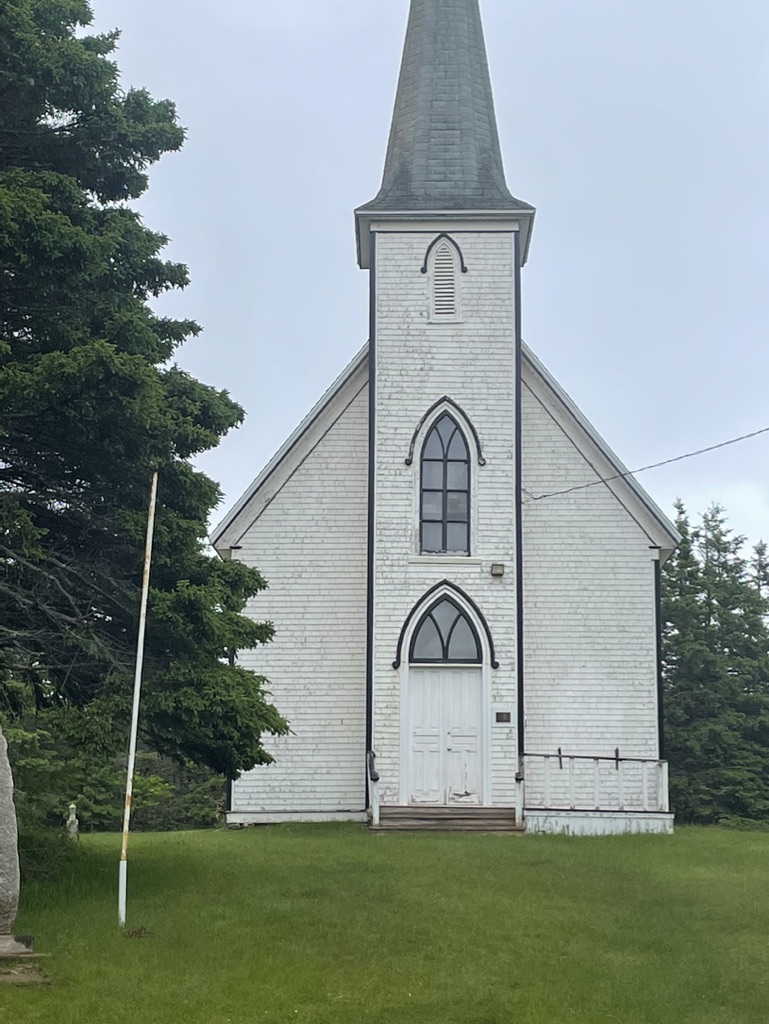
PEI’s Island Walk Part 1 – Charlottetown to Summerside

Blog posts are a labour of love for me, and yet there is a cost to running this site and organizing my walks.If you’d like to help with that, I’d really appreciate something for my tip jar.The Buy Me a Coffee service allows patrons like you to fund writers like me.  If that sounds like a worthy idea to you, then go ahead – keep buying me coffees.Thank You Very Much to everyone who has contributed already!

*****

In June 2022, I completed the 700 km Island Walk, around Prince Edward Island. You can read about that walk over several posts, starting with this one.  

This was before Hurricane Fiona caused so much damage on the Island, impacting many of the places I visited.  Some of what I describe below may have changed by the time you do the Island Walk, but please, don’t let that stop you.  PEI needs your tourist support as it recovers.

This post is about days 1-3 of my journey, between Charlottetown and Summerside.  The links below have the details from the Island Walk website for the Sections that I covered during this part of my journey.

Screen capture from the Island Walk website – copyright OpenStreetMap

Note, by the way, that the section #s on the official website are somewhat confusingly labelled. They are based on each finish point, and since the overall walk start point is also the overall finish point, the 1st section is labelled as “32-1” with its accompanying web page titled as Section 32 (because it starts at the end of the last section, which is section 32) and goes to the end of section 1; thus the 2nd section is labelled as “1-2” and its webpage is titled Section 1, and so on. 

That said, the links below reflect the sections as I walked them.

I highly recommend that you use the Island Walk website and its directions for the details of the official route, since that route can change from time to time such as for detours around major road works.  I also encourage you to use the official route and its sections as a starting point.  Find your own pace, detour as and when your fancy takes you, walk the sections in whatever order seems sensible, and remember – everybody walks their own camino.

If you are planning on doing the walk in chunks spread over several months or years, this portion is a good intro to the route and the island.


Beginnings

That first morning dawned a bit chilly with low grey skies and a breeze.  I was fidgety and nervously eager to get started, and had to force myself to take a minute and check my pack again, even though I’d gone over it twice the night before.  One cup of coffee, a bite of toast, a banana.  Time to go.

My original plan had been to travel from bed to bed each day, as you would on the Camino de Santiago, so that every day I’d carry all my clothes, toiletries, electronics, and some snacks and food with me.  That approach changed as I delved into the planning and realized that it was impractical to walk from accommodation to accommodation – in some stretches I’d have to do 40km or more, and deviate by several km from the route to find a place.  As a result, I settled onto the idea that I’d base myself in several places for a few days at a time, and find transportation to take me to/from the trail each day.  (See this post for details of my plans and gear choices).

So come that first morning, even though my wife Ann was still in PEI with the car and was travelling to our next accommodations in Summerside, I still chose to take all my clothes and gear with me that first day, just as a kind of penance for my original sin of mis-planning.  That meant that my pack was pretty heavy for a day hike – about 11 kg.  And since it was a cool morning, I was wearing a couple of warm layers.  

I felt over-dressed and over-burdened as we walked together, a few blocks from the place we’d stayed at in Charlottetown over to Joe Ghiz park where the route starts.  This wasn’t an Everest expedition but that’s how I felt.  We didn’t say much.  We reached the park, and then with little ceremony, Ann quickly took a couple of pictures, we hugged, and I was off.

In hindsight, that first hour, first morning, first day weren’t typical – I hadn’t yet found my routine.  I fiddled with the shoulder and waist belt straps on the pack, trying to get it sitting just right on my back and shoulders and hips.  I put on clothing layers and took them off.  I started out with walking poles and then put them away.  I was hungry but undecided about whether to stop and eat or just get going to let a rhythm build.

So I focused on walking.  The 1st Section of the Walk starts at km 0 of the Confederation Trail in Joe Ghiz park, so the first couple of kilometres are along the Trail as you head north out of the city before turning west.  This Section is “mostly a road walk with some great views of North River in Charlottetown and the Elliot River in Dunedin”, according to the Island Walk website.

And so I found it.  Charlottetown does have some lovely quiet streets in its downtown, but a quick walk through them reminded me of an old joke I’d heard in England, about something being small but perfectly formed.  Practlcally all of the downtown area (and there’s barely an uptown let alone a midtown) is within earshot of the bells of St Dunstan’s Basilica Cathedral.  Joe Ghiz park is just a few blocks from the city’s centre, but it’s already on the outskirts of the downtown core in an area that at one point was obviously full of warehouses and manufacturing – hence a rail line, which is now the route of the Confederation Trail.  All of that means that your initial sights on the Walk are urban/industrial, but you don’t mind because you’re Walking the Island Walk and eager to get going.

And in truth, the Trail is a good way to start the Walk since you’re away from traffic and there are benches and picnic tables where you can stop if needed, as I did with my adjusting and fiddling.  And then, after only a few km, you realize that you’re already on the outskirts of Charlottetown, near the University of PEI, and there are farms on one side of the trail and big box retailers on the other. 

Quite soon, you leave the Confederation Trail and the road-walking starts, because in order to get out of the city you have to cross some rivers, which are bridged by busy streets and highways. In fact, I followed the same route outbound along Capital Drive that we’d driven into the city, past the same fast food restaurants and strip malls, none of which was any more interesting at foot speed in walking than it was at road speed in driving.  At a busy roundabout, Capital Drive turns into PEI Highway 1, the Trans-Canada Hwy, and you follow that for a couple of km.  You do pass the big Cow Creamery shop just out of town, if that’s your thing, but it had started to drizzle so that first day it wasn’t mine.

It was only once I’d clicked off perhaps 10km of the route, having left Charlottetown behind and reached the outskirts of the nearby town of Cornwall, that I left the Trans-Canada highway behind and started onto the secondary roads, to finally get into the countryside.

But having reached rural PEI after a couple of hours of walking, my bladder was nudging me and my stomach was agreeing.  Looking around, I thought it would be completely appropriate to make my first rest stop at a Tim Hortons – Canadian roads from coast to coast to coast are practically paved with Timbits.  

But, ironically, that turned out to be the only Tim’s stop I made on the entire walk, which in retrospect still surprises me.  

I had assumed before the walk that PEI was covered with Tim’s locations just like the rest of Canada.  I hadn’t accounted for two things, however.  One is the relatively low population of PEI, which can only support so many coffee and donut shops, so those that exist are on the main highways outside a handful of largish towns, places which are often bypassed by the Walk route.  The other is that Islanders divide their loyalties between Tims, the rival Robin’s Donuts chain, and the many ice cream stands on the island.  

What I also learned, as the walk progressed, is that the low population density, concentrated as it is in places like Charlottetown, Summerside, Souris, and Montague, means that things like diners, coffee shops, cafes, and corner stores are often non-existant along the Walk route.

But that lesson was in the future – here I just wanted my medium dark roast double/double with milk, a breakfast wrap, and a bio break.  And after I’d sat for a short rest, and asked the staff to fill my water bottle (another first time for something on that first day), and wondered why no one was looking at the weird guy with a backpack and walking poles because I secretly hoped that I could tell crowds of awed listeners about my Big Adventure, I hoisted my gear and got going again.

Continuing that first day, heading south and west along secondary roads into gently rolling farming country that’s only 10 km from downtown Charlottetown as the crow flies but which feels like it’s much further, I was taken by the quiet.  I’d lived for 40 years in big cities, and I still associated walks with city soundscapes and background noises.  Here, there was little road traffic, nor many people about.  I barely heard a dog bark.  Just the measured click of walking poles, the clip of boots on pavement, and the susurration of breeze-stirred leaves.  I did notice the crows, though – noisy buggers.  All, in hindsight, a foretaste of things to come, had I known it.

I reached the end of Section 32-1 at a crossroads near the hamlet of Dunedin.  I was disappointed when I got there, expecting some sort of prominent landmark and in fact seeing nothing but more farms and fields, with just the Island Walk marker next to a stop sign to tell me I’d reached the end of this first Section.  It was mid-afternoon, and looking around, I confirmed that, yep, quiet, green, crows – all good. 

In planning the trip, I had broken it up into walk stages of approximately 30 km each because I had a goal of finishing in about 23 days instead of the suggested 32.  So, because Section 32-1 is only about 21 km long, I continued walking.  Section 1-2 of the Island Walk includes “lots of walking on red dirt roads with a canopy of trees overhead. Two of the nicest quiet dirt roads on PEI – Rebokary Lane and Ferguson Rd”, says the guide.  

And that’s what I found at first – this Section brings you into the “real” rural PEI, as the route initially follows paved secondary highways and then the first of the many dirt roads I would follow over the Walk, up low hills and past sunken lanes and hedgerows and roadside bushes and freshly tilled fields.  Again, though, a bit of a disappointment – “nicest red dirt roads”?  Yeah, they’re red and they’re dirt and they’re roads, but that’s it? Just red, dirt, roads?  I was underwhelmed at the time, but I later came to rather like these modest, unassuming yet iconic PEI byways.

Still, it was here that I noticed something that was to become a pet peeve as the Walk progressed.  I was getting tired, at this point about 6 hours into my first day, and I really needed a pee.  No gas stations, community centres, or other signs of civilization were to hand, and since I was on a dirt road, in the middle of seemingly nowhere, I reckoned I could be a country boy and duck behind a tree. 

That solved the immediate problem, but while I needed a rest, I didn’t want to sit on the wet dirt – oh for a park bench or a convenient set of church steps – so I just shrugged off my pack for a few minutes while I stood under a tree and sipped some water.  After that less-than-refreshing break, I glanced at my watch, mindful of the pick-up time I’d arranged with Ann, slung my pack again – which someone had filled with rocks, clearly – onto shoulders that I knew would show bruises later that evening, and cursed the stiffness in my hips and knees.  “So you wanted to walk around PEI, huh?  Move it, slow poke.”  The first self pep talk.

Plodding on, southwesterly, I reached the end of the dirt road and merged onto the paved Route 19 highway that runs along the Argyle Shore.  I could feel the hot spots on my feet turning into blisters as I walked, but I was damned if I was going to text Ann for an early pick-up.  That first day was ending with what was the first of many end-of-day, put-your-head-down-and-just-get-on-with-it trudges, west along Route 19 for several more km.

My target was the Argyle Shore Provincial Park as a pick-up point.  Looking ahead, I could see the road climbing a gentle hill and I’d think, ok, last one, and then I’d crest it and stride down and and then look up to see another one, and each seemed to get longer and longer and steeper and steeper.  The sun had come out and there were some nice views out over the blue-green waters of the Northumberland Strait, looking charming and calm, and I could see the Nova Scotia coastline just across the water.  Home, I thought.  Just over there.  

And then I looked up with about 500 m to go and saw my wife walking towards me, down a gentle slope, to escort me for the last few minutes of my first day.  “How are you feeling?”  “Tired”.  I slumped into the car when we got to it.  

It took about 15-20 minutes to drive into Summerside where we were staying, and by the time we got to our AirBnB, I could hardly get out of the car, the muscles in my legs having stiffened and the blisters on my feet ballooned.  After hobbling into the house, it took a desperately needed mug of strong sweet tea, a long hot shower, and a restorative glass of wine before I could look at my feet.  Ugly puffy blisters greeted me from the bottoms of several toes on both feet along with the side of my left foot.  I took out my first aid kit, extracted some alcohol swabs, blister bandages, and antiseptic cream, and reached for my Swiss Army knife.  Ann looked on with disgusted interest.  “Eeewww”.

An appropriate word for Day 1.  It had proven to be more challenging than I had expected.  The low rolling countryside, up and down crossing ravines and small river valleys, had been unexpected – PEI is flat, right?  I was surprised to see the stair count on my exercise tracker – so much for my assumptions of an easy walk.

The Argyle Shore

Rolling out of bed the next morning was easy, as I’d slept like a log.  Standing up was the hard part.  The popped blisters covered in bandages and moleskin didn’t bother me so much as the stiffness in my legs and back.  I hobbled about for 15 minutes making coffee and a light breakfast, then gathering snacks, assembling sandwiches, filling water bottles, grabbing a spare shirt and pair of socks, and tucking everything into my pack.  I was ready to go by 8:00.

Ann drove me back to Argyle Shore Provincial Park, and I got out of the car feeling reluctence at the prospect of doing it all over again, competing with eagerness at the same time.  But the sun was out, and while the westerly breeze had a bite to it, it seemed a fine morning to put on sun glasses, snug on my broad-brimmed hat, and shoulder my pack.  

My goal that day was to finish the 2nd half of Section 2, which ends at Victoria-by-the-Sea, as well as then completing Section 3 of the route, which ends at Borden-Carlton.  Altogether, that meant about a 32 km day.  

I continued following Route 19 for several km to De Sable, and it took all of that to work out the kinks in my legs and feet.  Or more precisely, to walk myself into a rhythm where I didn’t notice my feet.  By the time I crossed the Trans-Canada Hwy to continue northwest on secondary and dirt roads, I was feeling relaxed and back into my mental walking zone, letting random thoughts play along with snippets of songs, tuning back into my surroundings occasionally to listen to the wind in the trees or inhale the rich earth loaming smells of the fields. 

The route here along the Argyle Shore is relatively quiet, and compared to the northern shore up around Cavendish and the Prince Edward Island National Park, it’s relatively under-touristed.  The day trippers go north from Charlottetown, so it’s the long term tourists who park their RVs here or rent seasonal cottages in places like the Argyle Shore.  I passed several such sites, some with enviable views – since the road is set back from the shore by a km or two, the land between the road and the shore is privately owned and these campsites and cottage clusters get the seaside at first hand.  And since it was very early in the season for tourists – the Provincial Park hadn’t even opened yet – there were few other people around.  No walkers, no cyclists in view, and barely a vehicle.

There are spots here on the route where you climb a bit, and can look back south across the Northumberland Strait, and the air that morning was sharply clear (I’d even call it a bit crisp with the chilly breeze).  For the most part, the scenery was of farms and fields, holiday homes down private lanes, small patches of forest, and modest houses.  Only a few barking dogs.  And crows – PEI seems to have 10 times more crows than people.  They caw, the sound I recognized, and they cry with screeching-baby like sounds that I hadn’t heard before, and the thought occurred that this was the reason why the collective noun is of a murder of crows.

Sections 2 and 3 are all road-walking, west along Route 19 and then north up Route 116 into some hills, west and then south along red dirt roads, and back onto Route 116 south, crossing the Trans-Canada again and heading for the shore, and then turning west along a causeway into Victoria-by-the-Sea – the terminus of Section 2. By this point, the breeze had freshened into a proper stiff headwind, a light gale even, so that I had to lean into it and hold onto my hat.  Later in the walk, I would come to appreciate any breeze as a mosquito defence, but that morning it felt like a fight with the stubborn westerly wind.

I took a break in Victoria, walking out along the wharf, 

to stop for a late breakfast at a place out called Casa Mia. It was a nice stop, with a delicious omelette and friendly service.  The restaurant’s views over the water were lovely.  My planned 30 minute stop turned into 55 minutes, and it was a challenge to get up from the table and head back out just after mid-day, but I wanted to finish the 20 km of Section 3 that day by reaching Borden-Carlton by about 4:00 pm.

The Island Walk website says that Section 3 “starts with dirt road walking and then some road walking with a great view of the Confederation bridge”.  Except that it’s more of a graveled road rather than a red dirt road, which granted isn’t paved but it is less pleasant to walk on gravel than packed red dirt – the stones can shift a bit under your feet so it takes more concentration.  After a few km on this gravel road, I joined the bigger Route 10 highway, following it west for the rest of the day along the shore, through Augustine Cove to Cape Traverse.  There were some glimpses of the Confederation Bridge, and as it slowly grew larger I knew I was making progress towards my goal for the day.

I was back into my walking rhythm after the break at lunchtime, and I was getting my pace figured out.  If I sang Old MacDonald Had a Farm to myself at a moderate galloping beat, then that gave me a steady 5 to 5.5 km per hour pace.  Over time, I tried other tunes.  Little snippets of The Lion Sleeps Tonight or Sudbury Saturday Night.  That helped, but when a song gets stuck in your head as you walk, it’s maddening, so I found myself looking around for some arresting sight to break my train of thought and change the music.

By mid-afternoon that day, I was learning that road-walking has its own challenges.  Uneven shoulders scattered with chunks of pavement.  Too many glimpses of roadside trash.  And, worst of all, no place to sit and rest, no place for a pee.  My habit on long walks, usually, is to take breaks every 90 to 120 minutes, and that was proving to be difficult here, unless I simply stopped by the side of the road and stood there with my pack off while having a drink.  I did find a field with a small grove of bushes that screened me from the road, and had a bio break there.  But places to sit were hard to find.  And my feet were barking again, the blister bandages having rubbed off and balled up in my socks.  

With steady walking, the distance to Borden-Carlton gradually shrank.  15 km to go.  10 km, then 5.  The sun swung past its zenith and headed west to shine back into my face.  At two pm, I checked the map to see where I was.  At three, I looked again – closer but getting there by 4 was looking tough.  And then, as I walked I told myself that it’s a marathon, not a sprint.  Let your body tell you when to stop, so I did, a bit short of my end-of-day target of Borden-Carlton to complete Section 3, and instead texted Ann to pick me up about 3 km early, at Cape Traverse.

Summerside was closer, but still far enough away for my legs to stiffen up in the car again, and the hobble into the house must have had the neighbours wondering about the cranky old guy who was vacationing there.  After my new daily ritual of a strong, sweet mug of tea and a hot shower, I confirmed what I had suspected, that my old blisters had new ones, and got out the first aid kit again.  After dinner, I read for a bit, and dozed while I did so.  The exercise and fresh air had tired me right out, so it was an early night.

Onwards to Summerside

That 3rd morning was the last time that my wife would be with me for a while on this trip, until the latter half of my journey.  It was bittersweet to give her a hug that morning when she dropped me off in Cape Traverse, before she headed home to Lunenburg.  I was still ramping up, learning and slowly getting fitter, and I was becoming more inwardly focused as I locked onto my goal.  At the same time, a friend to talk to each evening is a good way to unwind, and now I’d be on my own for a bit.

But it was good sunny, breezy, warm-but-not-hot walking weather, and I felt rested and ready, as I set out along Route 10, watching as the car disappeared into the distance,  The rural character of PEI is strong in this area, along the Northumberland Strait – farms, some views of the sea, farms, more views of the sea, occasional glimpses of the Confederation Bridge, and so on to, through, and past Borden-Carlton to finish Section 3 within my first hour of the day, and then across the Trans-Canada Hwy in Borden-Carlton where I onto start Section 4 along Route 10 towards Summerside.  

The Island Walk website stated that in this Section I would “walk by farms and fields and through small communities, including Central Bedeque. Busy road entrance to Summerside (8 km), then a peaceful walk on the Confederation Trail right through the city.”

And for the most part, that’s accurate.  This part of the route follows Route 10 for about 10 km, and about 5 km out of Borden-Carten I stopped at a church that had a picnic table out front, for a short rest and a water break.  Getting up to leave, I had a chat with the woman who looked after the church, who came out to see who this strange person was. She asked where I was walking, and I explained about the Island Walk.  She was quite interested, and wished me well, the first of many friendly people I met on my walk.  It was only later that I realized that in more than 2 days of walking to that point, I’d yet to meet another walker or a friendly local.

After that welcome break, I continued west towards Central Bedeque, where I stopped at a great little place called Baba’s Kitchen for lunch.  

I walked in to find a queue of people lined up to place their orders, and several of the ladies in line saw my pack and asked where I was walking.  It turned out that they were a group of quilters from all around the maritimes, in PEI for a quilting weekend.  As we chatted, they asked where I was from – Lunenburg, I said.  Oh, you have to meet so-and-so in our group, she’s from Lunenburg.  And so I met Lynne, with whom I had a great chat.  It turned out that she lived only about a kilometer from me, a nice little small-world moment.

After a very tasty sandwich and a coffee, I continued on my way.  Outside Central Bedeque, the route joins and follows the Trans-Canada Highway (the “busy road entrance to Summerside (8 km)” part), and as I walked along I heard a series of cheerful car horn toots, as each of the quilters I’d met passed me – thank you ladies, that put a huge grin on my face.  

But soon after that, I realized that I didn’t much fancy walking all the way to Summerside along the busy and noisy Trans-Canada Highway with its trucks and cars.  Instead I detoured, and followed empty sun-bathed secondary roads north to Wilmot Valley, where I joined the Confederation Trail at Travelers Rest about 5 km outside of Summerside.  

That detour was pleasant enough, and it did get me to the end of Section 4 in downtown Summerside via the Confederation Trail, 

just as the official route would have, but it was at the cost of walking an extra 8-9 km that day.  My planned short day had ended up being longer than I’d thought and I was ready for a rest by the time I reached my accommodations in Summerside.  Lesson learned – stay on the route.

I did notice, though, that as you get closer to Summerside, you start to shed some of the ruralness I’d walked through earlier.  Summerside is the biggest community on the island outside of Charlottetown, and you pass ice cream joints, antique shops, and other seaside resort town things as you get closer to the town.  Then, somewhat suddenly as you join the Confederation Trail for the last bit into town, your walk goes back to being quiet and shady and green – quite a contrast after the busy stretch of the Trans-Canada, and a welcome change at that.

It also struck me that Summerside is a community that can’t make up its mind as to whether it’s a seaside resort town or a service and light industry town.  There’s a big Canada Revenue Agency office here, and a former air force base, along with a great boardwalk by the sea and yet more ice cream places.  It’s clearly a service town, but it has these seaside touches too.  All in all, however, I couldn’t quite like it – it felt sprawly and tawdry in places, missing those lovely wooden houses you see in other parts of the province.

And so I finished the first part of my walk.  Three days to get into the rhythm of it with help and support from my wife.  The next couple of stretches would be solo.  I was looking forward to them.

Day 1 Summary – Charlottetown to Argyle Shore

  • Pretty good day for walking – a bit overcast with a few showers in the morning, then sun all afternoon.  Cool for June, about 6C in the morning, and quite breezy.
  • Completed all of Section 1 (21 km from Charlottetown to Dunedin) and roughly half of Section 2 (which in total is 24 km from Dunedin to Victoria-by-the-Sea).  
  • Daily GPS distance = about 30 km, elapsed time almost 7 hours
  • Fitbit daily stats = 31.4 km, 42,100 steps, 395 exercise minutes, 154 flights of stairs

Day 2 Summary – Argyle Shore to Cape Traverse

  • Good weather, lots of sun, though coolish temps and strong breezes that kept me in a windbreaker all day
  • Completed the rest of section 2 from Argyle Shore Provincial Park to Victoria-by-the-Sea and then walked almost all of Section 3 (which is 20 km in total from Victoria-by-the-Sea to Borden-Carlton)
  • GPS measured distance = about 28 km, elapsed time just under 7 hours
  • Fitbit daily stats = 30 km walked, 40,200 steps, 367 exercise minutes, 97 flights of stairs

Day 3 Summary – Cape Traverse to Summerside 

  • Another great walking day, sunny, breezy, and warmer so I could finally get down to shirtsleeves
  • Completed the remaining few km of Section 3 from where I had left off at Cape Traverse to Borden-Carlton, and then more or less did Section 4 (21 km from Borden-Carlton to Summerside), though I deviated from the official route entering Summerside
  • GPS measured distance = about 30 km walked, elapsed time just over 8 hours
  • Fitbit daily stats = 31.8 km, 42,600 steps, 400 exercise minutes, 47 flights of stairs

Suggestions

Cornwall, Victoria-by-the-Sea, and Borden-Carlton between them have several options for accommodation and dining, and the larger communities of Charlottetown and Summerside that book-end this portion of the Walk have many such options.  That said, it’s still tricky to walk from accommodation to accommodation in this area – the end of Section 1 is out in the middle of the countryside though there is one B&B I saw about 500m from that point.  After that, though, Sections 2, 3, and 4 all end in towns where you can find lodging.  I’d strongly recommend booking ahead, especially in high season.

If, like me, you base yourself in a place like Summerside for a few days while you do this part of the walk, and if you don’t have a spouse or partner with you who can drive you to/from the route each day, then you’ll need to plan transportation options.  Summerside has a couple of taxi companies that cover most of the west end of the island – they will run you all the way out to North Cape if you want.  That can be expensive, however – expect rates in the region of $2 per km.  

Other transportation options exist.  There are some tour operators who will provide rides.  There is also the T3 bus network, which can get you to/from some of the points on the Island Walk route.  Check their website for full schedule info.

As for sustenance, in these first sections it’s possible to find a lunch spot each day, at Cornwall, De Sable, Victoria, Borden-Carlton, and Central Bedeque.  Nevertheless, I would recommend taking some snacks, and you’ll need water.  I was able to fill water bottles at the places I stopped at for lunch.

Bio pit stops are another matter.  All that road walking means that if you need to pee, you’re either sneaking into the bushes by the side of the road, or holding on till you reach a gas station (and there aren’t a lot of those along these roads).

I did notice a number of churches along more major roads like Route 19 and Route 10, as well as a few community centres and museums, and I learned as I progressed over the rest of the Walk to look out for these types of places, because they often provided a restful sit-down on a bench or some steps.  Outside of that, however, there are few other rest options on the road sections, unless you are comfortable just flopping on the ground.

Next – Summerside to Tignish


Other Posts About this Journey


If you feel like supporting my blog, you can buy me a coffee.
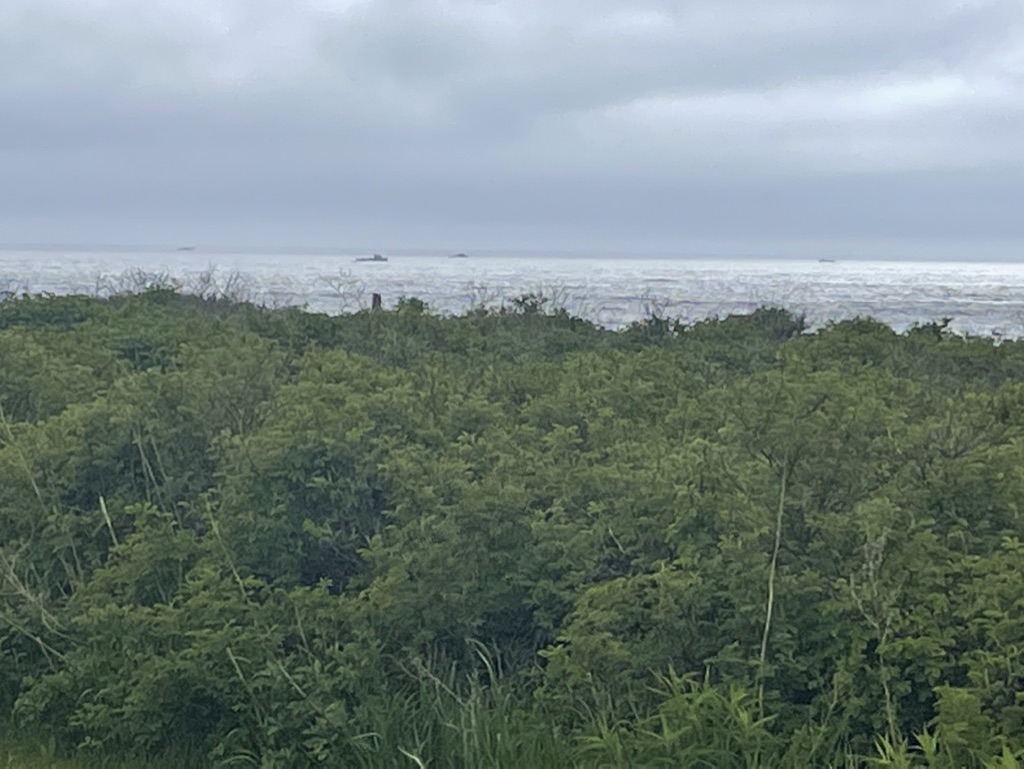
PEI’s Island Walk – Plans, Gear, and Lessons

Blog posts are a labour of love for me, and yet there is a cost to running this site and organizing my walks.If you’d like to help with that, I’d really appreciate something for my tip jar.The Buy Me a Coffee service allows patrons like you to fund writers like me.  If that sounds like a worthy idea to you, then go ahead – keep buying me coffees.Thank You Very Much to everyone who has contributed already!

*****

In June 2022, I completed the 700 km Island Walk, around Prince Edward Island. You can read about that walk over several posts, starting with this one.  

This was before Hurricane Fiona caused so much damage on the Island, impacting many of the places which I had visited.  Some of what I describe below may have changed by the time you do the Island Walk, but please, don’t let that stop you.  PEI needs your tourist support as it recovers.

This post is about how I planned the walk, deciding on things like the pace to follow and gear to use; where I stayed and how I found accommodations; how I worked out logistics like getting to and from the route each day; and what lessons I learned along the way.

Forgive the wordiness and lack of pics – this is full geek mode for me.


Research

Once I’d decided to do it, I fell into my project planner mode, and started to figure out how I was going to walk it. How many days to take? Follow the route closely or ad lib in parts? What to take, and what to carry? Where to stay?

One of the good things about the Island Walk is that the PEI government has adopted it under its tourism umbrella, so the route signage is pretty good. The official website has a good map, and you can download to print out the route directions stage by stage if you want. 

As well, the route has been added to map sets like Open Hiking and the Back Roads Map Books Canada Trails, which smart phone apps such as AllTrails or GaiaGPS can use. I used GaiaGPS on my walk, with a premium subscription so that I could trace my route and add waypoints. I did that in advance of the walk, to have markers show up for each of the 32 suggested stage end points as well as for each 30 km of the Walk.

There are other sources too.  For example, the Island Walk website will point you to the official guide book which you can order online. I didn’t bother with it, to be honest, but it’s there. A few hours of Googlewhacking found several blog posts, Facebook pages, and YouTube videos about the walk, including one by the original founder of it, Brian Guptil, and I am sure that since I looked in the spring of 2022, there have been more posted.

There’s also an official Facebook page that’s linked to the Island Walk website, and that has a private message blog for which you’ll need to request access. That official blog is handy, because it lets you pose questions to other walkers and get advice on things like places to stay or eat, or transportation options.

Plans

While doing my research, I quickly determined that I wanted to do the walk in less than the suggested 32 days, partly to save money on accommodation and partly because I just didn’t want to be away from home that long. The stages as marked on the suggested route are mostly between 20-25 km, and I knew from experience that I could handle as many as 35 km in a day, so that led me to aim, initially, for about 30 km per day so that I could finish in about 23-24 days. 

Based on that idea, and the notion that I’d walk from accommodation to accommodation each night (see the section below), I created a walking plan where each daily stage targeted about 30 km of the route, plus whatever distance I’d need to walk to/from accommodation each day.  I used Google Maps to trace the route and scoured for places to stay – hotels, B&Bs, holiday cottages, and camp sites.  I reckoned that I could take camping gear with me and use that for some of the nights.  

The result was a plan that did get me round the Island in about 23 days, but which didn’t look very appealing.  There were a number of pretty long days, approaching 40 km when I took the walk to/from accommodation into account.  Also, in some cases there was only one B&B or holiday resort that would work given the stage lengths, but I was planning to do this starting in late May, and some of these didn’t open for the season till mid-June. 

So Plan #1 went out the window.

For Plan #2, I went back to the drawing board.  After more research, I saw that people on the Island Walk Blog were talking about using some of the towns as a base for several days, and arranging transport to/from there.  That sounded like a better idea, so taking into account that the town I chose as a base had to be on the route and have some grocery stores and shops, I decided to use Summerside, Tignish, Kensington, and Murray Harbour as my bases.  I rejgged my planned stages and was able to reduce the daily walking average to about 30 km, since with pickups and dropoffs I could stick closely to the route.  That would get me to the finish in 23 days.

After talking it over with my wife, we also decided that she would join me for the 2nd half of the walk, so that she could explore the Island herself while schlepping me to and from the route each day.  She had initially planned to be with me for the first couple of days anyway, so that gave me transport coverage for about 18 days out of the 23.  Given that I could start or end a few stages in my base town, I assumed I would only need transport help for a few days.

Plan #2 survived the start of the walk, but hit a wall on Day 6.

I was slogging and foot sore, and everything felt like a grind, as I struggled up the west coast of the Island towards Tignish.  I managed 20 odd km that day of a planned 32, and took a rest stop at Mimnigash, and then I basically couldn’t get up.  After 30 minutes of self-pep-talk, followed by 30 more of now-what mental meanderings, I called my ride in Tignish and asked to be picked up early.  

When I got settled into my hotel that afternoon, I called my wife and we talked through where I was at.  I listened to her chuckling, as she said she had been wondering when I’d realize that 23 days was too short, and we agreed to lengthen the trip.

Looking at the official stages, I realized that I’d ended my Day 6 at the end of Stage 8, at Mimnigash.  That put me 2 days ahead of the official 32 schedule already.  To finish in 27 or 28 days, I just needed to pick up another 2-3 days over the rest of the walk, which I reckoned I could do by adding a couple of km per day to each of the remaining official stages.  That approach allowed me to reduce my planned daily walk length from an average of about 30 km down to about 25-27 km per day, while increasing the duration to about 27 days in total.  This became Plan #3. 

In order to make this plan work, I needed to adjust my accommodation bookings.  I had a place lined up in Kensington, and they were able to move my dates by a day, so that worked out.  After that, however, I wasn’t sure where to go.  B&Bs and AirBnBs were filling up fast, and were getting more expensive with the high season starting.  Plus there was a festival of some kind in Charlottetown for the weekend I planned to finish, June 26-27, and hotels there were sold out.

Thus Plan #3 quickly evolved into Plan # 4, as I ended up booking a place in Murray Harbour, and then a final one in Vernon Bridge.  This changed my stage plans, and I added one more day, so that I’d finish in 28 days.  My daily average distance dropped a smidge more, and more importantly, things now looked doable.

And so parts of Plan #2 combined with Plan #4 became my actual as-walked plan.  I ended up averaging 25.5 km per day, with a longest day of 34 km, and a shortest of 15 km.  I started on Wednesday, June 1, and finished on Monday, June 28.

With all of that learned, my advice on Planning is simple – you should make one based on as much research as you have time for, and then you should expect and allow it to evolve as circumstances change.  If I had tried to stick rigidly to my original plan, I wouldn’t have enjoyed the walk as much because I would have been more tired and possibly would have injured myself in pushing too much.   

Routes

While I may have adjusted my plans a few times, in the end I did follow the official route quite closely in terms of the roads and trails followed, only deviating a bit around Summerside. I also had a few days where I walked the described route for a stage, and then added several km to it in order to get to/from that day’s accommodation.  This added a few km to the overall total distance walked – it came to about 718 km compared to the official route length of 690 km, making my overall daily average of actual walking come to about 26.6 km.

Also, you will find that for the most part, the whole of the route is sign-posted quite well, with directional signs telling you when to turn onto this road or that.  

The signs are placed with the assumption that you are walking correctly, and safely, facing oncoming traffic, i.e you are on the left side of the road with cars on your right.  They are generally on the right side of the road – that is, on the opposite side of the one you should be walking on.

The signs are only on one side of the road, so this sign-posting practice also assumes that you are going clockwise round the island, following the sections from 1 to 32 in order (i.e start in Charlottetown, head to west Summerside, then north Tignish, etc).  If you do the route the other way round, or a la carte in chunks, you may have to look over your shoulder for the signs.

There were a few places where I could have added a short detour to my day, to take in a place of interest.  The official stage descriptions point out these sorts of things.  For me, generally speaking, I didn’t do that.  The only exception was the walk through Prince Edward Island National Park up around Cavendish and into North Rustico.  There the official route follows the park walking/cycling trail, which is inland a bit beside the road.  Instead, I cut down onto the beach and walked along it parallel to the road.  It didn’t really change the distance but it was far more satisfying.

Over the course of my walk, I got into the habit each night of reviewing each day’s route as-walked, marking where I finished using my map app, and then scouting the next day’s route using Google Maps in satellite view to get a sense of the directions, sights, and possible rest stop options along the way.  This became quite handy, particularly on road sections, as I quickly learned that finding a comfy spot to sit and rest was a challenge. 

Later in the walk, when my wife joined me in PEI and drove me to/from the walk every day, using the map app and Google Maps also let me geomark the next day’s start and end points, and put those into my wife’s phone, so that she could just follow the directions in the car.   

Accommodation

As you can see based on how my planning evolved, finding accommodation drove it as much as the route itself.  While the Island Walk is referred to in some places as a “Camino” like walk, the reality is that it would be quite difficult to do it in the manner of the Camino de Santiago.  You simply can’t walk from accommodation to accommodation expecting to find an inn or hostel or B&B more or less on the route every 5-10 km.  The tourist accommodation on the island is concentrated in a few places (Charlottetown, Summerside, the Cavendish area, the Stanhope area, etc.), which leaves long sections at the west and east ends of the Island where there aren’t any B&Bs or hotels conveniently near the route. 

It’s also important to realize when planning your accommodation that PEI has a short but intense tourist season.  Many places only open after about mid-May or Victoria Day weekend (3rd Monday in May), and shut not long after Labour Day (first Monday in September) or at latest Thanksgiving (2nd Monday in October).  But July and August are peak tourist – the island’s population doubles or even triples in these months.  That leaves narrow 4-week shoulder seasons in June and in September, which can work as I found in June.  

So all of that said, if you make your plans well in advance, e.g. in January for a walk in June or July, then you probably could book things out so that you could walk more or less from place to place, as long as you accept that you’re going to have more than a few days where you’ll need a lift as well as some extra distances to/from the route.

An alternative to that is to try to camp your way round the Island.  There are some provincial parks that offer campsites as well as several private campgrounds, relatively near the route.  In a few cases these align with the suggested stages, but for the most part they don’t, so you’ll have to improvise your stage lengths as needed.  Even then, there aren’t formal campgrounds near the route in all cases. 

For example, walking the Confederation Trail between St. Peter and North Lake covers more than 50 km, with essentially no nearby campsites.  You could try knocking on doors and asking if you can camp in a field, and Islanders being pretty hospitable, you might be able to make that work.  I wouldn’t try to stealth camp, though.  There is essentially no crown land along the route, so if you try to stealth camp you’ll be trespassing on private land and that’s not just illegal, it’s downright rude.  

By the way, another thing I learned in my research is that while there are many cottages for rent on the island, many of them are in holiday resorts where they only rent by the week.  It was frustrating because some of these were right on the route, but since I only needed one night I couldn’t use them.

All of this is a long-winded way of explaining why I ended up replanning a couple of times and settling on a base-accommodation approach.  In the end, I spent 5 nights in Summerside, 4 nights in Tignish, 6 nights in Kensington, 11 nights in Murrary Harbour, and finally 3 nights in Vernon Bridge.  These places were a mixture of AirBnBs and inns.  Since I had left it late, I had trouble finding AirBnBs around Montague and around Souris, which would have been a lot more convenient for the east end of the island than Murray Harbour, but on the other hand the place in Murray Harbour was great.  If you book a few months ahead of time, and if you avoid peak season in July/August, you should be fine finding something.

Practicalities and Logistics

I met just a few fellow walkers on the trip, but in chatting with those few people a consensus emerged on a few things to keep in mind when planning this walk.  In no particular order, I’d list them as follows.

  1. Road walks = no place to sit down, no place to pee
  2. Accommodation needs to be planned well ahead
  3. Since accommodation is likely to be spread out and not near the route, transportation to/from the route is key
  4. Timing is everything – you’ll have a short season to do the walk if you want things to be open but avoid the tourist crush

I think if I was going to do the walk again, I’d seriously consider packing a small portable stool or chair, which would be a blessing especially on the road walk sections.  There are many stretches where you’re multiple hours between towns.  Scouting each day’s route the night before using Google Maps in satellite mode helped me to spot community centres, public parks, churches, schools, post offices, and even cemeteries, where they might be a bench, as well as toilet facility candidates like gas stations, cafes, bakeries, and ice cream stands. 

This let me make notes for myself about distances between these landmarks, so that, for example I could start on a morning knowing that after about 8 km I’d come to a church where I could sit on the steps for a break.  Even then, I had a couple of frustrating days where I’d find the church I’d seen on the map but realize that it’s wooden steps had been removed because the church had been closed.  On a rainy day when you don’t want to sit on the ground, that’s a real pain.

For most people, the other key is that while you need to stay hydrated, doing so usually leads to the need for a bio break every so often.  If you are discreet and careful, you can sometimes find a conveniently located little stand of trees or bushes just off the road.  Nevertheless, it always seemed that I had been walking for hours without seeing a car and then the moment I stepped off the road, 3 of them would trundle past.  Or I’d walk along a promising stretch of road with houses on one side and fields on the other, only to realize that every stand of trees or bushes was exactly opposite someone’s house.  

I did meet one fellow walker who’s strategy was simply to walk fast, drink little, and hold it all in.  She would hydrate and pit stop before leaving, and then plow through each stage non-stop, only looking for a toilet when she had reached her destination at the end of a stage.  That might have worked for her, but it wouldn’t work for everyone, and it certainly didn’t work for me.  All I can say is that if you do need to “go”, al fresco, you need to be respectful of others and of private property and follow the backcountry rule – leave no trace.  

Since getting to/from the trail and your accommodation may well require transportation, you’ll have to figure this out ahead of time.  There are some options.  If you’re near Summerside or Charlottetown, there are several taxi firms that you can book and they’ll drive you for 50 km or even 100 km if you need it so that you can be dropped at the start of a stage and picked up at the end.  But that convenience  will be pricey – expect to pay up to $2 per km.

An alternative is the T3 bus network, and it’s a good option in some cases.  It’s very inexpensive at $2 per ride (as of June 2022).  It runs from several of the towns you’ll pass through, on routes that lead back to Charllottetown but pass through several places, e.g. the route between Summerside and Charlottetown passes through Kensington.  To use the service, you need to make a booking on their website, which can be same-day but is better done the night before. 

Through careful planning, you can arrange these rides to get from your accommodation to your drop-off and pick-up points.  The drawback is that the buses are on fixed schedules and run only 2-3 times a day, so there might be 4-5 hours between runs, thus you’ll have to time your walk to catch the bus.  And, at least as of June 2022, the buses only run Monday-Friday so on weekends you’ll have to find alternate methods.

One of those alternate methods is to do the Walk without walking – ride a bike instead.  I met several people who were doing the route this way.  By riding, they could not only go a bit faster and do the route more quickly, they could also find accommodation as much as 10 km off the route, and they could adjust their daily stage lengths to go from town to town.  The route is easy to cycle as the Confederation Trail is firmly gravelled, and the rest is on roads.  

If cycling is not your thing, and buses don’t work, nor taxis, then one other option is to find a sherpa – a person to drive you to/from the route each day.  This in turn takes several forms.

One is to use one of the private tour companies in PEI that have started to offer Island Walk packages combining accommodation arrangements as well as transportation, so that your luggage is schlepped for you and they take you from B&B to B&B.  You can find outfits that do this by doing some research on the blog that goes with the Island Walk website.

A similar idea is to stay at one of several resorts, inns, and B&Bs which offer transportation to/from the route.  You can usually book this at the time you book the accommodation.  As the Island Walk becomes more popular, I suspect that this type of thing will grow.  You can find these kinds of places by doing some research on the blog that goes with the Island Walk website.

One method I used was to ask for advice at one of the inns I stayed at, and they pointed me to a private tour operator named Stanley MacDonald.  He runs custom small-group tours for cruise ship passengers coming into Charlottetown, and in between he’s happy to pick up Island Walkers like me and take them to/from anywhere on the island.  There are several operators like this, and again, using the Island Walk blog can help you connect with them.

Finally, there’s the Little-Help-From-Your-Friends approach.  In my case, my wife stayed with me for about half of the time I was doing the walk.  She would drive me each day to/from my route, and in between she explored the island, visiting museums and shops and beaches and cafes and just generally chilling.  Similarly, you could also walk with a buddy or two, and use two cars where you both drive to the endpoint to leave a car, then drive back to the start and park the other car, so that at the end of the day you can drive back and pick up the 1st car again.  

There is one other way to do it, and that’s simply to plan your accommodation and your daily stages so that, as with the traditional Camino, you walk from place to place each day.  A combination of camping (including asking people to stay in their field) along with B&Bs or hotels might well work, if you’re able to do the detailed planning required.  I didn’t meet anyone on the Walk who was trying this, but I suppose it’s doable.

Food, Snacks, and Hydration

I’ve done all-day walks many times, and I’ve learned what works for me regarding nutrition.  First of all, I focus on hydration – I’d rather carry the extra weight of an additional water bottle than run out on a hot day.  For this trip, most days I started with about 1.5L of water and I tried to fill my bottles whenever I could at a store or coffee shop.  On a few hot days, I also carried an extra 500ml water bottle, just in case.  In addition, I always tried to include fruit with my snacks and lunches, since oranges, grapes, cherry tomatoes, etc. will provide a lot of hydration and electrolytes.

Regarding food, I try to eat lightly during the day while I am walking, saving the larger meal for the end of the day.  That means starting with a simple breakfast – yoghurt and toast, a bagel and cream cheese, or oatmeal with honey, that sort of thing – and then carrying snacks and food to provide short bursts of calories every couple of hours during the walk. 

I try to avoid junk foods like candy bars or high-sodium chips or jerky, and instead eat healthy foods like fresh fruits and veggie snacks, sandwiches with lean proteins like smoked turkey, whole grain breads, and so on.  I’ll carry a few protein bars, as well as a nut-free (I’m allergic) trail mix of raw pumpkin and sunflower seeds, raisins, and dried fruit.  I avoid things that need to stay cold – no tuna salad with mayo – so I can skip heavy ice packs.

On this walk, I also tried to limit caffeine during the day.  I just had one cup of coffee in the morning, and then waited till I was done for the day before I had any more.  Caffeine is a diuretic (it makes you pee), so limiting it made sense to me.

There were a couple of occasions where I was able to buy lunch along the route, but I think that only happened about 4-5 times for me.  So the rest of the time I packed a lunch.  You could adjust your route a bit I guess and hit a few more places, but you’ll need to pack a lunch at least half the time.  I have seen that a number of the B&Bs and inns that offer Island Walk transportation and stay packages will sometimes offer to make you a packed lunch as well, so that’s up to you.

One other tip is to choose accommodation that’s near grocery stores – that’s in part why I chose to stay in Summerside, Tignish, and Kensington.  It was much healthier to buy fresh food and prepare it myself for snacks and meals, rather than eating out all the time, and it was cheaper to boot.  30+ years of travelling on business taught me that there’s much to be said for home cooking.  

Gear

As for what to wear and carry and take, I think there are only a few essentials.

  1. Comfortable shoes
  2. Comfortable walking clothes suitable for the day’s weather
  3. Rain gear
  4. A knapsack or day pack
  5. Water
  6. Snacks and often lunch
  7. Bug protection

After that, it’s up to you.  I carried a little inflatable seat pad, for example, and it came in handy several times when I couldn’t find anywhere to sit down.  I also carried some spare clothes in a dry bag, tailored each day to the weather and conditions.  It was great to be able to change out of a sweaty shirt before getting into the car for a 45-min ride back to my digs, or to have a warm fleecy handy, or a complete change of clothes when I knew I’d be walking in the rain.  And the dry bag for these clothes was key as well.  Despite the fact that I had a rain cover for my pack, there were a couple of all-day walks in the rain that would have soaked anything I was carrying.

On the other hand, I did not carry sunblock or bug spray.  I don’t like putting chemicals on my skin (and suffered bug torment accordingly), but other walkers I met did have that on hand.  It’s a personal choice, and of course the time of year will factor in as well.  Peak mosquitoes are in May and June.

What else?  Well, many people use walking poles, and I started with a set as well.  I had used them previously on a 1-week 200 km walk from Niagra-on-the-Lake to Toronto that included part of the Bruce Trail, and they were essential gear there.  However, after the 2nd day of the Island Walk, I gave them to my wife to take home, since the road and trail conditions were fine, and I wasn’t carrying a big pack.  You decide.

A word on the foot wear – really, you could wear just about anything, as long as it’s comfortable.  I wore mid-weight hiking boots, which I was careful to break in before the Walk, and they worked pretty well.  I had some blisters early, and near the end of the walk I had a little bit of muscle/joint/ligament pain in the soles and ankles, but mostly that was just about walking for 6-7 hours a day.  Overall I was quite pleased with the boots. 

Other walkers whom I met wore running shoes, hiking/trail shoes, and in one case hiking boots, and I’m sure their respective choices worked for them too.  Just keep in mind that if you’re doing the whole walk in one go like I was, you are going to exercise your feet more than you’re likely to have done before.  Shoes that work for a 1 or 2 hour hike may not hold up for multiple 6-hour days of walking.  Keep that in mind, and don’t wear either brand-new footwear or old comfortable-but-not-enough-mileage-left footwear.

As for clothing, it’s really about the weather.  I walked in June, and at the start on June 1st the day’s high temp was about 10 C, with some rain showers and a cold wind in my face.  I started the walk carrying a light touque and runner’s gloves, just in case.  By the end of the walk, the daily temps were up in the mid-20’s and peaked around 30 C, with hours of blue sky above.  I knew going in that I’d get a range of conditions, so I focused on lightweight layers that I could add or subtract as needed. 

Also, since I had a few days where I’d be carrying all of my clothes and gear from one night’s accommodation to another, I kept my clothing selection small and focused on lightweight items – just 3 pairs of trousers, 3 wick-away fast-dry T-shirts, 3 pairs of underwear, 4 pairs of merino wool socks, 1 wick-away fast dry long-sleeve T-shirt, and 1 lightweight fleecy, and of course each day I’d wear part of that.  All of my clothes fit into a 10L dry bag and I could get that plus everything else into a 38L overnight pack with no issue.  

In addition to those clothes, I packed and often wore two bits of rain gear, a jacket and a pair of pants.  The rain jacket also gave me another outer layer if it was cold, and it served well as mosquito defense too.  As with most rain gear, you’re going to sweat under it if you’re working hard, GoreTex or not, so the jacket I used had underarm zips so that I could ventilate a bit as I walked while keeping out moisture.  But even so, it’s hard to balance staying dry vs staying cool.  Accept that rain gear helps but you’re going to get wet anyway.

The final piece of essential gear for me was my hat.  I actually had 3 of them – a full brim Tilley hat for sun protection, a baseball style hat that I could wear under my rain jacket hood to keep the rain off my glasses, and my bug hat.  

The latter was picked up at a dollar store in Alberton in the 1st half of  my journey, after battling mosquitoes along the Confederation Trail, and it turned out to be darn handy.  Your head, your choice, just keep sun, rain, and bugs in mind.

I ended up using two different packs on the trip.  I have a 55L multi-day pack that I really like and I used it for the first half of the trip.  During this part, my wife wasn’t with me, so I had a few days where I had all my clothes and gear with me as I left one accommodation and moved on to the next, so I had to carry stuff that I didn’t need during the day on the trail – all my spare clothes, my indoor sandals, toiletries, snacks, electronics chargers and cables, an iPad.  Altogether, with some extra snacks, lunch, and full water on board, my pack came in at roughly 11kg.  I could have left a few things out of course, but the pack made carrying that weight all day quite comfortable.

During the 2nd half of my journey, my wife joined me so we had a car available, eliminating the need to carry everything.  That let me switch to a lighter 38L overnight pack.  This was, to be honest, still a bit bigger than I really needed, and I also own a 22L day pack which would have worked, but using the 38L pack meant that I could just chuck stuff in and not worry too much about packing carefully, and that way I always had spare clothes, rain gear, first aid kit, sitting pad, snacks, lunch, and water all to hand.

You could of course get by with a much smaller day pack, especially if you have someone able to sherpa you around each day.  I met a walker during my journey who carried a little 15L day pack, with just a rain jacket, some water, and a light snack.  You decide what works for you.

Let’s see, what else?  I did carry a first aid kit every day, though fortunately I never needed it during the day while walking.  I went through a bunch of blister bandages, though, and the associated alcohol swabs and antibiotic cream that you need to pop a blister while reducing the risk of infection.  My first aid kit also had tick tweezers, and thankfully I never had to use them.

Outside of all that, there was other gear that I used at night, rather than carry on the trail.  Toiletries of course – toothbrush, shampoo, deodorant, etc.  Also an iPad for entertainment, and that meant chargers and cords.  Plus I had indoor sandals to wear, and what a blessing that is when you finally take your boots off each night.  I had thought about adding a fancier shirt in case I went out for dinner but in the end didn’t carry that.  I did carry a little sewing and repair kit, but never needed it.  Your choice.

Gear List

  • Gregory Balto 55L multi-day pack – used for the 1st half of the trip
  • Gregory Paragon 38L overnight pack – used for the 2nd half of the trip
  • Oboz Yellowstone hiking boots
  • Mountain Equipment Coop (MEC) Hydrofoil rain jacket
  • MEC Hydrofoil rain pants
  • MEC seat cushion
  • MEC 10L dry bag
  • Outdoor Research 5L dry bag
  • Tilley T3 sun hat
  • Outdoor Research baseball-style hat
  • 1 pair Black Diamond carbon fibre walking poles
  • Phone charger cubes and cables
  • iPad
  • Toiletries kit
  • First aid kit – lots of blister bandages, needle & antiseptic, moleskin, tweezers
  • Repair kit (sewing needles, thread, buttons, safety pins, duct tape, and light parachute cord)
  • Medium sized MEC quick dry trail towel
  • 1 L Nalgene water bottle
  • 600ml squeeze water bottle
  • Clothing
    • 3 pairs pants (all quick-dry synthetic material, 2 of them convertible into shorts)
    • 3 wick-away stay dry T-shirts 
    • 4 pairs merino wool socks
    • 3 pairs underwear
    • 1 long-sleeve wick-away stay dry T-shirt
    • 1 lightweight zip fleecy
    • 1 pair slides as indoor shoes
    • 1 merino wool lightweight touque
    • 1 pair runners lightweight gloves 

Training and Fitness

It’s a bit of a cliche, but really, how do you know if you’re ready to do a 700km walk without actually doing it?  Do you train for a marathon by running a marathon?  


In my case, I knew beforehand that a) I wanted to cover around 30km a day, and b) that I would be carrying clothes, rain gear, food, water, etc. each day that would add up to something like 6-8 kg.  So I did a few training walks of 10-20 km around town and nearby areas, and then after a few such walks where I’d carried nothing, I started to add a full pack with between 10-15 kg of kettle bell weights in it.  By the time I started the walk, I’d done a couple of 25 km hikes carrying more weight than I was planning for on the actual trip, so I reckoned I was good to go.

What that didn’t prepare me for, however, was the repetitive stress of walking every day.  It’s one thing to work out, it’s another to do it over and over again.  Your body is, literally, made for walking, so you will adjust and get used to it, but you’ll find that it takes some time.  The first few days of walking, I had a fair amount of muscle and joint stiffness on top of tender feet due to blisters.  By about day 7 or 8, however, I’d walked myself into decent shape and was generally fine each evening.  But then, by day 25 or so, I was starting to feel new aches and pains, and I put those down to just long term wear and tear.

One thing I’d do differently in future would be to plan for a couple of rest days.  I think taking a rest day every 10-15 days would be prudent, and as I get older will probably be essential.  As it was, I walked every day and just used a couple of 3-hour/15 km days as a way to rest a bit, so that’s another way to do it – mix up your daily distances to give yourself some short days once in a while.  

Everyone is different, of course, and while you definitely don’t need to be a high-performance athlete to do the Walk, you are likely to find that you do need to push yourself on this if you plan to do it in one continuous journey as I did.  Some of that will be mental and some physical.  As long as you let your body dictate your pace, and are honest with yourself, you’ll be fine.  I did this at age 59, and wearing a spare 5 kg around my belly, and not only survived but enjoyed it. 

Lessons

One of the reasons I decided to do the Island Walk was because my bucket list of walks includes a number of long-distance, multi-week journeys – things like the Camino de Santiago, for instance.  I wanted to use the walk to learn what works for me.  In that sense, it was a great test, and more than anything I learned what might be the most valuable thing I could have learned – simply that I can do it.  There were times when I felt like bailing out, and I didn’t.  Just knowing that I am able to push through that mental wall is important.

But more than that, If there is one key takeaway for me, it’s that this kind of journey is like a knife that pares away your preconceptions and strips you down to essentials.  You walk, you eat, you sleep, you walk some more.  Repeat.  It’s an energizing feeling, that sense that you don’t need to worry about anything else.  Just walk.  


Other Posts About this Journey


If you feel like supporting my blog, you can buy me a coffee.
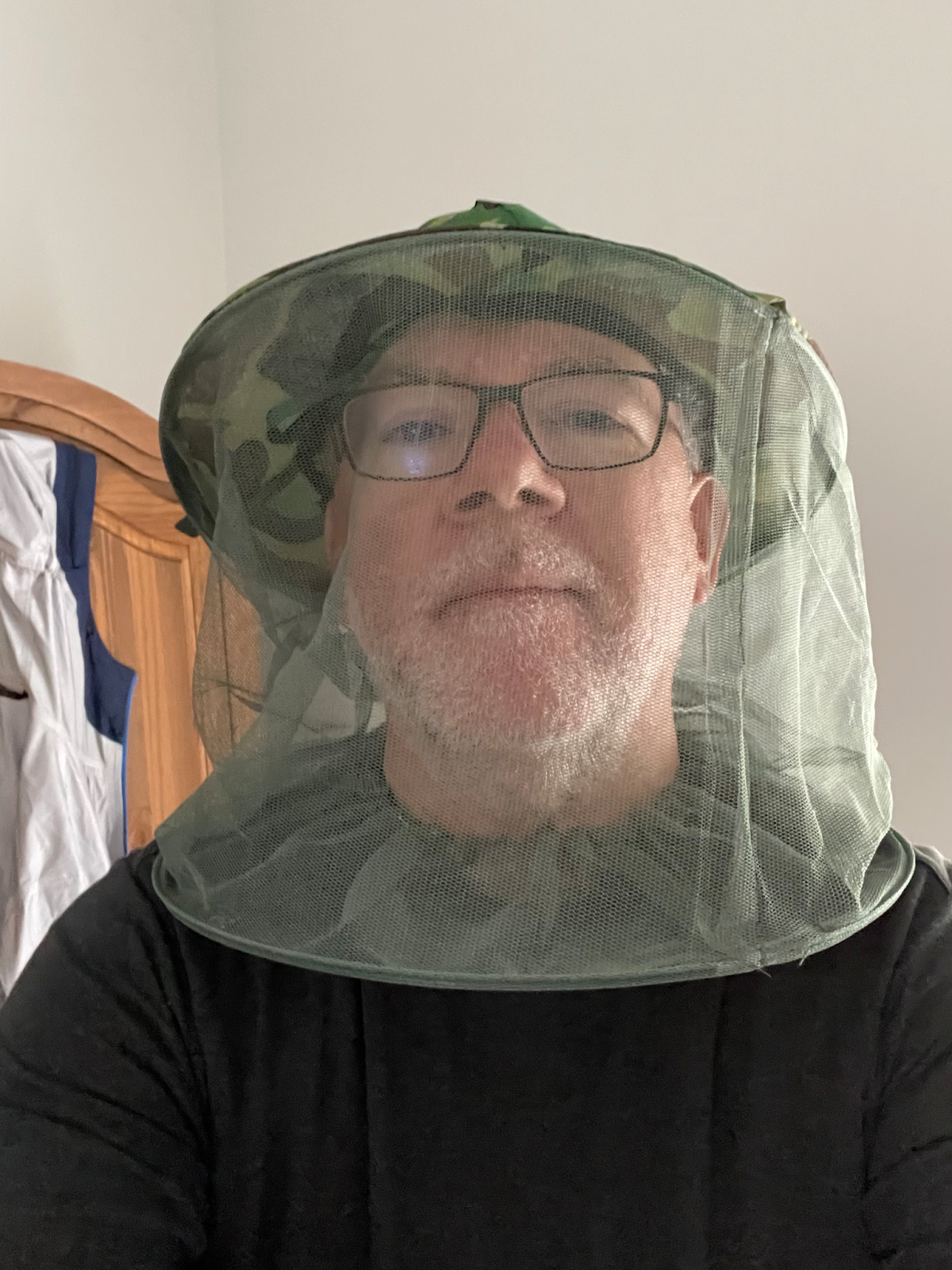
Favourite Maritime Walks – Bay to Bay Trail

Part of a series on my favourite walking routes in the Maritimes.

Blog posts are a labour of love for me, and yet there is a cost to running this site and organizing my walks.If you’d like to help with that, I’d really appreciate something for my tip jar.The Buy Me a Coffee service allows patrons like you to fund writers like me.  If that sounds like a worthy idea to you, then go ahead – keep buying me coffees.Thank You Very Much to everyone who has contributed already!

*****

Please note that some of the amenities, parks, or services listed below may have limited hours depending on time of day and the seasons. Check the links included below for up to date information on what’s open and what’s not during your walk.

The Bay to Bay Trail is a favourite walking/cycling route between Lunenburg and Mahone Bay, part of the longer Rum Runners Trail that goes between Halifax and Bridgewater. You can walk it in either direction, of course, and if you are feeling ambitious you can walk from one town to the other, have lunch, and walk back again for a wonderful walking day. Since I live in Lunenburg, I’ll often just hitch a ride whenever my wife is going to Mahone Bay and then walk home.

Length: About 10 km, from Start to Finish between the towns, and it’s easy to add or remove a km or two depending on diversions.

Surface: Firm gravel trail, minimal grades and slopes.

Public Transit: none

Route:

I’ve started the route in Lunenburg. The Bay to Bay Trail is part of the Rum Runners Trail network, and officially it starts on the edge of town off of Maple Street. I assume you are beginning your walk in the heart of Lunenburg, so in that case the start is at the entrance to the Back Bay Trail, off of Dufferin Street and adjacent to the Knot Pub. Basically, you are at the old Lunenburg Railway Station which is now the Second Story Women’s Centre.

Facing the old railway station, you’ll see a gravel path to the left – that’s the Trail, so simply follow that. You’ll pass a vehicle gate, and you’re on your way. Your only navigation choice is about 200 m from the start – to get to the Bay to Bay Trail, take the left hand fork when you come to it and bear north west for about 500m along the Bay to Bay Connector Trail.

Note that if you bear right at that fork, you’re following the Back Harbour Trail (which is part of a favourite walk of mine that I call the Lunenburg Loop).

The Bay to Bay Connector Trail runs behind and below the houses along Dufferin Street and then Maple Street (aka Highway 3) and ends at a set of stairs.

Climb these and follow the path to the road – this is the top of Maple Street. Cross using the cross walk and turn right. You’ll see the pink marker for the Rum Runner Trail network and a large map that shows the overall Rum Runner Trail along the South Shore.

Entrance to the Bay to Bay Trail, at the top of Maple Street in Lunenburg

The entrance to the Bay to Bay Trail portion is in front of you, on the left side of the road, leading down into the old railway cutting. Follow that, and you are on your way. It’s 10km from this point to what I’ve marked as the end of the Trail, at the top of Mahone Bay’s Main Street where it curves west.

As you walk along the Trail, there are several sights that you’ll pass. About 200m along the Bay to Bay Trail, on your left near some electrical transmission lines, there is an osprey nest on a platform that the electric utility has put up to keep the birds from building nests on the electrical poles themselves. If you’re walking the Trail between mid-spring and mid-summer, you’ll often see and hear the osprey parents and sometimes their chicks.

Further along the trail, after about 2 km, you’ll pass Martin’s Brook. Here, a local artist named Gillian Maradyn-Jowsey has installed several sculptures that look like wood piles, called the Riverbank Habitat. There’s a bench on the bridge over the brook, so it’s a peaceful spot for a rest.

As you continue along the Trail, you’ll come to the beaver pond and marsh area. This open space is alive with birds in all seasons, and the trail crosses it on a slightly raised embankment. There’s a bench right in the middle, and that’s conveniently located right around half way between Lunenburg and Mahone Bay. I often stop here for a short rest – it’s lovely to listen to the breeze through the reeds along with the trickle of water. This space is about as far as the Trail gets from the local roads, so often there’s no traffic noise, just the natural soundscape.

Once you’re past the beaver pond and marsh area, the Trail is lined with forest on either side. The trees are mixed deciduous and conifers and there are little bursts of colour from wild flowers, lichens, moss, and leaves – this part is especially lovely in the autumn.

Keep going a couple of km through this section, and you’ll come to the road crossing at Fauxburg Rd, which signals the entrance to Mahone Bay itself.

The Trail continues past this road, so keep going. Since you’re now in town, you’ll pass a couple of other roads, as well as the Park Cemetery. Near the end of the Trail, you’ll cross over Ernst Brook, where there is another bench overlooking the water. I often stop and have a lunch here, if I am walking from Lunenburg to Mahone Bay and back again.

Just past Ernst Brook, the Bay to Bay Trail ends at the little triangle park at the base of Longhill Road and Main Street. There is a small car park here, and some bike racks. You can choose to end your walk here, and turn right to follow Main Street down to the shops and restaurants near the shore of Mahone Bay.

Parts of this walk are pretty exposed, so keep an eye on the weather and dress appropriately – the summer sun can be stronger than you think, and the winter winds can chill right through to your bones. The walking surfaces are usually fine, just be careful of ice in winter. There can be some muddy stretches just after a heavy rain, but other than that, for the most part you can walk this route in running shoes or light trail shoes most of the year.

Sights:

I love this walk for a number of reasons. It’s a good length for me as an exercise walk – it takes me roughly 2 hours. It’s easy to tack on a few km or more by continuing around Mahone Bay along a stretch of the Dynamite Trail behind the town. You can also shorten it a bit by exiting the Trail as you enter Mahone Bay, at Fauxburg Road or Hawthorn Road, and following those streets down to the town. Finally, the Trail changes its character as the seasons progress. Spring, summer, autumn, and winter all bring their own variations of colour, flowers, birds, and skies.

There is wildlife to see all along the Trail. I’ve seen deer many times, including within Lunenburg and Mahone Bay. Squirrels, chipmunks, raccoons, ducks, geese, frogs, turtles, and snakes all live along the walk, and one of these days I’ll see the beavers at the beaver poind.

Food & Refreshment:

There are many options for refreshment at both the start and end of the Trail in either town. I like to reward myself by stopping at the end of the walk, which for me is often in Mahone Bay. Of course, you can also picnic along the Trail on one of the benches at Martin’s Brook, the beaver pond, or Ernst Brook. Sometimes I’ll take a flask of tea with me in winter and on a sunny day, it’s quite pleasant to sit despite the chill.

There are public washrooms located near the start of the Trail in Lunenburg, along Bluenose Drive, at the west end of the harbour. There is also a public washroom in Mahone Bay down by the water, near the 3 churches. There are no washrooms along the Trail itself however, so if you’re caught short between the towns there are many stretches of trees along the trail where you can make a discreet al fresco pit stop – remember to leave no trace if you do that, i.e. hike out your wipes and dig a cat hole if needed.

There are no garbage bins along the Trail so please remember to take all your garbage and waste with you – you’ll find bins at the start and end of the Trail in both Lunenburg and Mahone Bay.

Finally, there are no water sources along the Trail itself, so bring water with you. There are water fountains located near the public washrooms in the towns, so you can fill up at either end.

Diversions:

While I’ve described the route from Lunenburg to Mahone Bay, you can, of course, choose to walk it the other way.

As well, it’s easy to tack on walks round either Mahone Bay or Lunenburg, if you want to explore either town and make a day of it. For example, sometimes I’ll start by walking east around what I call the Lunenburg Loop and join the Bay to Bay Trail at the fork from the Back Harbour Trail – doing that makes it a 15-16 km walk.

Or, at the other end, I’ll do a loop around Mahone Bay by starting there at the corner of Main Street and Edgewater Street and following Edgewater north past the 3 churches, up Clearland Road to where Dynamite Trail crosses, and then following that Trail west around the back of the town to where it crosses Longhill Road, so I can rejoin the Bay to Bay Trail.

If I am feeling extra energetic, I will sometimes start in Mahone Bay, walk along Highway 3 (Edgewater Street) east and north out of town around the edge of the bay, to Oakland Road. Then I follow Oakland Road east along the north shore of the bay for a couple km, to Sleepy Hollow Road. Going north up that road lets me connect to the Dynamite Trail, where I turn west and follow the Dynamite Trail past Oakland Lake, under Hwy 3, and over the bridge at the Mushamush River,

and on around the back of the town to Longhill Road, which I follow southeast to connect to the Bay to Bay Trail.

Doing that loop makes it closer to a 20km walk, and it’s especially nice in autumn with all the colours on full display.


If you feel like supporting my blog, you can buy me a coffee.

Big Walks – PEI’s Island Walk

Blog posts are a labour of love for me, and yet there is a cost to running this site and organizing my walks.If you’d like to help with that, I’d really appreciate something for my tip jar.The Buy Me a Coffee service allows patrons like you to fund writers like me.  If that sounds like a worthy idea to you, then go ahead – keep buying me coffees.Thank You Very Much to everyone who has contributed already!

*****

Over the past few years, I’ve been thinking about doing a Big Walk. My bucket list has a number of them – the Camino de Santiago in France and Spain, the Bruce Trail in Ontario, and many more – and I keep reading about ideas for others as well. I had plans to take on at least one of these in each of 2020 and 2021, but the COVID-19 epidemic meant that those dreams stayed just that – dreams.

So come spring 2022, after 2 years of listening to me wish and sigh, my wife finally put the boot in and said it was time to either do one of these walks or else stop talking about it.

OK, agreed, but which walk to do? Knowing that 2022 would probably still have some COVID-19 travel disruptions, I decided to try something that was relatively close to home. Plus, knowing that this was going to be my first multi-week walk, it made sense to choose something that while challenging was also achievable in terms of length and terrain. That line of thought led me to the Island Walk.

Morning, Day 1

This is a relatively new addition to the world of long walks. It was first tried out in 2019 by a couple of experienced walkers from Prince Edward Island who had done the Camino de Santiago in Spain and who wanted to find a similar length walk that would showcase their home province. They came up with a route that combines walking on red-dirt back roads

with sections of the province’s Confederation Trail

to take you more or less around the coast of Prince Edward Island. It’s about 700 km in total, and is divided into a suggested 32 daily stages which range between 12 -26 km in length. In the end, I chose to do it a bit faster than that pace, finishing in 27 days.

Why?

The first question asked by most of the people I spoke to both on the walk as well as friends and family before and after is, why? Why do it?

The lazy answer to that is to say “because it’s there”, and that was part of it. Could I complete a long walk like that? And beyond that, I had a few other things in mind:

  • Exploring PEI – this was the only Maritime province I’d yet to visit, and seeing it on foot seemed like a great way to explore Canada’s smallest province
  • Physical challenge – despite trying to average 75 minutes of activity per day for the past 5 years, I’ve still managed to add a few pounds, and a good long walk was one way to shed a few of those
  • Trying out ideas – if I am going to do other long-distance multi-week walks, I’d like to figure out what works for me in terms of pace, gear, nutrition, etc. Doing so close to home was a bonus.
  • Thinking time – a walk is always a chance for me to clear my mind, but the mental challenge of maintaining focus while remaining observant while walking 5-6 hours a day is a new one
  • Put up or shut up – there comes a point where you either decide to do something or you put it aside.

Impressions

So having done, what did I think? Did I like it? Was it worth it? Did it meet my expectations or preconceptions?

At North Cape, Day 8

A couple of weeks have gone by since I finished it, and I’m still digesting it. There were things I liked – the structure of a long walk, the routine of getting up, getting ready, getting out, and getting it done, day after day. There was the rhythm of it, getting locked into a sort of Zen calmness and clarity, when the steady pace emptied my mind and I simply walked.

I liked some of the scenery. PEI is a low-key kind of place – no rugged mountains or crashing seas, but calm seas, long beaches,

green fields, wild flowers, fishing ports, and friendly people.

I liked the challenge, the push you need to start each day even when your feet hurt and the drive you need to see it through. I liked the solitude (I met exactly 6 other walkers and 4 cyclists on the route over 27 days) and I liked chatting to people that I met along the way.

I didn’t like the bugs – the mosquitoes were voracious.

I didn’t like the monotony of some stretches of the Confederation Trail, running flat and straight and on and on. I didn’t like having to to hitch rides most days to and from the route because there were few accommodation options adjacent to the route. And I didn’t like road walking, long stretches with no place to sit and rest, and hard asphalt that made my heels and ankles ache.

But those are quibbles. No journey contains only the highlights, there are always low lights and often no lights, and to expect otherwise is to be rudely awakened; but I wasn’t so much awakened to those things as resigned to them as being part of the journey that simply taught different lessons.

I guess the biggest takeaway for me is that a journey like this isn’t supposed to have one purpose, one impression, one lesson. Some time ago, a line I read in a blog post about the Camino de Santiago stuck in my head – “everyone walks their own Camino”. That message resonated again and again each day of my journey. No two people are going to do a walk like this, even if they are walking together, and do it for the same reasons while forming the same memories.

If I could distill anything out of this, I think it would be a few little mantras. Cherish the journey, respect the journey, and learn from it. Accept it on its own terms. Don’t overthink it. Your journey is its own lesson. Everybody walks their own Camino.

For the the last day, I’d deliberately walked extra distance on the preceding few days to ensure I’d have a short day at the end, partly in case of rain and partly because I didn’t want to finish the walk with a long sloggy day. And as I came into Charlottetown I was struggling to digest the journey, what it had meant, what I felt, how I thought of it. Ann wanted to meet me at Joe Ghiz Park where the route starts and ends, and a couple of friends, Michael and Carol, had come up from Lunenburg to surprise me and celebrate crossing the finish line. I was about a kilometre from the park, and way ahead of schedule, so I doddled a bit on the Hillsborough Bridge to look at the city skyline,

and then I texted Ann to say that I wanted to get there by myself so that I could try to process it. And so that’s what I did – walked the last bit trying to be normal, got to the park, took a selfie,

done

took off my pack, and when Ann walked in and gave me a hug, I started to cry. That was how I processed it – with tears, of relief and thanks. I thought I was walking by myself, and at that moment I realized that I was really walking with her.

Memories

Green on red – PEI’s colour palette in June is layers of green upon red earth, with little yellow and purple and pink and white flowered highlights.

Blue maritime skies. Grey rain-filled lowering clouds, and soft misty mornings. Green tunnels of trees and shrubs and bushes and ferns.

Odd sights.

Blue-green seas. Black crows. Red mud. And more green on red, red on green, again and again.

The rural character of the province sinks deep into your brain, until you expect no other colours. Green on red. Sunshine and trails. Memories.


Over the coming weeks, I’ll be writing more about this walk. Stay tuned.

If you feel like supporting my blog, you can buy me a coffee.
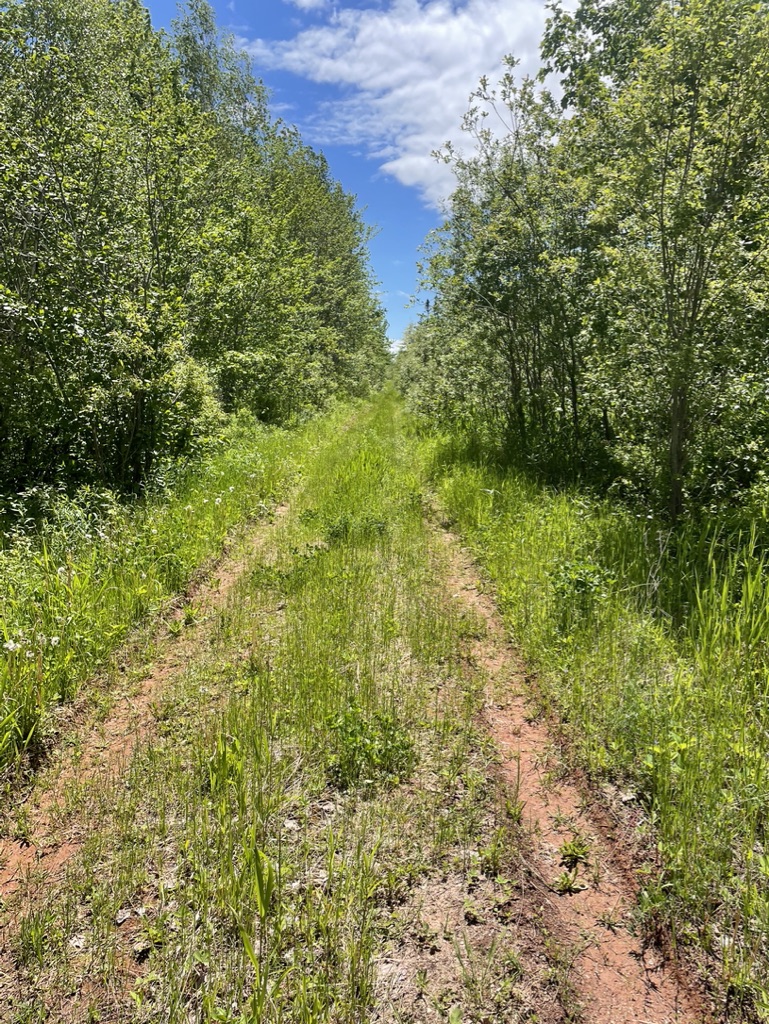

Other Posts About this Journey


If you feel like supporting my blog, you can buy me a coffee.
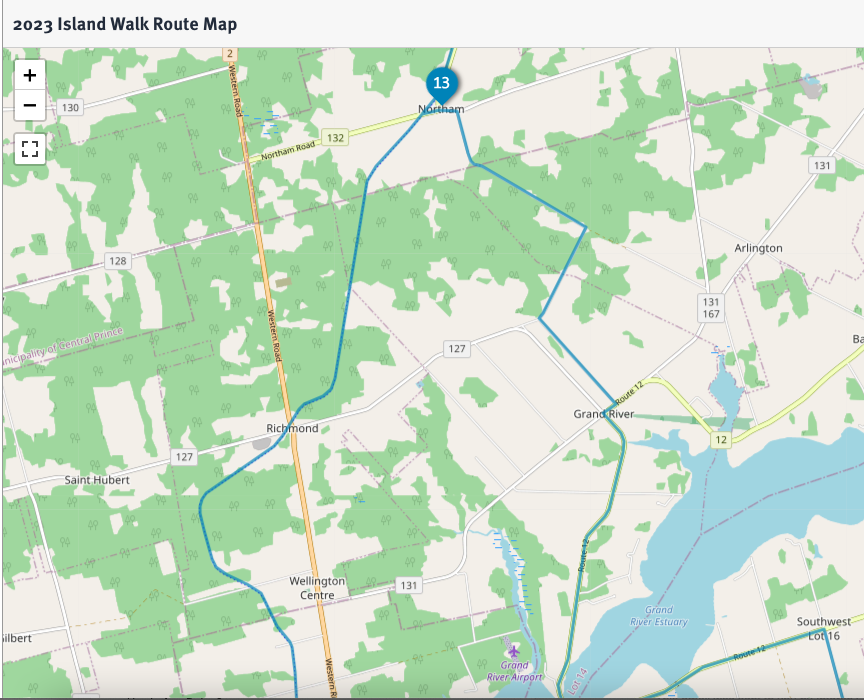
Favourite Walks – Lunenburg Loop

Part of a series on my favourite walking routes in the Maritimes.

Blog posts are a labour of love for me, and yet there is a cost to running this site and organizing my walks.If you’d like to help with that, I’d really appreciate something for my tip jar.The Buy Me a Coffee service allows patrons like you to fund writers like me.  If that sounds like a worthy idea to you, then go ahead – keep buying me coffees.Thank You Very Much to everyone who has contributed already!

*****

Please note that some of the amenities, parks, or services listed below may have limited hours depending on time of day and the seasons. Check the links included below for up to date information on what’s open and what’s not during your walk.

The Lunenburg Loop is a great way to explore the area around the town, gulp down that fresh Atlantic air, and get some great views of the harbour.

Length: About 7.5 km, depending on diversions.

Surface: Paved sidewalks and firm gravel trail

Public Transit: none

Route:

I’ve started the route by the waterfront, at the bottom of the stairs/ramp down from Duke Street where it joins Bluenose Drive. The harbour is in front of you and the red-coloured Fisheries Museum of the Atlantic is on your right.

To start, turn towards the museum and walk west on Bluenose Drive, towards the west end of the harbour. After about 100m you’ll pass a public washroom – good place for a pit stop!

At the corner of Bluenose Drive and Montague, turn left and follow the gravel path to enter the little park – this is the Harbour Walk path. Follow this west past the end of the harbour, and up the wee lane to join Falkland Street. Cross Falkland here at the cross walk, and then turn right. Walk along Falkland past the Bluenose Lodge inn, heading for the cross walk at Dufferin Street. You’ll see the Knot Pub right in front of you on the other side of the street. After crossing Dufferin, turn left (unless the pub beckons) and walk about 20 m, then bear right into the car park of the old railway station. The Back Harbour trail starts here – it follows the route of the old rail line that once carried fish and freight to and from Halifax.

Proceed northwest along the Trail till you come to a fork in the path – bear right to stay on the Back Harbour Trail (left takes you onto the connector to the Rum Runner trail to walk to Mahone Bay, a lovely 10km walk in itself).

Follow the Back Harbour trail through the woods and then some open spaces.

The view in October

After about 1km you’ll come to the cross walk over Starr Street. Pick up the trail on the other side, and continue along, taking in the views of the back harbour and its fishing boats and leisure craft. After about 1.5 km, you’ll come to Sawpit Road – use the cross walk and pick up the path again on the other side. Follow the trail through the light woods and shrubs, past frog ponds and fields, until you come to the road crossing over Blue Rocks Road. The trail continues, on a diagonal line on the other side of the road – rejoin the Trail and follow it for another 200-300 m or so till it ends at Battery Point Road.

Turn right down Battery Point Road for a wee bit. At the intersection of Hospital Road, you can turn right, climb the hill for about 30 m, and take the left dirt lane by the post boxes. This dirt lane is the old Shore Road. Follow it up the hill, squeezing past the gate at the top (don’t worry, you’re fine). Follow the old Shore Road, up the hill and then bearing to the right, as you climb up along the ridge behind the fish factory. You’ll emerge at a little clearing with a new path in front of you that continues gently up the hill following the old route of the Shore Road.

Alternatively, instead of turning up Hospital Road off of Battery Point Road, you can keep going down Battery Point road towards the fish plant. The road ends at the car park for the fish factory – turn right and cut across the car park towards the harbour and the old warehouses and docks. At the end of the car park there’s a dirt road climbing up towards the right – at the top you’ll the see the little clearing and a path on your left – follow this to join the old Shore Road towards town. Going this way across the car park can be a bit better in winter if there’s ice around.

The old Shore Road path offers lovely views south and west of the harbour on your left and there are some great lookout points. There is also a wonderful spot with a bench where you can have a rest.

After a few hundred meters, the footpath ends at a traffic barrier and here you rejoin the current paved stretch of the Shore Road. Follow it west and down hill to the intersection with Pelham Street. Bear left and follow Pelham west for several hundred meters, to Shipyard Hill Road. Turn left and go downhill to join Montague Street, bearing right (west) here. Follow Montague for several hundred meters to the corner where it’s joined by Bluenose Drive. Turn left and follow the road down a slight hill and then right (west) along Bluenose Drive, to finish where you started by the Fishery Museum.

Parts of this walk are pretty exposed, so keep an eye on the weather and dress appropriately – the summer sun can be stronger than you think, and the winter winds off the harbour can freeze your eyeballs. The walking surfaces are usually fine, just be careful of ice in winter. There can be some muddy stretches just after a heavy rain, but other than that, for the most part you can walk this route in running shoes or light trail shoes most of the year.

Sights:

I love this walk because of the varied sights – the history of the town on display in the views of the harbour front, the historic buildings like the Bluenose Academy (today, housing the Lunenburg Academy of Music Performance as well as the town library), the working life of the town seen in the fishing boats,

and the wildlife that lives along the trail. I’ve seen deer many times,

along with ospreys, herons, finches, ducks, geese, frogs, salamanders, snakes, turtles, mice, foxes, racoons, squirrels, and chipmunks. Stretches of the trail take you through a gorgeous tunnel formed by the arched branches of birch trees, and beside little ponds. The harbour views along Shore Road are some of the best you’ll get. And the houses tucked along Falkland, Pelham, and the Shore Road are a big part of Lunenburg’s Unesco Heritage designation.

One of the attractions of this route, for me, is that the sights change with the seasons. The spring brings chirping frogs and toads, crocuses and wildflowers, budding trees and greening grass. Summer is cool shade and warm breezes. Autumn is an explosion of colour. And winter is snow clinging to branches and ice in the harbour, tinged with the scent of wood smoke.

Food & Refreshment:

There are many options for refreshment at the start and end of the trail, near the harbourfront, ranging from ice cream to light snacks for full dinners. I live here – they’re all good! That said, I would be remiss in not mentioning our neighbours, John and Samera, who own J3 Pizza on Montague Street. And of course, the restaurant group that includes the South Shore Fish Shack, Half Shell Oyster Bar, the Salt Shaker Deli, the Beach Pea Kitchen and Bar, and the Bar Salvador (all along Montague Street), are favourites in part because our house used to be a restaurant where Martin and Sylvie started out.

I also can’t omit the Grand Banker, the Old Fish Factory, and the Shipwright Brewery along Montague, and the Dockside restaurant, the Ice Cream shop, the Savvy Sailor cafe, the No. 9 coffee bar, and Rascal’s Run Burrito Bar – all also along Montague Street. Plus there’s the Smoke Pit BBQ shack on Bluenose Drive, and more places up on Lincoln Street, including Lincoln Street Food, the Laughing Whale coffee roastery and cafe, the Moontown Market cafe, and the Lamprai and Spice Sri Lankan takeout. For a small town, we’re packed with options for refreshment.

And there’s more! Beyond all those yummy options, you might also want to pop into Foodland on Montague to grab picnic supplies and snacks. There’s also the Subway sandwich shop on Montague, and the Burger King on Falkland. And don’t forget about the Knot Pub, which does great food plus local beverages. On the other side of the harbour from the Fishery Museum, off Tannery Road, there’s the Lightship Brewery Pub along with the Barn coffee spot. Plus, just outside of the old town on the Bridgewater road, there’s Alex’s Chill and Grill for burgers and fish and chips, the Independent grocery store, the local Nova Scotia Liquor Commission store, and the local Tim Hortons. Spoiled for choice, we are.

There are public washrooms located along Bluenose Drive, at the west end near the start of the Harbour Walk trail, and at the east end by the Zwicker wharf. In summer, there is usually a portaloo located near the Back Harbour Trail where it crosses Starr Street.

There are park benches and picnic tables at several spots along the Back Harbour Trail, so why not bring some refreshments and enjoy the views while you have a rest. Please remember to take all your garbage and waste with you – you’ll find bins at several spots around town and by the trail access points where you can dispose of it.

Finally, there are water fountains located near the public washrooms. Take some water, because there are no fountains along the Back Harbour Trail itself.

Diversions:

This route can easily be extended or shortened, as desired.

To extend it,

at the start of the walk, as you cross Falkland Street before turning towards the Knot pub, keep going straight up Broad Street. This will take you through what’s known as New Town, up the hill towards the Hospital. It makes a nice comparison to the houses you’ll see later along the route in the Old Town. If you continue all the way up Broad to High Street at the front of the hospital, turn right and follow High Street to Dufferin. Turn right on Dufferin and continue down the hill following the street, and you’ll come to the start of the Back Harbour Trail by the Knot Pub. This will add about 2 km to the walk.

To shorten it, you can jump off the Back Harbour Trail at several points – after about 1km where the trail crosses Kissing Bridge Road – turn right here onto Starr Street and follow that south back to Lincoln Street; or at Hopson Street (follow that south up and over the hill and back down, to rejoin Pelham); or at Sawpit Road (follow that south up and over the hill and back down to rejoin Pelham)

Also, if you follow the full route as described, then you’ll notice that beside Battery Point Road, there is a small trail leading off to the east – this is the entrance to the Salt Marsh lookout.

Follow this trail for about 100m and you’ll come to a shaded platform that offers great views out over the salt marshes and the many birds that make it their home. It’s a peaceful, cool spot for a picnic too. To rejoin the route, follow the trail back to Battery Point Road.

At Sawpit Road, where the trail crosses, you can turn left and follow the road north down the hill. Cross the highway here (no cross walk so use caution) and follow the road down the hill to walk down to Sawpit Wharf. There’s a bench on the end of the wharf which makes a great rest spot where you can look out over the back harbour. To rejoin the route, simply follow Sawpit Road back up the hill to the Trail crossing.

Another option is at Starr Street, where the Back Harbour Trail crosses it – you can exit the trail here and bear right to go up Kissing Bridge Road. You’ll be walking uphill with the Hilltop Cemetery on your right. About halfway up the hill, you can follow a lane into the cemetery and wander through it up towards the Academy – a lovely way to view the building. To rejoin the route, follow the cemetery paths back to Kissing Bridge Road, down the high to where the Trail crosses it.

Enjoy exploring Lunenburg.

If you feel like supporting my blog, you can buy me a coffee.
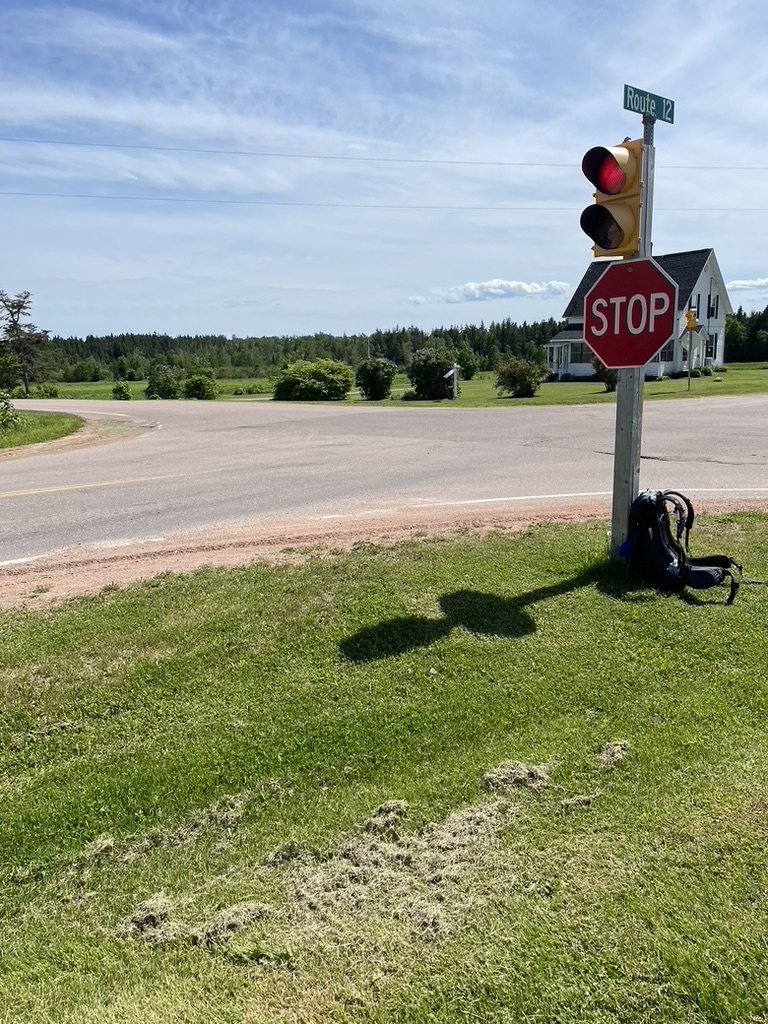
Favourite Toronto Walks – Yonge Street

Part of a series on my favourite walking trails in Toronto.

Blog posts are a labour of love for me, and yet there is a cost to running this site and organizing my walks.If you’d like to help with that, I’d really appreciate something for my tip jar.The Buy Me a Coffee service allows patrons like you to fund writers like me.  If that sounds like a worthy idea to you, then go ahead – keep buying me coffees.Thank You Very Much to everyone who has contributed already!
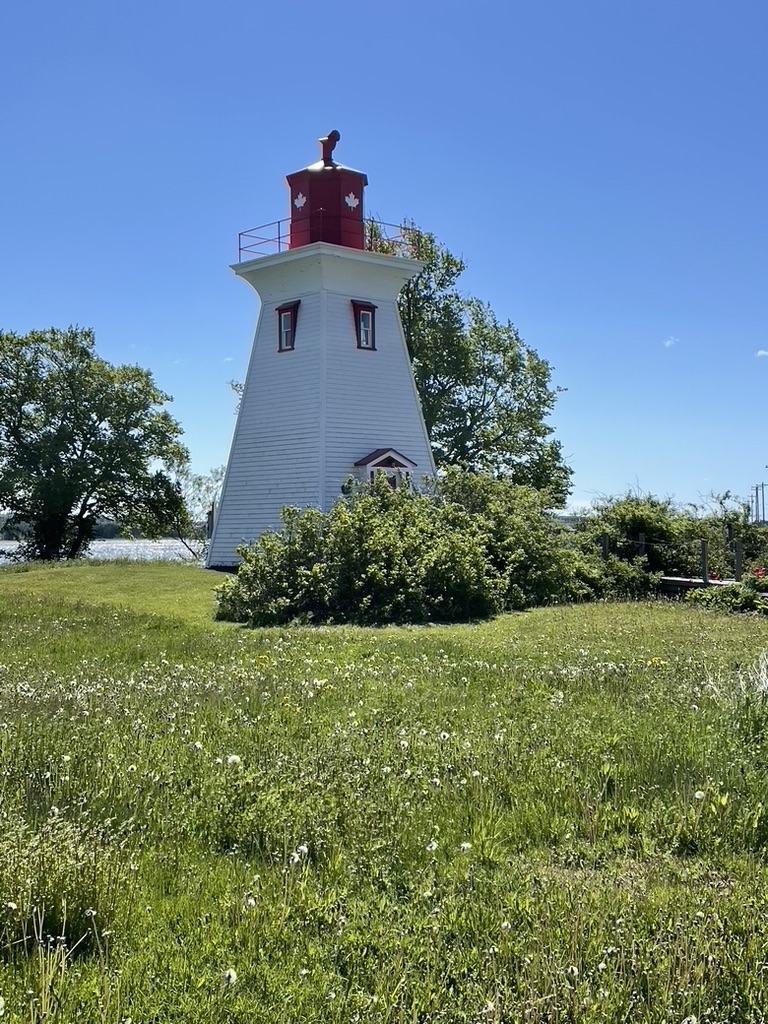
*****

And now on to the regular post …..
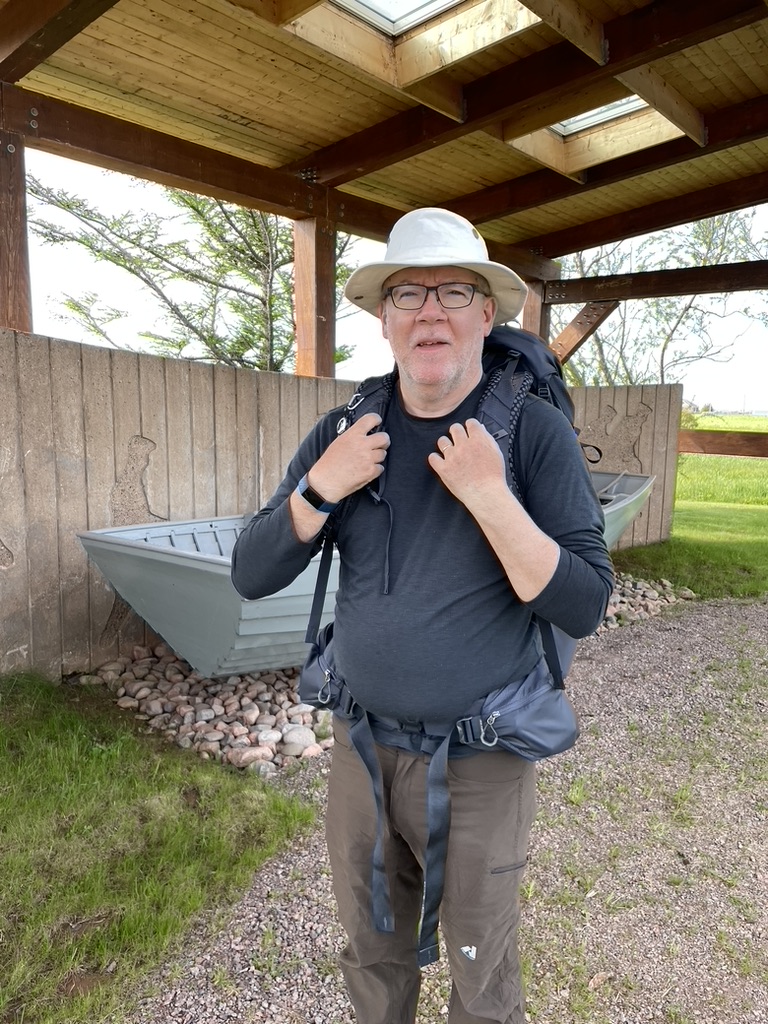
Samual Johnson once said, “when a man is tired of London he is tired of life”. With a nod to Dr. Johnson, I’d say that also applies to Yonge Street in Toronto.

The foot of Yonge looking north from the Lake

Many cities have a well-known street – Broadway in New York, Oxford Street in London, George Street in Sydney – but Yonge is a different from those thoroughfares in that, in a sense, there isn’t one “Yonge Street”. While it may be a single road, because it’s such a long street it takes on many moods, so that multiple stretches of Yonge form distinct little neighbourhoods, referred to usually by the cross streets – Yonge & Dundas, Yonge & Bloor, Summerhill, Yonge & St. Clair, Yonge & Eg, and so on as it goes north. Walking any 3-4 km stretch of Yonge between Steeles and the Lake will take you through at least a couple of these neighbourhoods, each with its own atmosphere and vibe. That, and Toronto’s famous mix of cultures from round the world, means that walking Yonge is like a mini tour of the United Nations dipped in maple syrup. I love it.

Length: Yonge is a little more than 20 km from the lake to Steeles, so allow about 5 hours if you want to walk the whole thing. That said, an hour’s stretch at picked at random is lots of fun and lets you explore the surrounding neighbourhoods too.

Surface: It’s a public road so concrete, concrete, concrete, and in winter add large dollops of salt. Wear comfy shoes.

Public Transit: Subway Line 1 runs most of the length of Yonge, from King up to Finch, and bus route 97 covers most of Yonge as well so it’s very easy to pick start and stopping points based on one of the subway or bus stops.

Route:

If it were me, I’d pick a stretch partly based on the weather and partly on the kind of food I like to eat. Starting down at the Lake on a sunny late spring day can be fantastic, and so can exploring mid-town or uptown. Downtown, mid-town, and uptown there are too many restaurants and shops to count, and there are parks like Ramsden or Alexander Muir Gardens or York Mills along the way too.

One way to decide is to simply pick a subway stop at random and then tell yourself you’re going to walk at least 3 subway stops either north or south along Yonge – keeping in mind that north of St. Clair, the stops are quite a bit farther apart than they are downtown.

The Beltline Bridge over Yonge, just south of Davisville

However you do it, try walking not just Yonge but also the surrounding streets that parallel it. Often a block east or west of Yonge takes you into residential streets and that’s a great way to explore too, and also get away a bit from the traffic and hustle.

A favourite stretch of Yonge for me is in mid-town, between Bloor and north past Eglinton. This stretch goes past Ramsden Park (a mid-town jewel) as well as Mount Pleasant Cemetery, and it’s lovely to detour into those treed oases for cooling greenness on a hot summer day.

The entrance to Alexander Muir Park on the east side of Yonge, about 2 blocks south of Lawrence Ave

Sights:

Sights on Yonge are as much or more about the people than about the buildings or shops. People watching on Yonge is a year-round sport, and endless fun. Part of that is being people-watched yourself – the way you walk down Yonge, what you wear and what you carry, will provide gossip for others just as much as you can gossip about them. In summer, that includes sitting at one of the sidewalk cafes and patios and people-watching the street scene, sipping a cold glass of something while the passers-by judge you by the food you’re eating. Oh the joys.

Of course, there is history along Yonge as well, if you want to explore. Yonge-Dundas Square, which has become a celebration point when something big happens, like the Raptors NBA Championship win in 2019. Or little bits of history like the plaque that marks the Montgomery Tavern at Yonge and Montgomery, where William Lyon Mackenzie set off with a group of like-minded followers in 1837 during the so-called Upper Canada Rebellion to protest against the government of the day. And landmarks like the clock tower of the old CN rail station at Summerhill that’s now become an iconic location of the LCBO.

The Hockey Hall of Fame at Yonge and Front Street

Of course, for many people Yonge is really about the shopping. For most of it’s length, it’s lined by shops of all descriptions – antiques, clothing, shoes, foods, guitars, bikes, tea, electronics, and so much more. We lived for many years just off Yonge in mid-town and did all of our daily shopping within a 2-block stretch of Yonge that included a fishmonger, a greengrocer, a cheese shop & deli, a bakery, and a butcher, all great little shops where we knew the shopkeepers and they greeted us by name. Sure, Yonge has its share of the big chain stores, but why would you bother when you find some little neighbourhood gem for a unique experience? Between the shops and the many unique little restaurants and bars, you can shop local and follow your 100-km diet. Who needs more?

Food & Refreshment:

It’s Yonge, so expect at least a coffee shop if not an actual restaurant or takeaway every few hundred meters pretty much the whole length of the street. You’ll find virtually every type of cuisine the city offers, and every type of establishment from bars to bistros. There are also countless food shops, butchers, cheese shops, fishmongers, grocery stores, and greengrocers, so you can do all your shopping along Yonge – bring a knapsack and some shopping bags.

Keep in mind that Yonge is an urban streetscape for most of its length, so a hot summer’s day can feel even hotter, just a cold winter’s blast of wind can freeze to the bone. The many shops and refreshments along the way will give you breaks from the weather.

Finally, while there are no public toilets or water fountains available on Yonge Street itself, there are many options available. Downtown, there are washrooms & water fountains in the malls off Yonge at the Eaton Centre, College Park, and Yonge-Bloor. At mid-town, there are washrooms in the mall on the north-east corner at Yonge & St. Clair, and on the north-west corner at Yonge & Eglinton. Uptown, there are malls on the north-east corner at Yonge & Sheppard and the south-west corner at Yonge & Steeles. Of course, there are tons of coffee shops along the way so you can always pop into one of those.

Diversions:

  1. Make a game of it – how many coffee shops can you find along Yonge? How many couples walking dogs will you spot? How many BMWs per block?
  2. You can also use Yonge as a corridor between wider neighbourhoods that are well worth exploring, like Yorkville, Rosedale, Deer Park, or Lawrence Park. In that case, pick a couple of neighbourhoods that are separated by a few km of Yonge, and use the street to walk between them.
  3. There’s much debate about what counts as “downtown”, “mid-town”, and “uptown”. If you want to break down Yonge by those labels, then I’d say downtown is Yonge from Bloor south to the Lake; midtown is Yonge between Bloor and Eg; and uptown is north of Eglinton. Of course, ask 10 people and you’ll get 10 different definitions so try exploring what your friends suggest is downtown or midtown or whatever.
  4. Yonge is ever-changing and flows with the seasons, so exploring any part of it will be very different in December versus June.

Walking by numbers

Recently, we’ve been in a stretch of above normal, spring-like November weather. It’s a bit incongruous to be out in shorts and a t-shirt under balmy blue skies and warm temps, while shuffling through piles of autumn leaves.

That said, it’s meant for glorious days that beg for a walk, and I’ve obliged as much as I can. Out recently, I decided to walk from our place in mid-town Toronto to meet my wife in Leslieville. It’s an easy walk, mostly downhill through the heart of the city, and as I was out, I got to thinking about it in terms of numbers.

There are numbers about the walk itself – about10km, about 1:45 minutes, 20 C, etc. And then there are numbers about things along the way, like how many parks I passed by or cut through – 7 of them, if you count Riverdale East and Riverdale West as two parks. Or the bridges that I crossed over or under – 5 as I recall, including the delightful Glen Road pedestrian bridge over the Rosedale Valley.

And what about the number of languages I overheard as I walked – there were at least 6 I think, not counting English – French, Arabic, Hindi, Italian, Spanish, and what I think was Cantonese and Russian. Plus, at least 6 accents to the English voices I overheard – mid-Canadian, north-east American, Caribbean, English, Irish, and South African.

I also passed by 3 cemeteries at Mount Pleasant, St. Michaels, and St. James, and marvelled at the gorgeous colour in each.

I stopped counting upscale cars very quickly, as in passing through Rosedale every drive seemed to have multiple examples. I did count 1 completely over-the-top car, however – a Rolls-Royce middle-finger-to-the-world SUV that was more tank than anything else, that rolled majestically through Cabbagetown down the middle of the road piloted by a blond middle-aged woman who may as well have had “Karen” stamped on her forehead.

I also stopped counting the number of people I saw who were also out for a stroll – dozens of fellow walkers, all in Lululemon it seemed, and ranging from new parents with infants to retired couples in their 80’s. Will they still be out in January when it’s -20?

Countless as well were the number of scents and aromas that I could distinguish as I passed – cannaboid funk in many places, 5-spice cookery along Broadview in old east Chinatown, frying onions from a dozen pubs, and everywhere autumn leaves, along with stale urine in the Glen road underpass, and the dreary pall of diesel exhaust.

All along the way, there was only one real constant, and that was the clear blue above as it danced through the golden leaves.

And there was only one ridiculously cute great-nephew whom I met at the end of my walk – Miles, named after mine and my nephew’s favourite musician. Kinda blue, just like the sky.