Walks Past – June 1994, London

In 1994 I took on a consulting gig that gave me my first chance to visit London. I flew over in June for a 4-month gig, based to the south of the City in a suburb called Whyteleafe, on the A22 close to the M25. The first weekend I had free, I jumped onto an early train into the City and stepped off at Blackfriars. I had never been to London before and yet I felt I knew it through things I had read – the London of Sherlock Holmes and of Rumpole of the Bailey; the London of the Blitz during the Second World War; and the London of finance as described in The Economist.

So off I set on a ramble. That walk had been building in me for 30 years, though I probably didn’t realize it then.

I remember being full of energy when I stepped off the train. I remember being within a whisker of getting wiped out by a bus because I looked left instead of right at a crosswalk. I remember being self-conscious as a tourist and dreading being called out as such.

London is my favourite walking city in the world. There is history, life, and energy on literally every corner. I think I could fetch up nearly anywhere within 10k of Trafalgar Square and have fun walking around. Since that day in 1994, I’ve had the chance to live in London and it just reinforced what I felt that day.

Upon arriving I walked from Blackfriars Station east into the City, I suppose on Cannon Street, towards Monument tube station and then back west towards St. Pauls Cathedral. I toured the cathedral and climbed into the dome for a view over the city. I walked west again from there into Westminster along Fleet Street and then the Strand. I chased the pigeons at Trafalgar, waved a salute to the maple leaf flag at Canada House, and stood next to St. Martins-in-the-Field church and wondered about the name since it’s nowhere near a field. I walked along the Mall and past Buckingham Palace and through Green Park to Hyde Park Corner and the Wellington Arch. I walked through Knightsbridge to Harrods. I walked from Harrods through Belgravia into Sloane Place, and then I walked on through Pimlico to Victoria Station to catch the train back to Whyteleafe.

Along the way, I stopped for a coffee and a bite in the City and discovered the joys of flapjacks. I stopped for a pint somewhere along Fleet Street and had a ploughmans’s lunch. I stopped at Harrods in the food hall and had oysters and a glass of Meurseault – which at the time, seemed to me to be the height of sophistication.

I’m sure I did more than 10k that day, and probably closer to 15k. I arrived around 9am and didn’t get back to Whyteleafe until after 8pm, utterly knackered and deeply in love with London. That walk is #1 on my list of all-time favourites, and if you said to me tomorrow, you have one walk left in your life, I’d say I’ll do that one again – from Blackfriars to Victoria. Samuel Johnson said that when you are tired of London, you are tired of life, and that’s London for me – a banquet from which I never want to stop feasting.
Walking to Be

Some walks have purpose, some are aimless. Walks with purpose are what I think of as “to do” walks. Walking to the shops, walking to work, walking the dog, walking for exercise.

Other walks are “to be” walks. Walks for the joy of being outside, walks with open eyes and keen ears and eager senses.

To be or not to be, then, is a question for the walker as well as for Hamlet. Is my walk a walk of purpose, a walk that gains a goal? Or is it a walk for me, just because – to be in the sun, to be moving, to be aware of my surroundings.

I’ve written before about words for walking. Some of those words convey intent and determination – trudge, march, stride. I think of them as walks with a purpose. “To do” walks have to be done, you’ve got to get on with things after all.

But “to be” walks, those are the ones we remember. The stroll along the beach in the sun. The quiet hike through forests. The delicious hand-holding wander on summer evenings.

You can like the “to do” walks. It’s still a walk after all and maybe the weather is nice, or you’re looking forward to the destination and after all you do need to get that job done.

But the “to be” walks, those you love. It’s the difference between reading the newspaper and immersing in a great book; between quenching your thirst and tasting great wine; between eating lunch at your desk and having dinner with friends.

Walk Journal – Feb 10, 2019

Where: Toronto – Lytton Park, Lawrence Park, Hoggs Hollow, Armour Heights, Upper Avenue

Duration – about 2 hours, about 9 km

Weather – cloudy and dry, about -3C

Today was a get-back-on-the-horse walk. I’ve been out of sorts the past couple of weeks, between lousy weather and demands of work. It’s put my walking out of kilter and as a result I’ve felt cooped up and restless.

Since there is still a fair amount of ice on sidewalks and trails, I decided to get a longish walk in by sticking to main roads. From our place near Avenue Road and Roselawn, I headed north and east through the Lytton Park neighbourhood to pick up Yonge Street at Glengrove. Then it was straight north along Yonge, through Lawrence Park, past Yonge Boulevard, and down into Hoggs Hollow to Wilson Avenue. There I turned west and climbed the Wilson Ave hill to Armour Heights at Avenue Road. Another left and it was south all the way down Avenue Road through Amour Heights and the Upper Ave, back to Roselawn.

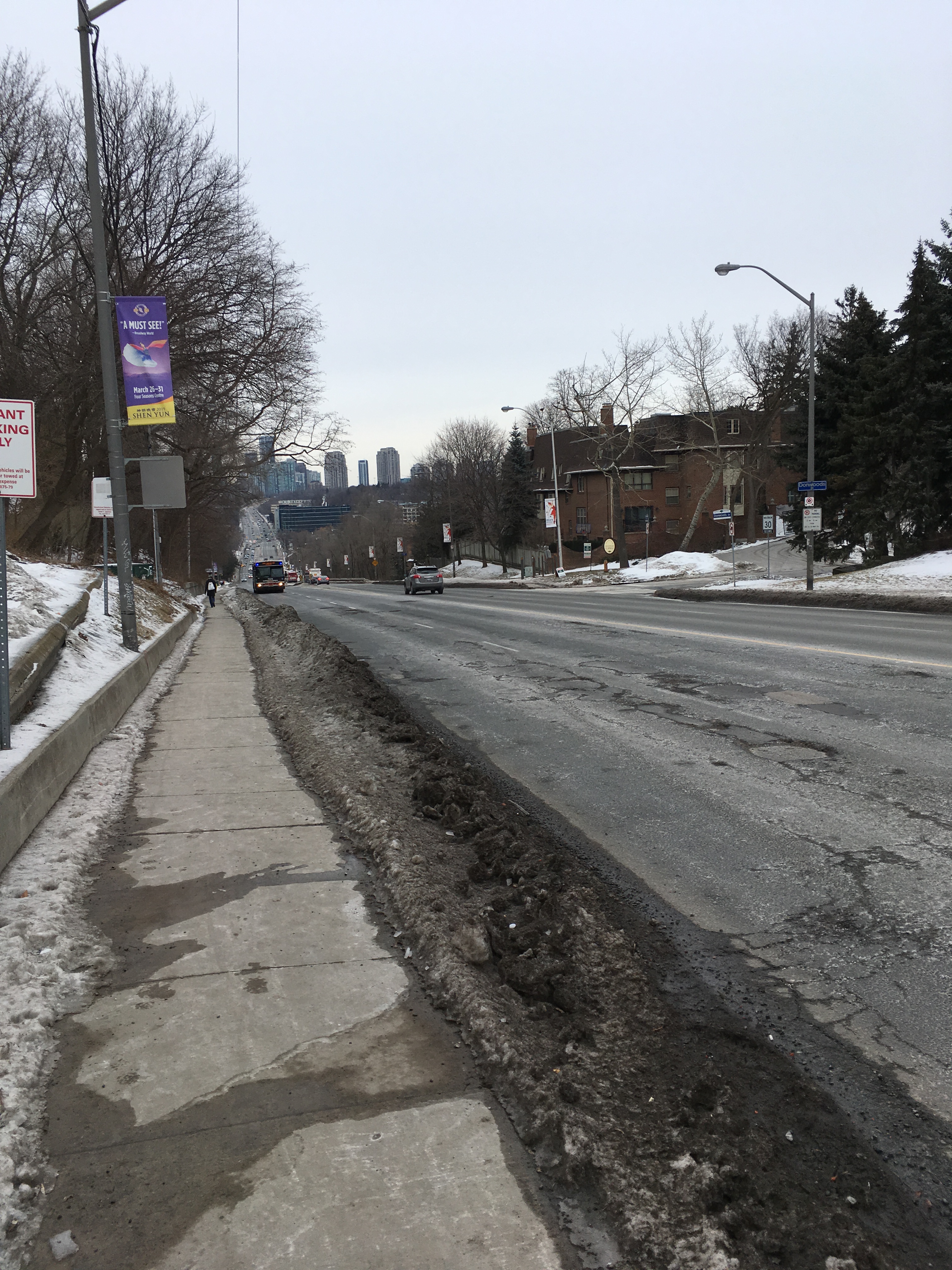
North along Yonge – down the hill at Hoggs Hollow

For the most part, it was an easy walk. The sidewalks on the main roads are mostly clear of ice, and the weather wasn’t too bad compared to the past couple of weeks. The hill up Wilson to Armour Heights is not too steep – it’s a steady climb on a moderate slope though it does go on and on.

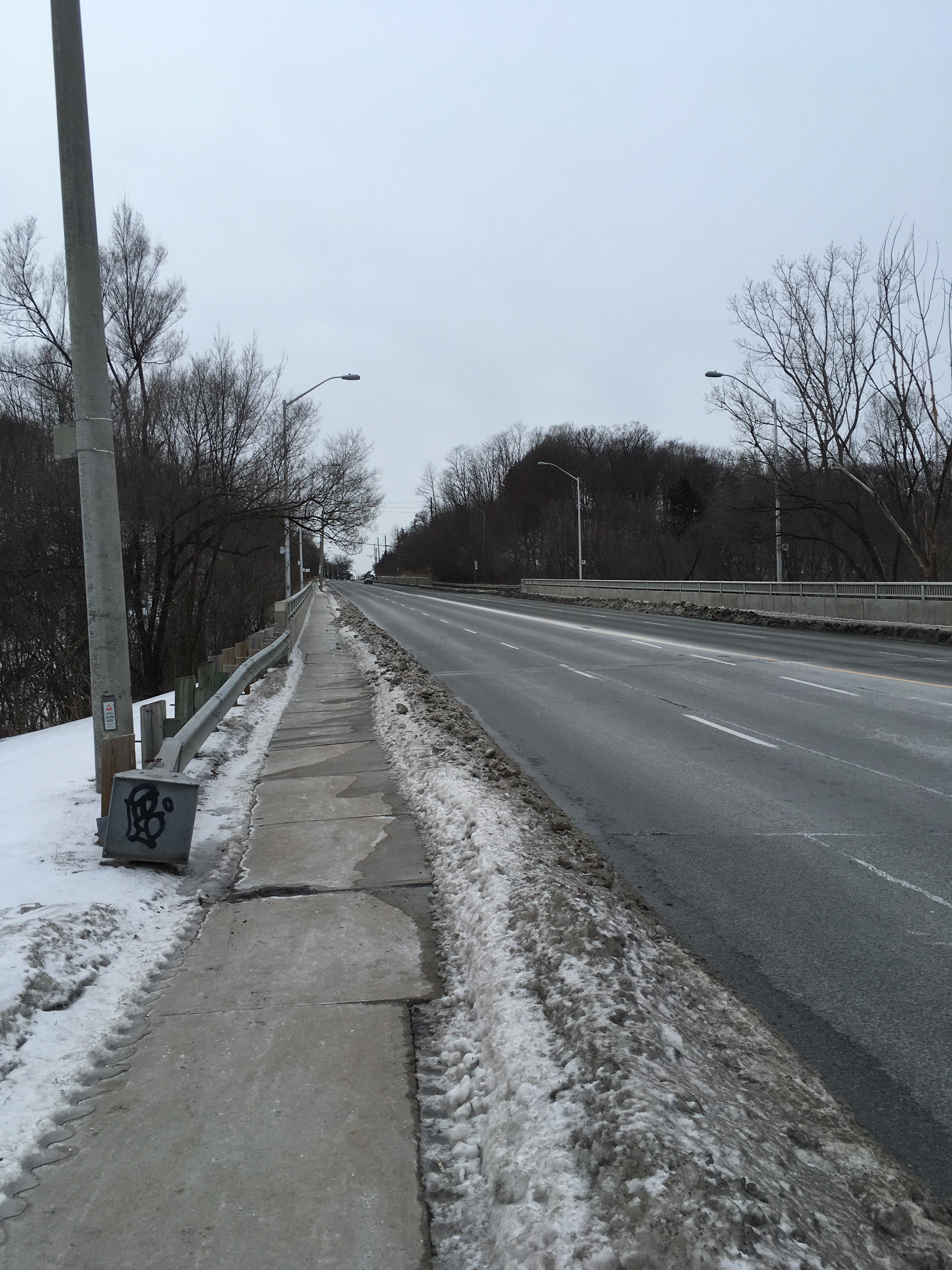
Looking west up the hill on Wilson to Armour Heights

In the other seasons it’s a more pleasant walk, particularly around Yonge & Wilson. The West Don River flows south-east under Wilson and across the south-west corner of Yonge & Wilson, then under Yonge and into Hoggs Hollow at the site of the historic York Mill, in what today is known as Jolly Miller Park. It’s named after a pub called the Jolly Miller that was a hang-out in my college days, though today it’s been renovated into a much swankier place called the Miller Tavern. There are some lovely trails here and Hoggs Hollow is a bit of a fancy neighbourhood, so house-snooping as you wander the streets is good fun.

In winter, with mounds of grey snow/frozen slush along the streets and park trails closed by ice, the trees bare and the grass brown, with traffic sounds magnified by the lack of vegetation, the area is not at its best. Today it was just hills to climb.

Still, walking up Yonge and down Avenue Road always offers people watching opportunities. I passed a young couple who were so perfectly matched – beautiful faces, slim, petite build, similar features, similar hair – that it made me think, how often do you see couples like that? There’s the old saw about partners growing more alike as they age, but these two were young. Even then, most of us don’t look that much like our partners, and let’s face it, most of us are pretty ordinary. It reminded me of the convention that in a typical couple, one partner has settled up and the other has settled down. You know what I mean – one partner is usually the looker compared to the other. Not these two – they were walking examples of another old saw, that like attracts like. More power to them, whomever they are. It’s pleasing to know that the world has beauty in our collective gene pool.

There is also the retail landscape – having lived near these neighbourhoods for more than 30 years, I’m always watching out for familiar places. There is a grocery store at Yonge & Bedford just north of Lawrence, and it’s been there for decades – it was the nearest one to Glendon College when I was there in the early 1980’s, and it was also open 24 yours a day. I’d often walk over and late-night-shop for cheap eats to eke out my food money. Then there’s Gamberoni’s restaurant on Yonge – I haven’t been there in probably 20 years, but early in our marriage we celebrated birthdays and anniversaries there with close friends over several consecutive years, and seeing it still thriving brought a smile and memories of laughter – cheers Paul. I bet the pasta is still the same.

On Avenue Road in the Amour Heights/Upper Ave neighbourhood it was more of the same – there’s been a lot of change and turnover amongst the old standbys. The old Lobster Trap restaurant is gone now, renovated into a steak place. The old Steak Pit restaurant is gone too, with a condo is going up in its place. But the Copper Chimney is still there where we order our Indian takeaway, and the Safari Bar & Grill where I’ve played many a game of pool with the lads. It’s like finding new clothes in the closet amongst well-worn favourites.

A walk in February reinforces that sense of change – winter is mid-way, soon to surrender to spring. Pristine fresh white snow changes to dirty ice and then to meltwater & slush. Cold grey skies change to sunny blue. And neighbourhoods change as homes are sold and families move. I passed at least a half-dozen real estate open house signs, and a dozen more for-sale signs. February now marks the start of the spring home-sale period, an earlier harbinger than the return of robins or the start of spring training baseball. Just a couple of weeks from now we should get our first spring thaw and a blast of warm air, and that’s always something to look forward to.

Walking is visceral that way – you get a good look at your neighbours and passers-by, at their homes and shops, and at the parks, gardens, and streets of your community. It triggers memories and the free association of ideas, past mingling with present and plans for the future. John Lennon once said that life is what happens when you’re busy making other plans. For me, walking is what happens when living my life.

Slog Walking

This past couple of weeks have been winter walking at its worst. We’ve had large dumps of snow, rain, freezing rain, sleet, slush, mush, and gusty winds. The streets are sloppy and the sidewalks are worse. Plus I’ve been busy at work and driving to a customer’s office 5 days a week.

It adds up to a bad time for walking, and after 10 days or so of this I was feeling it. My back hurt from sitting too much, and I just needed some air. I wasn’t sleeping well either, so my energy levels were way down. I felt stifled and listless, and it reminded me of what I used to feel like before I started walking back in 2016. I dread getting on the scale for my Sunday weigh-in this week, I’m sure I’ve put on a few pounds just from getting out of my routine.

Winter will do that to you, there are going to be days when the weather doesn’t cooperate. Work will do that too, days when you’re just too busy to get out. Combining the two is the worst.

Today I managed to get out for the best part of 2 hours and it felt good to be stretching my legs. Even so, there’s still a lot of ice about on sidewalks, and the weather today made it tricky – it was below freezing at about -4C but the sun was out so there was a lot of melt-water leaking onto the sidewalk and that froze as soon as the sun shifted and shade covered the area. You had to be careful and pick your way, looking out for dry stretches and penguin-walking through the wet/icy parts.

I know that too much salt is bad all around – it kills grass, ruins the sidewalk, destroys your boots, and fouls the meltwater that runs off to the lake. Still, I was hoping that people would spread it liberally today, and while some people did, others ignored it and hoped for the best. That’s the trouble with winter walking in Toronto – you have to be on your guard all the time because just when you assume that your footing is good, you’ll slip on a patch of ice.

Getting a walk in when the elements conspire against you – that’s slog walking. Baseball pitchers & catchers report for sprint training this coming week, the first sign of spring. Play ball.

Walks in Winter

Today was a day for a winter’s walk, January cold and about 15-20 cm of snow overnight. When you get out early on a day like that, especially on a Sunday when people are up later anyway, you appreciate the city in winter and the clean fresh face it wears this time of the year.

I hadn’t realized how much snow we had gotten overnight until I went out – the sidewalks were still covered in snow in many places and the roads were also covered except where cars had made paths to follow. It made for a more strenuous walk than usual for our neighbourhood but it was quite cold so the exercise was welcome to keep the blood flowing.

I headed north from our place, into the Lytton Park and Chatsworth neighbourhoods. There is a school called Glenview near us, and when our son was younger we would go there to go sledding on days like we had today. Seeing other younger parents brought back memories of his adventures then.

At the bottom of the hill at the school and east out the back of the schoolyard is the Chatsworth Ravine, and that was gorgeous in the sun with a fresh coat of snow.

Chatsworth Ravine park

As I followed the trail through the ravine, I could hear the sounds of digging out – the scrape of snow shovels and the hum of snow blowers. There is also a small creek flowing through the park (Burke’s Brook) and it hadn’t frozen over so there was the ripple and splash of that as well.

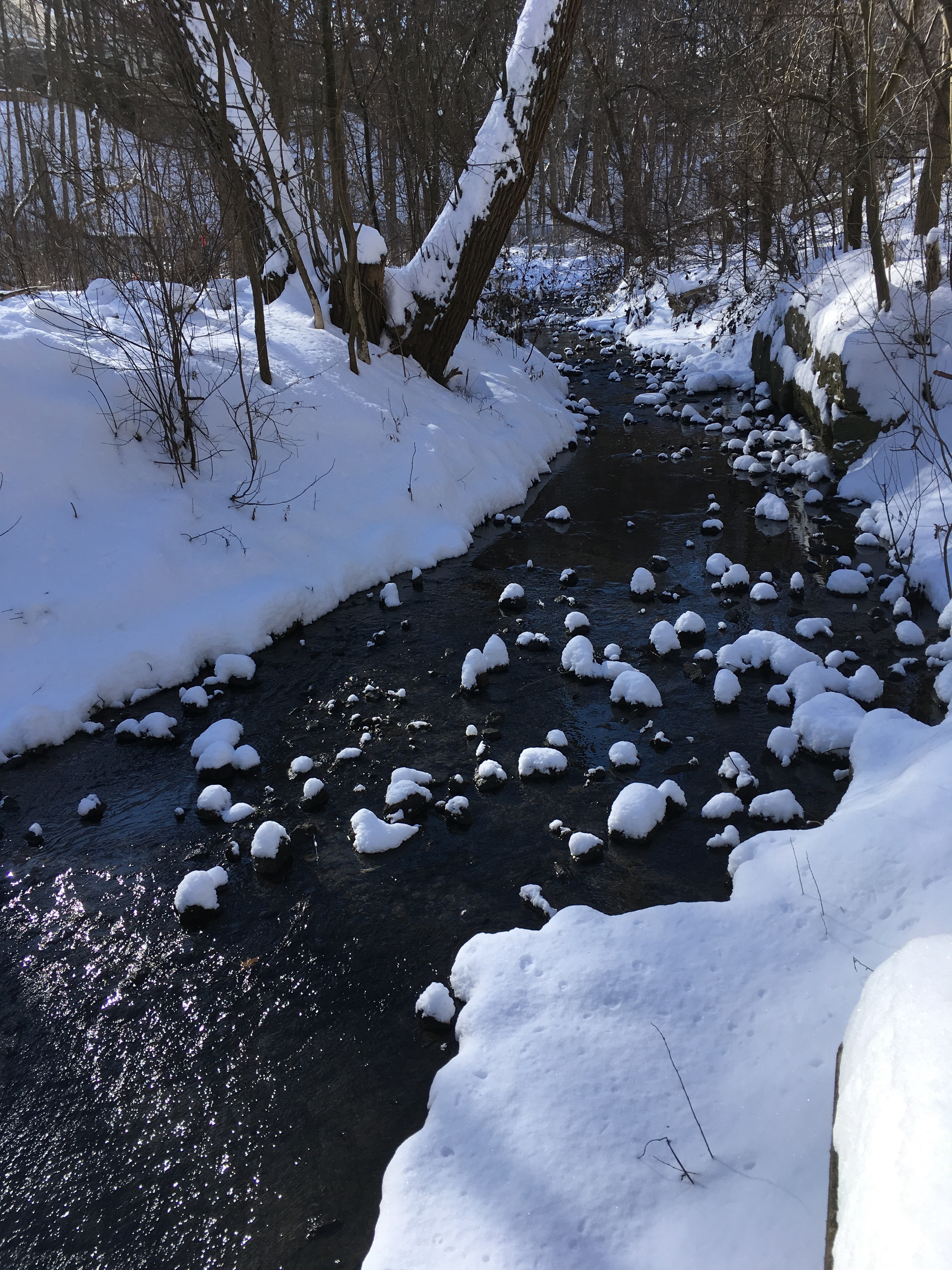
Burke’s Brook in Chatsworth Ravine

From the ravine I kept east to Duplex and up the stairs, crossing the road to Chatsworth and then down the hill to Yonge. From there I crossed and went into Alexander Muir Park, and along the trail east through the ravine under the Mount Pleasant bridge and then up Glengowan into the Lawrence Park neighbourhood. This is a lovely part of Toronto, with mature trees heavy with snow, brick and stone homes dating back to the 1920’s and 1930’s, and quiet streets that reward a wanderer with the sounds of birds and squirrels.

By the time I climbed the hill on Glengowan and looped back north up onto Dawlish, I was pretty tired after slogging through the snow, so I went west back to Mount Pleasant and then south to Blythwood, so that I could go west back to Yonge and make my way home.

Today brought many things to mind about walking in Toronto in winter:

  • the smell of wood smoke in the air
  • the excuse-me shuffle as you pass others heading the other way on the narrow shovelled portion of the sidewalk
  • the curse of unshoveled stretches and the blessing of clear patches
  • salt, salt, salt in some places and ice, ice, ice in others
  • the friendly nod and smile as you pass homeowners digging out
  • the glad-it’s-not-me thought when you see a snowed-in car
  • the crunch and squeak of cold dry snow underfoot
  • the uncertain navigation of drivers without winter tires
  • the laughter of children rolling down hills and their excited shrieks on sleds and toboggans
  • the snow hush muffling the streets, as traffic sounds are deadened

You know a city by it’s sounds and smells and people and streets, and in winter all of these change. Toronto in spring, in summer, in autumn are different places, and winter has its own character too. I’m like many people in the city, I like it when the sun is out and when it’s cold I can’t wait for spring.

And still, I have to admit it’s beautiful, in any season. I read an article on the BBC news website today, about words in Japanese that have no direct translation into English. One phrase in particular came to mind as I walked in the snow – “mono no aware”, which the BBC article translates as “the ephemeral nature of beauty – the quietly elated, bittersweet feeling of having been witness to the dazzling circus of life – knowing that none of it can last”.

Snow melts, we all know that, and even before then the wind and sun play upon the surface, sculpting the shapes and casting shadows that change with the movement of trees and boughs. No two moments in a snowy landscape are the same and no amount of photography can capture them all. Standing still, absorbing, you take them in and let them go like breaths, exhaling clouds.

Mono no aware. Snow in the city. Winter calm.

Walking Toronto’s Neighbourhoods

The City of Toronto currently lists, as of Jan 2019, about 140 individually named neighbourhoods, from Agincourt to Yorkdale (there’s no official neighbourhood name starting with a Z so there’s a marketing opportunity waiting).

I was thinking about that the other day, when my mind was wandering as I walked. Why was my mind wandering? Because I was in familiar territory, only about a km from my home. Why was it familiar? Because it was “my neighbourhood”. That got me thinking about neighbourhoods, and what they represent. There’s a personal sense of neighbourhood, the comfort you feel in familiar surroundings. There’s also a more civic sense of neighbourhood, of enabling a group of people who live in an area to have a sense of pride in that place. “I’m from the Beaches” someone will say, and you’ll know where that is.

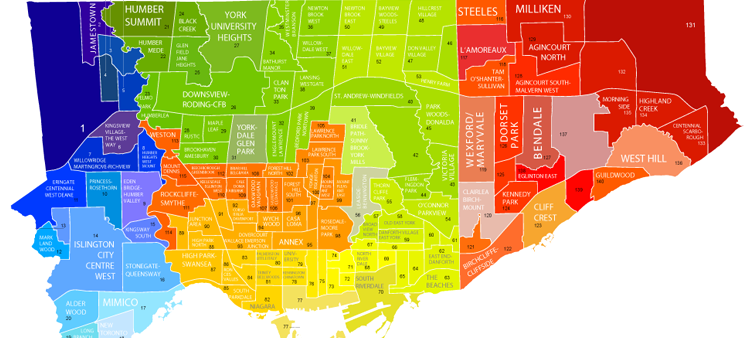
Colourful map of Toronto neighbourhoods

All those neighbourhoods are also a challenge. As I noodled on neighbourhoods I thought, how many have I walked through, at least in part? If I credit myself for “visiting” a neighbourhood if I walked at least one block there, then what’s my score?

It turns out that as of Jan 2019, I think it’s about 60. I walk a fair amount, averaging 60 km a week, but Toronto is pretty big (about 800 sq km) and like most people I have my favourite walking routes, so unless I set out to visit a particular neighbourhood I’m not likely to travel through it when just out for a walk (sorry West Humber-Clairville).

Still, that got me thinking that it’s not even half of the official neighbourhoods of Toronto. That’s a challenge. How long will it take me to get to 70? To 100? To all 140? Will the city add/define more before I get there?

Over the next year or 2 I’m going to see how many I can cross off my list, and I’ll come back and update this post. In the meantime, I’m going to continue enjoying my neighbourhood, and the comforting feeling of belonging.

Walking to Work

For much of my career, I have been able to walk at least part of the way in travelling to work. The ability to do that is something that I have always factored into what makes a given role attractive or otherwise. I’ve tried the car-commute thing, and the long train ride thing, and it’s just not that pleasant. I’d much rather walk to work, just as I’d much rather live in a walkable neighbourhood, or visit a walkable city.

Having said that, it’s true that walking to work is a different type of walking. You have a destination, and usually are on a schedule so there’s often deadline pressure too. It’s walking with a purpose, a utilitarian walk rather than an exploratory or meditative one.

Walking to work is of course very different to walking from work, because walking from work often means you are walking to home. In fact the everyday language we use for this is a clue – we say we’re “walking home”, not “walking from work”. “Home” is the key word. When we talk about our travel, we use the phrase “walking to work” rather than “walking work” as we would say “walking home”. Why? The “to” gives the work-bound walk the destination, the purpose, and that makes it a utilitarian journey. I walk “to” work to accomplish something. I “walk home” because I have already accomplished something and home is my reward.

There are times when the walk to work is a trudge, a slog, a drag of the feet. You know you have to go in and yet you’re dreading it. Other times it’s kind of mindless, a repetitive act completed on autopilot. For many people, and I am one, the walk to work has become part of their exercise routine, so those morning steps clocked on my fitness tracker count towards my daily and weekly goals.

And then there are those days you savour, when the walk to work is a pleasure, a brilliant start to a day looked forward too. Sometimes that’s just the weather – who doesn’t like walking on a gorgeous spring morning or a crisp autumn day? Best of all are when it’s that lovely day plus the sheer anticipation of digging into some challenge that I’m ready to tackle. My steps are light, my stride is confident, and my energy is up.

Can you fake that? Convince yourself that all is good and the walk to work is going to be great, even when you don’t really feel it? I’m not sure, or at least I can’t do it. That’s why when I do have that feeling I relish it, to make the walk a warm-up to what I am sure will be a great day.

That’s the thing about walking to work. It’s necessary, so we take it for granted. And yet it’s going for a walk, so why can’t we bring the same eagerness to it that we bring to walking for other reasons? Why can’t walking to work also be walking for pleasure?

A walk to work is after all still a walk, and that means it’s still a chance to explore, meditate, and exercise even if it has a utilitarian purpose. Whether or not you are looking forward to what happens when you get there, the walk to work is a journey, and journeys are opportunities to learn something about the world. There have been many grey, foul-weather days when walking was not pleasant or even possible, and there may be days to come for me when perhaps I won’t be able to walk so easily or even at all. Walk when you can, while you can, because you can, even if it’s walking to work.

I tried to keep that thought in mind this morning, slip-sliding slushily in a cold, sleety rain with a hunched slog into a chill wind. “Embrace the journey”. That comes more easily some days than others.

Walking as Exploration

On the Myers-Briggs personality assessment scale, I am an INTJ – introverted and analytical, a planner. I’ve always had an imagination and an inner dialogue, and I love to immerse myself in a good book.

Those traits go back to my earliest memories of childhood play – I loved to explore while making up a story for myself. I was the frontier explorer, the daring soldier, the lifesaving paramedic, as I ran about the neighbourhood and made blanket forts in the basement.

Part of that too came out in walking to explore. When I was about 9 we moved to a new home and neighbourhood, on the edge of the small town in south-west Ontario where I was born. Surrounding our little sub-division were fields, orchards, gravel pits, and small forests and I could literally run wild. I would roam for hours on my own, imagining that I was lost in the woods or was blazing a trail to a new land. In that environment, walking was exploration every day.

As I grew older, and later moved to Toronto to attend university, that need to walk about and explore my surroundings found new expressions. I attended Glendon College, a small campus of York University set in the Don Valley. Behind my dorm was a trail down into the valley to the Don River, and along the river there were other trails. I have always been a night owl, and would usually write essays and assignments into the small hours of the morning. By 5 or 6 a.m. I would be ready to take a break, and would go for walks along these trails. I’d be the only person about and the city would be quiet, and I could go back to those childhood days when I was alone in the woods and exploring.

Later after I graduated, one of my early jobs was working for a software vendor in a role that saw me travel to customer sites around North America. Whenever I would arrive somewhere new, I would be itching to go for a walk and learn about that city. I explored Montreal, Chicago, Boston, and Denver (loved them), and Des Moines, Newark, and Poughkeepsie (not so much). We also travelled for pleasure, and were able to explore cities and landscapes in Europe, Canada, the US, Australia, and New Zealand. In all of these places, I would wander about, exploring markets and shops, bars and restaurants, people watching and absorbing the pulse of the place.

I still remember the first time I went to London. I was there working on a project out in the suburbs near Croydon, and couldn’t wait for the first weekend to myself. I took an early train to Blackfriars, and spent the day walking from the Tower through the City to the Inns of Court and onwards along the Embankment, then to Trafalgar, along the Mall to Buckingham Palace and through St. James Park into Kensington and to Harrods. And then of course I did it all in reverse back to the train. I must have covered at least 15 km that day and loved every moment.

Walking as exploration has been my favourite activity since I was a child and it’s still the primary reason I walk. Whether it’s exploring my local neighbourhood in Toronto, ranging out through Toronto parks and trails, or wandering while on holidays – all walks are journeys into the feel and history and spirit of a place. When I talk about walking as immersion, I’m submerged in the stream of consciousness of the walk. But when I am walking as exploration, I’m immersed and yet wakeful, absorbing my surroundings – the sounds, smells, people, cars, dogs, buildings, birds, trees, and the whole shebang of that place and then I’m that little kid again exploring the woods and fields behind the house.

That’s why I walk.

Walk Journal – Jan 20, 2019

Location: Toronto – Forest Hill, Mount Pleasant Cemetery, Chaplin Estates

Duration: about 2.5 hours, around 12 km

Weather: Clear and cold, -15 C with a -28 C wind chill

Today’s walk was a chilly one, and a workout. We had some snow last night and today the temperatures were well down into negative numbers, with a brisk north wind to help cool things further. Even so, the sun was out and it was a winter scene that wanted a good walk, so off we went. We started out going west on Roselawn to Latimer and then south across Eglinton onto Russell Hill Road. We took that south, crossing the Beltline as we went.

The Beltline in the snow is always gorgeous

We kept going south on Russell Hill Road, through Forest Hill to Heath Street. Then we turned east and headed to Avenue Road, crossed it, went south on Oriole, and east on St. Clair to Yonge. There we popped into Zelden’s Diner for a proper winter brunch, and then back out into the cold. We headed north up Yonge with the wind in our faces, and at Mount Pleasant Cemetery, I went in and headed east while my wife headed home.

I did the full loop around the cemetery, crossing Mount Pleasant Road and looping around the eastern half over to Bayview and then back west across Mount Pleasant Road again, through the cemetery west to the northwest corner to connect to the Beltline. I took that over Yonge to Oriole Park, and then headed north through the Park and into the Chaplin Estates neighbourhood along Lascelles Boulevard all the way north to Eglinton, where I crossed into Eglinton Park and kept onwards north to Roselawn where I turned west and slogged up the hill to Avenue Road and home.

Mount Pleasant Cemetery on a chill winter’s day

Walking on a day like today, with hard crunchy snow underfoot, is a lot more tiring than walking on bare, dry roads. Your feet slip a little and so you shorten your stride and walk a bit flat-footed so that you keep more of the sole of your boots on the ground. That change in gait is less efficient that a full, free stride, and you work muscles you didn’t know you had – my hips are sore and so is my knee.

On top of that, with the cold and the wind, you need to be careful to manage your temperature. I wore 3 layers of clothing under my coat plus two layers on my legs, so at first I was warm but not overly warm. As I went on, however, my face was getting blasted and I could feel my cheeks freezing so I had to cover up to avoid frostbite. When I did that I started to overheat a bit. The last couple of km home were a grind, alternately too hot and too cold, with dragging feet and heavy legs, especially up the hill at Roselawn. I’m pretty gassed even now, a couple of hours later.

Still, walking in winter is always interesting. You could tell it was cold just by the crunchy sound of the snow when you walk on it, and with bright sunshine you needed sunglasses – I have a bit of a wind/sun burn on my face except around my eyes as a result.

Some folks are diligent about shovelling and some aren’t so there’s navigation challenges avoiding slippery bits. Others chuck salt about like it’s free so you feel like you’re walking on pebbles. Then there are the homes with heated driveways which melt the snow and cause the runoff to freeze into ice patches on the sidewalks and roads.

As you walk you pass others out, walking dogs or just walking, and you nod to each other acknowledging the cold and the challenge of being out in it. Numbskull drivers without winter tires spin wheels and slide about, making crossing streets a near contact sport for the pedestrians. Snow plows leave curbside snow ridges to be jumped, and snow blowers with unobservant operators make snowstorms to pass through.

Our winters, in truth, are not that long or severe compared to other parts of Canada. Usually it’s cold for about 3-4 months and there will be warm spells in there too, so when we get a cold snap and a bit of snow it’s more of a taste of real winter than a meal. Torontonians whine about winter, but we know deep down that we’re wimps compared to our fellow Canadians in Edmonton, Winnipeg, or Montreal. Walking on a day like today is a chance to pat ourselves on our red flannel backs while we sip our Tim Hortons double-doubles and dream of spring.

Walking as Escape

Do you walk towards something, or do you walk away from it? When it’s the latter, then walking is escape – from cares, from responsibilities. How often have you decided to go for a walk because there is something nagging at you, some task to be done, some confrontation to avoid?

Walking to get away, like running to get away, is a response to pressure. It can be literal escape – the duck down a side corridor at work because someone you want to avoid is coming the other way. It can also be metaphorical escape, in fleeing pressure.

Or it can be liberating, an escape from a mental cage – walking to escape the confines of the house or office on a sunny day when you are bursting to stretch your legs. That escape is thrilling, it’s energizing. We’ve all felt it, that release of energy. It’s the relief you get when you can get off the plane after a long flight – that feeling of release when you’re let out of the aircraft and are walking towards the baggage carousel, of finally being able to uncoil and unwind – that’s walking as escape.

Walking to escape isn’t quite the same as walking as procrastination. That’s also about avoiding things to be sure, but procrastination is about putting things off. Escape is about breaking free and not going back. Walking as procrastination actually builds pressure because you know you’re going to have to do the thing eventually. Walking as escape means leaving that pressure behind, that sense of responsibility.

We use the phrase “care free” to describe that sensation, and it’s no accident that “free” is part of the phrase. Freedom may be temporary, perhaps we’re on metaphorical parole from our cares, but that sense of freedom that comes from a good walk is one of the best parts of it.